NinjaOne vs Plesk
NinjaOne and Plesk tackle different IT headaches. NinjaOne is your unified endpoint manager. Plesk is your website and server control panel. Choosing between them depends on whether you're managing devices or hosting web properties.
Best for: IT teams seeking to consolidate multiple management tools into a single platform., MSPs looking to scale operations with AI-powered automation and unified management.
Best for: Web agencies managing client sites, IT admins overseeing multiple servers
Unified, fast, and user-friendly IT ops.
We find NinjaOne excels as a consolidated IT management platform, delivering on its promise of streamlined operations and rapid deployment. Overall, it offers powerful automation and a clean interface, making it a strong choice for teams looking to replace multiple single-purpose tools.
Pros
- Unified console for RMM, patching, backup, and service desk.
- Rapid deployment and user proficiency, often in under a month.
- Strong, responsive customer support and free unlimited training.
- Automated patch management that significantly cuts remediation time.
Cons
- Public pricing requires a sales consultation for exact quotes.
- Not suitable for on-premise deployment needs.
- May offer more features than very small teams require.
- Dependence on cloud connectivity for all operations.
Powerful panel, check the support.
Plesk is a feature-rich control panel that excels at centralizing server and website management, especially for WordPress. We found it robust and cloud-compatible, but the overall experience can be inconsistent due to reported customer support challenges. Overall, it's a strong contender for technical users who value its toolkit, but we'd advise trying the free trial to test support responsiveness firsthand.
Pros
- Unified dashboard for managing multiple sites and servers
- Powerful, automated WordPress Toolkit for updates and staging
- Broad security features built-in at the OS and app level
- Compatible with all major cloud platforms (AWS, Azure, Google Cloud)
Cons
- Customer support responsiveness is frequently criticized in reviews
- Pricing can be opaque, and some users report billing surprises
- May present a learning curve for users unfamiliar with server admin
- Not ideal for single, simple websites or fully managed, hands-off services
AboutNinjaOne
💡 NinjaOne is a unified IT operations platform designed for IT teams and managed service providers (MSPs). It acts as a central hub to manage all your endpoints, secure devices, automate patching, handle backups, and provide remote support.
The software is built to replace multiple single-purpose tools. It's for organizations that want to streamline device management, improve security compliance, and boost helpdesk efficiency from one place.
AboutPlesk
Plesk is a comprehensive server management platform built for developers, IT admins, and hosting providers. It acts as a centralized control panel for building and managing multiple sites. You get tools for security, performance monitoring, and onboarding new clients from a single place.
Highlights
Feature Comparison
Features Overview
We highlight the main differences and pick a winner for each feature.
Core Purpose & Design
NinjaOne manages IT devices. Plesk manages web servers and sites. They solve fundamentally different problems.
NinjaOne is a unified IT operations platform. It brings endpoint management, patching, backup, and service desk into one cloud console. It's designed to replace multiple single-purpose tools. Plesk is a comprehensive server management control panel. It provides a centralized dashboard for building, managing, and securing websites. It runs directly on your own VPS or dedicated server. The key difference is focus. NinjaOne is for device-centric IT operations. Plesk is for server and website-centric management.
User Interface & Ease of Use
NinjaOne promises rapid deployment. Plesk offers a powerful but potentially complex dashboard.
NinjaOne emphasizes a user-friendly cloud interface. They report users achieve proficiency in under 10 days. The goal is straightforward operation without dedicated administrators. Plesk provides a centralized dashboard to manage sites and servers. It includes one-click tools like the WP Toolkit. However, full root access and server admin features may present a learning curve. NinjaOne is likely quicker to master for general IT tasks. Plesk may require more server administration knowledge for full utilization.
WordPress & Website Management
Plesk wins hands-down for WordPress management. NinjaOne doesn't compete in this area.
NinjaOne does not offer website management or a WordPress toolkit. Its focus is on the underlying devices and security. Plesk offers an Ultimate WordPress Toolkit. It lets you install, manage, update, clone, and stage all WordPress sites from one place. It includes automated testing and security. For anyone managing multiple WordPress sites, Plesk is the clear choice. It's a specialized tool for web properties, which NinjaOne is not.
Automation & Security
NinjaOne automates IT security tasks. Plesk provides built-in server and app security layers.
NinjaOne features autonomous patch management powered by AI. It cuts patch cycles from days to minutes, reducing security risk. It also includes endpoint security and compliance features. Plesk provides robust security at the OS, network, and application levels. This core protection is enhanced through partner integrations. It's designed to secure your web hosting environment. NinjaOne automates security for a fleet of devices. Plesk protects the servers those devices might run on. The automation scope differs.
Remote Support & Service Desk
NinjaOne includes fast remote control and a helpdesk. Plesk is for server access, not user support.
NinjaOne provides single-click remote access directly from its console. Users report connecting in seconds. It also includes an integrated service desk with ticketing to streamline helpdesk operations. Plesk gives you full root access via SSH to your server. This is for administrator access, not for supporting end-users with device issues. NinjaOne is built to help IT support employees. Plesk is built for developers and admins to manage infrastructure. They solve different support problems.
Integration & Extensibility
Plesk has 100+ control panel extensions. NinjaOne integrates with major security and IT tools.
NinjaOne integrates with tools like CrowdStrike, Microsoft Intune, and ServiceNow. These are enterprise-grade IT and security platforms for workflow automation. Plesk offers over 100 extensions in its catalog. These include tools for SSL, CDN, Git, and security. They extend the functionality of the control panel itself. NinjaOne's integrations connect it to broader IT ecosystems. Plesk's extensions add features directly into its management dashboard.
Scalability & Deployment
NinjaOne scales in the cloud with you. Plesk scales with the servers you manage.
NinjaOne is cloud-native SaaS. You add endpoints, and it scales without you managing infrastructure. Pricing decreases with higher device counts, from $3.75 down to $1.50 per endpoint. Plesk is software you install on your own server. Scaling means adding more servers and licenses. It's compatible with all major clouds like AWS, Azure, and Google Cloud. NinjaOne scales from a management perspective. Plesk scales from an infrastructure perspective. The models are fundamentally different.
Customer Support
NinjaOne offers free, unlimited support. Plesk support receives mixed reviews.
NinjaOne includes free, unlimited expert support with a 98+ CSAT rating. They also provide free onboarding and training. Plesk offers 24/7 built-in support. Partners get priority support. However, user reviews frequently criticize support responsiveness. NinjaOne has a clear advantage here based on public promises and review sentiment. Plesk support is a noted pain point for some users.
Pricing Model & Transparency
NinjaOne quotes per device. Plesk has fixed per-server plans. Both require some calculation.
NinjaOne pricing is per-device, ranging from $1.50 to $3.75 monthly. You need a quote for exact costs, but the model is straightforward: pay per endpoint you manage. Plesk pricing is per-server license. Plans range from $15.57 to $57.74 monthly (billed annually). The price depends on the edition and whether you manage up to 10, 30, or unlimited domains. NinjaOne's cost scales with device count. Plesk's cost scales with server/plan tier. Neither offers fully transparent, instant online pricing.
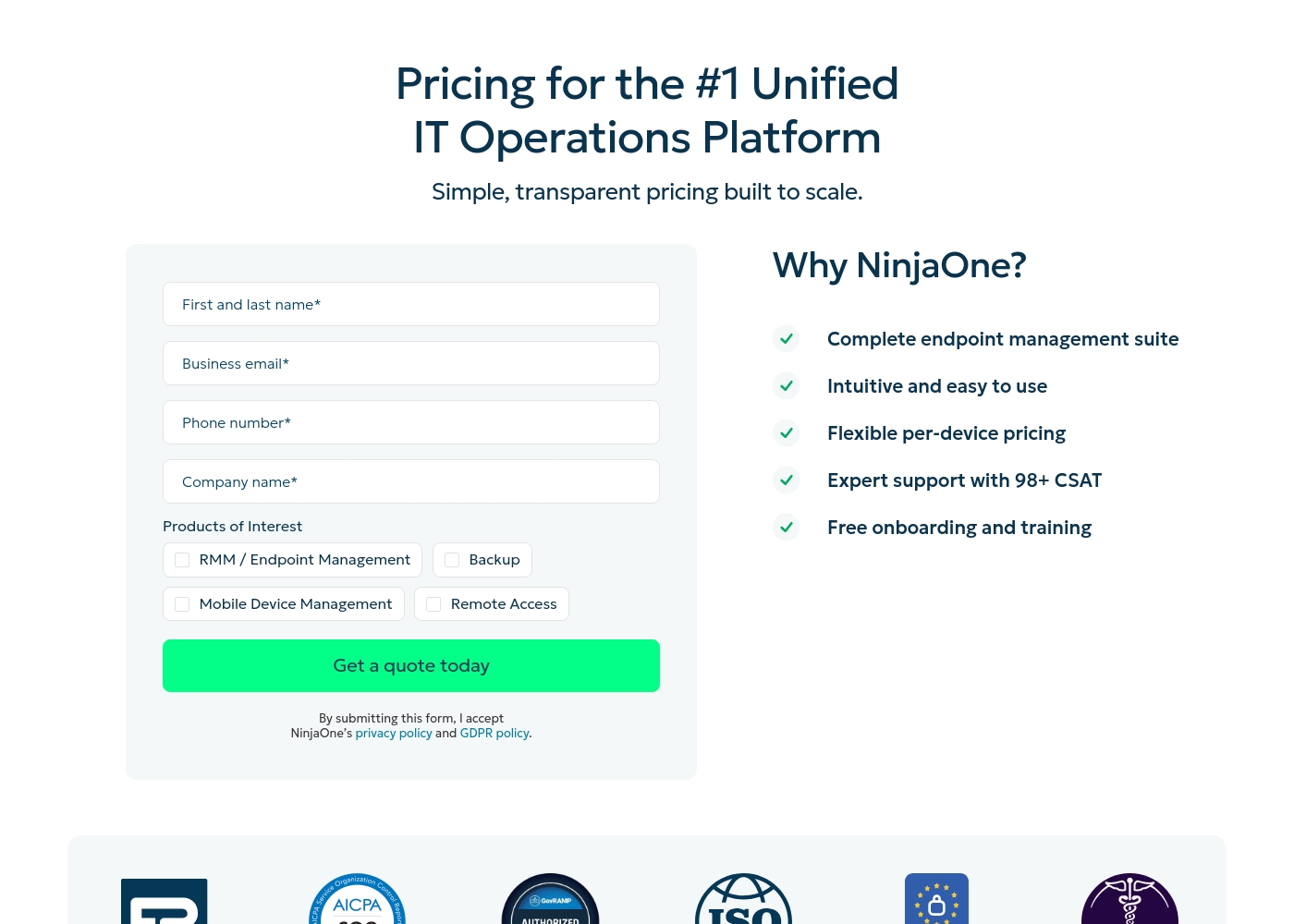
NinjaOne costs between $1.50 and $3.75 per endpoint each month with one flexible plan that scales based on your device count and specific product needs.
Here is how their pricing model works for your team.
Unified IT Operations
Price: From $1.50 to $3.75 per device monthly Best For: MSPs and IT departments managing multi-OS environments Refund Policy: 60-day cancellation notice Other Features: Remote monitoring and management, autonomous patch management, endpoint security, backup, and free unlimited training.
- RMM / Endpoint Management
- Autonomous Patch Management
- Mobile Device Management (MDM)
- Endpoint and SaaS Backup
- Remote Control & Service Desk
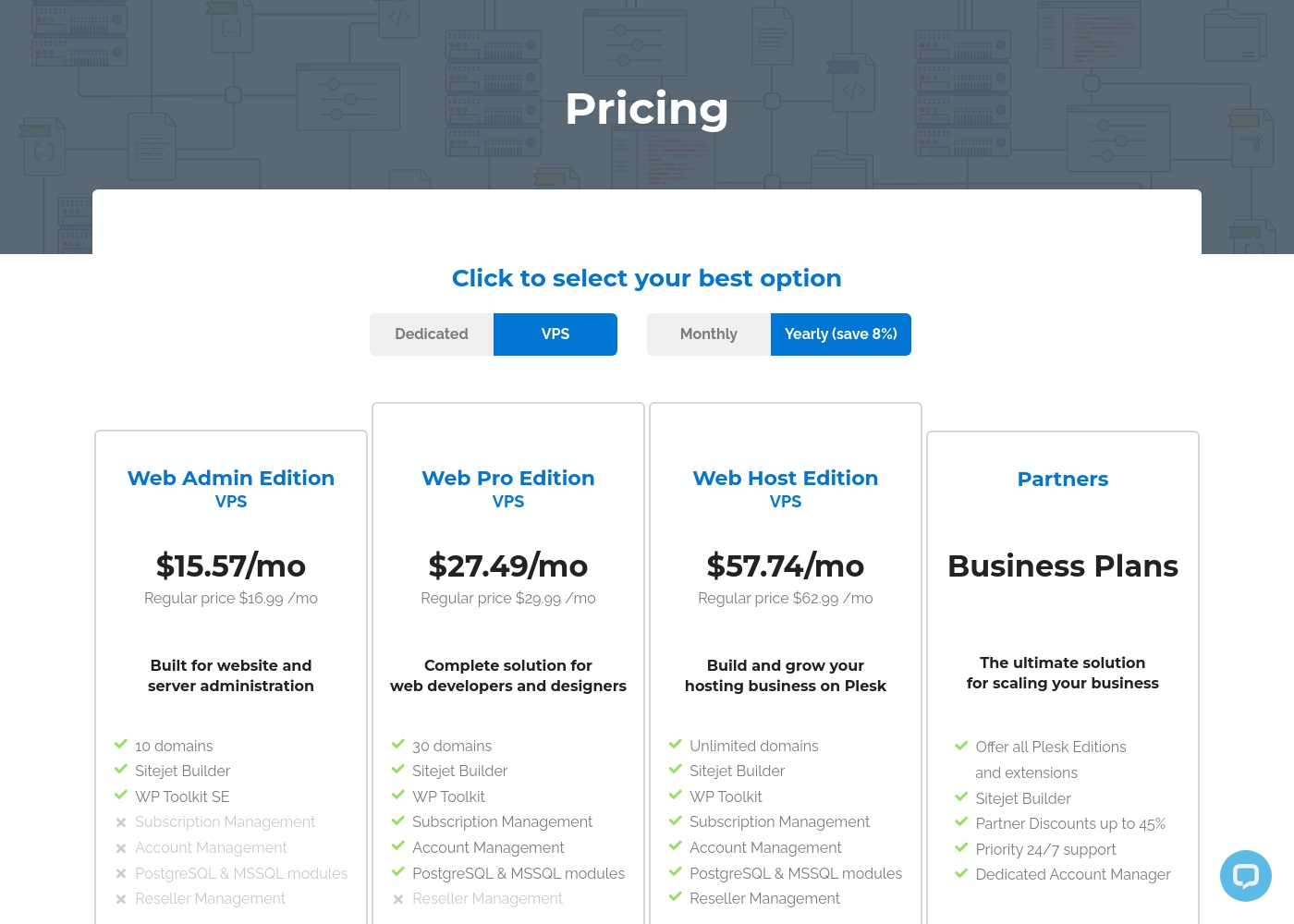
Plesk costs between $15.57 and $57.74 per month with 4 plans: Web Admin Edition at $15.57/mo, Web Pro Edition at $27.49/mo, Web Host Edition at $57.74/mo, and Partners at $250/mo minimum.
You can see how the specific licenses break down below to find the right fit for your server.
Web Admin Edition
Price: $15.57 per month billed annually Websites Supported: 10 domains Best For: Basic website and server administration Other Features: Sitejet Builder, WP Toolkit SE
- 10 domains
- Sitejet Builder
- WP Toolkit SE
- 30 domains
- Sitejet Builder
- WP Toolkit
- Subscription Management
- Account Management
- Unlimited domains
- Sitejet Builder
- WP Toolkit
- Subscription Management
- Account Management
- Offer all Plesk Editions
- Sitejet Builder
- Partner Discounts up to 45%
- Priority 24/7 support
- Dedicated Account Manager
Pricing Notes
- NinjaOne pricing is per endpoint and decreases with volume. Plesk pricing is per server license and increases with the number of domains supported.
- NinjaOne includes free onboarding, support, and training. Plesk support is standard, with priority support only for higher-tier partners.
- Both offer a 14-day free trial. NinjaOne's trial is for testing core functionality. Plesk's trial is a full version with no credit card required.
- Plesk licenses auto-renew by default. NinjaOne requires 60 days' notice to cancel if not on a promotional commitment.
- For a team managing 100 endpoints, NinjaOne could cost $150-$375/month. A hosting provider managing 10 servers with 30 domains each would pay $274.90/month for Plesk Pro licenses.
Pricing Head-to-Head
User Reviews
NinjaOne enjoys strong praise on both Trustpilot and Capterra for its intuitive interface and responsive support. 👍 Users consistently highlight the platform's ease of use, noting that the unified console simplifies managing endpoints across multiple operating systems.
The automated patch management is frequently cited as a major time-saver, reducing security risks and manual workloads. Customer support receives high marks for being fast, knowledgeable, and proactive.
NinjaOne replaced about 10 different tools for us. The interface is clean, and support is always helpful when we need it. Deployment was smoother than we expected.
We found that user sentiment for Plesk is quite mixed. On Trustpilot, many users praise its user-friendly interface and reliable server management tools, especially the WordPress toolkit.
🛠️ However, a significant number of reviews complain about unresponsive customer support and billing issues, particularly after contract renewals. Some find the software intuitive for basic tasks, while others report it can be unreliable and cause server downtime.
Plesk makes managing my WordPress sites a breeze. The dashboard is intuitive, and the one-click updates save me hours every week. It's the most reliable panel I've used.
Our Verdict
This isn't a head-to-head battle between similar tools. It's a choice between two different specialists. NinjaOne wins for managing your company's IT devices and security. Plesk wins for managing your web hosting infrastructure. NinjaOne's superpower is unification. It replaces a dozen IT management tools with one cloud console. Users report cutting patch cycles from 72 hours to minutes. That's a massive time and risk reduction. Plesk's superpower is control. It gives you a powerful dashboard to manage dozens of websites and servers. Its WordPress Toolkit alone can save web teams hours of manual work every week. It's built for the web professional. The deciding factor is your core problem. Are you juggling endpoint security, patching, and remote support for your team? Or are you juggling website updates, server security, and client hosting? Your answer points directly to the right tool. For most IT departments and MSPs, NinjaOne is the clear choice to streamline operations. For web agencies, developers, and hosting providers, Plesk is the essential control panel for your business. Don't compare them as equals—compare them as specialists for your specific job.
Frequently Asked Questions
Which is better for small teams: NinjaOne or Plesk?
It depends entirely on your work. A small IT team managing company devices should choose NinjaOne. A small web agency building client websites should choose Plesk.
Does NinjaOne handle website hosting like Plesk?
No. NinjaOne manages the devices that might access websites. Plesk manages the servers that host websites. They operate at different levels of the IT stack.
Is Plesk worth the cost for a single WordPress site?
Probably not. Plesk is designed for managing multiple sites and servers. For a single site, simpler hosting tools or your provider's dashboard may be more cost-effective.
Can I migrate from NinjaOne to Plesk easily?
They aren't directly comparable for migration. Moving from NinjaOne means adopting a new IT ops platform. Moving to Plesk means adopting new server management software for different needs.
Which tool has better customer support?
Based on reviews and promises, NinjaOne does. It offers free, unlimited support with high satisfaction ratings. Plesk's support receives mixed reviews, with responsiveness being a frequent concern.
Are there hidden costs with NinjaOne or Plesk?
NinjaOne includes free onboarding and training, with pricing based on endpoint volume. Plesk's support is standard, but renewal auto-renews by default. Both require sales contact for exact quotes.
Ready to Choose?
Both tools have their strengths. Choose based on your specific needs.