DreamHost vs Plesk
DreamHost and Plesk solve different problems. DreamHost is a complete, managed WordPress hosting platform. Plesk is a powerful server control panel you install on your own server.
Best for: Beginners launching their first WordPress website, Small businesses wanting managed, hands-off hosting
Best for: Web agencies managing client sites, IT admins overseeing multiple servers
Exceptional Support Meets Reliable WordPress Hosting
We find DreamHost offers industry-leading customer confidence, anchored by an in-house support team that users consistently rate as exceptional for speed and knowledge. The platform delivers excellent feature value, including AI-powered tools and essential observability, bundled into accessible promotional pricing for new customers. Overall, we confidently recommend DreamHost, especially for long-term WordPress users who prioritize reliable service and expert, responsive technical assistance.
Pros
- Overwhelmingly positive feedback for responsive, knowledgeable, in-house customer support.
- Strong promotional pricing available for four-year contracts ($2.99/mo starting price).
- Built-in observability and AI-powered error analysis included across all plans.
- Industry-leading 100% Uptime Guarantee and a generous 30-day money-back guarantee.
Cons
- Promotional rates renew at significantly higher standard prices after the initial term.
- Customers must prepay for lengthy terms to secure the lowest introductory pricing.
- Wait times for ticket submission or chat support can sometimes vary.
Powerful panel, check the support.
Plesk is a feature-rich control panel that excels at centralizing server and website management, especially for WordPress. We found it robust and cloud-compatible, but the overall experience can be inconsistent due to reported customer support challenges. Overall, it's a strong contender for technical users who value its toolkit, but we'd advise trying the free trial to test support responsiveness firsthand.
Pros
- Unified dashboard for managing multiple sites and servers
- Powerful, automated WordPress Toolkit for updates and staging
- Broad security features built-in at the OS and app level
- Compatible with all major cloud platforms (AWS, Azure, Google Cloud)
Cons
- Customer support responsiveness is frequently criticized in reviews
- Pricing can be opaque, and some users report billing surprises
- May present a learning curve for users unfamiliar with server admin
- Not ideal for single, simple websites or fully managed, hands-off services
AboutDreamHost
DreamHost provides a simple, reliable web hosting platform backed by over 27 years of excellence. It’s trusted by developers, designers, and businesses alike. This employee-owned service is mission-driven and passionately supports the WordPress community. They currently host over 1.5 million active websites and offer specialized tools built specifically for the world’s most popular CMS. 💡
AboutPlesk
Plesk is a comprehensive server management platform built for developers, IT admins, and hosting providers. It acts as a centralized control panel for building and managing multiple sites. You get tools for security, performance monitoring, and onboarding new clients from a single place.
Highlights
Feature Comparison
Features Overview
We highlight the main differences and pick a winner for each feature.
Core Function
DreamHost is a web host; Plesk is a control panel. They solve fundamentally different problems.
DreamHost provides the actual server and hosting service. You sign up, and your website lives on their infrastructure. Plesk is software you install on a server you already own or rent. It gives you a dashboard to manage that server and any sites on it. The key difference is ownership. With DreamHost, they manage the server. With Plesk, you manage the server software.
WordPress Management
Plesk's WP Toolkit is more powerful for managing multiple sites. DreamHost's is simpler for single sites.
DreamHost includes a free migration tool and handles core updates automatically for your hosted sites. It's designed for simplicity. Plesk's WP Toolkit allows cloning, staging, automated testing, and bulk management across many WordPress sites from one dashboard. It's built for scale. If you run one or two WordPress sites, DreamHost is easier. If you manage 10+ client sites, Plesk's toolkit saves massive time.
Server Control & Access
Plesk gives you full server control. DreamHost abstracts the server away completely.
With DreamHost's shared hosting, you don't get root access. They manage the server environment for you. You focus on your website. Plesk provides full root access via SSH on every server. You can install any software, tweak configurations, and control everything at the OS level. This makes Plesk ideal for developers and sysadmins who need deep control. DreamHost is better for those who want a hands-off, managed experience.
Built-in Features & Analytics
DreamHost bundles monitoring and AI tools. Plesk focuses on management and security layers.
DreamHost includes a Traffic Dashboard and AI-Powered Error Log Analysis, saving you $20-50/month on third-party tools. These are built into the hosting plan. Plesk's core features are its multi-level security (OS, network, app) and performance monitoring tools. It relies on its extension marketplace for specific analytics. DreamHost provides more ready-made insights out of the box. Plesk gives you more flexibility to build your own monitoring stack.
Cloud & Infrastructure Flexibility
Plesk runs anywhere you host a server. DreamHost runs on its own trusted infrastructure.
Plesk is compatible with AWS, Google Cloud, Azure, DigitalOcean, and all major virtualization platforms. You can move it between providers. DreamHost's managed hosting runs on their own globally distributed data centers. You don't choose the underlying cloud. Plesk offers maximum flexibility for your infrastructure. DreamHost offers the simplicity of a managed, single-vendor solution.
Customer Support
DreamHost is praised for 24/7 expert support. Plesk's support receives mixed reviews.
DreamHost's support is handled by in-house experts available 24/7 via chat and email. Users consistently rate it as fast, knowledgeable, and friendly. Plesk includes 24/7 support on standard plans. However, user reviews frequently cite slow response times and difficulty reaching help for critical issues. For immediate, reliable human help, DreamHost has a clear edge based on user sentiment.
DreamHost costs between $2.99 and $9.99 per month with 3 plans: Web Hosting Launch at $2.99, Web Hosting Growth at $3.99, and Web Hosting Scale at $9.99.
DreamHost offers three tiers of web hosting tailored for users at different stages of growth. The prices listed reflect the introductory promotional rate applied for the first four years of service.
Web Hosting Launch
Price: $2.99 /mo (Renews at $7.99 /mo) Websites Supported: 25 Websites Best For: Simple, reliable hosting to launch Refund Policy: 30-Day Money-Back Guarantee Other Features:
- 40k Monthly Visits
- 25 GB NVMe Storage
- 20 Mailboxes (3 Months Free)
- Free Handcrafted Starter Website
- 25 Websites
- 40k Monthly Visits
- 25 GB NVMe Storage
- Unmetered Bandwidth
- Daily Automated Backups
- 50 Websites
- 200k Monthly Visits
- 50 GB NVMe Storage
- Unmetered Bandwidth
- Daily Automated Backups
- 100 Websites
- 400k Monthly Visits
- 100 GB NVMe Storage
- Unmetered Bandwidth
- Daily Automated Backups
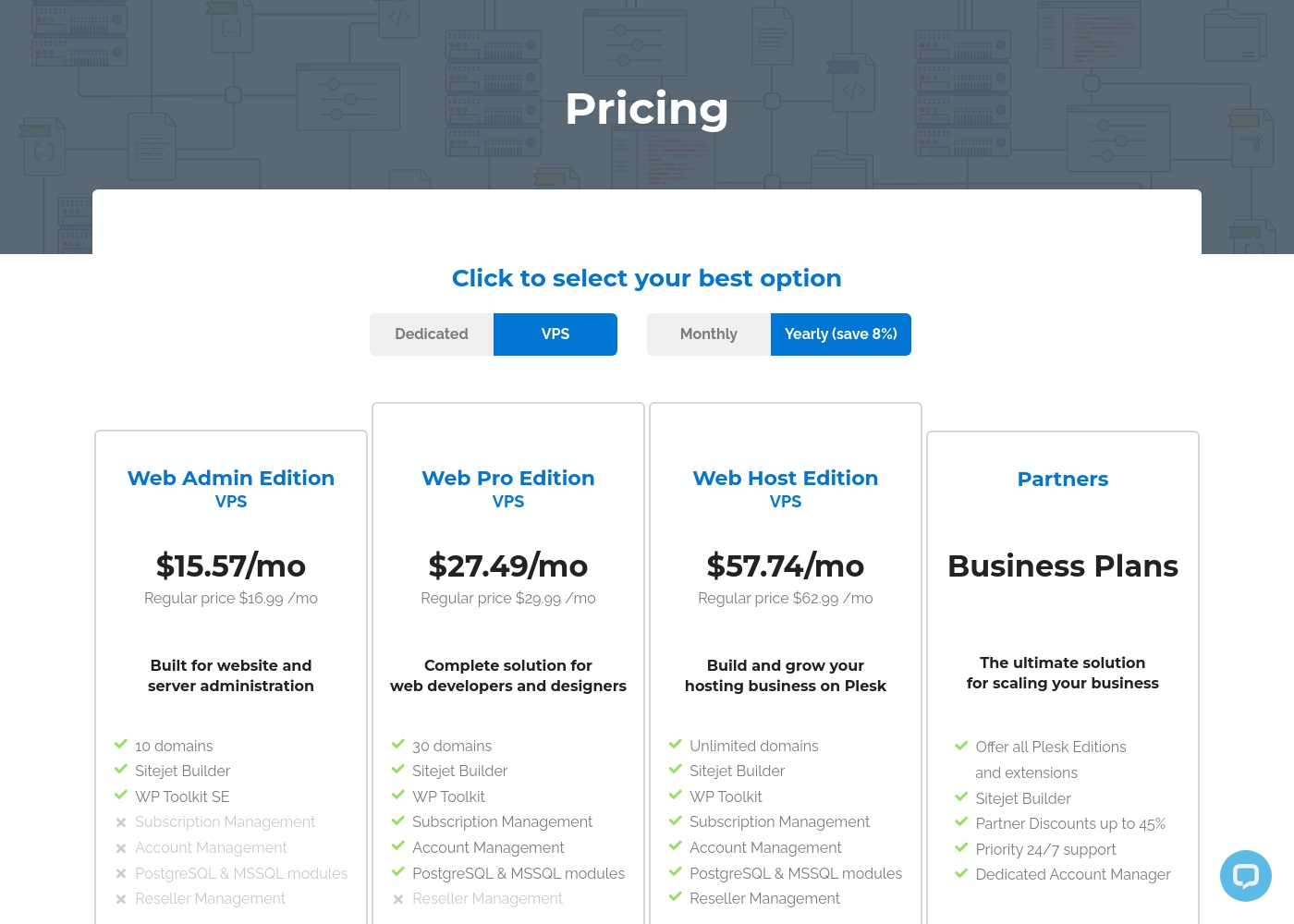
Plesk costs between $15.57 and $57.74 per month with 4 plans: Web Admin Edition at $15.57/mo, Web Pro Edition at $27.49/mo, Web Host Edition at $57.74/mo, and Partners at $250/mo minimum.
You can see how the specific licenses break down below to find the right fit for your server.
Web Admin Edition
Price: $15.57 per month billed annually Websites Supported: 10 domains Best For: Basic website and server administration Other Features: Sitejet Builder, WP Toolkit SE
- 10 domains
- Sitejet Builder
- WP Toolkit SE
- 30 domains
- Sitejet Builder
- WP Toolkit
- Subscription Management
- Account Management
- Unlimited domains
- Sitejet Builder
- WP Toolkit
- Subscription Management
- Account Management
- Offer all Plesk Editions
- Sitejet Builder
- Partner Discounts up to 45%
- Priority 24/7 support
- Dedicated Account Manager
Pricing Notes
- DreamHost's low prices ($2.99-$9.99) are promotional and lock you into a 4-year prepaid term.
- DreamHost renews at standard rates ($7.99-$19.99/mo) after the initial period.
- Plesk's listed prices are for annual billing on VPS licenses. Monthly billing costs about 12% more.
- Plesk requires you to already have a server. DreamHost includes the server in its price.
- Plesk offers a free 14-day trial with no credit card. DreamHost offers a 30-day money-back guarantee.
Pricing Head-to-Head
User Reviews
Users rate DreamHost exceptionally high, frequently highlighting the quality of its customer support as top-tier. Reviewers consistently describe the in-house professionals as knowledgeable, patient, quick to respond, and highly effective at resolving complicated issues—even those not strictly on 'their end.' This high level of support is cited by numerous customers who have been with the company for 10, 15, or even 20 years, proving long-term reliability and consistency.
Onboarding is noted as smooth, with new websites going live in just hours. Users also praise the platform's reliability and site speed, emphasizing the user-friendly dashboard and ease of website management.
Dreamhost support was extremely helpful, knowledgeable, and prompt with replies. He diagnosed the issue and provided clear instructions to rectify our technical situation quickly.
We found that user sentiment for Plesk is quite mixed. On Trustpilot, many users praise its user-friendly interface and reliable server management tools, especially the WordPress toolkit.
🛠️ However, a significant number of reviews complain about unresponsive customer support and billing issues, particularly after contract renewals. Some find the software intuitive for basic tasks, while others report it can be unreliable and cause server downtime.
Plesk makes managing my WordPress sites a breeze. The dashboard is intuitive, and the one-click updates save me hours every week. It's the most reliable panel I've used.
Our Verdict
DreamHost and Plesk aren't really competitors. They serve different needs. DreamHost is a complete hosting package. Plesk is powerful server management software. DreamHost's superpower is simplicity with value. You get hosting, a free domain, SSL, and AI tools in one managed plan. Their 24/7 expert support is consistently praised as industry-leading. Plesk's superpower is centralized control. It lets you manage dozens of websites, multiple servers, and complex WordPress setups from one dashboard. It runs on any cloud provider. The deciding factor is what you're building. If you need to host a website easily, DreamHost is the clear, simple choice. If you need to manage servers and multiple client sites, Plesk is the specialized tool for the job. For most beginners and small businesses, DreamHost offers better value and peace of mind. For developers and agencies, Plesk provides the control and scale they require.
Frequently Asked Questions
Can I use DreamHost and Plesk together?
Yes, but it's not common. You could install Plesk on a DreamHost VPS to get the control panel benefits. Most users choose one or the other for their primary need.
Which is better for managing multiple WordPress sites?
Plesk is significantly better for this. Its WordPress Toolkit offers bulk management, cloning, and staging. DreamHost manages each site individually within its dashboard.
Does Plesk include web hosting?
No. Plesk is only the control panel software. You must provide your own server from a provider like AWS, DigitalOcean, or a traditional host.
Is DreamHost good for developers who need full control?
Not really. DreamHost's shared hosting is managed and doesn't offer root access. Developers needing that level of control should look at Plesk or a VPS.
Which has better security features?
Both offer strong security, but differently. DreamHost includes free SSL and automatic updates. Plesk provides multi-level OS and network security with more advanced firewall options.
What's the cheapest way to get started?
DreamHost's Launch plan at $2.99/month is the lowest entry point, but it requires a 4-year prepaid term. Plesk's Web Admin starts at $15.57/month, but you also need to pay for a server.
Ready to Choose?
Both tools have their strengths. Choose based on your specific needs.