ActivePieces

ActivePieces review

Open-source AI automation and agents, deployable on the cloud or your own Docker infrastructure

By Ciroapp Editorial Team · Updated Sep 16, 2026

Commission may apply at no extra cost

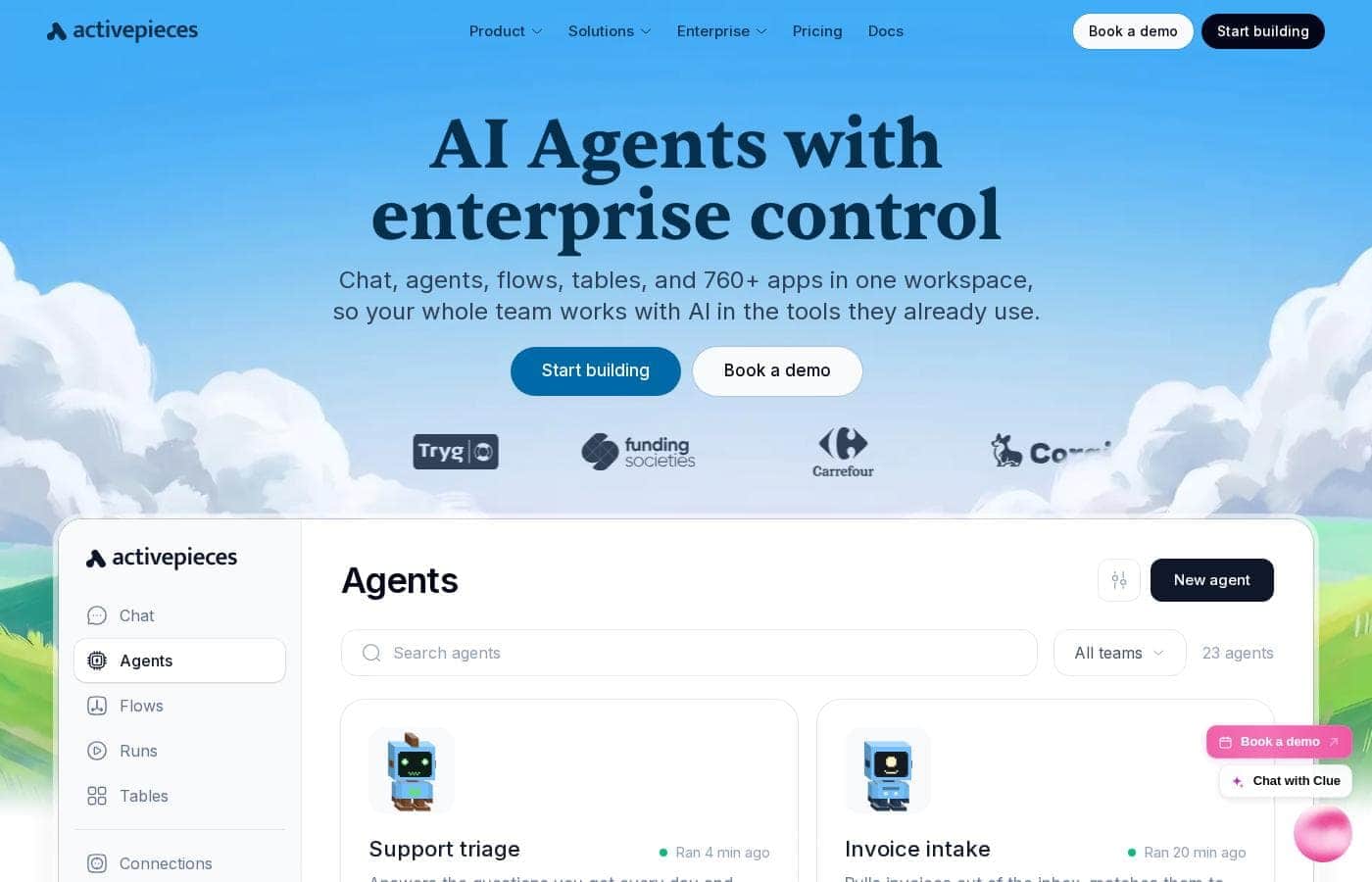
ActivePieces homepage screenshot

At a glance

Quick overview for ActivePieces: rating, pricing summary, key features, and highlights.
Vendor page checked Nov 18, 2026

Ciroapp score

4.0/ 5

ActivePieces gives you two ways to run automation: their managed cloud or your own Docker setup. The open-source core, SOC 2 Type II compliance, and a free starting plan are real strengths, but self-hosting demands DevOps skills and usage-based billing can drift. Overall, it's a smart pick for technical teams that want control without giving up convenience.

Pros

  • Dual deployment model — the same platform runs on ActivePieces' managed cloud or self-hosted via Docker, so you are not forced into a single hosting philosophy
  • Open-source core allows inspection, customization, and extension, avoiding the constraints of closed SaaS automation tools
  • SOC 2 Type II compliance makes it viable for enterprises and regulated environments, which is unusual among self-hostable open-source automation tools

Cons

  • Self-hosting with Docker requires real DevOps capability; updates, backups, and scaling become your team's responsibility
  • Usage-based pricing can make monthly costs unpredictable once automation volume grows beyond the $0 to $166/month plan range
  • With an open-source foundation, some customization and edge-case functionality may require your own development effort rather than being available out of the box
Best for
  • Engineering-led teams that want AI agents and automations running inside their own infrastructure via Docker self-hosting
  • Startups that need working automations today on a free plan and expect usage-based scaling as volume grows
  • Enterprises and regulated organizations that require SOC 2 Type II compliance but still want open-source flexibility
This section is a summary. Detailed sections about features, use cases, pricing, and reviews follow below.

What is ActivePieces?

ActivePieces is an automation platform built around AI agents and workflow automation, available both as a hosted cloud service and as a self-hosted deployment you run with Docker. Its open-source foundation means teams can inspect and extend the platform instead of being locked into a closed product. The vendor positions it for everyone from early startups to Fortune 50 organizations, backed by SOC 2 Type II compliance.

Pricing starts at $0/month, so it can be evaluated without an upfront commitment.

ActivePieces is an open-source automation ecosystem designed for building AI agents and connecting them to the tools a team already relies on. You can start building immediately on the vendor's cloud, or take the same framework and self-host it with Docker for direct control over data and infrastructure. Because the core is open source, the platform is customizable in ways closed SaaS automation tools are not, while still being engineered to meet enterprise requirements.
Should you choose ActivePieces?

Quick buyer guidance before you compare plans or click through.

Choose it if

  • Engineering-led teams that want AI agents and automations running inside their own infrastructure via Docker self-hosting
  • Startups that need working automations today on a free plan and expect usage-based scaling as volume grows
  • Enterprises and regulated organizations that require SOC 2 Type II compliance but still want open-source flexibility
  • Operations teams replacing brittle trigger-action workflows with AI-native agents that can handle judgment-based steps

Skip it if

  • Teams with no technical staff who intend to self-host, since Docker deployment and ongoing maintenance demand DevOps skills
  • Buyers who need fixed, predictable monthly costs, because usage-based billing can fluctuate with automation volume
  • Users who want a fully managed, zero-decision experience and will never use the open-source or self-hosting capabilities that differentiate the platform

Next steps before buying

  1. 1Sign up at activepieces.com and start on the free $0/month cloud plan so you can evaluate the builder and AI agents against a real process before spending anything
  2. 2Pick one repetitive workflow, map it end to end (trigger, steps, any AI decision points), and rebuild it in ActivePieces as your first automation
  3. 3If data control matters to you, trial the Docker self-host option on a staging server and verify your backup, update, and scaling procedures before moving to production
  4. 4Compare the paid tiers up to $166/month against your expected run volume so usage-based billing does not surprise you after rollout

ActivePieces Key Features

✨ AI Agents and Automation

ActivePieces is purpose-built for AI automation and agents, meaning workflows can include AI-driven reasoning and decision steps rather than only static trigger-and-action rules. This makes it suitable for automating processes where context or judgment matters, not just simple data shuttling between apps.

✨ Open-Source Foundation

The platform is built on an open-source framework, so its internals can be inspected, customized, and extended. Teams are not confined to whatever a closed SaaS vendor chooses to expose, and the codebase can be adapted to fit specific internal requirements.

✨ Cloud or Self-Hosted via Docker

You can begin building on ActivePieces' managed cloud with no infrastructure work, or deploy the same system yourself using Docker. Self-hosting keeps automation runs, data, and logs inside your own environment, which matters for organizations with strict data-handling policies.

✨ Enterprise-Ready Compliance

Despite its open-source roots, ActivePieces is engineered to be enterprise-ready and holds SOC 2 Type II compliance. The vendor reports adoption from startups through Fortune 50 companies, indicating the platform holds up under demanding, large-scale use.

✨ Flexible Pricing Structure

Plans run from a free tier at $0/month up to $166/month, with monthly subscription and usage-based billing options. This lets small teams start at no cost and scale spending in proportion to the automation volume they actually run.

Use Cases

💡 Automating Cross-App Business Processes

Teams can use ActivePieces to connect the applications they already use and automate the handoffs between them, such as routing records, syncing data, and notifying the right people. This reduces manual copy-paste work and keeps systems consistent without custom integration code.

💡 Deploying AI Agents for Repetitive Operational Work

Because the platform is built for AI agents, operations and support teams can automate tasks that involve judgment or summarization rather than pure rules. Agents can be embedded into workflows so routine work proceeds automatically and humans step in only where needed.

💡 Self-Hosting Automation for Data Control

Organizations that cannot send workflow data to a third-party cloud can run ActivePieces via Docker on their own infrastructure. This suits regulated industries and internal-tools teams that need automations, logs, and credentials to stay inside their perimeter.

💡 Startup Prototyping on the Free Plan

Early-stage teams can validate automation ideas on the free $0/month cloud tier before committing budget. As volume grows, usage-based billing and paid plans up to $166/month let costs rise in step with actual workload instead of forcing an early platform switch.

ActivePieces pricing

Prices not verified yet — see the vendor page.

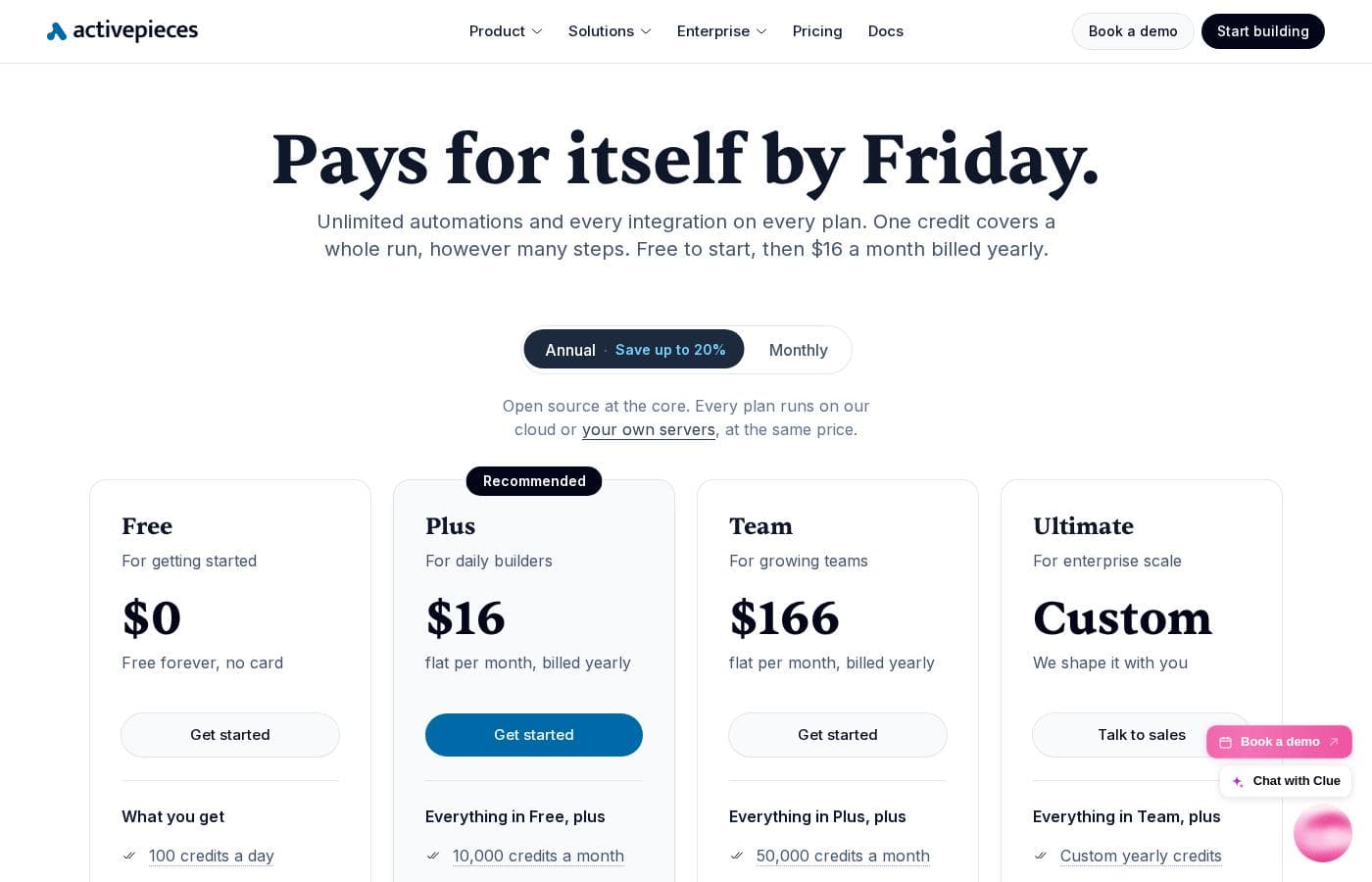
ActivePieces's pricing page

ActivePieces pricing page screenshotView pricing page screenshot

Price history

Tracking prices since Oct 1, 2026. No price change detected yet.

Pricing types: Free plan, Monthly subscription, Usage-based pricing

Email me when ActivePieces changes price

One email when we detect a price change on the vendor's pricing page. No newsletter, no deals. Unsubscribe in one click.

User Reviews

No reviews yet.

Write a Review

Write a Review for ActivePieces
0/100 characters
0/2000 characters

Why use ActivePieces?

Most automation tools force a trade-off: hosted platforms are convenient but limit control, while self-hosted options are flexible but demand maintenance. ActivePieces removes that dilemma by supporting both deployment models on one open-source codebase.

Teams with strict security requirements get SOC 2 Type II compliance out of the box, while cost-conscious users can start on a free plan and move to usage-based pricing as workloads grow. That combination of deployment flexibility, compliance, and AI-native agent building is uncommon in a single tool.

ActivePieces alternatives

Other tools in the Automation category

View all Automation tools
DataSnipper

DataSnipper

Automation4.2/5

DataSnipper is an AI platform for audit and finance work, built around Excel. Its agents run end-to-end tasks like revenue testing, royalty calculations, and document extraction; your team reviews and approves the output. It serves external and internal auditors, tax teams, financial controllers, government auditors, and advisory firms. The company reports that all top 100 accounting firms use it, with clients including BDO, RSM, and Morgan Stanley.

FlowMattic

FlowMattic

Automation4.2/5

FlowMattic is a powerful automation tool trusted by over 7,582 WordPress professionals worldwide. It helps businesses manage their vital operations effortlessly. The platform acts as an essential, reliable, and future-proof tool for anyone running a business on WordPress. Users find that it easily replaces other complex automation systems thanks to its seamless integration. ✅ Whether you run an agency, an e-commerce store, a SaaS platform, or an educational platform, FlowMattic provides the dedicated automated workflows needed for sustainable growth.

Pabbly Connect

Pabbly Connect

Automation4.1/5

Pabbly Connect is an integration platform that connects multiple applications so you can send data from one app to another and keep data in sync across tools. It’s built for anyone looking to automate cross‑app processes and remove manual handoffs.

Zapier

Zapier

Automation4/5

Zapier is an automation platform that connects the apps a business already runs on. A Zap is a workflow that moves work between apps without someone triggering it each time. You can build in an AI tool like Claude or ChatGPT through Zapier MCP, then run and govern the workflow in one place. It's aimed at teams that want automation without asking engineering for a sprint, from first-time founders to enterprise IT.

Integrately

Integrately

Automation3.9/5

Integrately is a simple and powerful platform designed to hook up your favorite business tools quickly and efficiently. It’s perfect for anyone needing to automate routine tasks without complex coding knowledge. The platform integrates with a vast ecosystem of over 1400 apps, including major players like Pipedrive, Hubspot, Trello, and Google Sheets. The core benefit rests on its massive library of Ready Automations ✨. You don't have to build intricate workflows from the start. Instead, you select a pre-built pathway, connect your accounts, and the automation is instantly ready to boost your productivity.

OttoKit

OttoKit

Automation3.9/5

OttoKit is a powerful cloud automation platform designed to make your applications work better together. It was previously known as SureTriggers, but the core functionality remains the same. This platform connects over 1,000 popular tools, from CRMs to chat apps and spreadsheets. It serves agencies, eCommerce entrepreneurs, and community builders. You can easily build systems that feel like you hired a super-assistant without needing any coding skills.

Cheapest Automation software for 1 to 25 users

ActivePieces FAQ

Can I self-host ActivePieces?

Yes. ActivePieces can be self-hosted using Docker, letting you run the full platform on your own infrastructure and keep workflow data, logs, and credentials in-house. If you would rather not manage servers, the vendor also offers a hosted cloud version of the same system, and you can move between the two models as your needs change.

Is ActivePieces suitable for enterprises with security requirements?

Yes. The platform is SOC 2 Type II compliant and is used by organizations ranging from startups to Fortune 50 companies. Teams with stricter requirements can layer self-hosting on top, running the open-source deployment inside their own perimeter for additional control over data residency.

How much does ActivePieces cost?

ActivePieces offers a free plan starting at $0/month, with paid plans ranging up to $166/month. Billing options include monthly subscriptions and usage-based pricing, so costs can scale with the volume of automation your team actually runs rather than a fixed seat count.

Ready to try ActivePieces? Check out the official site or pricing.

Are you ActivePieces? Claim this listing · Get the badge