ActivePieces vs OttoKit
ActivePieces and OttoKit both deliver serious automation power boosted by AI agents. ActivePieces focuses on open-source flexibility and highly customized, deep integration. OttoKit offers extraordinary value through lifetime deals and broad connectivity across 1,000+ apps. Your budget preference and required complexity will dictate which tool wins this comparison.
Best for: AI developers building complex agents, Users requiring self-hosting capability for privacy
Best for: Businesses seeking massive lifetime cost savings on automation, Agencies managing multiple clients using isolated Workspaces
Powerful Automation, Complex Pricing
We find ActivePieces to be a technologically superior tool that rivals Zapier and Make, excelling in handling complex, AI-first workflows and offering excellent cost efficiency. Overall, while the core automation engine and feature set are industry-leading and SOC 2 Type II compliant, the platform's relationship with its community has been significantly strained by retroactive policy and pricing changes.
Pros
- AI-first automation featuring agents and 470 connectors.
- High flexibility with no-code canvas and powerful Code module for custom JS libraries.
- Considered cost-effective and cheaper than competitors like Zapier and n8n.
- Includes enterprise-ready features like flow versioning and auto retry for failures.
Cons
- Lack of transparency regarding sudden, substantial pricing structure changes.
- Early supporters felt betrayed by perceived changes to lifetime deals.
- Users were automatically downgraded from paid plans to trial plans without notification.
- Inconsistent customer support response for issues not reported on GitHub.
Ambitious features need better stability.
We find OttoKit features—like AI Agents and the visual builder—highly promising, especially combined with the budget-friendly LTD pricing. Overall, we must caution users about potential risks related to workflow reliability and slow customer support response times.
Pros
- Access to advanced features like AI Agents and Human in the Loop (HITL).
- Highly competitive one-time Lifetime Deal (LTD) pricing structure.
- Visual, no-code drag-and-drop workflow builder.
- Seamless integration designed specifically for WordPress sites.
Cons
- Reported significant issues with workflow reliability and functionality.
- Support response times can be very slow (up to seven days for a fix).
- Support communication observed as sometimes blunt or unhelpful.
- Concerns raised over long-term support model due to heavy LTD strategy.
AboutActivePieces
ActivePieces delivers the full ecosystem for AI automation and agents. It focuses on connecting smart agents, no-code flows, and a central data store called Tables. This impressive platform is trusted by companies ranging from startups all the way to Fortune 50 organizations. You can easily start using ActivePieces on the cloud, or choose to self-host with Docker for ultimate control. Whether you are building complex AI agents or setting up simple automations, the system makes it smart and easy. 💡
AboutOttoKit
OttoKit is an intuitive cloud platform that connects over 1,200 apps together. It helps you automate what matters across all your business platforms. This tool is ideal for agencies, eCommerce entrepreneurs, and community builders who want processes to run themselves.
OttoKit uses a friendly, drag-and-drop canvas for creating Visual Workflows 💡. You do not need any coding skills to build powerful automations. It’s also the top automation solution specifically designed to integrate with WordPress sites.
Highlights
Feature Comparison
Features Overview
We highlight the main differences and pick a winner for each feature.
Pricing Strategy
OttoKit offers lifetime deals, providing significant long-term capital savings. ActivePieces uses standard, flexible monthly subscription plans.
ActivePieces scales based on active flows, ranging from $25 to $150 per month. Its Free plan generously includes 1,000 tasks monthly to get you started. OttoKit offers one-time lifetime purchases for its Pro, Business, and Business Plus tiers. This structure appeals highly to users prioritizing long-term predictable costs. OttoKit's lifetime deal is a huge financial draw for users planning five or more years ahead. ActivePieces pricing focuses on flow complexity and enterprise reliability features instead. ActivePieces users have reported abrupt pricing changes historically, making OttoKit's fixed lifetime price more reassuring for some.
App Ecosystem Size
OttoKit boasts over 1,000 app connectors, offering vastly wider global coverage. ActivePieces provides a very robust library of 434 specialized pieces.
OttoKit leads significantly with its vast library of 1,000+ connectors globally. This makes it ideal if you need connectivity across a wide range of general business applications. ActivePieces focuses its 434 pieces on deep integration and supporting AI agent capabilities. ActivePieces's pieces are often designed to be primary tools for the agents. While OttoKit has more apps, ActivePieces prioritizes the depth of integration for complex logic. Choose OttoKit if sheer breadth of apps is your primary decision-maker. Both support generic API requests and webhooks to connect anything, regardless of the built-in library size.
AI Agent Focus
ActivePieces is purpose-built for complex, agent-first orchestration and deep flexibility. OttoKit includes AI Agents primarily for task execution and monitoring.
ActivePieces is engineered to build true AI Agents that think, act, and collaborate. Agents access the 434 piece library as tools for real-world tasks. It offers unique features like Tables, acting as a central datastore for active agents. OttoKit features general AI Agents for real-time monitoring and basic decision-making processes. OttoKit's AI helps make existing workflows smarter, focusing on efficiency improvements. ActivePieces targets building highly automated, sophisticated agentic decision systems. If your automation strategy centers around building intelligent, autonomous workers, ActivePieces has the deeper toolset.
Deployment Flexibility
ActivePieces allows cloud hosting or self-hosting via Docker for maximum control. OttoKit is a cloud-native platform with no option for self-installation.
ActivePieces offers its open-source Community Edition, enabling users to self-host using Docker. This is vital for users needing complete data sovereignty or custom environments. For large organizations, ActivePieces also offers an Enterprise cloud or self-hosted deployment. OttoKit operates exclusively as a cloud-based service, simplifying setup significantly. OttoKit offers reliable performance but locks you into their cloud infrastructure. ActivePieces provides ultimate flexibility, catering to both cloud users and technical teams. This choice determines if you prioritize full vendor control (ActivePieces) or effortless managed service (OttoKit).
Reliability Tools
ActivePieces offers automatic recovery (Auto Retry) and Versioning for stability. OttoKit focuses on easy error reporting and simple, manual Replay functions.
ActivePieces manages continuous reliability with features like auto retry functionality. If a step fails temporarily, ActivePieces immediately tries to run it again. It also holds a powerful versioning management feature, allowing instant rollback of broken flows. OttoKit instantly alerts users if a workflow fails or hits critical limits. OttoKit supports a single-click Replay function for repeating failed runs once the error is fixed. ActivePieces is better suited for maintaining complex, continuous, enterprise-grade reliability autonomously.
Agency/Client Features
OttoKit provides dedicated Workspaces and Sub-account features essential for agencies. ActivePieces supports internal teams but lacks specific client isolation tools.
OttoKit's structure, with Organizations and Workspaces, is built for client work management. The Business Plus plan includes specific features for creating client sub-accounts. This configuration is crucial for agencies needing strict separation between client data and projects. ActivePieces Business plan includes limits of 5 users and 10 projects for internal teamwork. While ActivePieces supports multi-team collaboration, it is less optimized for external client separation. OttoKit is the superior platform for agency-as-a-service providers and consultants.
Task Volume Scaling
OttoKit defines exact task volumes up to 30,000 tasks/month for clarity. ActivePieces offers 'unlimited' tasks but limits usage based on active flows (50 max).
OttoKit's pricing scales clearly based on monthly task count, culminating at 30,000 tasks. This predictability is highly valuable for planning capacity. ActivePieces offers 'unlimited' tasks on paid plans, but strictly limits the number of simultaneously running workflows. The top Business plan stops at 50 active flows. This flow limit means ActivePieces benefits users who have a few massive, critical automations. OttoKit benefits users running numerous, smaller automations across 1,000+ apps. For absolute volume and external flow predictability, OttoKit provides clearer scaling limits.
Data Tools Comparison
ActivePieces includes the native Tables datastore for agents and flows. OttoKit provides specialized Core Apps for flow routing and data manipulation.
ActivePieces features Tables, a centralized component acting as an internal, dynamic database. This component ensures agents have reliable reference data for decision-making. OttoKit offers advanced Core Apps like Email Parser and API Modules on paid plans. These tools enable complex data manipulation and routing within the visual workflow. If your automation needs to store, reference, and sync internal data, ActivePieces' Tables are indispensable. OttoKit focuses more on efficiently moving data between external services. For deep, integrated data storage within the automation platform, ActivePieces provides a significant edge.
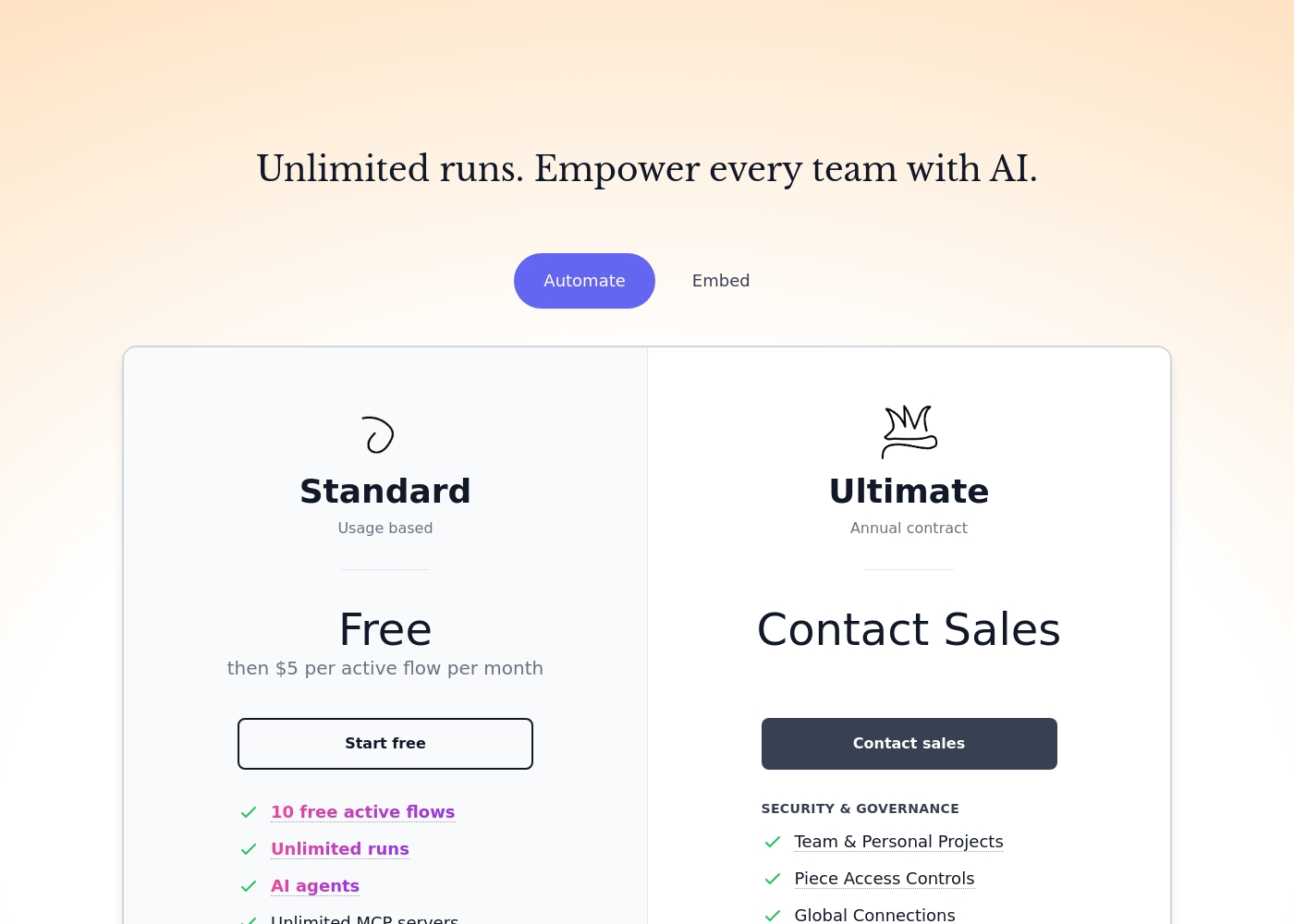
ActivePieces cloud plans start Free, then cost $5 per active flow per month, with enterprise tier pricing requiring a sales inquiry. Two managed plans are available: Standard (Free then $5 per active flow per month) and Ultimate (Contact Sales, Annual contract).
Here is a look at the specific features included in each plan type.
Standard
Price: Free then $5 per active flow per month Other Features:
- 10 free active flows
- Unlimited runs
- AI agents
- Unlimited MCP servers
- Unlimited tables
- Email support
- 10 free active flows
- Unlimited runs
- AI agents
- Unlimited MCP servers
- Unlimited tables
- Security & Governance
- Team & Personal Projects
- Piece Access Controls
- Global Connections
- Custom RBAC
OttoKit costs between $0 and $1299.00 (one-time) with 4 plans: Free at $0, Pro at $349.00, Business at $649.00, and Business Plus at $1299.00.
Here’s a breakdown of the four available options.
Free
Price: $0 Best For: Anyone to get started with automation and basic features. Refund Policy: Not applicable Other Features:
- 1 Workspace
- 20 Workflows
- 1 WordPress Connection
- Limited Core Apps
- 20 Workflows
- 1 WordPress Connection
- All available Integrations
- Standard Support
- AI Agents
- Unlimited Workflows
- Premium Support
- MCP
- AI Agent
- Unlimited Workflows
- Premium Support
- 5 Workspaces
- Unlimited WordPress Connections
- MCP
- Unlimited Workflows
- Unlimited Workspaces
- Unlimited WordPress Connections
- Premium Support
- MCP

Pricing Notes
- OttoKit offers huge value via one-time lifetime purchases for high task volumes.
- ActivePieces scales primarily based on the number of active flows (2 to 50 active flows).
- OttoKit offers a transparent 14-day money-back guarantee for paid plans.
- ActivePieces offers a free trial, while OttoKit provides a generous free-forever plan with 250 tasks/month.
- The paid tiers of OttoKit are available via 11 monthly installments, improving upfront affordability.
- All paid ActivePieces plans feature 'unlimited tasks' subject to their flow activity limits.
Pricing Head-to-Head
User Reviews
We see a nuanced divide in user feedback for ActivePieces on Trustpilot, reflecting both its powerful technical capabilities and its governance challenges. Users consistently praise the platform as a powerful, cost-effective alternative to established competitors like Zapier and Make.
Reviewers note its simple integration process, short learning curve, and ability to handle intricate, heavy-lifting workflows effectively. Many users appreciate the solid community support and quick response when submitting platform bugs via GitHub.
I moved nearly all my Zaps from Zapier with no issues. Their pricing is truly amazing and much cheaper than key competitors. They even allow connecting multiple Gmail accounts to one workflow, which is a limiting factor on n8n.
OttoKit currently has minimal external feedback, with only one detailed review available on Trustpilot. This single user reported a highly mixed but ultimately concerning experience.
While the platform offers powerful functionality—the reviewer noted, "When it works, it works well"—they reported significant issues with reliability during testing. All three workflows tested required support intervention.
I was very hopeful about OttoKit, but the testing phase was deeply concerning. Of the three workflows we built, all had major issues requiring support. I cannot trust this product for any of my client work right now.
Our Verdict
Choosing between ActivePieces and OttoKit means picking between technical depth and exceptional fixed-cost value. ActivePieces favors power users and customized agent creation. OttoKit focuses on massive task volume for a single, low price. ActivePieces is brilliant for AI orchestration and developer control across complex flows. Features like native Tables and versioning significantly enhance enterprise reliability. If you need complex logic, custom code integration, or SOC 2 compliance, ActivePieces is your best bet. Its open-source option for self-hosting via Docker is a massive advantage. OttoKit’s superpower is its incredible lifetime value and its huge 1,000+ app connector library. Agencies love the dedicated Workspaces support for seamless client management. If you run a high-volume WordPress-centric business, OttoKit offers specialized performance optimization. The 14-day money-back guarantee secures your large, one-time payment investment. The critical difference is the pricing model versus technical flexibility. Choose ActivePieces if custom code and advanced agent features are non-negotiable for your use case. Conversely, choose OttoKit if the one-time payment structure delivers maximum cost savings for your high task volume. Final recommendation: If you prioritize deep control and self-hosting, harness the technical depth within ActivePieces. If cost savings, broad connectivity, and agency tools are your goal, demand the aggressive value of OttoKit’s lifetime deal.
Frequently Asked Questions
Which tool is better suited for running a high volume of automated tasks?
OttoKit clearly defines its capacity up to 30,000 tasks per month on the top tier. ActivePieces advertises 'unlimited tasks' but limits users to a maximum of 50 active workflows. High-volume users with many simple automations might find OttoKit's explicit limits more favorable.
Does ActivePieces have any dedicated features for agencies like OttoKit does?
OttoKit excels for agencies, offering dedicated Organizations, Workspaces, and client sub-accounts. ActivePieces supports team collaboration with fixed user and project limits. For managing multiple external clients with strict data separation, OttoKit offers superior tools.
Can I self-host both ActivePieces and OttoKit on my own server?
Yes, you can self-host ActivePieces using its open-source Community Edition with Docker. This offers maximum control. OttoKit is strictly a cloud-based service and does not offer any self-hosting options.
How do ActivePieces and OttoKit compare on the number of direct integrations?
OttoKit officially supports over 1,000 popular apps, setting it ahead in sheer breadth. ActivePieces provides 434 specialized pieces, focusing on depth and tool capabilities for AI Agents. If broad, general connectivity is key, OttoKit wins this metric.
Is OttoKit worth the one-time cost over the monthly subscription of ActivePieces?
For anyone anticipating using the platform for years, OttoKit's lifetime deal offers extreme cost predictability and savings. ActivePieces provides modern subscription flexibility. OttoKit is a much better long-term investment financially, assuming task volume fits.
Which platform offers better tools for ensuring workflow reliability?
ActivePieces provides robust, automatic systems like auto retry functionality and flow versioning. OttoKit provides strong error monitoring and an easy click-to-replay function. ActivePieces offers a more hands-off, engineered approach to reliability.
Ready to Choose?
Both tools have their strengths. Choose based on your specific needs.