ActivePieces vs TaskMagic
This comparison pits complex AI agent orchestration against simple web recording automation tools. ActivePieces is the powerhouse built for scale, reliability, and enterprise AI. TaskMagic is the incredibly easy virtual assistant for instant web task automation. Your choice depends completely on the complexity and environment of your specific workflows.
Best for: Organizations building complex, mission-critical AI Agent workflows, Developers requiring flexibility and custom code integration
Best for: Individuals automating repetitive, manual web tasks (clicks, typing), Automating tasks on websites that do not offer public APIs
Powerful Automation, Complex Pricing
We find ActivePieces to be a technologically superior tool that rivals Zapier and Make, excelling in handling complex, AI-first workflows and offering excellent cost efficiency. Overall, while the core automation engine and feature set are industry-leading and SOC 2 Type II compliant, the platform's relationship with its community has been significantly strained by retroactive policy and pricing changes.
Pros
- AI-first automation featuring agents and 470 connectors.
- High flexibility with no-code canvas and powerful Code module for custom JS libraries.
- Considered cost-effective and cheaper than competitors like Zapier and n8n.
- Includes enterprise-ready features like flow versioning and auto retry for failures.
Cons
- Lack of transparency regarding sudden, substantial pricing structure changes.
- Early supporters felt betrayed by perceived changes to lifetime deals.
- Users were automatically downgraded from paid plans to trial plans without notification.
- Inconsistent customer support response for issues not reported on GitHub.
Pros
Cons
AboutActivePieces
ActivePieces delivers the full ecosystem for AI automation and agents. It focuses on connecting smart agents, no-code flows, and a central data store called Tables. This impressive platform is trusted by companies ranging from startups all the way to Fortune 50 organizations. You can easily start using ActivePieces on the cloud, or choose to self-host with Docker for ultimate control. Whether you are building complex AI agents or setting up simple automations, the system makes it smart and easy. 💡
AboutTaskMagic
✨ TaskMagic is an AI automation platform for anyone who wants to save time. It works for solopreneurs, teams, and agencies. If you can explain a manual task in everyday language, TaskMagic can automate it. It connects to tools you already use, like Gmail or Salesforce, and it automates any website, even without an API. You just describe the goal, and it builds the automation for you.
Highlights
Feature Comparison
Features Overview
We highlight the main differences and pick a winner for each feature.
Core Automation Method
ActivePieces uses structured APIs, while TaskMagic relies on web recording.
ActivePieces excels at automating processes using structured data and API connections. It handles complex, multi-step workflows with high reliability. This technical approach is necessary for enterprise-level automation. TaskMagic uses a simple record-and-replay method mimicking clicks and typing. It captures exactly what a human does in a browser to create fast, immediate automation. The core difference is ActivePieces is API-based orchestration, and TaskMagic is behavior-based web simulation. Neither tool requires coding to start building flows. TaskMagic is perfect for automating data entry across websites that don't offer any public API integration.
Advanced AI Capabilities
ActivePieces focuses heavily on AI agents; TaskMagic does not mention specific AI features.
ActivePieces is explicitly designed for building true AI Agents that think and act independently. Users get 1,000 AI credits monthly on the Business plan. ActivePieces even uses AI to write custom code steps, maximizing potential. TaskMagic's feature set focuses on the mechanical recording of web interactions. The provided data does not mention any built-in AI steps or agent features for TaskMagic. TaskMagic excels at the automation layer itself. The AI agent and orchestration framework of ActivePieces makes it far more powerful for complex tasks. TaskMagic aims for non-API-related simplicity instead of intelligent automation. If your workflow requires decision-making, analysis, and interaction with large language models, ActivePieces is the only choice here.
Browser Automation
TaskMagic records browser actions easily; ActivePieces focuses purely on API connections.
TaskMagic's dedicated purpose is mimicking human input like clicking, typing, and copying data. The 'Apps + browser' plan explicitly supports extensive browser-enabled automations. You simply record the process once and then replay it. ActivePieces focuses on API and backend integrations for its 434 'pieces.' It lacks the simple record-and-replay functionality that TaskMagic provides seamlessly. TaskMagic fills the gap when a target app or website has no structured API available whatsoever. ActivePieces requires an API or a custom HTTP request to interact with external services. If you need to scrape simple data or fill forms across multiple websites, TaskMagic is much easier to deploy quickly.
Integration Ecosystem
ActivePieces offers 434 structured connectors; TaskMagic automates unlimited apps via recording.
ActivePieces has 434 dedicated, API-backed connectors called 'Pieces' for reliability. It also uses MCPs to allow external AI agents to access these 434 tools. This library ensures robust and structured data interaction with core business apps. TaskMagic claims it automates tasks across 'unlimited apps' by mimicking the human user interface interaction. This bypasses the need for formal API integration entirely, focusing on accessibility rather than structure. For structured data management and powerful connections, ActivePieces is superior. TaskMagic provides broader surface-level coverage for niche web apps. ActivePieces allows deeper, more reliable data transfer; TaskMagic provides simpler input/output functions.
Reliability & Scalability
ActivePieces is built for enterprise scale; TaskMagic optimizes for quick updates.
ActivePieces is built for reliability, offering features like auto retry functionality in flows. It is also SOC 2 Type II compliant, providing enterprise-level security guarantees. The platform offers versioning management, letting you restore broken flows easily. TaskMagic maintains reliability primarily through its quick update method for changing sites. If a website changes structure, you can re-record the flow in minutes to fix it immediately. ActivePieces' focus on governance includes dedicated SSO and Audit logs available on its Enterprise plan. TaskMagic does not detail these advanced enterprise security or compliance features in the provided information. If data security and guaranteed uptime are critical for your business, ActivePieces is designed to meet that level of demand.
Deployment Flexibility
ActivePieces offers self-hosting options; TaskMagic is available only as a cloud service.
ActivePieces is unique because it offers a fully open-source Community Edition you can self-host. Highly technical users and enterprises can run ActivePieces using Docker in their own environment. TaskMagic is presented solely as a hosted solution accessible through its monthly plans. TaskMagic lacks the deployment flexibility provided by the ActivePieces open-source architecture. Self-hosting is vital for organizations with strict data residency or compliance needs. Developers and technical users benefit greatly from the self-host option ActivePieces provides.
Pricing Structure
TaskMagic is significantly cheaper; ActivePieces provides more technical value for the cost.
TaskMagic has a maximum monthly cost of only $49 for its top 'Apps + browser' plan. TaskMagic also offers an impressive $0 Free Forever plan with unlimited tasks and steps. ActivePieces starts free but its top standard plan is $150 monthly. The cost scales based primarily on active flow limits (10 vs 50 flows). ActivePieces offers exceptional technical value but is a more expensive investment than TaskMagic. For budget-conscious users running simple web tasks, TaskMagic provides better immediate value and lower overhead.
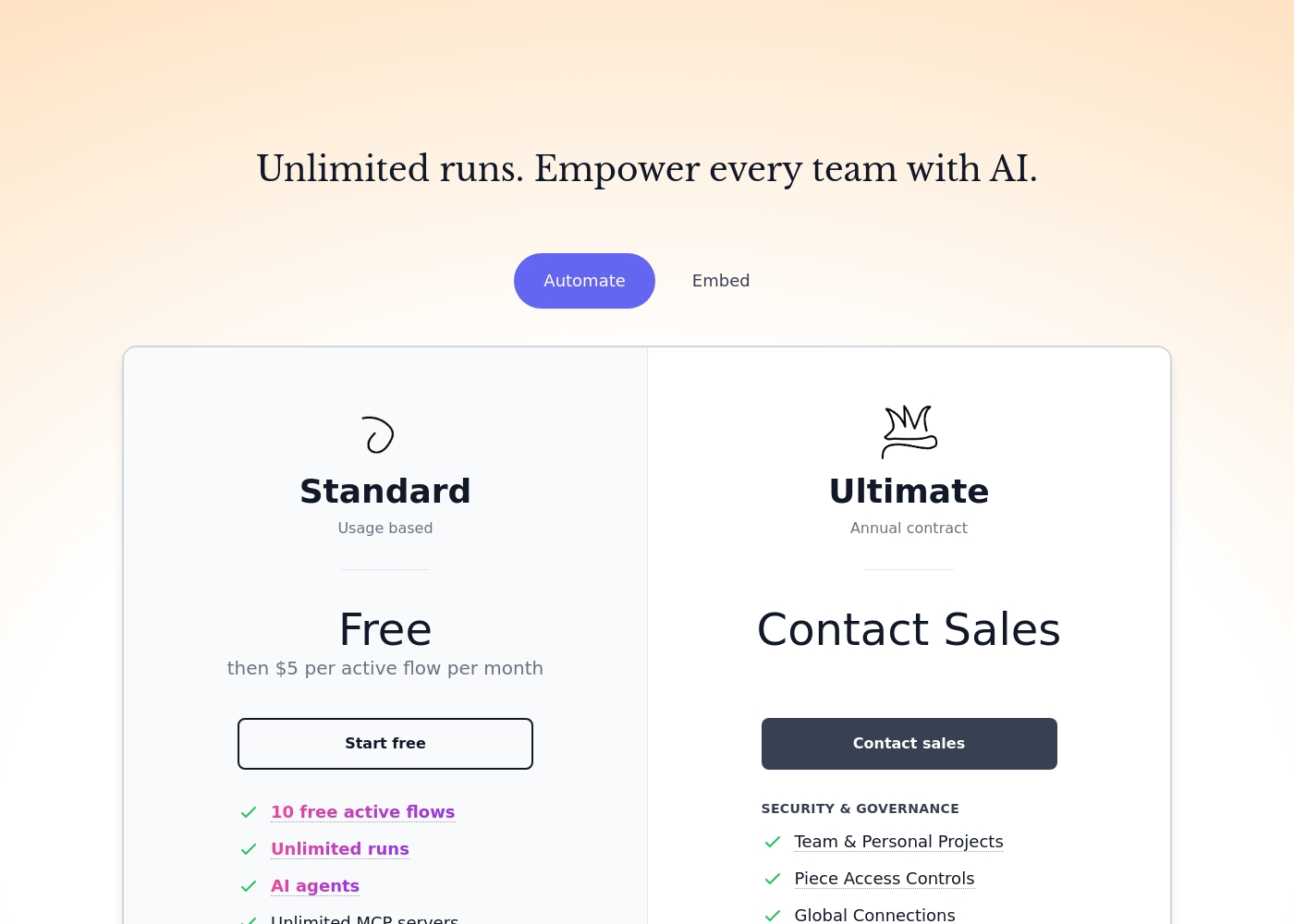
ActivePieces cloud plans start Free, then cost $5 per active flow per month, with enterprise tier pricing requiring a sales inquiry. Two managed plans are available: Standard (Free then $5 per active flow per month) and Ultimate (Contact Sales, Annual contract).
Here is a look at the specific features included in each plan type.
Standard
Price: Free then $5 per active flow per month Other Features:
- 10 free active flows
- Unlimited runs
- AI agents
- Unlimited MCP servers
- Unlimited tables
- Email support
- 10 free active flows
- Unlimited runs
- AI agents
- Unlimited MCP servers
- Unlimited tables
- Security & Governance
- Team & Personal Projects
- Piece Access Controls
- Global Connections
- Custom RBAC
TaskMagic pricing: TaskMagic offers straightforward monthly subscription plans starting at $29 per month. Both plans include full access to apps and agents with predictable credit systems and no per-task fees or hidden costs. Plans range: 404

Pricing Notes
- TaskMagic offers a significantly lower cost ceiling, with its top plan priced at $49/month.
- ActivePieces' pricing scales based on the number of active flows, while allowing 'unlimited tasks'.
- TaskMagic provides a Free Forever plan with unlimited tasks and steps, offering great beginner value.
- ActivePieces accepts payment for additional AI credits within the paid subscription tiers.
- Neither ActivePieces nor TaskMagic explicitly states a money-back guarantee or refund policy.
Pricing Head-to-Head
User Reviews
We see a nuanced divide in user feedback for ActivePieces on Trustpilot, reflecting both its powerful technical capabilities and its governance challenges. Users consistently praise the platform as a powerful, cost-effective alternative to established competitors like Zapier and Make.
Reviewers note its simple integration process, short learning curve, and ability to handle intricate, heavy-lifting workflows effectively. Many users appreciate the solid community support and quick response when submitting platform bugs via GitHub.
I moved nearly all my Zaps from Zapier with no issues. Their pricing is truly amazing and much cheaper than key competitors. They even allow connecting multiple Gmail accounts to one workflow, which is a limiting factor on n8n.
Our Verdict
This comparison is about choosing simplicity versus advanced capability for your workflows. ActivePieces and TaskMagic offer excellent automation but target vastly different user needs. ActivePieces is the robust powerhouse built for serious scale and enterprise-level complexity. TaskMagic is the incredibly easy assistant, perfect for immediate, simple web tasks. ActivePieces’ superpower is undeniable AI agent orchestration and developer flexibility. Only ActivePieces gives you 434 native API integrations, custom code steps, and native data storage (Tables). ActivePieces also delivers enterprise requirements like SOC 2 compliance and rock-solid reliability features. TaskMagic’s core strength is making browser automation accessible and fast via record-and-replay. TaskMagic completely bypasses the need for APIs, tackling manual web input that ActivePieces cannot easily handle. TaskMagic also provides exceptional monetary value, with its top plan capping at just $49 per month. Your essential deciding factor is the environment of your tasks. Pick ActivePieces if you require complex logic, human-in-the-loop approvals, and structured data handling. Choose TaskMagic if most of your pain points involve recording repetitive clicks and typing on websites without APIs. If you are building the next generation of robust, scalable business processes, ActivePieces is the clear technical winner. For accessible, budget-efficient automation tailored to everyday browser tasks, TaskMagic provides the fastest solution.
Frequently Asked Questions
Which is better for complex AI assistant work: ActivePieces or TaskMagic?
ActivePieces is explicitly built for AI agent orchestration and advanced intelligent flows. It includes dedicated AI steps and credits for complex tasks. TaskMagic focuses on the mechanical automation of web actions, not advanced AI logic.
Does TaskMagic require an API to automate tasks?
No, TaskMagic is designed specifically to automate tasks that lack public APIs. It works by recording your mouse clicks and keystrokes on the website. ActivePieces uses structured API connectors for its 434 'Pieces'.
Is ActivePieces suitable for large teams and enterprise use?
Yes, ActivePieces is SOC 2 Type II compliant and offers Enterprise plans with SSO and Audit logs. The Business plan supports 5 users and 50 active flows. TaskMagic is better suited for smaller teams needing browser utility.
Which tool is cheaper: ActivePieces or TaskMagic?
TaskMagic is significantly cheaper, pausing its pricing at $49 per month for the top tier. ActivePieces' top standard plan is $150 per month. TaskMagic includes unlimited tasks and steps in its free plan.
Can ActivePieces handle browser automation like TaskMagic?
TaskMagic handles browser automation easily using its native record-and-replay function. ActivePieces is primarily an API/backend orchestrator. If you need dedicated click-and-type automation, TaskMagic is the superior tool.
Does ActivePieces offer better developer features than TaskMagic?
Yes, ActivePieces provides maximum flexibility via custom code steps in multiple languages and API access. It also offers a Community Edition for self-hosting. TaskMagic focuses entirely on no-code recording simplicity.
Ready to Choose?
Both tools have their strengths. Choose based on your specific needs.