ActivePieces vs Albato
ActivePieces and Albato both offer robust automation, yet they serve very different users. ActivePieces is built for complex AI agent orchestration and deep technical control. Albato excels by providing accessible no-code automation and world-class human customer support. The choice rests on whether you prioritize technical depth or user comfort and breadth of integrations.
Best for: Technical teams needing ultimate flexibility and custom code integration, Developers utilizing custom code and APIs for maximum control
Best for: Small to mid-sized businesses focused purely on speed and uptime, SaaS companies needing embedded white-label integrations
Powerful Automation, Complex Pricing
We find ActivePieces to be a technologically superior tool that rivals Zapier and Make, excelling in handling complex, AI-first workflows and offering excellent cost efficiency. Overall, while the core automation engine and feature set are industry-leading and SOC 2 Type II compliant, the platform's relationship with its community has been significantly strained by retroactive policy and pricing changes.
Pros
- AI-first automation featuring agents and 470 connectors.
- High flexibility with no-code canvas and powerful Code module for custom JS libraries.
- Considered cost-effective and cheaper than competitors like Zapier and n8n.
- Includes enterprise-ready features like flow versioning and auto retry for failures.
Cons
- Lack of transparency regarding sudden, substantial pricing structure changes.
- Early supporters felt betrayed by perceived changes to lifetime deals.
- Users were automatically downgraded from paid plans to trial plans without notification.
- Inconsistent customer support response for issues not reported on GitHub.
Reliable No-Code Automation with Exceptional Support.
We find Albato to be a highly effective no-code iPaaS solution, notably excelling in customer support and ease of use compared to key competitors. Overall, this platform provides reliable, flexible synchronization and workflow automation at a competitive price point for businesses of all sizes.
Pros
- Exceptional, highly responsive, and human customer support (a major strength).
- Significantly improved cost-effectiveness compared to market alternatives.
- Intuitive, clean, and easy-to-use interface and drag-and-drop builder.
- Handles complex webhooks and multi-step automations effortlessly.
Cons
- The Free plan severely limits automations to just two steps.
- Some niche or specific tools may occasionally be missing initially.
- No explicit money-back guarantee is advertised.
AboutActivePieces
ActivePieces delivers the full ecosystem for AI automation and agents. It focuses on connecting smart agents, no-code flows, and a central data store called Tables. This impressive platform is trusted by companies ranging from startups all the way to Fortune 50 organizations. You can easily start using ActivePieces on the cloud, or choose to self-host with Docker for ultimate control. Whether you are building complex AI agents or setting up simple automations, the system makes it smart and easy. 💡
AboutAlbato
Albato is an AI-driven Integration Platform as a Service (iPaaS). This platform is designed to make your existing tools work together faster, easier, and smarter. It focuses entirely on no-code automation, which means technical skills are not necessary to build complex setups. Albato already connects to over 1,000 popular apps, making it a robust solution for businesses of any size. It is currently trusted by more than 200,000 users looking for powerful integration capabilities. 💡
Highlights
Feature Comparison
Features Overview
We highlight the main differences and pick a winner for each feature.
AI & Agent Features
ActivePieces focuses on true AI agent orchestration; Albato uses AI for quick data handling.
ActivePieces is uniquely designed for building true AI Agents that think and act independently. These agents access over 434 tools to perform complex tasks. Albato integrates 'Albato AI' for in-workflow tasks like summarizing text or refining product descriptions. ActivePieces is building an agent workforce; Albato is using smarter steps. The core difference is execution: ActivePieces agents operate autonomously, managing state and context. Albato AI handles specific data transformations within an existing flow. If you require intelligent, complex decision-making, ActivePieces provides the underlying architecture you need.
Integration Library Size
Albato offers 1,000+ app connectors, nearly triple what ActivePieces currently offers.
Albato connects to over 1,000 popular applications with one-click, ready-to-use integrations. This extensive library minimizes the chance of needing custom work. ActivePieces offers a robust library of 434 'Pieces' covering essential business applications. Development is rapid, but the overall number is currently lower. Albato clearly wins on sheer quantity and breadth of supported external SaaS tools instantly. Both handle custom API needs well. If your workflow relies on several niche applications, Albato is more likely to have a pre-built connector available.
Customer Support
Albato's customer support is widely praised as exceptional; ActivePieces relies heavily on community help.
Albato users consistently praise the platform's outstanding human support, often citing prompt and technical assistance. Reviewers frequently call out specific agents for going above and beyond. ActivePieces offers community support on the Free tier and email support for Plus users, which can be less responsive. The technical community is strong, but dedicated support isn't Albato's level. This is a major differentiator: Albato offers deep peace of mind through reliable, helpful human interaction. ActivePieces requires more self-service. For non-developers who get stuck on complex logic, Albato's expert help is a significant advantage that saves time and frustration.
Deployment Flexibility
ActivePieces offers cloud or self-hosting via Docker; Albato is strictly a cloud-based iPaaS.
ActivePieces is built on an open-source architecture, allowing users to self-host using Docker for maximum control. You can choose to run it entirely on your own infrastructure. Albato functions purely as an Integration Platform as a Service (iPaaS), meaning it is accessible only via their managed cloud solution. This simplifies maintenance. Self-hosting with ActivePieces is critical for organizations needing data residency or specific security requirements. Albato locks you into their ecosystem. ActivePieces offers the ultimate choice for technical teams concerned with vendor lock-in or proprietary data control.
Data Storage/State
ActivePieces includes native Tables for stateful data; Albato requires external databases.
ActivePieces includes a native component called 'Tables,' acting as a central datastore for agents and flows. This makes complex state management easier. Albato does not offer a native internal data store; data must typically be routed to external tools like Google Sheets or a database. Having integrated Tables in ActivePieces vastly simplifies building complex, stateful workflows that require consistent memory. This is a powerful advantage. If you are automating processes that need to remember and update data quickly within the workflow, ActivePieces simplifies the architecture.
SaaS Embedding Needs
Albato offers a specific white-label solution for SaaS companies; ActivePieces does not.
Albato provides a dedicated white-label solution, allowing SaaS companies to embed 1,000+ native integrations into their product. This is claimed to save 90% of development time. ActivePieces does not offer a public, packaged solution for embedding its engine into third-party software products seamlessly. Its enterprise features are tailored for internal use. Albato's offering increases user retention and revenue for SaaS companies by making integration part of their native UX. If your business is building a platform and needs a quick, powerful integration marketplace, Albato is the clear choice.
Pricing Transparency
Albato offers clear, usage-based transaction tiers; ActivePieces faces complaints about uncommunicated changes.
Albato pricing focuses strictly on transaction volume across clear tiers, offering predictable, scalable costs. You know exactly what you pay per 1,000 tasks. ActivePieces advertises 'unlimited tasks' but imposes soft limits via 'fair usage' and strict limits on the number of active flows allowed. Review sentiment shows a strong negative focus on ActivePieces' abrupt, uncommunicated plan changes and flow limits imposed on earlier customers. Albato simply offers a more transparent and user-friendly pricing structure that has earned high marks from its user base.
Free Plan Offering
ActivePieces offers 10x the free tasks compared to Albato's free plan.
The ActivePieces Free plan is generous, offering 1,000 tasks per month, 2 active flows, and 200 AI credits. This allows extensive testing. Albato's Free plan limits users to only 100 transactions and a maximum of 2 steps per automation. This severely restricts its utility for anything beyond basic tests. If you are a hobbyist or solo user starting out, ActivePieces provides significantly more testing and real-world usage bandwidth. The ActivePieces free plan is functionally richer. Albato's free plan is designed mainly for initial contact and basic testing, while ActivePieces offers a more sustainable free tier.
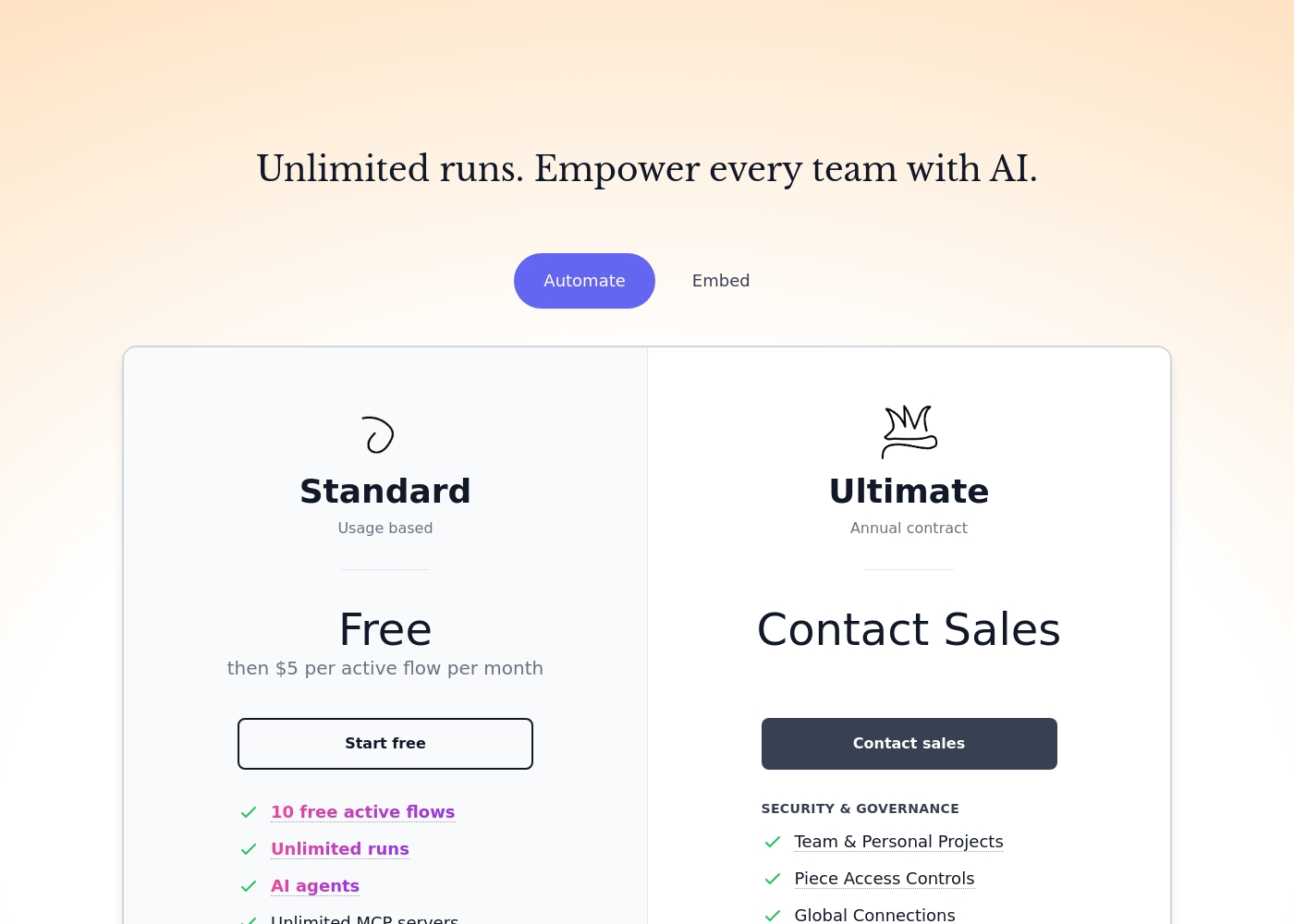
ActivePieces cloud plans start Free, then cost $5 per active flow per month, with enterprise tier pricing requiring a sales inquiry. Two managed plans are available: Standard (Free then $5 per active flow per month) and Ultimate (Contact Sales, Annual contract).
Here is a look at the specific features included in each plan type.
Standard
Price: Free then $5 per active flow per month Other Features:
- 10 free active flows
- Unlimited runs
- AI agents
- Unlimited MCP servers
- Unlimited tables
- Email support
- 10 free active flows
- Unlimited runs
- AI agents
- Unlimited MCP servers
- Unlimited tables
- Security & Governance
- Team & Personal Projects
- Piece Access Controls
- Global Connections
- Custom RBAC
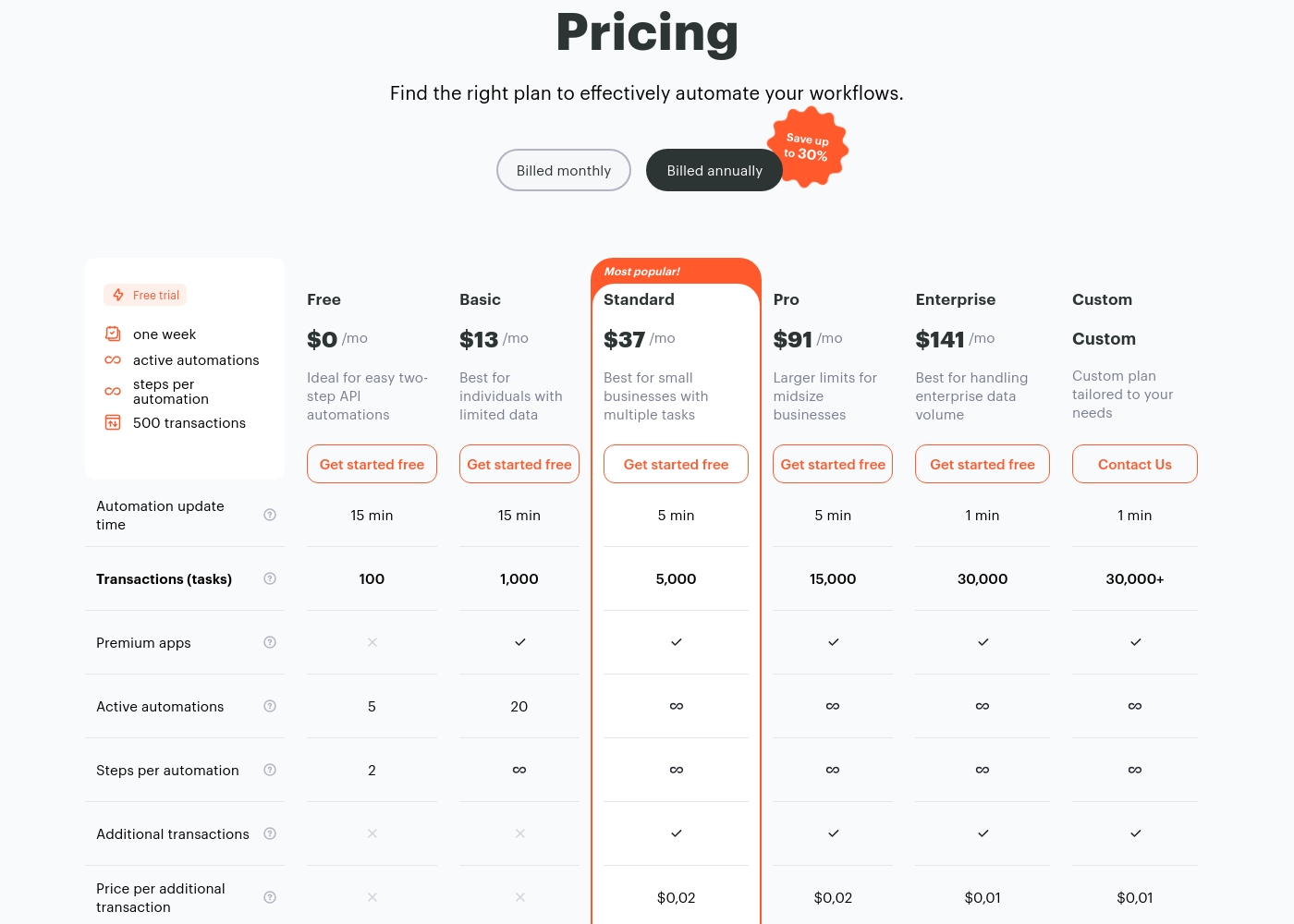
Albato costs between $0 and $141 per month with six available planning options: Free at $0, Basic at $13, Standard at $37, Pro at $91, and Enterprise at $141.
Let’s explore the details of each tier to help you find the perfect fit for your integration needs.
Free
Price: $0 /mo Best For: Ideal for easy two-step API automations Other Features:
- 100 transactions
- 5 active automations
- 2 steps per automation
- 100 transactions
- 5 active automations
- 2 steps per automation
- 15 min automation update time
- 1,000 transactions
- 20 active automations
- Unlimited steps per automation
- Access to premium apps
- 5,000 transactions
- Unlimited steps per automation
- 5 min automation update time
- Can purchase additional transactions ($0.02/task)
- 15,000 transactions
- Unlimited steps per automation
- 5 min automation update time
- Can purchase additional transactions ($0.02/task)
Pricing Notes
- ActivePieces' actual cost complexity stems from strict limits on active flows, not just its advertised 'unlimited tasks' model.
- Albato offers significant volume scaling; additional transactions drop from $0.02 to $0.01 on Enterprise tiers.
- The ActivePieces Free plan is 10 times more generous (1,000 tasks) than the Albato free plan (100 transactions).
- Albato offers potential savings of up to 30% for opting into annual contracts across its paid plans.
Pricing Head-to-Head
User Reviews
We see a nuanced divide in user feedback for ActivePieces on Trustpilot, reflecting both its powerful technical capabilities and its governance challenges. Users consistently praise the platform as a powerful, cost-effective alternative to established competitors like Zapier and Make.
Reviewers note its simple integration process, short learning curve, and ability to handle intricate, heavy-lifting workflows effectively. Many users appreciate the solid community support and quick response when submitting platform bugs via GitHub.
I moved nearly all my Zaps from Zapier with no issues. Their pricing is truly amazing and much cheaper than key competitors. They even allow connecting multiple Gmail accounts to one workflow, which is a limiting factor on n8n.
Users consistently praise Albato as an excellent, cost-effective alternative to platforms like Zapier and Make, noting that its transparent pricing offers far better value. The platform excels in user experience, featuring an intuitive interface with a clean drag-and-drop builder that makes complex, multi-step automations accessible, even for non-technical users.
The most frequently celebrated aspect, however, is Albato’s truly outstanding customer support. Numerous reviewers call out specific agents like Pedro and Alex for being patient, technical, prompt, and going 'above and beyond' to solve complex workflows; this high support level often cements the decision to subscribe.
I find Albato to be the best in class for automation. The UX design for implementing webhooks and mapping data makes the process simple and intuitive. This ensures analyzing potential bugs is a breeze, operating reliably every time.
Our Verdict
Choosing between ActivePieces and Albato is a classic battle of technical supremacy versus user comfort. If you need powerful control and complexity above all else, ActivePieces is your winner. If you need 1,000+ simple connections and hold customer support sacred, choose Albato. ActivePieces’ superpower is handling complex, stateful workflows centered around AI Agents. It provides powerful features like native Tables for centralized data and full versioning management. Plus, ActivePieces' open-source flexibility lets you self-host via Docker, which Albato simply cannot offer. Albato’s superpower is making automation effortless and support painless. Users rave about the clean, intuitive UI/UX, which means non-developers can build powerful processes quickly. Albato also has an integration library nearly three times the size of ActivePieces, ensuring vast connectivity. The deciding factor is your tolerance for building versus buying support. ActivePieces requires you to be self-sufficient but gives you the keys to the entire engine. Albato guarantees a fantastic user experience with expert support ready to solve your integration problems quickly. Pick ActivePieces if your goals involve complex AI orchestration or mandatory self-hosting. Go with Albato if you are a small business looking for world-class human support and rapid, reliable automation across 1,000+ apps.
Frequently Asked Questions
Which platform offers better customer support: ActivePieces or Albato?
Albato is the clear choice for customer support. Users frequently highlight Albato’s exceptional, human, and responsive technical help. ActivePieces customer support generally relies more on its active community and email support services.
Can I self-host my automation solution using ActivePieces or Albato?
Yes, ActivePieces offers deployment flexibility; you can choose the cloud service or self-host the open-source version using Docker. Albato is strictly a proprietary cloud-based Integration Platform as a Service (iPaaS) solution.
How many external applications can I connect with ActivePieces vs Albato?
Albato wins on quantity, connecting to over 1,000 popular applications with one-click integrations. ActivePieces currently offers 434 'Pieces' for building your workflows.
Does ActivePieces or Albato offer a more generous free plan?
ActivePieces provides a significantly more generous free plan, including 1,000 tasks per month and two active flows. Albato’s free plan is very limited, offering only 100 transactions per month.
Which tool is better for integrating AI into workflows?
ActivePieces is built primarily to orchestrate true, autonomous AI Agents that can manage state and context. Albato integrates sophisticated AI 'steps' (Albato AI) for tasks like data analysis and summarization within a standard flow.
Does Albato offer migration help from other platforms like ActivePieces?
Yes, Albato specifically provides free expert migration assistance. You can contact their team to help smoothly transition your existing automations from platforms like Zapier or Make to Albato.
Ready to Choose?
Both tools have their strengths. Choose based on your specific needs.