Paylocity

Paylocity review

Unified HR, payroll, and finance software for growing US workforces

By Ciroapp Editorial Team · Updated Sep 16, 2026

Commission may apply at no extra cost

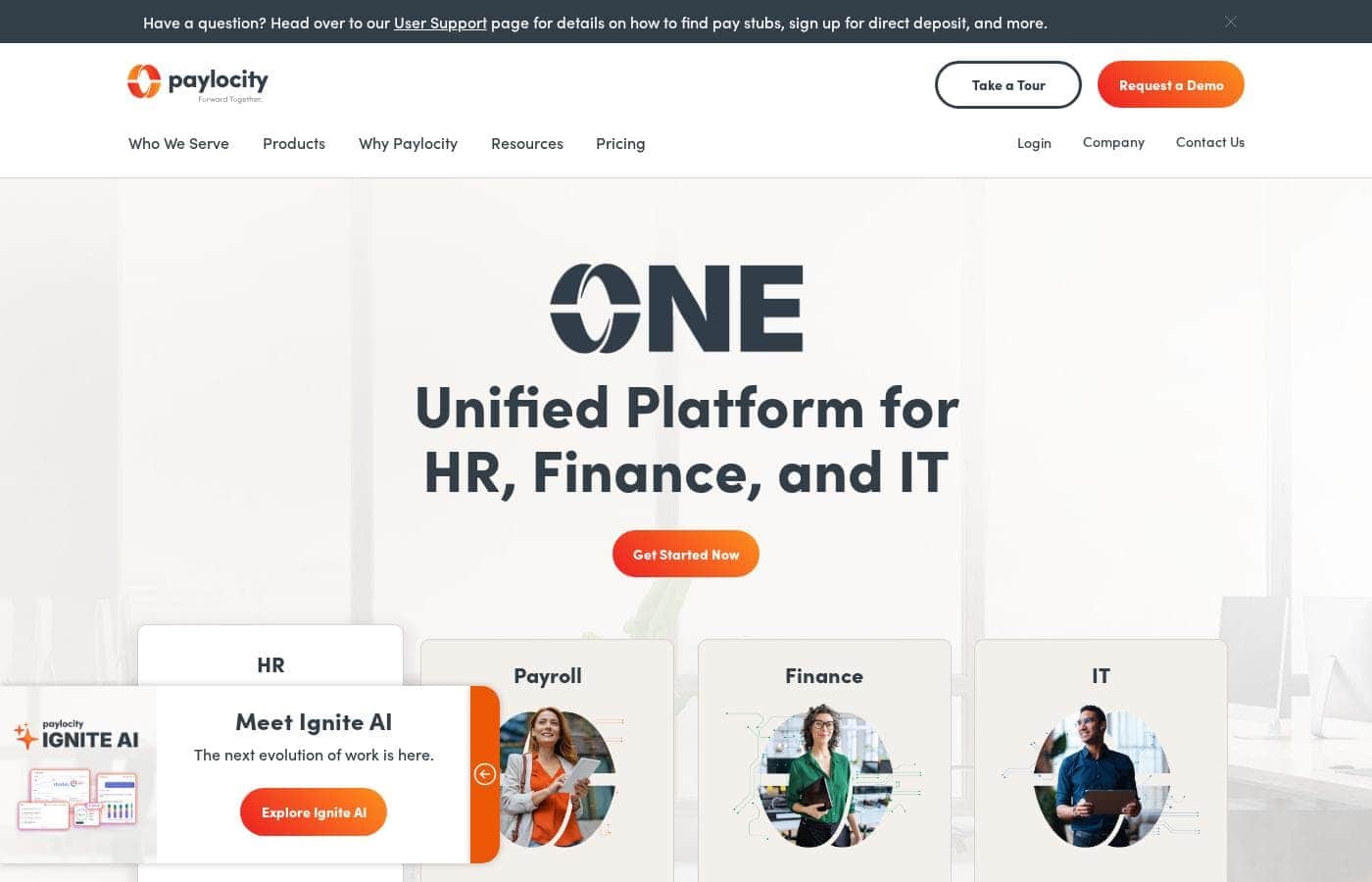
Paylocity homepage screenshot

At a glance

Quick overview for Paylocity: rating, pricing summary, key features, and highlights.

Ciroapp score

3.7/ 5

Paylocity pulls payroll, HR, benefits, and spend management onto one shared database, which cuts re-keying and keeps reporting consistent as US teams grow past 100 employees. Quote-only pricing, a weeks-long implementation, and US-centric payroll depth are the trade-offs. Overall, it's a strong pick for mid-market US companies consolidating tools, less so for tiny teams or global workforces.

Pros

  • Pros:Payroll, HR, and finance share a single database, so raises, terminations, and organizational changes flow through every module without re-keying data.
  • Pros:Payroll automation, including tax filings and direct deposit, comes from Paylocity's original core competency, making it a dependable foundation for US payrolls.
  • Pros:Scales from companies with fewer than 100 employees to enterprises with 500+ staff, reducing the need to migrate platforms during growth.

Cons

  • Cons:Pricing is quote-based and not published openly, so budgeting and vendor comparison require talking to sales.
  • Cons:The breadth of the suite can exceed what very small teams need, and unused modules add cost and complexity.
  • Cons:Implementing a full unified platform involves data migration and onboarding that typically takes weeks rather than days.
Best for
  • US-based companies with roughly 50 to 500+ employees that want payroll, HR, and benefits consolidated on one platform
  • Mid-market organizations replacing a patchwork of separate payroll, HRIS, and expense tools with a single vendor
  • Finance leaders who want labor costs and employee spending connected to the same system as payroll
This section is a summary. Detailed sections about features, use cases, pricing, and reviews follow below.

What is Paylocity?

Paylocity positions itself as a single platform for the systems most companies run separately: HR, payroll, finance, and IT administration. Originally built as a payroll provider, it has expanded into a broader human capital management suite that serves organizations from under 100 employees to enterprises with 500 or more staff. This review covers what the platform actually does, which buyers it fits, and the trade-offs worth weighing before committing.

Paylocity is a cloud-based platform that unifies core HR, payroll, benefits, and finance functions on one shared database. Instead of stitching together a payroll vendor, a separate HRIS, and standalone reporting tools, companies manage employee, pay, and spend data in a single system. It also extends into IT management, which is unusual for an HCM suite, and emphasizes analytics that turn workforce data into business decisions.
Should you choose Paylocity?

Quick buyer guidance before you compare plans or click through.

Choose it if

  • US-based companies with roughly 50 to 500+ employees that want payroll, HR, and benefits consolidated on one platform
  • Mid-market organizations replacing a patchwork of separate payroll, HRIS, and expense tools with a single vendor
  • Finance leaders who want labor costs and employee spending connected to the same system as payroll
  • Growing businesses that want a platform able to scale from under 100 employees to enterprise size without re-implementation

Skip it if

  • Buyers who need published, per-employee pricing to compare vendors quickly without contacting sales
  • Very small teams with basic payroll needs that would find a full HCM suite excessive and costly
  • Organizations with primarily international payrolls that need deep multi-country tax and compliance support
  • Teams without the time or staff to manage implementation, data migration, and admin training for a broad platform

Next steps before buying

  1. 1Inventory the modules you need, such as payroll, HR, benefits, spend management, and reporting, and confirm your employee count and entity structure before contacting sales.
  2. 2Request a quote and demo through paylocity.com, asking for pricing broken out by module, per-employee fees, and any implementation charges.
  3. 3Ask for a written implementation timeline covering data migration, parallel payroll runs, and go-live support.
  4. 4Designate an internal system administrator and complete the vendor-provided training before configuration begins.
  5. 5Run at least one parallel payroll cycle to verify tax setup and deductions before cutting over fully.

Paylocity Key Features

✨ Payroll processing

Payroll is Paylocity's foundation. The platform automates pay runs, tax filings, and direct deposits, while employees access pay stubs and tax documents through self-service instead of asking HR. Because payroll shares a database with the rest of the suite, raises, bonuses, and off-cycle runs stay consistent with HR records.

✨ Core HR and benefits administration

The HR module acts as the system of record for employee data, covering onboarding workflows, document storage, and compliance tracking. Benefits administration handles open enrollment and carrier management, with employees making their own elections through the web or mobile app.

✨ Finance and spend management

Paylocity extends beyond HR into finance with spend management capabilities covering expenses and payables, designed to connect company spending with payroll and accounting. The goal is fewer hand-offs between HR and finance when reimbursing employees or reconciling labor costs.

✨ Analytics and reporting

Dashboards and configurable reports surface headcount trends, labor costs, turnover, and compensation data drawn from the unified database. Standard reports cover common compliance needs, while ad-hoc reporting lets HR and finance leaders build custom views without exporting to spreadsheets.

✨ Employee experience tools

Employees get self-service through web and mobile for updating personal information, requesting time off, viewing pay history, and enrolling in benefits. Paylocity also includes communication features such as company feeds and surveys aimed at keeping distributed workforces engaged.

✨ Integrations and extensibility

An open API and prebuilt connectors let Paylocity exchange data with accounting systems, ERPs, and other third-party tools. This matters for companies keeping some existing systems in place, since employee and payroll data can sync rather than be re-entered.

Use Cases

💡 Small businesses outgrowing basic payroll

Companies under 100 employees that have outgrown a basic payroll provider, or a mix of spreadsheets and outsourced payroll, can move HR records, benefits, and pay onto one platform without needing a large internal HR department.

💡 Mid-market companies consolidating point solutions

Organizations in the 100-500 employee range often accumulate separate tools for payroll, HRIS, time tracking, and expenses. Paylocity's pitch to this segment is replacing those subscriptions with one vendor and one data source.

💡 Enterprises standardizing on unified HCM

For companies with 500 or more employees, the platform supports larger organizational structures and provides the reporting depth HR and finance teams need to manage headcount and labor costs across the business.

💡 Finance teams tying labor spend to accounting

Because payroll and spend data share a system with finance functions, controllers and CFOs can track labor costs and reimbursements with less manual reconciliation between HR and accounting tools.

💡 HR teams reducing routine administrative work

Teams buried in pay-stub requests, address changes, and time-off paperwork can push those tasks to employee self-service, freeing HR staff to focus on higher-value work like recruiting and retention.

Paylocity pricing

Prices not verified yet — see the vendor page.

Paylocity's pricing page

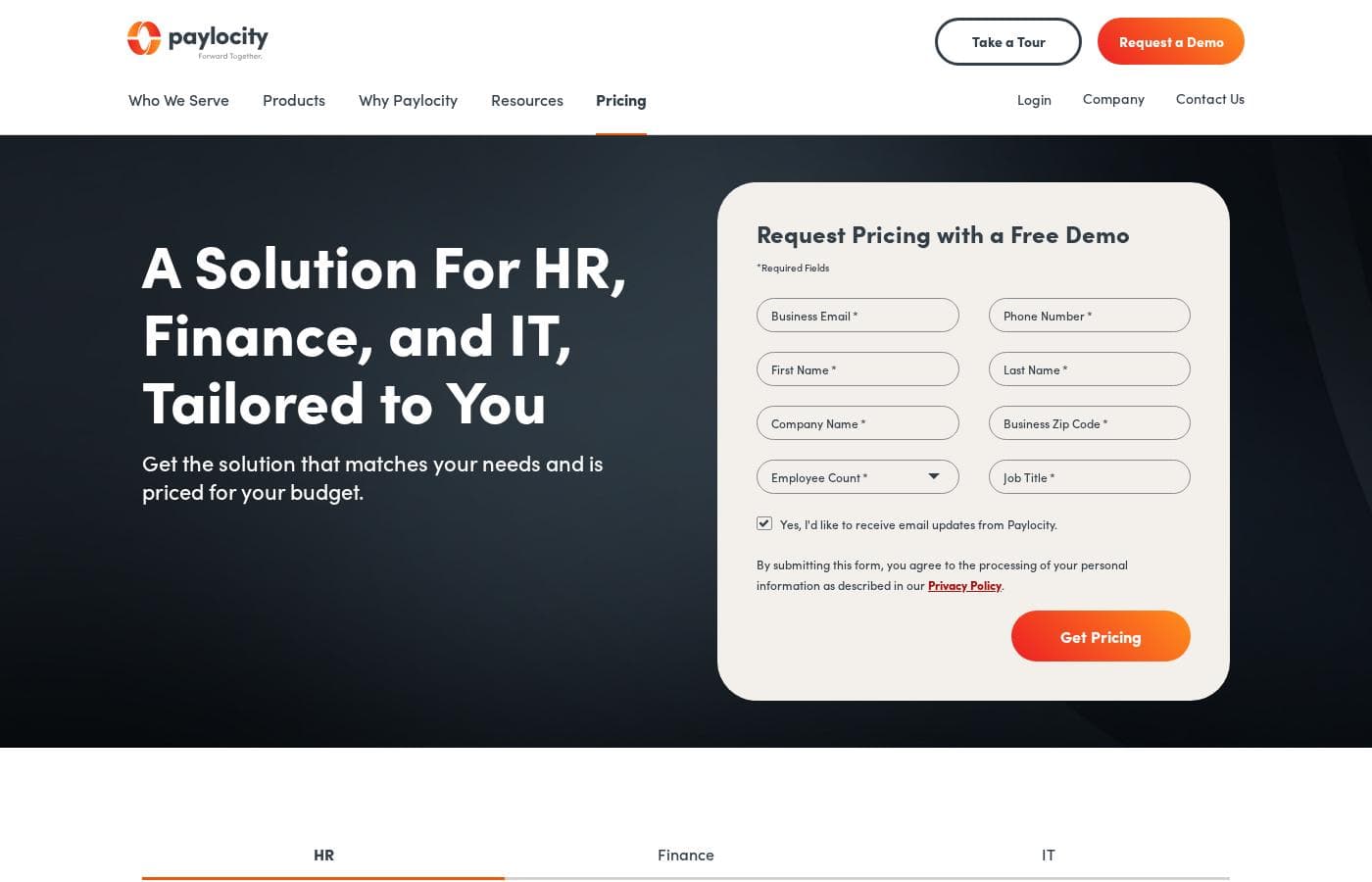
Paylocity pricing page screenshotView pricing page screenshot

Pricing types: Monthly subscription, Yearly subscription

Pricing notes

Paylocity pricing: Billing options: Monthly subscription, Yearly subscription

Email me when Paylocity changes price

One email when we detect a price change on the vendor's pricing page. No newsletter, no deals. Unsubscribe in one click.

User Reviews

No reviews yet.

Write a Review

Write a Review for Paylocity
0/100 characters
0/2000 characters

Why use Paylocity?

The core argument for Paylocity is consolidation: one employee database means payroll runs without re-keying data, reports pull from a single source, and changes like raises or terminations flow through every module at once. For growing companies, this reduces the manual reconciliation work that multiplies with each added point tool.

Employee self-service on web and mobile also shifts routine tasks like pay-stub requests and time-off approvals away from HR staff.

Paylocity alternatives

Other tools in the Human Resources Management System category

View all Human Resources Management System tools
Rippling

Rippling

Human Resources Management System4.3/5

Trusted by more than 30,000 businesses, Rippling is the only platform that brings HR, IT, and Finance together - payroll, benefits, devices, expenses, compliance, and more, all in one place. Refer a client and earn $600 for a qualified demo, $1,000 when they sign.

BambooHR

BambooHR

Human Resources Management System4.2/5

BambooHR is a complete, all-in-one HR software platform designed to simplify complex people management. It brings all your employee, payroll, time, and benefits information together in one secure location. This system is built for easy navigation, making it ideal for both novices and seasoned HR experts. Whether you are a small team or serve a global workforce across 150 countries, BambooHR gives you the tools you need to streamline operations and be compliant. 💡 It allows even a single-person HR department to perform strategic work efficiently.

Breezy HR

Breezy HR

Human Resources Management System4.1/5

Breezy HR is a hiring platform and applicant tracking system used by teams of all sizes to streamline recruiting—from attracting candidates to hiring. It helps you build a simple, beautiful careers site, reach more applicants, and move people toward offers. It also offers a mobile app and integrations to fit your workflow.

Connecteam

Connecteam

Human Resources Management System4.1/5

Connecteam is an all-in-one app designed for deskless teams. It brings scheduling, time tracking, digital forms, checklists, messaging, learning, and HR processes into one place, so teams in construction, cleaning, security, and more can stay connected and productive.

VIVA HR

VIVA HR

Human Resources Management System4/5

AvaHR is a trusted HR platform used by 5,000+ customers, with a 92% satisfaction rate and 4.9/5.0 ratings. It's designed for HR teams seeking to streamline hiring, collaboration, and communication in one place.

Recruitee

Recruitee

Human Resources Management System4/5

Recruitee is an ATS and collaborative recruitment platform designed for hiring teams. It brings sourcing, automation, and candidate evaluation into one shared space so teams move faster and stay aligned. Join 181,000+ users and manage 20M+ applicants across 90+ countries with 120+ integrations.

Cheapest Human Resources Management System software for 1 to 25 users

Paylocity FAQ

What is Paylocity?

Paylocity is a cloud-based platform that unifies HR, payroll, finance, and IT management in one system. It serves organizations of every size, from small businesses with fewer than 100 employees to enterprises with 500 or more staff, and focuses on simplifying payroll while giving leaders data for smarter workforce decisions.

How much does Paylocity cost?

Paylocity does not publish open pricing; costs come through a custom quote that depends on the modules you select and your employee count. Subscription plans can be billed monthly or yearly, and the most reliable way to get exact figures is to request a quote through the Paylocity pricing page.

Is Paylocity only for large companies?

No. Paylocity markets solutions for organizations of every size, including small businesses under 100 employees as well as enterprises with 500+ staff. Smaller teams can scope the modules they adopt to what they actually need rather than taking the full suite.

Does Paylocity include employee self-service?

Yes. Employees can use web and mobile access to view pay stubs and pay history, update personal information, request time off, and manage benefit elections, which reduces the volume of routine requests landing on HR teams.

What makes Paylocity different from a standalone payroll tool?

Standalone payroll products handle pay runs and taxes in isolation, while Paylocity shares that payroll data with HR, benefits, finance, and reporting modules on one database. Changes like raises or terminations update everywhere at once, and reports pull from a single source of truth.

Ready to try Paylocity? Check out the official site or pricing.

Are you Paylocity? Claim this listing · Get the badge