Adobe Commerce

Adobe Commerce

Adobe Commerce: Composable, cloud-native ecommerce for global, multi-brand B2C and B2B.

software.categoryRank
1 min read · Updated 2/24/2026
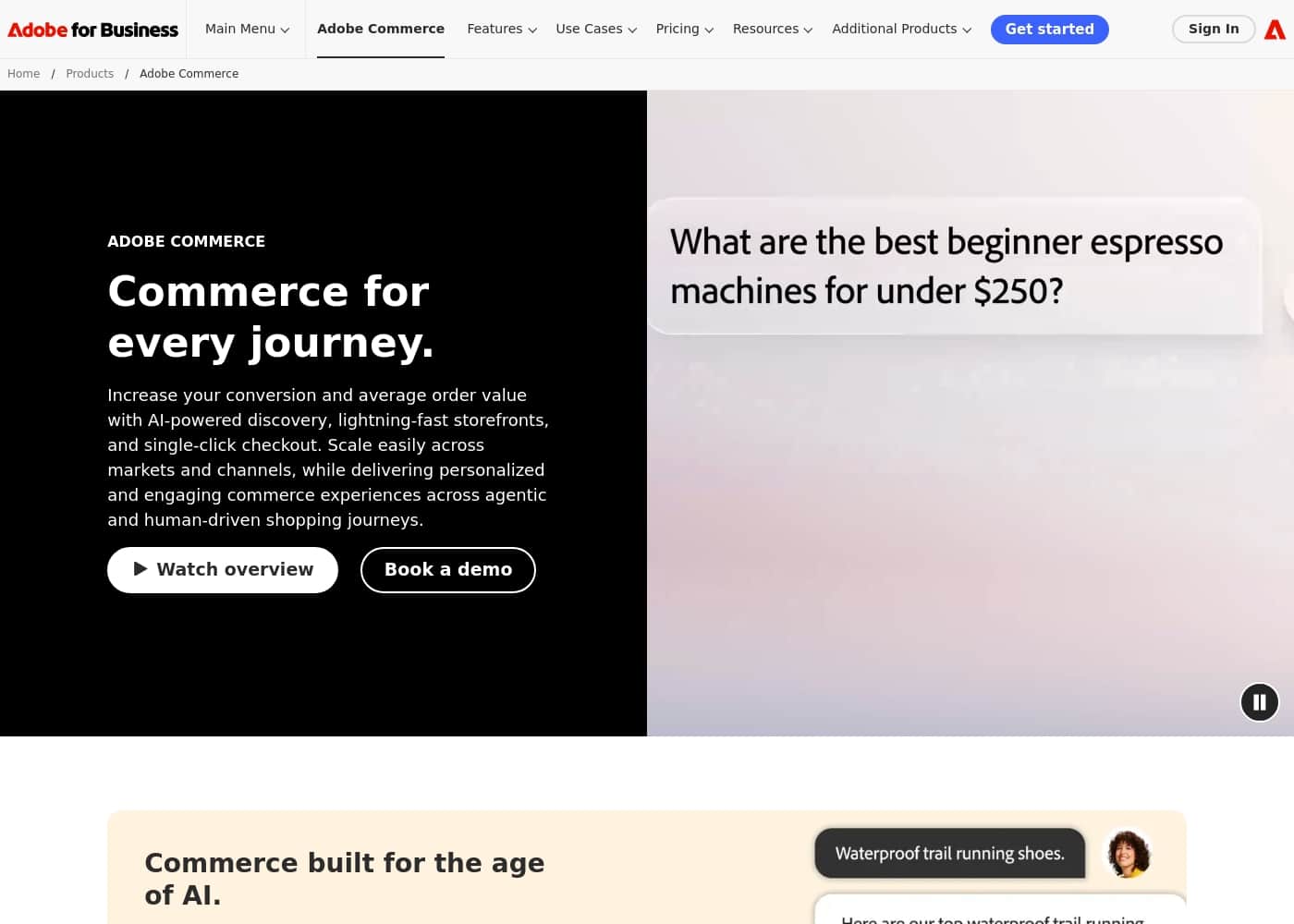
Adobe Commerce homepage screenshot

At a glance

Quick overview for Adobe Commerce: rating, pricing summary, key features, and highlights.
Range: Not explicitly statedMonthly subscription, Usage-based pricing
This section is a summary. Detailed sections about features, use cases, pricing, and reviews follow below.
Disclosure: This page may contain affiliate links for Adobe Commerce. If you click these links and make a purchase, Ciroapp may earn a commission at no additional cost to you.

Adobe Commerce review, pricing, features, pros & cons

Building fast, personalized storefronts for many brands and markets is hard. Brands juggle multiple sites, languages, and catalogs, which slows growth. Adobe Commerce is a composable, cloud-native platform that enables global, multi-brand B2C and B2B experiences, real-time personalization, and scalable performance ✨.

It helps boost traffic, conversions, and GMV.

What is Adobe Commerce?

Adobe Commerce is a composable ecommerce platform that lets brands quickly create global, multi-brand storefronts for B2C and B2B from one cloud-native system. It's built for businesses seeking high-performance storefronts, AI-powered personalization, and scalable operations 💡.

Adobe Commerce Key Features

🚀 Lightning-fast storefronts and performance

Launch fast with a prebuilt storefront that includes product listings, product detail pages, cart, and checkout. Adobe Commerce is a cloud-native, composable platform that supports global, multi-brand B2C and B2B storefronts.

The storefront is optimized for speed and reliability, helping you achieve top Google Lighthouse scores. Marketers can use a visual storefront editor and native A/B testing tools to optimize content.

Developers benefit from a low-code environment, accelerators for common use cases, and a centralized console to manage APIs, events, and apps. The platform delivers fast responses globally through edge computing, and APIs are designed to scale with your growth.

✨ Real-time personalization and AI-powered experiences

Real-time personalization helps tailor every shopper interaction and boost conversions. Adobe Commerce uses AI to deliver fast, relevant search results and product recommendations based on on-site behavior and product popularity.

There are 13 types of AI-powered product recommendations that draw on customer history, frequently paired items, visual similarities, and trending products. Personalization data can flow to Adobe Real-Time CDP and Journey Optimizer to power sophisticated audiences and personalized experiences.

✨ Simplified development and composable architecture

An API-first, composable platform lets you innovate quickly and extend with apps and services without disruptive upgrades.

Launch quickly using a comprehensive suite of precomposed services that can be set up in minutes and managed from a centralized, self-service console. Build differentiated experiences with extensive APIs, hundreds of application events, and a library of apps. You can extend Adobe Commerce with apps and services that install, scale, and update without impacting the rest of your solution.

Developers benefit from a low-code development environment, accelerators for common use cases, and unified consoles, logging, and CLIs. APIs are delivered globally via edge computing for fast responses.

🌐 Limitless growth with scaled operations

Operate on an always-up-to-date, secure, and cloud-native platform designed for enterprise-scale growth.

The distributed architecture and auto-scaling help you handle peak traffic and unlimited orders. The catalog service supports millions of SKUs, thousands of prices per SKU, and rapid price updates across product types.

Expand to new markets, brands, and business models—from B2C to B2B—within a single platform. Prebuilt dashboards and data visualization tools let you identify and act on growth opportunities.

✨ A sales platform for accelerated B2B and multi-brand capabilities

Expand your B2B business with an always-on digital sales portal and tools to boost seller productivity. Online B2B purchasing supports company accounts with multiple buyers, roles, and purchasing permissions.

Personalize buying with customer-specific catalogs, pricing, payment options, and promotions. Quick-ordering options and automated purchase approvals speed transactions, while sellers can negotiate quotes online and guide customers through their orders.

Operate multiple business models from a single platform—including B2B, direct-to-consumer, and B2B2C or B2B2B through channel partners—and offer a B2B self-service portal.

Use Cases

🌍 Global, multi-brand storefronts from a single cloud-native platform

Adobe Commerce lets teams run global, multi-brand storefronts from a single cloud-native system. Brands can launch B2C and B2B experiences across markets and languages with native localization for currencies and tax rules.

Because the design is API-first and composable, teams can add apps and services without disruptive upgrades. The platform supports millions of SKUs, auto-scaling, and secure hosting to keep growth on track.

Real-time personalization and AI-powered recommendations help tailor experiences across sites and regions. Integration starter kits and prebuilt connectors speed back-office work with ERP, CRM, PIM, WMS, and OMS.

🎯 Real-time personalization that boosts conversions

The platform uses AI to surface fast, relevant search results and personalized product recommendations.

Shoppers see tailored offers as they browse categories and product lists. These signals come from customer history, popularity, and trends to guide discovery.

This helps engage shoppers and lift conversions, while tying into Real-Time CDP and Journey Optimizer for audience targeting.

⚡ Peak traffic handling and scalable performance

When sales events spike, Adobe Commerce runs on an auto-scaling, multicloud platform that keeps sites responsive.

Steps to stay fast during peak events:

  1. Enable auto-scaling across the cloud.
  2. Route requests via edge locations for fast responses.
  3. Use the scalable catalog service to keep product data fresh.
  4. Monitor health with 200+ metrics to catch issues early.

💼 B2B self-service portal and streamlined purchasing

A B2B seller can expand online purchasing by offering company accounts, multiple buyers, and purchasing roles.

The platform supports customer-specific catalogs, pricing, and promotions, plus quick-ordering and online quote negotiation. Sellers can guide buyers entirely online with online approvals.

This setup helps teams move from phone calls to online decisions while keeping control over processes.

🔗 Seamless back-office integrations powered by API-first design

Adobe Commerce connects with ERP, CRM, PIM, WMS, and OMS using integration starter kits and prebuilt connectors.

Data synchronization covers orders, inventory, products, and shipping, with templates and best practices to speed setup and reduce risk.

🌐 Global localization and scalable catalog management

The platform provides native localization for languages, currencies, and tax rules, plus in-region hosting to support global growth.

Brands can model catalogs for multiple markets from one instance and manage millions of SKUs with rapid price updates. Prebuilt extensions help you connect local payment and shipping options, making expansion smoother.

Pricing Overview for Adobe Commerce

Pricing range
Not explicitly stated
Pricing types
Monthly subscription, Usage-based pricing

Adobe Commerce offers flexible subscription plans with pricing not explicitly stated in the provided materials; details vary by deployment option (SaaS, PaaS, and Optimizer).

Plans & Pricing

Adobe Commerce as a Cloud Service (SaaS)

MonthlyNot explicitly stated
YearlyNot explicitly stated
  • Multi-tenant cloud service with automatic feature and security updates
  • Core commerce capabilities: orders, inventory, checkout, tax, and shipping management
  • Merchant-defined promotions and coupons
  • Global expansion and catalog management for millions of SKUs
  • AI-powered search, product recommendations, and data-powered personalization

Adobe Commerce on Cloud (PaaS)

MonthlyNot explicitly stated
YearlyNot explicitly stated
  • Single-tenant, dedicated cloud infrastructure
  • Global expansion with localized storefronts managed from a single instance
  • API-first extensibility and integration starter kits
  • High-performance storefront and scalable catalog management
  • PCI Level 1 and SOC 2 compliant security framework

Adobe Commerce Optimizer

MonthlyNot explicitly stated
YearlyNot explicitly stated
  • Storefront, catalog, and merchandising solution
  • Multi-tenant cloud service
  • Can be paired with any ecommerce transaction engine
  • API-first extensibility and integration starter kits
  • Data-driven insights and prebuilt dashboards
  • FIRST LINE (pricing summary): Adobe Commerce costs between Not explicitly stated per Not explicitly stated with Not explicitly stated plans: Adobe Commerce as a Cloud Service (SaaS) at Not explicitly stated, Adobe Commerce on Cloud (PaaS) at Not explicitly stated, Adobe Commerce Optimizer at Not explicitly stated.
  • After that line: Pricing details follow in the sections below.

Adobe Commerce as a Cloud Service (SaaS)

Price: Not explicitly stated Websites Supported: Not explicitly stated Best For: Not explicitly stated Refund Policy: Not explicitly stated Other Features:

  • Multi-tenant cloud service with automatic feature and security updates
  • Core commerce capabilities: orders, inventory, checkout, tax, and shipping management
  • Merchant-defined promotions and coupons
  • Global expansion and catalog management for millions of SKUs
  • AI-powered search, product recommendations, and data-powered personalization

This SaaS option is well-suited for brands seeking a scalable, cloud-native storefront with automatic updates and broad global reach.

Adobe Commerce on Cloud (PaaS)

Price: Not explicitly stated Websites Supported: Not explicitly stated Best For: Not explicitly stated Refund Policy: Not explicitly stated Other Features:

  • Single-tenant, dedicated cloud infrastructure
  • Global expansion with localized storefronts managed from a single instance
  • API-first extensibility and integration starter kits
  • High-performance storefront and scalable catalog capabilities
  • PCI Level 1 and SOC 2 compliant security framework

This PaaS option fits teams needing a dedicated cloud environment with strong localization and secure hosting, while preserving flexibility to integrate with existing systems.

Adobe Commerce Optimizer

Price: Not explicitly stated Websites Supported: Not explicitly stated Best For: Not explicitly stated Refund Policy: Not explicitly stated Other Features:

  • Storefront, catalog, and merchandising solution
  • Multi-tenant cloud service
  • Can be paired with any ecommerce transaction engine
  • API-first extensibility and a broad ecosystem of apps
  • Data-driven insights and prebuilt dashboards for optimization

Optimizer is ideal for teams focusing on storefront and merchandising optimization, with strong integration options and analytics-powered decisions.

Closing: There is no free plan or free trial explicitly stated in the provided materials. If you need flexibility without committing to a specific plan, consider the stated capabilities and deployment model to choose between SaaS, PaaS, and optimization-focused options. If your priority is a hosted, automated updates model, SaaS may suit you best; if you require a dedicated cloud setup with localization at scale, PaaS could be a better fit; for storefront and merchandising optimization, Optimizer offers a focused path.

User Reviews

No reviews yet.

Write a Review

Write a Review for Adobe Commerce
0/100 characters
0/2000 characters

Why use Adobe Commerce?

Here's why teams choose Adobe Commerce: - API-first, composable design lets you innovate quickly and extend with apps and services without disruptive upgrades. - Global multisite architecture supports multiple brands and markets with native localization for languages, currencies, and tax rules.

  • Real-time personalization and AI-powered product recommendations help match customers to products and boost conversions. - Auto-scaling, cloud-native operations handle peak traffic and grow with your catalog, including millions of SKUs.

  • Security and governance meet PCI Level 1, with WAF, CDN, DDoS protections, and HIPAA-ready options for Adobe Commerce on Cloud. - Integration starter kit and prebuilt connectors speed back-office integrations with ERP, CRM, PIM, WMS, and OMS.

Ready to transform your workflow with Adobe Commerce?

Frequently Asked Questions

What deployment options does Adobe Commerce offer and how do they differ?

Adobe Commerce offers three deployment options: Adobe Commerce as a Cloud Service (SaaS), Adobe Commerce on Cloud (PaaS), and Adobe Commerce Optimizer. SaaS is a multi-tenant cloud with automatic feature and security updates; PaaS uses a single-tenant, dedicated cloud, and Optimizer provides storefront and merchandising you can pair with any engine.

Is pricing disclosed for Adobe Commerce plans?

Not explicitly stated on the official site. Pricing pages show Get pricing and Get customized pricing, but dollar amounts are not published.

Is there a free trial or free plan for Adobe Commerce?

Not explicitly stated on the official site.

Can Adobe Commerce integrate with ERP, CRM, and PIM systems?

Yes. It can connect with ERP, CRM, PIM, WMS, and OMS, and provides an integration starter kit with templates and onboarding scripts; prebuilt connectors are available via Adobe Exchange.

What security and compliance features does Adobe Commerce include?

It is PCI Level 1 certified and SOC 2 compliant; includes AI-powered WAF, CDN, and DDoS protections, plus a security scan tool, and HIPAA-ready options for Adobe Commerce on Cloud.

How does the platform handle peak traffic and scale?

It runs on an auto-scaling, multi-cloud platform that can handle flash sales and over 200,000 orders per hour; a SaaS catalog service speeds data retrieval and offers 200+ monitoring metrics.

How does Adobe Commerce support global expansion and localization?

It uses a native multisite architecture with localization for languages, currencies, and tax rules; supports in-region hosting and multiple inventory locations, with prebuilt extensions for local payments and shipping.

What level of customer support is available for Adobe Commerce users?

Support includes 24/7 expert assistance, account managers and advisory teams, plus extensive resources and a network of partners to aid ongoing success.

What are the practical differences between the SaaS, PaaS, and Optimizer options?

SaaS provides a cloud-native storefront with automatic updates; PaaS offers a dedicated cloud infrastructure with strong localization; Optimizer focuses on storefront, catalog, and merchandising and can pair with any ecommerce engine.

Are there limits on catalog size, SKUs, or orders I should know about?

The platform supports millions of SKUs and thousands of prices per SKU, and can handle over 200,000 orders per hour during peak periods.

How can I onboard or migrate data to Adobe Commerce?

Use the integration starter kit with templates and onboarding scripts; data ingestion starter kits help import catalog data from PIM or other backends; prebuilt connectors speed integration via Adobe Exchange.

Who is Adobe Commerce best suited for?

Not explicitly stated on the official site. The materials describe global, multi-brand B2C and B2B use cases, suggesting brands with multi-market needs.

Ready to try Adobe Commerce? Check out the official site or pricing.