Adobe Commerce vs Big Cartel
This comparison pits the enterprise behemoth against the indie artist's hero platform. Adobe Commerce handles massive global B2B operations with deep features and high complexity. Big Cartel focuses on simple, stress-free, commission-free selling for creative small businesses. The difference between Adobe Commerce and Big Cartel is fundamentally a matter of scale and budget.
Best for: Enterprise organizations requiring B2B and B2C functionalities at scale., Companies needing to process over 100,000 orders per hour during peak sales.
Best for: Independent artists, bands, and solo makers starting an online shop., Solo sellers prioritizing 0% commission fees over advanced functionality.
Powerful, scalable, but opaque.
We found Adobe Commerce to be a feature-rich platform ideal for complex, multi-market enterprises needing B2B and B2C capabilities from one system. Its AI tools and cloud performance are standout strengths. Overall, it's a robust solution, but the custom pricing model and required sales consultation may be hurdles for smaller businesses.
Pros
Cons
Simple Selling for Creative Beginners
Big Cartel excels as a straightforward, commission-free platform tailored specifically for independent artists needing an easy start. We find the generous free plan perfect for testing the waters, but limitations in advanced features and reported issues with support response times make scaling challenging. Overall, this is an excellent, affordable choice for hobbyists or new sellers who prioritize simplicity over complex functionality.
Pros
- Permanently free Gold plan is available for starters ($0).
- No sales commission taken (0% transaction fees).
- Simple, intuitive, and easy to set up for non-coders.
- Designed specifically for independent artists and makers.
Cons
- Platform functionality is limited, especially for scaling (max 500 products).
- Customer support response times can be painfully slow, sometimes taking hours.
- Users report recent platform instability and bugs.
- Paid plans are considered high value for the basic feature set provided.
AboutAdobe Commerce
Adobe Commerce is a comprehensive e-commerce platform for businesses of all sizes, especially mid-market and enterprise. It provides the tools to build and manage online stores, whether you're selling to consumers (B2C), other businesses (B2B), or both. 🛒 It’s built to be flexible, scalable, and intelligent, helping you create personalized shopping experiences.
AboutBig Cartel
Big Cartel is an easy-to-use platform designed to help creatives turn their passion into profit. It’s where do-it-yourselfers go to become professionals.
This solution serves independent artists, bands, and makers of all types. Its diverse audience includes painters, jewelry makers, designers, printmakers, and photographers.
The goal is simple: give you the tools you need to sell your stuff and grow your shop. You’ll keep more of what you earn with straightforward pricing and no hidden fees.
Highlights
Feature Comparison
Features Overview
We highlight the main differences and pick a winner for each feature.
Platform Scale
Adobe Commerce handles traffic for global enterprises; Big Cartel is strictly capped at 500 products.
Adobe Commerce is built for truly limitless growth against massive enterprise demand. It reliably handles catalogs containing millions of SKUs with rapid price changes. The platform successfully processes over 200,000 orders hourly during major peak sales events. Big Cartel is strictly capped in capacity, even on the highest-tier Diamond plan. Users are limited to a maximum of 500 unique product listings across their entire shop. It is not designed to handle high-volume retail traffic surges successfully. You trade Adobe Commerce's superior performance and massive scale for Big Cartel's simplicity and fixed, low inventory limit. If your inventory exceeds 500 items or you expect huge traffic spikes, Big Cartel is instantly unusable. Adobe Commerce's capabilities far exceed Big Cartel's hard constraints. Choose Adobe Commerce for unlimited growth potential and robust operations management.
Pricing & Entry Cost
Big Cartel has a free plan and fixed $30 maximum cost; Adobe Commerce requires a custom quote.
Adobe Commerce operates with customized, quote-based pricing tailored to specific business needs. The cost depends wholly on factors like expected transactional volume and technical infrastructure. You must contact their sales team for any pricing information, reflecting its enterprise nature. Big Cartel offers clear, transparent pricing ranging from a free Gold plan up to $30 per month. Users save 20% on the Platinum and Diamond tiers by choosing annual billing. There are absolutely no hidden fees. Adobe Commerce's necessary high investment is unknown and complex; Big Cartel’s predictable cost ceiling is very low. Big Cartel is immediately accessible to anyone with a $0 plan. Adobe Commerce necessitates a lengthy enterprise sales process. Big Cartel's Gold plan lets individual artists launch an online store immediately with zero initial cost.
Transaction Fees
Big Cartel charges 0% commission on sales; Adobe Commerce’s model is subscription-based for high volume.
While Adobe Commerce integrates various payment gateways, its core pricing focuses on the massive platform subscription cost. The platform is engineered for volume, where transaction costs are mitigated by vast enterprise sales. Adobe Commerce aims at maximizing absolute revenue. Big Cartel explicitly charges 0% transaction fees and takes no cut or commission from your sales revenue. You only pay the flat, predictable monthly or annual subscription fee, including the free Gold plan. This is perfect for cost-conscious artists. The Big Cartel model provides superior immediate value compared to Adobe Commerce for smaller sellers based on profitability per item. Big Cartel puts higher profit margins directly back into the creative seller's pockets on every sale. For low-volume creatives, commission-free selling is a major advantage.
B2B Functionality
Adobe Commerce has specialized B2B tools including quote negotiation; Big Cartel is strictly B2C.
Adobe Commerce features specialized tools to accelerate complex B2B sales revenue growth. This includes customer-specific catalogs, automated purchase approvals, and fast quick-ordering capabilities. The platform supports full online negotiation of sales quotes. Big Cartel is focused entirely on simple direct-to-consumer (B2C) sales for independent artists. It does not possess any of the advanced features needed for professional B2B operations or complex account management. Big Cartel is not built for company transactions. Adobe Commerce supports highly complex, negotiated enterprise sales workflows, while Big Cartel only handles immediate consumer purchases. If selling B2B is required for your business model, Adobe Commerce offers the only native functionality to achieve this successfully. This functionality is critical for global enterprise users.
Ease of Setup
Big Cartel uses a simple four-step setup; Adobe Commerce requires extensive development expertise.
Implementing and maintaining Adobe Commerce typically demands a dedicated team of developers and high technical expertise. It is a powerful, flexible platform but carries significant operational overhead for the business. Big Cartel is highly user-friendly, emphasizing quick and simple store setup using a four-step process. Users can rapidly deploy customizable templates without requiring any coding knowledge. It is truly built for makers, not complex web developers. Adobe Commerce provides unlimited power through high complexity, while Big Cartel provides immediate accessibility through unmatched simplicity. A creative artist can launch a functioning Big Cartel shop in less than an hour. A complex Adobe Commerce deployment takes many months.
Technology Architecture
Adobe Commerce is composable and API-first; Big Cartel relies on simple, easy-install apps.
Adobe Commerce is an API-first composable platform that dramatically simplifies complex system integration. Developers use robust APIs and integration starter kits for smooth ERP, CRM, and PIM connections. This deep architecture allows for custom solutions. Big Cartel offers extended functionality only through a limited selection of easy-install apps. It lacks the deep, API-driven extensibility required for complex synchronization with enterprise back-ends. Big Cartel operates as a monolith for simplicity. Large corporations needing real-time data synchronization across hundreds of internal systems must choose Adobe Commerce. Big Cartel's simplicity means developers have far fewer tools for custom and complex integrations. Adobe Commerce is highly flexible for future needs.
Global Multi-Site
Adobe Commerce supports multiple global storefronts; Big Cartel supports a single shop instance.
Adobe Commerce simplifies global expansion using a flexible multisite architecture. You can manage multiple storefronts across different brands or regions from one administrative interface. It supports native localization for currencies, languages, and tax regulations. Big Cartel is designed to manage a single, straightforward online shop for individual customers. It completely lacks the advanced multisite architecture necessary for serious international expansion or managing multiple brands simultaneously. You would need multiple shops. Adobe Commerce simplifies the complex task of running a global operation under one system. This architecture ensures efficiency when expanding to new geographic markets rapidly. Big Cartel is sufficient only for domestic or simple international shipping.
Advanced Merchandising
Adobe Commerce uses AI for 13 product recommendation types; Big Cartel offers basic promotions and discounts.
Adobe Commerce uses AI-powered merchandising tools to personalize the customer journey in real time. It offers 13 types of sophisticated product recommendations based on search history and consumer data. This drives higher average order values. Big Cartel’s highest tiers offer basic promotional tools like discounts and percentage-off campaigns. It also includes abandoned cart recovery on the Diamond plan. Big Cartel does not offer any AI-driven personalization features. Adobe Commerce leverages high-end technology to optimize every shopper interaction for better conversions. Big Cartel relies on simple, manual promotional levers to encourage purchases. For data-driven selling, Adobe Commerce is superior.
Adobe Commerce costs are not explicitly stated for its three primary plans: Adobe Commerce as a Cloud Service, Adobe Commerce on Cloud, and Adobe Commerce Optimizer.
Take a look at the specific packages below to see which infrastructure fits your company best.
Adobe Commerce as a Cloud Service (SaaS)
Price: Not explicitly stated Websites Supported: Not explicitly stated Best For: B2C and B2B businesses wanting a complete, multi-tenant cloud solution. Refund Policy: Not explicitly stated Other Features: Transaction processing, B2B commerce operations, Global expansion, Multi-tenant cloud service, Automatic feature updates
- Transaction processing
- B2B commerce operations
- Global expansion
- Multi-tenant cloud service
- Automatic updates
- Single-tenant dedicated infrastructure
- API-first extensibility
- High-performance storefront
- 24/7 support
- PCI Level 1 compliance
- AI-powered search
- Product recommendations
- Catalog management
- Multi-tenant cloud service
- Merchandising reports

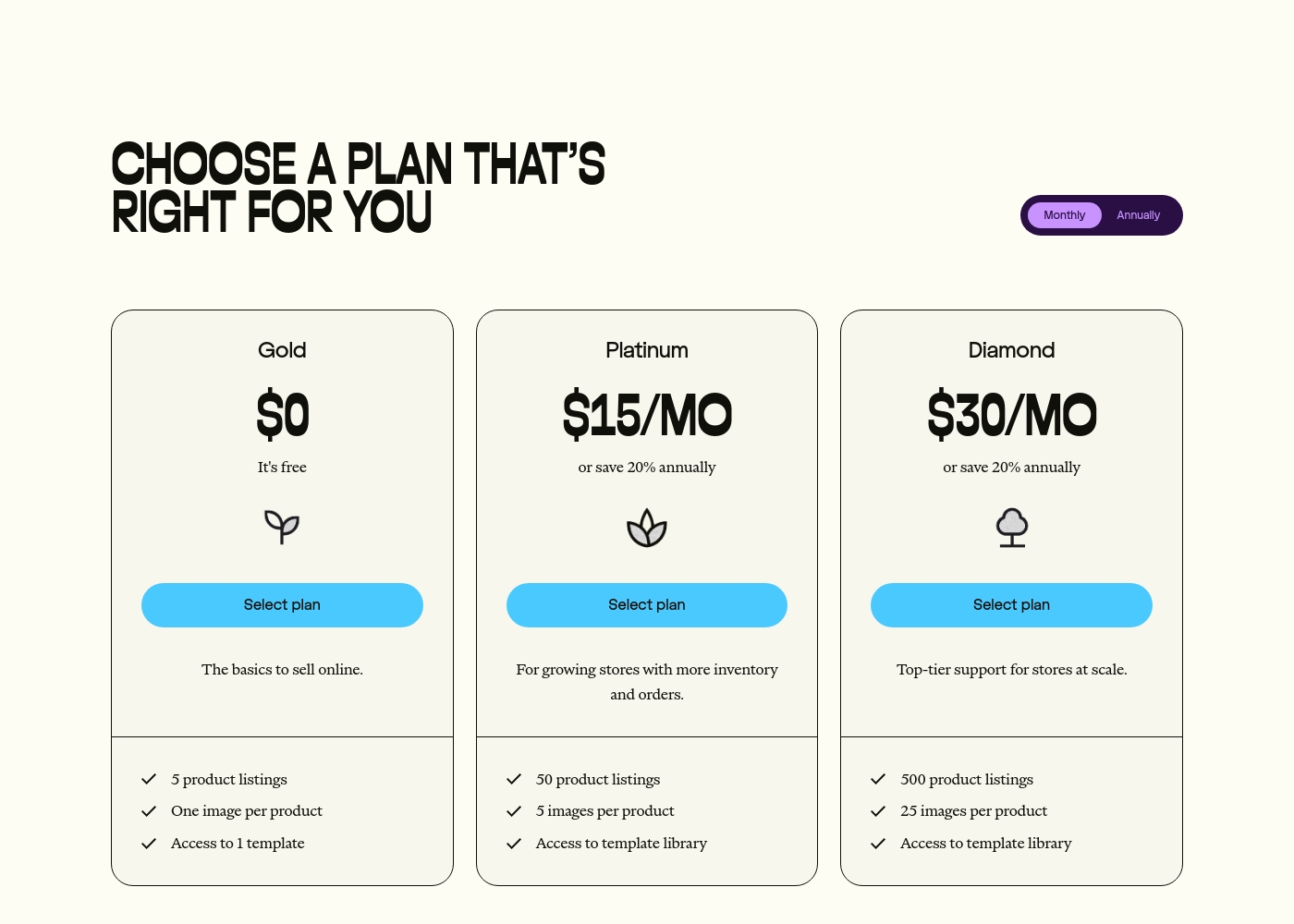
Big Cartel costs between $0 and $30 per month with 3 plans: Gold at $0, Platinum at $15/month ($144 annually), and Diamond at $30/month ($288 annually).
Let's explore the details of each plan to find the right fit for your creative business.
Gold
Price: $0/month (It's free) Best For: The basics to sell online Other Features:
- 5 product listings
- One image per product
- Access to 1 template
- Accept cards, PayPal, & more
- 5 product listings
- 1 image per product
- Access to 1 template
- Accept cards, PayPal, Afterpay, & more
- Big Cartel mobile app for iOS & Android
- 50 product listings
- 5 images per product
- Access to template library
- Offer discounts & run promos
- Shipment tracking
- 500 product listings
- 25 images per product
- Access to template library
- Prioritized tech support
- Abandoned cart recovery
Pricing Notes
- Adobe Commerce requires a custom quote based on transactional volume and technical requirements; there is no public pricing.
- Big Cartel offers a permanently free Gold plan, letting users start with zero financial commitment.
- Crucially, Big Cartel charges a 0% commission on sales, ensuring sellers keep all revenue beyond the subscription fee.
- Big Cartel offers transparent, fixed monthly fees ranging up to $30, with a 20% discount for annual commitment.
Pricing Head-to-Head
User Reviews
Finding reliable, public user reviews for Adobe Commerce on Trustpilot or Capterra proved challenging. The Capterra link returned a security error, and no Trustpilot profile was available.
Based on this, we cannot synthesize a balanced review from external snippets. We must rely solely on the provided product information, which highlights AI-powered discovery, scalable cloud architecture, and strong B2B/B2C flexibility. However, the lack of accessible third-party feedback means we cannot comment on real-world accuracy, support responsiveness, or pricing value.
Big Cartel's external reviews are sharply divided, reflecting a highly polarized user base, resulting in a low Trustpilot rating (2.3). Many long-term users express deep frustration, citing recent unreliable platform development and high prices for what they consider limited functionality and a basic service (max 500 products).
Recurring negative themes include extremely slow customer support response times, with some users waiting hours for basic replies. Conversely, independent artists and new sellers highly praise the platform for its simplicity and ease of use.
I have used Big Cartel for years and it works perfectly for my artwork. I appreciate the 0% commission on sales, only paying the monthly fee. Their customer service has been quick and helpful whenever I needed it.
Our Verdict
This comparison pits ultimate power against ultimate simplicity in the e-commerce space. Adobe Commerce is explicitly designed for global empires and complex, high-volume enterprise sales. Big Cartel is the perfect, low-cost engine for the passionate, independent artist. Your final decision depends entirely on your operational scale and budget. Adobe Commerce’s major strength is its truly limitless enterprise scalability and flexibility. It reliably processes 200,000 orders hourly and handles millions of SKUs from one single instance. It enables deep B2B tools like online quote negotiation and integrates seamlessly via its API-first architecture. If you need complex data synchronization and global multisite management, Adobe Commerce is the only viable choice. Big Cartel wins big on affordability and unmatched simplicity for creators. Setup is incredibly fast, and the transparent pricing runs from a free Gold plan up to $30 monthly. Most importantly, Big Cartel charges a 0% commission on sales, ensuring independent artists keep maximum revenue. It is the ideal, non-technical launchpad for any creative maker. The deciding factor is product capacity: Big Cartel maxes out strictly at 500 listings total. If your inventory or expected traffic exceeds that immediate boundary, Big Cartel is instantaneously disqualified by its core limits. Adobe Commerce requires a massive investment but offers zero ceiling for future growth potential. Choose Adobe Commerce if you are a global enterprise organization needing deep integration and B2B tools. If you are an artist or maker seeking an easy, commission-free shop for fewer than 500 items, Big Cartel is your stress-free solution.
Frequently Asked Questions
Which platform is better for handling peak traffic times, Adobe Commerce or Big Cartel?
Adobe Commerce is far superior for handling peak traffic and sales events. It is built to reliably process over 200,000 orders per hour using auto-scaling. Big Cartel is a smaller platform not designed for such extreme, high-volume retail traffic surges.
Does Adobe Commerce offer a free plan like the one available on Big Cartel?
No, Adobe Commerce does not offer a free plan or a trial period for its enterprise solutions. Big Cartel offers a permanently free Gold plan that allows users to launch a basic shop with five products immediately. The Big Cartel free plan provides great value for testing the service.
Which is better for B2B sales: Big Cartel or Adobe Commerce?
Adobe Commerce is the only platform designed for professional B2B commerce. It includes specialized features like customer-specific catalogs, quick ordering, and online quote negotiation. Big Cartel is exclusively focused on simple B2C sales and lacks B2B tools.
Are there transaction fees when using Big Cartel or Adobe Commerce?
Big Cartel explicitly charges 0% commission on all sales, meaning you only pay the monthly subscription fee. Adobe Commerce is subscription-based, but transaction fees will depend on your integrated payment processor and not the platform itself.
Can I list more than 500 products on Big Cartel?
No, Big Cartel has a hard cap of 500 unique product listings even on its highest-tier Diamond plan. Adobe Commerce can handle millions of SKUs, making it the choice for large inventory management.
How do the integration capabilities of Adobe Commerce and Big Cartel differ?
Adobe Commerce is an API-first, composable platform, ideal for integrating complicated ERP/CRM systems. Big Cartel uses simple, easy-install apps for basic feature extensions. Adobe Commerce offers much deeper synchronization capabilities.
Ready to Choose?
Both tools have their strengths. Choose based on your specific needs.