Adobe Commerce vs WooCommerce
Adobe Commerce and WooCommerce are commerce giants, but their approach is totally different. Adobe Commerce is built for enterprise scale with managed, guaranteed performance. WooCommerce offers maximum customization on a flexible open-source model. Here’s how to choose your e-commerce powerhouse.
Best for: Enterprise organizations with high transaction volume and global ambitions, Businesses requiring guaranteed PCI Level 1 compliance and SOC 2
Best for: E-commerce businesses built on the WordPress ecosystem, Developers or agencies building unique, highly customized stores
Powerful, scalable, but opaque.
We found Adobe Commerce to be a feature-rich platform ideal for complex, multi-market enterprises needing B2B and B2C capabilities from one system. Its AI tools and cloud performance are standout strengths. Overall, it's a robust solution, but the custom pricing model and required sales consultation may be hurdles for smaller businesses.
Pros
Cons
Flexible Ecommerce Built on WordPress Power
We recognize WooCommerce's strength lies in its open-source platform, providing unmatched customization and scalability for ambitious users and developers. This flexibility, however, mandates external maintenance and a high tolerance for technical responsibility, as customer support is repeatedly cited as severely lacking. Overall, we recommend WooCommerce primarily for those with development resources or significant self-help capabilities.
Pros
- Core platform is open source, ensuring high value and low initial cost.
- Offers maximum customization and flexibility for unique stores.
- Trusted for stability and proven ability to handle large sales volumes.
- No platform commissions or subscription fees on the core product.
Cons
- Customer support is slow, non-responsive, or relies heavily on automated responses.
- Requires numerous plugins or custom coding to operate complex features (can feel bloated).
- Steep learning curve, especially concerning shipping, variations, and payment processors.
- Updates sometimes cause functionality issues or price errors.
AboutAdobe Commerce
Adobe Commerce is a comprehensive e-commerce platform for businesses of all sizes, especially mid-market and enterprise. It provides the tools to build and manage online stores, whether you're selling to consumers (B2C), other businesses (B2B), or both. 🛒 It’s built to be flexible, scalable, and intelligent, helping you create personalized shopping experiences.
AboutWooCommerce
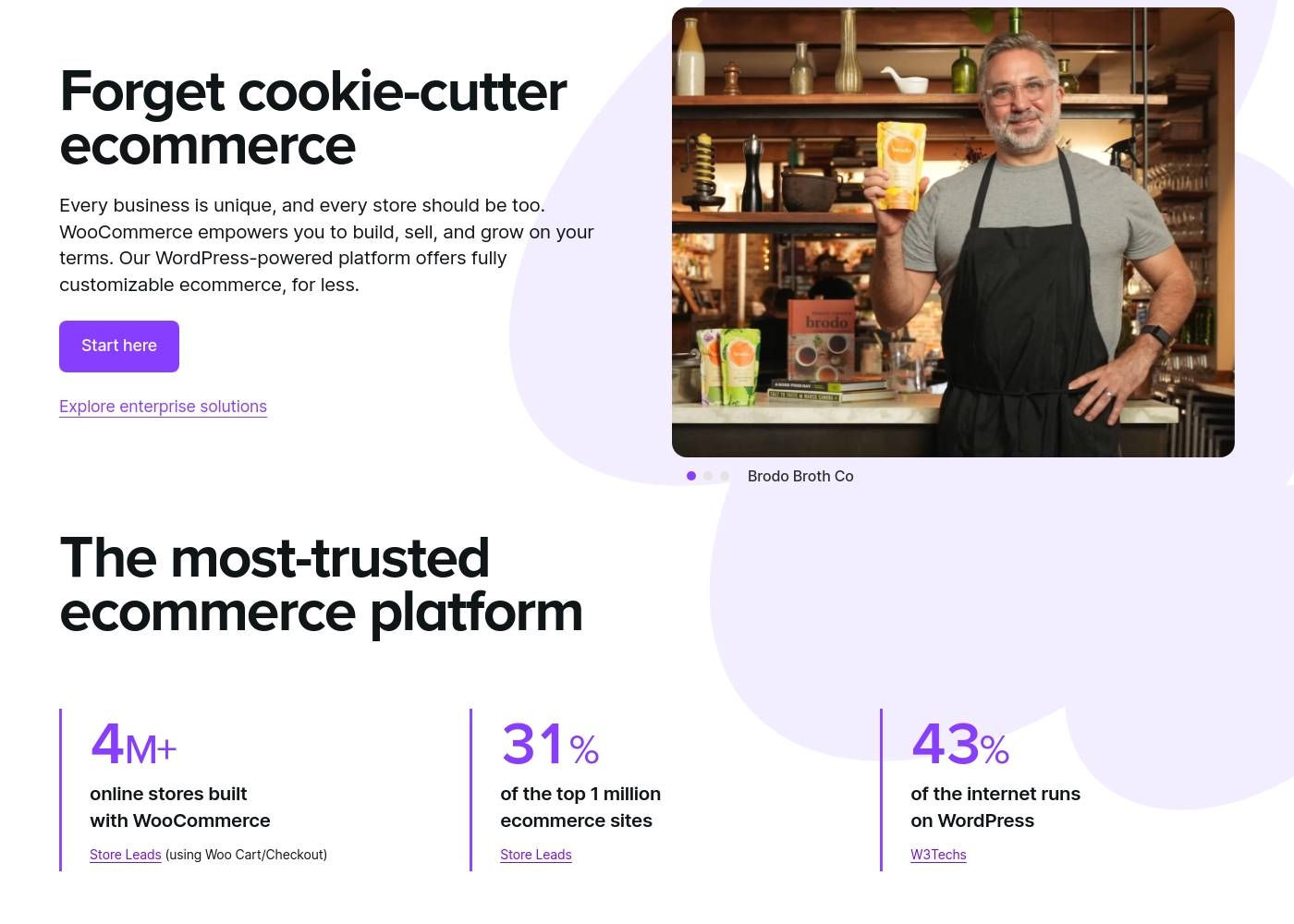
WooCommerce is known as the most trusted ecommerce platform globally. It provides an open-source solution built on the strength of WordPress, which powers 43% of the internet. This popular combination allows you to build, sell, and scale your way, creating a store as unique as your vision. It empowers businesses and developers alike, offering a foundation for creating powerful, flexible ecommerce experiences. Whether your business is complex, simple, big, or small, WooCommerce helps you take control of your success. 💡
Highlights
Feature Comparison
Features Overview
We highlight the main differences and pick a winner for each feature.
Pricing Model
Adobe Commerce uses custom quotes; WooCommerce is fundamentally open source and free to use.
Adobe Commerce requires you to contact sales for personalized pricing. Costs depend on your technical needs and transactional volume. They offer three very custom proprietary packages. WooCommerce has no mandatory subscription fees for its core product. Your costs are purely variable, based on necessary hosting and premium extensions. The key difference is cost predictability versus maximum financial flexibility. Adobe Commerce offers managed stability for a custom, large price tag. If you want maximum financial control, choose WooCommerce because its core is free.
Enterprise Scalability
Adobe Commerce guarantees massive scale; WooCommerce scale relies entirely on your hosting setup.
Adobe Commerce is built for substantial growth using a distributed architecture. It reliably processes over 200,000 orders per hour during peak sales events. AC offers virtually unlimited traffic support with powerful auto-scaling. WooCommerce can handle large sales volumes but requires robust, specialized hosting configurations. Your optimal performance is capped by external technical infrastructure. Adobe Commerce provides guaranteed performance infrastructure out of the box. For extreme peak sales events and guaranteed reliability, Adobe Commerce provides essential structural confidence.
Security & Compliance
Adobe Commerce is PCI Level 1 certified; WooCommerce security details are not explicitly published.
Adobe Commerce is a Certified PCI Level 1 Solution Provider for payment data protection. It is also SOC 2 compliant for enterprise standards. HIPAA-ready compliance is available as an add-on for PaaS users. WooCommerce states it provides safe and secure online payment functionality. However, detailed compliance certifications are not explicitly published on their official site. For regulated industries or handling sensitive data, Adobe Commerce offers verifiable, enterprise-grade certification. If security assurances are non-negotiable, Adobe Commerce provides immediate peace of mind.
B2B Capabilities
Adobe Commerce offers native comprehensive B2B tools; WooCommerce requires custom extensions for B2B.
Adobe Commerce accelerates B2B sales with native customer-specific catalogs and pricing. It supports company accounts with multiple buyer roles. Sellers can negotiate purchase quotes entirely online through the system. WooCommerce can handle B2B requirements but typically requires specialized, often expensive, extensions or custom coding. Buyers must often rely on the complicated extension ecosystem. AC is purpose-built for comprehensive B2B operations and streamlines complex purchasing. If B2B revenue is a primary focus, native capabilities of Adobe Commerce save significant integration effort.
Customization & Control
WooCommerce offers unlimited open-source control; Adobe Commerce uses an API-first approach for high extensibility.
WooCommerce is open source, meaning there is 'no ceiling' on customization or creation. Users gain total platform control, provided they have the necessary technical skill. This foundation offers full access to the source code for unique adaptations. Adobe Commerce uses an API-first, composable architecture for simplified development. You can easily integrate existing systems (ERP, CRM) using quick-start components. WooCommerce provides philosophical freedom and source code ownership. Adobe Commerce provides structural freedom through modern APIs and professional connectors. WooCommerce is the better choice for ultimate ownership and developer control.
AI Merchandising
Adobe Commerce features powerful native AI; WooCommerce relies completely on third-party tools.
Adobe Commerce uses AI to personalize customer experiences and match products faster. It offers 13 types of AI-powered product recommendations natively. Merchandisers get visual editing and generative AI tools for rapid content creation. WooCommerce requires installing extensions for any advanced AI merchandising or search functionality. These crucial tools must be separately sourced, configured, and often paid for. AC integrates world-class AI tools directly into its core platform functionality. Businesses focused on personalization and optimizing conversion should leverage the built-in AI of Adobe Commerce.
Customer Support
Adobe Commerce guarantees 24/7 technical support; WooCommerce support receives highly negative user reviews.
Adobe Commerce explicitly provides 24/7 technical support for issue resolution and troubleshooting. This dedicated support is critical for its managed, proprietary service model. WooCommerce users frequently register complaints about slow support or only receiving automated responses. A lack of reliable support is a severe drawback noted in many user reviews. WooCommerce's poor support is a known trade-off for its open-source freedom. If immediate help during mission-critical issues is vital, Adobe Commerce is the much safer choice.
Adobe Commerce costs are not explicitly stated for its three primary plans: Adobe Commerce as a Cloud Service, Adobe Commerce on Cloud, and Adobe Commerce Optimizer.
Take a look at the specific packages below to see which infrastructure fits your company best.
Adobe Commerce as a Cloud Service (SaaS)
Price: Not explicitly stated Websites Supported: Not explicitly stated Best For: B2C and B2B businesses wanting a complete, multi-tenant cloud solution. Refund Policy: Not explicitly stated Other Features: Transaction processing, B2B commerce operations, Global expansion, Multi-tenant cloud service, Automatic feature updates
- Transaction processing
- B2B commerce operations
- Global expansion
- Multi-tenant cloud service
- Automatic updates
- Single-tenant dedicated infrastructure
- API-first extensibility
- High-performance storefront
- 24/7 support
- PCI Level 1 compliance
- AI-powered search
- Product recommendations
- Catalog management
- Multi-tenant cloud service
- Merchandising reports

Since WooCommerce is open source, its pricing model is highly flexible, focusing on customization rather than fixed tiers.
Core WooCommerce Platform (Open Source)
Best For: Anyone seeking maximum customization freedom and control over their platform. Other Features:
- Powered by WordPress
- Fully customizable ecommerce
- Access to hundreds of trusted extensions and themes
- Support teams across the world
- Safe and secure online payments
This open-source framework lets you build your unique store from the ground up. It's the best option if you want to scale your way without the limitations of fixed proprietary systems. You gain control needed to create an utterly unique brand experience for your customers. ✨
- Fully customizable ecommerce
- Powered by WordPress
- Access to hundreds of trusted extensions and themes
- Open source flexibility
- Support teams across the world
Pricing Notes
- The core WooCommerce platform is free, but users must pay for separate hosting and necessary premium extensions.
- Adobe Commerce pricing is strictly custom, requiring sales consultation based on traffic and feature needs.
- WooCommerce offers maximum financial flexibility, but total costs can be unpredictable due to mandatory add-ons.
- Adobe Commerce does not offer a free trial or public pricing, indicating a significant enterprise-level investment.
Pricing Head-to-Head
User Reviews
Finding reliable, public user reviews for Adobe Commerce on Trustpilot or Capterra proved challenging. The Capterra link returned a security error, and no Trustpilot profile was available.
Based on this, we cannot synthesize a balanced review from external snippets. We must rely solely on the provided product information, which highlights AI-powered discovery, scalable cloud architecture, and strong B2B/B2C flexibility. However, the lack of accessible third-party feedback means we cannot comment on real-world accuracy, support responsiveness, or pricing value.
WooCommerce generates highly mixed feedback, primarily due to the severe dichotomy between its powerful, free core product and the perceived lack of service quality. Users praised its unlimited flexibility, open-source nature, and strong customization capabilities, noting it is essential for serious businesses and web developers who want maximum control without recurring platform fees.
Many established users expressed love for the product when paired with the right WordPress themes. However, the overwhelming concern centers on customer support responsiveness ❌.
Their support responsiveness is a major issue; it often takes days for them to even send a reply. This is unacceptable for mission-critical e-commerce operations. We strongly advise that businesses consider this lack of reliable support before committing.
Our Verdict
Choosing between Adobe Commerce and WooCommerce pits stability against flexibility. It's the classic battle of proprietary control versus open-source ownership. Most established businesses with large budgets should investigate Adobe Commerce first. Adobe Commerce is the ultimate enterprise powerhouse built for guaranteed reliability. It manages global multi-sites and guarantees 200,000 orders per hour during transaction peaks. Furthermore, Adobe Commerce provides native, certified security, including PCI Level 1. Its advanced B2B tools dramatically simplify complex enterprise sales processes immediately. WooCommerce excels in pure, unrestricted customization and initial cost control. The core WooCommerce platform is completely free, built on vast WordPress stability. It offers developers full access to customize every part of the store extensively. WooCommerce is also perfect for seamlessly syncing sales across major sites like Amazon and TikTok. The biggest decider isn't features, it's management style and budget assurance. If you need 24/7 dedicated support and enterprise-grade compliance, Adobe Commerce is mandatory. Conversely, if you have internal developers and prioritize source code freedom, WooCommerce is your clear path forward. Choose Adobe Commerce for guaranteed scale, dedicated support, and essential B2B native functions. Choose WooCommerce if you run WordPress and demand total open-source control over every technical investment decision.
Frequently Asked Questions
Which is better for small businesses: Adobe Commerce or WooCommerce?
WooCommerce is generally better due to its open-source core platform availability. The core WooCommerce platform is free to use forever. Adobe Commerce requires a proprietary, massive enterprise-level investment for access.
Which platform offers guaranteed extreme traffic handling and performance?
Adobe Commerce provides guaranteed performance infrastructure out of the box. It’s built to handle over 200,000 orders per hour during peak events efficiently. WooCommerce performance depends entirely on your chosen self-managed hosting infrastructure.
Does Adobe Commerce offer more advanced security compliance than WooCommerce?
Yes, Adobe Commerce is Certified PCI Level 1 and SOC 2 compliant as a service provider. It offers enterprise-grade security and advanced threat detection tools. WooCommerce's specific compliance certifications are not explicitly stated.
How does WooCommerce’s customer support compare to Adobe Commerce?
Adobe Commerce explicitly includes 24/7 technical support with its proprietary service. WooCommerce user reviews frequently describe support as slow or only receiving automated responses. Lack of reliable direct support is a major trade-off for the open-source platform.
Which solution is easier to integrate with existing ERP or CRM systems?
Adobe Commerce utilizes an API-first approach with official integration starter kits. WooCommerce relies heavily on extensions and the WordPress ecosystem. This frequently requires additional custom development effort.
Which platform is better for centralized management of multiple global stores?
Adobe Commerce offers centralized multisite architecture natively. You can manage multiple brands, regions, and languages from one administrative interface seamlessly. WooCommerce requires complex extensions and configuration for consistent multi-store management.
Ready to Choose?
Both tools have their strengths. Choose based on your specific needs.