Adobe Commerce vs Shopify
This is the fight between limitless enterprise power and unmatched ease of use. Adobe Commerce offers deep customization and massive B2B scale. Shopify provides fast setup, a huge app ecosystem, and ready-to-go retail features.
Best for: Enterprise organizations with 500+ employees, B2B businesses requiring online quote negotiation and complex approval flows

Best for: Solo entrepreneurs and small- to mid-sized retailers, Businesses needing a fast time-to-market and low complexity setup
Powerful, scalable, but opaque.
We found Adobe Commerce to be a feature-rich platform ideal for complex, multi-market enterprises needing B2B and B2C capabilities from one system. Its AI tools and cloud performance are standout strengths. Overall, it's a robust solution, but the custom pricing model and required sales consultation may be hurdles for smaller businesses.
Pros
Cons

Powerful Platform, Critical Service Gaps
We recognize Shopify offers an enterprise-level platform with impressive scaling tools and high-converting technology for merchants of all sizes. However, user reviews indicate systemic failures in support, billing practices, and marketplace fraud protection. Overall, Shopify provides powerful infrastructure but currently struggles to deliver a reliable, secure, or user-focused experience for many customers.
Pros
- Comprehensive commerce platform built for scaling and global growth.
- Unique Shopify Checkout converts 15% higher than competing platforms.
- Lower credit card transaction fees on Grow and Advanced plans.
- Access to Shopify Capital for loans without sacrificing equity.
Cons
- Customer support is frequently reported as unresponsive, slow, or useless (often relying on chatbots).
- Platform often fails to protect buyers and merchants from fraudulent stores.
- Frequent reports of unauthorized billing and confusing cancellation procedures.
- Complexity makes site setup difficult for non-technical beginners.
AboutAdobe Commerce
Adobe Commerce is a comprehensive e-commerce platform for businesses of all sizes, especially mid-market and enterprise. It provides the tools to build and manage online stores, whether you're selling to consumers (B2C), other businesses (B2B), or both. 🛒 It’s built to be flexible, scalable, and intelligent, helping you create personalized shopping experiences.
AboutShopify
Shopify is the powerful commerce platform designed to handle every aspect of modern selling. It serves everyone, from solo entrepreneurs launching their first product to large global enterprises. This platform manages your sales whether you are selling direct-to-consumer or handling wholesale B2B transactions. You get an organized, fully centralized Shopify Admin to control everything, from the back office to the front of the store. Millions of merchants trust Shopify; together, they have reached over $1 trillion in collective sales. ✨
Highlights
Feature Comparison
Features Overview
We highlight the main differences and pick a winner for each feature.
Pricing Transparency
Shopify offers clear monthly tiers; Adobe Commerce requires a custom quote.
Adobe Commerce uses tailored pricing based on your volume and complex feature needs. You must speak with sales to accurately estimate the required investment. This approach suits large enterprises needing custom structure. Shopify has clear starting tiers from $0 up to $399 per month for Advanced plans. The top Plus plan pricing is also publicly available at $2,300/month. Shopify’s transparent tiered pricing simplifies initial budgeting for SMBs. However, Shopify charges third-party transaction fees if you do not use Shopify Payments. For most users, Shopify's predictability is a huge win for planning.
Scalability & Peak Load
Adobe Commerce is engineered for massive enterprise scale and extreme transaction volume.
Adobe Commerce guarantees resilience during high-demand events like flash sales and holidays. It can reliably process over 200,000 orders in one hour during peak traffic. Its store architecture is optimized for top Google Lighthouse scores, boosting organic traffic. Shopify is also highly scalable, especially with the Plus plan for high volume merchants. Shopify focuses on speed, keeping stores within 50 milliseconds of every shopper. For mission-critical global events, Adobe Commerce provides explicit, assured performance.
B2B Features
Adobe Commerce provides deeper B2B tools like online quote negotiation and advanced approvals.
Adobe Commerce accelerates B2B sales with complex features like automated approvals and quick-ordering. Sellers can negotiate quote requests entirely online within the robust platform. Shopify offers strong wholesale features, including flexible pricing, discounts, and custom payment terms. It helps tailor offers efficiently for business customers. For highly complex workflows and digital self-service, Adobe Commerce leads the B2B market.
Ecosystem and Apps
Shopify has a massive 13,000+ app store for easy extensions and third-party tools.
Shopify is famous for its immense app store, supporting over 13,000 different plug-and-play integrations. This makes adding peripheral features fast, easy, and usually affordable for merchants. Adobe Commerce emphasizes an API-first, composable architecture for integration and extension. Developers integrate using comprehensive APIs and specific starter kits. While Adobe Commerce achieves superior technical depth, Shopify provides unparalleled breadth and speed.
Time to Market
Shopify allows you to launch a functional commerce store much faster than Adobe Commerce.
Shopify offers a quick setup flow, often enabling a live storefront launch in minutes or days. It provides a simple path from idea to selling products online right away. Adobe Commerce implementation involves a lengthy consultation and custom integration process first. Its composable nature demands significant upfront development and architecture planning. If speed and minimized friction are paramount, Shopify is the faster choice.
Security and Compliance
Both are PCI compliant, but Adobe Commerce offers higher enterprise compliance options.
Both platforms are secured and confirmed as PCI DSS Level 1 compliant to protect all payment data. Adobe Commerce is also SOC 2 compliant and undergoes regular penetration testing. Crucially, Adobe Commerce offers dedicated HIPAA-ready solutions as an add-on for the PaaS cloud plan. Shopify does not advertise this specific level of enterprise health compliance.
AI Merchandising
Adobe Commerce delivers deeper built-in AI merchandising for personalized browsing experiences.
Adobe Commerce uses real-time data to power 13 specific types of AI-driven product recommendations. It leverages AI for highly personalized search and dynamic category merchandising. Shopify uses AI (Shopify Magic) for content creation and useful business insights. It also supports sophisticated audience targeting tools. Adobe Commerce offers a natively integrated suite aimed specifically at boosting AOV.
Customer Support
User reviews often criticize Shopify support, while Adobe Commerce offers 24/7 technical assistance.
Adobe Commerce provides 24/7 technical support for professional issue resolution and troubleshooting needs. This enterprise commitment is often a requirement for large merchant accounts. Shopify reviews often report unresponsive customer support and slow issue resolution. Difficulty contacting personnel and inconsistent escalation are recurring user complaints. If support reliability is critical, Adobe Commerce has the upper hand.
Adobe Commerce costs are not explicitly stated for its three primary plans: Adobe Commerce as a Cloud Service, Adobe Commerce on Cloud, and Adobe Commerce Optimizer.
Take a look at the specific packages below to see which infrastructure fits your company best.
Adobe Commerce as a Cloud Service (SaaS)
Price: Not explicitly stated Websites Supported: Not explicitly stated Best For: B2C and B2B businesses wanting a complete, multi-tenant cloud solution. Refund Policy: Not explicitly stated Other Features: Transaction processing, B2B commerce operations, Global expansion, Multi-tenant cloud service, Automatic feature updates
- Transaction processing
- B2B commerce operations
- Global expansion
- Multi-tenant cloud service
- Automatic updates
- Single-tenant dedicated infrastructure
- API-first extensibility
- High-performance storefront
- 24/7 support
- PCI Level 1 compliance
- AI-powered search
- Product recommendations
- Catalog management
- Multi-tenant cloud service
- Merchandising reports

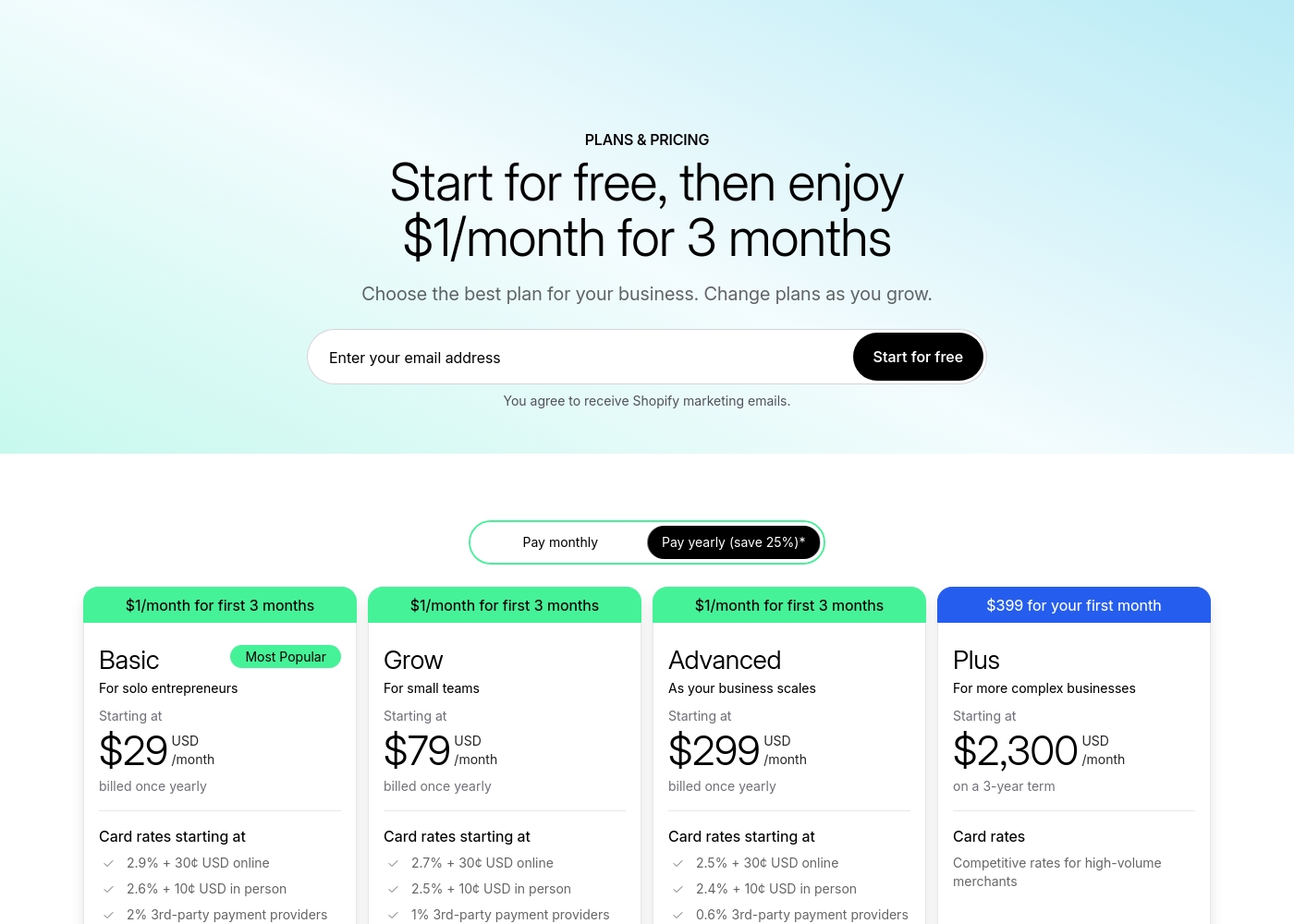
Shopify costs between $5 (Starter) and $2,300 (Plus) per month with six key plans: Starter at $5/month, Basic at $29/month (billed yearly), Grow at $79/month (billed yearly), Advanced at $299/month (billed yearly), Retail at $89/month, and Plus at $2,300/month (on a 3-year term).
Here’s a detailed look at the core subscription options designed to help your business evolve and scale.
Starter
Price: $5 USD / month Best For: Selling instantly through social media and messaging apps Other Features: Simple online store, Learn more link
- Sell instantly through social media and messaging apps
- Simple online store access
- For solo entrepreneurs - Most Popular
- 2.9% + 30¢ USD online card rates
- Up to 77% shipping discount
- 10 inventory locations
- 24/7 chat support
- For small teams
- 5 staff accounts
- 2.7% + 30¢ USD online card rates
- Up to 88% shipping discount and insurance
- 1% 3rd-party payment provider fees
- As your business scales
- 15 staff accounts
- 2.5% + 30¢ USD online card rates
- 3rd-party calculated shipping rates
- Enhanced 24/7 chat support
Pricing Notes
- Adobe Commerce pricing is entirely custom; you must contact sales for a quote based on your requirements and volume.
- Shopify offers clear tiered pricing starting at $0, with the high-end Plus plan costing around $2,300/month.
- Shopify charges third-party transaction fees ranging from 0.6% to 2% if you do not use Shopify Payments.
- Adobe Commerce does not advertise any free plan or trial period for any of its service packages.
Pricing Head-to-Head
User Reviews
Finding reliable, public user reviews for Adobe Commerce on Trustpilot or Capterra proved challenging. The Capterra link returned a security error, and no Trustpilot profile was available.
Based on this, we cannot synthesize a balanced review from external snippets. We must rely solely on the provided product information, which highlights AI-powered discovery, scalable cloud architecture, and strong B2B/B2C flexibility. However, the lack of accessible third-party feedback means we cannot comment on real-world accuracy, support responsiveness, or pricing value.
While Shopify is recognized as an exceptionally powerful commerce platform that enables aggressive scaling, external feedback indicates significant user dissatisfaction. Customers frequently cite severe issues with customer support, emphasizing that interactions are often negative, slow, or handled by unhelpful chatbots.
A major recurring theme, especially on Trustpilot, focuses on platform reliability and integrity, with many users openly classifying Shopify as a 'fraudsters paradise' that fails to protect consumers from scam stores operating on the platform. Furthermore, the pricing structure and billing accuracy generate major complaints.
The platform is expensive and gives minimal customer support. You often learn how things work by making costly mistakes. Given their high fees, they should offer much better service.
Our Verdict
The decision between Adobe Commerce and Shopify is a classic choice between depth and breadth of features. Both are robust commerce players, but they serve dramatically different buyers today. Adobe Commerce is built for the global enterprise that requires bespoke power and high volume capability. Shopify is the accessible hub dominating the small-to-mid-market retail landscape. Adobe Commerce’s superpower is its limitless, sophisticated scaling backed by superior AI. It reliably handles over 200,000 orders per peak hour using a resilient architecture. Adobe Commerce natively provides deep B2B functionality, like quote negotiation and advanced approvals. Its API-first structure enables unmatched customization and crucial compliance like HIPAA readiness. Shopify’s strength lies in its ecosystem and extremely rapid time-to-market advantage. You can launch a highly functional storefront often within just a few days using clear, tiered pricing. Shopify offers a massive 13,000+ app store for easy plug-and-play feature additions. They also assist growing brands with unique growth funding options via Shopify Capital. The deciding factor is complexity versus ultimate control. If your team needs guaranteed performance, deep B2B customization, and strict compliance, choose Adobe Commerce. If you need simple multichannel retail integration, a powerful app store, and low startup friction, Shopify is a powerful choice. Pick Adobe Commerce for true enterprise scale, unique B2B demands, and compliance certainty. Opt for Shopify if you are an SMB or mid-size brand prioritizing fast deployment and connectivity.
Frequently Asked Questions
Which is better for complex B2B needs: Adobe Commerce or Shopify?
Adobe Commerce is better for complex B2B needs requiring online quote negotiation and automated approvals. Shopify offers strong B2B features like flexible pricing and customer discounts. Adobe Commerce provides a more robust, enterprise-level digital sales portal natively.
How do the pricing models differ between Adobe Commerce and Shopify?
Adobe Commerce uses custom, quote-based pricing tailored to your business volume and needs. Shopify uses transparent, tiered monthly plans starting at $0 or $29 per month. Starting with Adobe Commerce involves a much higher upfront investment and implementation cost.
Is customer support reliable for both Adobe Commerce and Shopify?
Adobe Commerce offers 24/7 technical support for enterprise issue resolution. Shopify receives recurring negative user feedback regarding slow response times and inconsistent support quality. Support is a major differentiator; Adobe Commerce is generally more reliable.
Which platform offers easier third-party integrations for smaller teams?
Shopify offers easier integrations due to its vast 13,000+ app store ecosystem. Adobe Commerce is API-first, often requiring dedicated developer resources to use starter kits or complex custom integrations.
Does Adobe Commerce or Shopify offer specific security compliance like HIPAA?
Adobe Commerce offers a HIPAA-ready option as an add-on for its PaaS cloud infrastructure. Shopify maintains standard PCI DSS Level 1 compliance. If you require HIPAA readiness, Adobe Commerce is the specified option.
Can Shopify handle as many orders as Adobe Commerce during high traffic events?
Shopify handles high volume efficiently on its Plus plan. Adobe Commerce explicitly guarantees processing over 200,000 orders per hour reliably during peak events. Adobe Commerce is engineered for extreme, guaranteed global peak demand capacity.
Ready to Choose?
Both tools have their strengths. Choose based on your specific needs.
