Nickel vs Square Payments
Nickel and Square Payments pull in different directions. Nickel unifies payments, credit, and cash flow in one place. Square Payments delivers omni-channel payments with transparent pricing and APIs.
Best for: Solo entrepreneurs starting with Nickel Core free plan, Growing teams needing net terms and credit tools
Best for: Multi-channel retailers needing AP/AR flexibility and fast funding, Mobile-first businesses needing offline payments
Solid for payments and cash flow.
Overall, we find Nickel to be a capable platform for consolidating payment collection, bill pay, and basic credit operations into a single dashboard. Its strong value lies in the free ACH tier and clear pricing, though teams needing advanced reporting or very fast support may encounter some limitations.
Pros
- Free core plan with unlimited ACH transfers.
- Clean, intuitive interface for managing payments.
- Strong integration with QuickBooks Online.
- Transparent, scalable pricing with no hidden fees.
Cons
- Customer support response times can vary.
- Advanced reporting and analytics are somewhat limited.
- Learning curve for setting up credit decision workflows.
- Transaction limit on the free tier may be restrictive.
Transparent Payments, Essential Small Business Tools
We find Square Payments provides robust, transparent processing designed perfectly for flexible operations. The usage-based model is simple, integrating comprehensive security and management features seamlessly across in-person and online sales. Overall, we recommend Square for its excellent ease of use and consistent reliability in fund transfers.
Pros
- Extremely user-friendly software and intuitive mobile app interface.
- Reliable and consistent fund transfers with options for fast deposits.
- Clear, transparent usage-based processing rates with no hidden fees.
- Ability to accept all modern payment methods easily (tap, card, Apple Pay, Afterpay).
Cons
- Processing fees are reported as high compared to some industry competitors.
- Customer support quality and responsiveness can be inconsistent.
- Not ideally suited for managing very large or complex inventory lists.
- Initial bank account verification can sometimes take several days.
AboutNickel
Nickel is a unified payment and credit platform built for businesses. It replaces your fragmented stack of financial tools. ✅
You can accept payments, pay bills, and offer net terms to customers—all from a single dashboard. It's designed to give you full control over your money cycle.
AboutSquare Payments
Square Payments is your complete system for managing transactions everywhere customers shop. It handles the financial highway that securely moves money from the buyer to your bank account. Square is built to support businesses of all sizes, offering flexible tools that adapt right along with you. You can take payments in person using dedicated hardware or simply use Tap to Pay on your iPhone or Android device. Selling online is easy too, whether through a free store, payment links, or integrated APIs. 💡
Highlights
Feature Comparison
Features Overview
We highlight the main differences and pick a winner for each feature.
Unified Money Platform
Nickel unifies A/R, A/P, and trade credit in one place. Square Payments supports multi-channel payments across in-person, online, and mobile.
Nickel brings A/R, A/P, and trade credit together in one platform to simplify money flow. Nickel's dashboard helps manage approvals and bill payments. Square Payments enables payments across in-person, online, and mobile channels for broad reach. Square's tools supportline-facing sales and eCommerce integration. Key difference: Nickel centralizes finance workflows; Square emphasizes payment breadth across channels. Real-world impact: a small business can close deals faster using credit insights with Nickel; Square captures more revenue with omnichannel capabilities. Nickel emphasizes credit-based automation; Square emphasizes channel flexibility.
Credit Tools & Net Terms
Nickel Pro adds credit insights and net terms. Square Payments lacks built-in credit tools.
Nickel Pro introduces digital credit applications, customer credit insights, and a decision workflow. Square Payments focuses on processing power, multi-channel sales, and invoicing. Key difference: Nickel targets risk management and credit decisions; Square targets broad payments. Real-world impact: Nickel helps you approve terms with data; Square helps move large tickets quickly. Nickel's insights help close deals faster; Square's breadth helps monetize more channels.
Onboarding & Support
Nickel offers white-glove onboarding and 24/7 support. Square Payments provides support with hours and community help.
Nickel's onboarding is premium with human guidance. Nickel offers 24/7 live chat and email support for ongoing help. Square provides phone support from 6 a.m. to 6 p.m. PT and 24/7 email. Key difference: Nickel focuses on setup; Square emphasizes accessibility. Real-world impact: Nickel reduces setup time; Square reduces downtime during issues. The experience leans toward human-centric onboarding with Nickel.
Integration & Accounting
Nickel integrates with QuickBooks Online via real-time sync. Square offers broad APIs and Store integrations.
Nickel real-time sync with QuickBooks Online keeps invoices and bills aligned. Square provides APIs and SDKs for developers to customize payment flows. Key difference: Nickel targets accounting harmony; Square targets developer flexibility. Real-world impact: Accountants see fewer manual entries with Nickel; developers tailor experiences with Square. Nickel’s QuickBooks tie-in helps reconciliation processes stay current.
Payment Methods Breadth
Nickel supports card, ACH, and checks via Bill Pay. Square supports cards, wallets, and BNPL.
Nickel accepts card, ACH transfers, and checks via Bill Pay. Nickel’s terms include a $25,000 per-transaction limit for Core. Square accepts cards, Apple Pay, Google Pay, and Cash App Afterpay across channels. Key difference: Nickel emphasizes traditional methods; Square expands wallets and BNPL. Real-world impact: More buyer options with Square can boost conversions.
Security & Compliance
Nickel offers PCI and SOC 2, with encryption. Square provides PCI, end-to-end encryption, and dispute management.
Nickel routes payments through sponsor banks with a holding account and robust security. Square handles PCI compliance and fraud protection across payments. Key difference: Both handle security; Square adds free dispute management. Real-world impact: Both protect funds; Square offers rapid dispute relief for merchants.
Offline Capability
Square supports offline payments for up to 24 hours. Nickel’s offline capability is not specified.
Square stores offline transactions and receipts until connectivity returns. Nickel's offline capability isn't described in the data. Key difference: Square ensures sales during outages. Real-world impact: Square reduces revenue loss when networks fail.
Pricing Transparency
Nickel offers tiered plans; Square uses usage-based pricing with clear rates.
Nickel Core is free; Plus is $35; Pro pricing not stated. Square shows rates per method with no hidden fees. Key difference: Nickel favors upfront plans; Square favors per-transaction clarity. Real-world impact: Business costs are predictable with either approach.
Developer Tools
Square provides APIs and SDKs. Nickel's developer ecosystem is not explicitly described.
Square offers comprehensive APIs and SDKs for apps and integrations. Nickel highlights QuickBooks Online integration but doesn't show broad APIs. Key difference: Square targets developers; Nickel focuses on accounting integration. Real-world impact: Build custom flows with Square; Nickel centers around accounting harmony.
Nickel pricing: Nickel offers a range of payment management plans starting from a free tier up to custom enterprise solutions. Pricing is designed to scale with your business needs, featuring unlimited free ACH transfers on all plans and a 20% discount for annual billing on the Plus tier.
- Nickel Core: $0/month
- Nickel Plus: $35/month (billed annually) or $45/month (billed monthly)
- Nickel Pro: Custom pricing for specialized credit operations
All plans include standard card payment processing at a 2.9% flat rate and native QuickBooks Online integration to streamline your financial workflows.
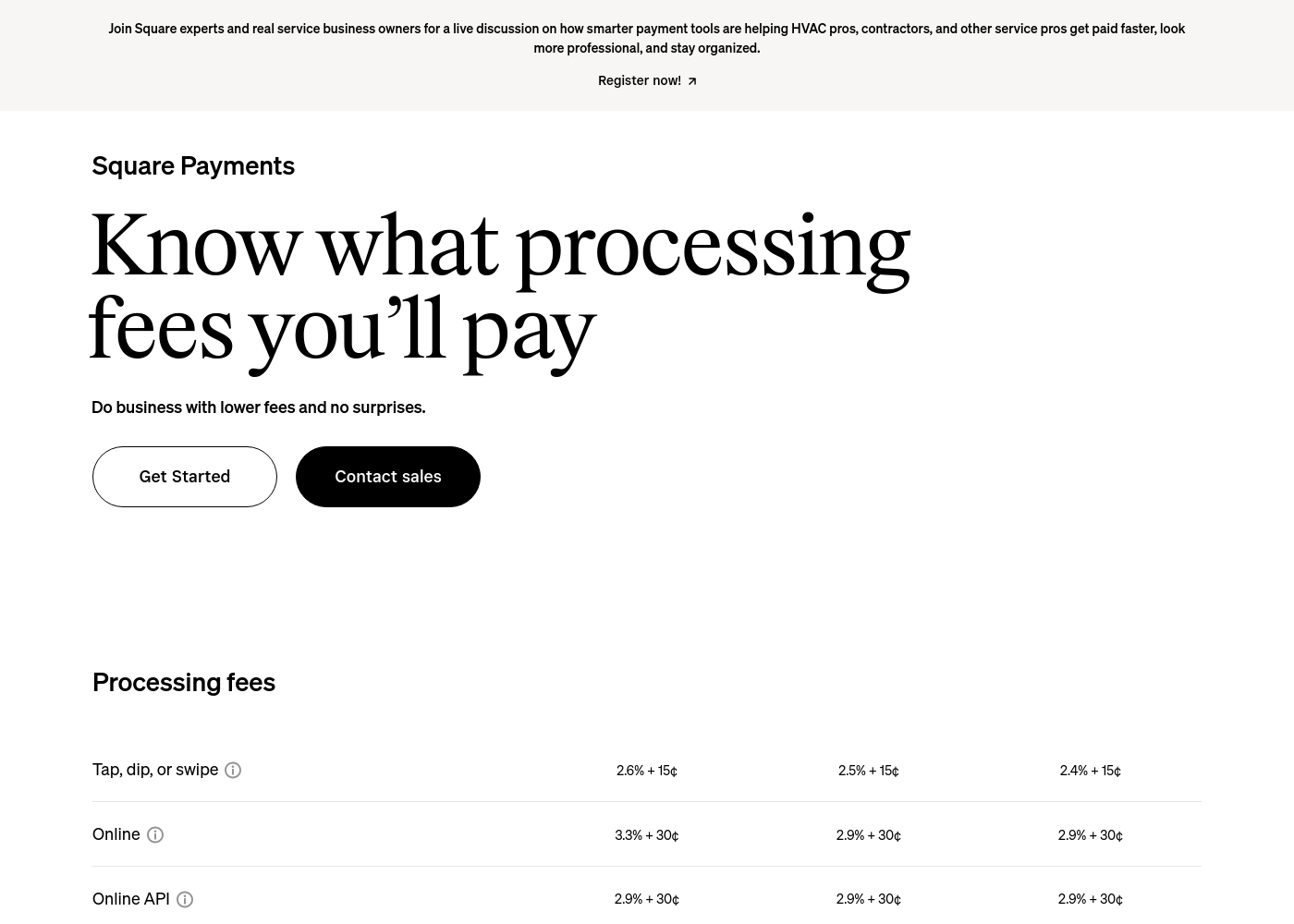
Square Payments costs between 1% minimum $1 (ACH) and 6% + 30¢ per transaction with 5 standard rate plans: In Person at 2.6% + 15¢, Online at 2.9% + 30¢, Invoices at 3.3% + 30¢, Manually Entered at 3.5% + 15¢, and Buy Now, Pay Later at 6% + 30¢.
Square is committed to transparent pricing, meaning you always know what you'll pay upfront based on the transaction method.
In-Person Processing
Price: 2.6% + 15 cents per transaction Best For: When a customer taps, dips, or swipes their card Other Features:
- Lower risk of fraudulent activity
- Use with Square hardware (Reader, Terminal, etc.)
- Same rate for all major credit cards
- 2.6% + 15¢ per tap, dip, or swipe
- One rate for every card type
- Lower risk transaction type
- 2.9% + 30¢ per transaction (Standard online store/API)
- Secure online payment processing
- Includes Square Online Store and eCommerce API purchases
- 3.3% + 30¢ per transaction (Card payment via Invoice)
- Applies when buyer keys in transaction online
- Includes Square Payment Links
- 1% with a minimum $1 per transaction
- Applies to ACH bank transfers
- Cost-effective for large payments
Pricing Notes
- Nickel Core includes unlimited ACH transfers and 3 active users; $25,000 per-transaction limit.
- Nickel Plus adds unlimited active users, scheduled/recurring payments; remote check deposit coming soon.
- Nickel Pro adds digital credit tools, credit insights, and net-60 terms.
- Square has no monthly fees; custom pricing for high volume (> $250k yearly).
- Square offers free dispute management and a broad set of tools across channels.
Pricing Head-to-Head
User Reviews
We found that external feedback on Nickel is generally positive, with users highlighting its ease of use and impact on cash flow. Many appreciate the intuitive interface for handling payments and the significant time saved through automation and QuickBooks integration.
😊 The free ACH transfers and transparent pricing are frequently praised as major value drivers for small businesses. However, some reviews point to occasional customer support delays and a learning curve for more advanced features like credit management.
Nickel has been a game-changer for our small business. Getting paid via ACH for free and paying our vendors through the same platform saves us so much time and money. The QuickBooks sync is flawless.
Square Payments generally receives high marks across thousands of customer reviews on Trustpilot and Capterra, primarily for its simplicity and accessibility for small business owners. Users frequently praise the platform's intuitive software and user-friendly mobile app, noting that it makes managing sales, tracking income, and sending invoices much easier.
Business owners appreciate the flexibility to accept almost every type of payment, including card taps, specialized payment links, and ACH transfers. While essential features like speedy deposits and payment reliability are often noted, user sentiment concerning pricing and customer support is often mixed.
Square has truly made running my business so much smoother! I can accept payments anytime, whether a client is in the studio, training online, or signing up for a new program. The app is incredibly user-friendly and simple to manage.
Our Verdict
Nickel and Square Payments are both strong, but the best pick depends on your needs. If you need onboarding and credit tools, Nickel shines. If you need omni-channel payments and fast transfers, Square Payments wins. Your choice hinges on volume, channels, and whether you value credit tools. If you need automation and credit, Nickel; if you need omnichannel payments and speed, Square Payments. For most teams, Nickel is the better starting point. If multi-channel selling and fast transfers matter most, Square Payments wins.
Frequently Asked Questions
Which is better for small teams: Nickel or Square Payments?
Nickel Core is free to start ($0/mo). Square Payments has no monthly fees either. If you want a zero-cost entry, Nickel works. If you value broad methods and online sales, Square Payments fits.
Does Nickel have QuickBooks Online integration like Square Payments?
Nickel offers real-time QuickBooks Online sync for invoices and bills. Square does not mention QuickBooks Online in the data. If you rely on QuickBooks, Nickel may be the better fit.
Is Square Payments worth the extra cost over Nickel?
Square's rates are per method and higher on some paths. Nickel Core is free but lacks BNPL. For multi-channel needs, Square may justify higher costs.
Can I migrate from Nickel to Square Payments easily?
Migration steps are not described in the data. Check with sales or support for transfer options.
Does Nickel support offline payments like Square Payments?
Offline payments are not described for Nickel. Square Payments supports offline payments for up to 24 hours.
What payment methods does Nickel support?
Nickel supports card, ACH transfers, and checks via Bill Pay. Card payments are 2.9%; ACH timing varies.
Ready to Choose?
Both tools have their strengths. Choose based on your specific needs.