Deel vs Tellent
Deel and Tellent tackle global workforce management from opposite ends. Deel is a compliance-first powerhouse for paying anyone, anywhere. Tellent is a unified HR suite for your entire employee lifecycle. The choice hinges on whether you need a global payroll engine or an internal HR platform.
Best for: Startups and enterprises expanding internationally via contractors or EOR employees., Finance and ops teams managing global payroll and compliance across 150+ countries.
Best for: Growing companies needing a scalable, modular HR suite., HR teams seeking to automate manual tasks and centralize data.
Seamless Global HR and Payment Engine
We found Deel to be a highly effective Global People Platform that successfully centralizes HR, compliance, and multi-currency payroll. The platform's extensive support for both contractors and EOR employees in over 150 countries minimizes legal risks globally. Overall, this service is backed by strong user sentiment and provides robust infrastructure for international workforce scaling.
Pros
- Extensive global coverage in over 150 countries (EOR and Contractor models).
- Extremely user-friendly interface and intuitive navigation.
- Fast and seamless onboarding process for new workers.
- Highly responsive, patient, and dedicated customer support is available 24/7.
Cons
- EOR model is a premium service at $599 per employee monthly.
- Users occasionally suggest reducing the number of necessary logins.
- Recent reports of new fees charged for certain cross-currency withdrawals.
Strong modular suite for growing teams.
We find Tellent offers a powerful, integrated platform for automating HR and recruitment. Its modular design is ideal for mid-sized companies scaling their operations. Overall, it's a solid choice for centralizing people data, though implementation requires planning.
Pros
- Unifies recruiting, HR, and performance management in one platform.
- Offers strong automation and AI features to reduce manual tasks.
- Provides a flexible, modular system that scales with company growth.
- Features a large partner ecosystem (500+ integrations) for connectivity.
Cons
- Pricing is not transparent publicly and requires contacting sales.
- The modular setup may involve a complex initial configuration.
- May not be cost-effective for very small businesses or solopreneurs.
- Advanced customization and deeper technical features can have a learning curve.
AboutDeel
Deel is your all-in-one Global People Platform. It streamlines how you onboard, offboard, and manage your people internationally. This powerful tool supports all required elements like Payroll, HR, Compliance, and Taxes. 💡
This system is built to scale with organizations of all sizes. Whether you are a small team or an enterprise, Deel handles full compliance while you hire worldwide. This platform simplifies processes for paying all types of workers everywhere.
AboutTellent
It's a People Decision Platform. Think of it as a single, connected suite for recruiting, core HR, and performance management. It's built for mid-sized and growing companies (they mention 7,000+ customers globally) that want to streamline operations. The system is modular, so you can start with what you need, like the ATS, and add an HRIS or performance tools later. 💡
Highlights
Feature Comparison
Features Overview
We highlight the main differences and pick a winner for each feature.
Global Coverage & Compliance
Deel leads in sheer country coverage for external workers. Tellent offers solid global support for your internal team.
Deel operates in 150+ countries for EOR and Contractor Management. Its Compliance Hub provides continuous regulatory updates.\n\nTellent supports hiring and compliance in over 100 countries. It focuses on localized support for your internal HR processes.\n\nThe key difference is scope. Deel is built for hiring and paying people globally. Tellent is built for managing your existing global workforce internally.\n\nIf your primary need is to legally employ someone in a new country, Deel's EOR is the specialized tool for that job.
Pricing Transparency
Deel lists its prices upfront. Tellent requires a sales conversation for a custom quote.
Deel clearly states prices like $599/employee/month for EOR and $49/contractor/month for management.\n\nTellent's pricing is based on your employee count and selected modules. You must contact sales to get a price.\n\nTransparency matters. Deel lets you budget immediately. Tellent's model avoids sticker shock but adds a sales step.\n\nFor companies comparing costs quickly, Deel's public pricing is a clear advantage.
Automation & AI Features
Tellent invests heavily in AI to automate internal HR tasks. Deel automates compliance and payments.
Tellent Intelligence generates personalized emails, translates job posts, and summarizes interviews. It claims 64% time savings.\n\nDeel automates contract generation, invoice approvals, and tax document management. Its focus is on operational efficiency.\n\nTellent's AI is strategic, freeing recruiters for human connection. Deel's automation is tactical, ensuring payroll accuracy.\n\nA recruiting team drowning in admin will love Tellent's AI. A finance team managing global payments will love Deel's automation.
Modularity & Scalability
Tellent is designed to grow with you module-by-module. Deel scales by adding more workers or countries.
Tellent lets you start with an ATS, then add an HRIS and performance tools as your company grows.\n\nDeel scales by onboarding more contractors, employees, or adding new country payrolls to your plan.\n\nTellent's modularity is for process complexity. Deel's scalability is for workforce volume.\n\nA startup hiring its 10th employee might add Tellent's performance module. A startup hiring its 10th contractor in Brazil uses Deel's existing infrastructure.
Customer Support Quality
Both offer strong support, but Deel guarantees a super-fast response time.
Deel guarantees a 1.25-minute first response time (FRT) and provides a dedicated point of contact.\n\nTellent includes live chat on all plans, with dedicated Customer Success Managers on higher tiers.\n\nDeel's SLA is a concrete, measurable promise. Tellent's support is strong but without a published speed guarantee.\n\nFor urgent payment or compliance issues, Deel's guaranteed FRT is a significant safety net.
Integration Ecosystem
Tellent boasts a larger marketplace. Deel offers key, focused integrations.
Tellent highlights 500+ tech and service partners in its marketplace for connectivity.\n\nDeel offers over 100 integrations across accounting, expenses, and HR systems.\n\nMore isn't always better. Tellent's ecosystem is vast, while Deel's is curated for global payroll needs.\n\nIf you need to connect dozens of niche tools, Tellent's marketplace wins. If you need solid accounting software links, Deel's integrations suffice.
Worker Misclassification Support
Deel offers a specific service to manage contractor classification risk. Tellent does not.
Deel's Contractor of Record service handles classification, compliance, and legal status for contractors in 130 countries.\n\nTellent's platform does not include a dedicated service for managing external contractor misclassification risk.\n\nThis is a critical legal and financial risk. Deel directly addresses it with a specialized, paid service.\n\nFor companies heavily reliant on contractors, Deel's Contractor of Record is a valuable risk-management tool.
Onboarding & Setup
Both have onboarding support, but Tellent's modular setup may require more planning.
Deel emphasizes a fast, self-serve onboarding process that can take just a few days.\n\nTellent has 500+ partners for implementation support. Its modular design means initial setup needs configuration.\n\nDeel's onboarding is for getting a person paid quickly. Tellent's onboarding is for setting up your company's HR processes.\n\nA company onboarding 100 new contractors will find Deel's process streamlined. Implementing a new HRIS requires Tellent's planned approach.
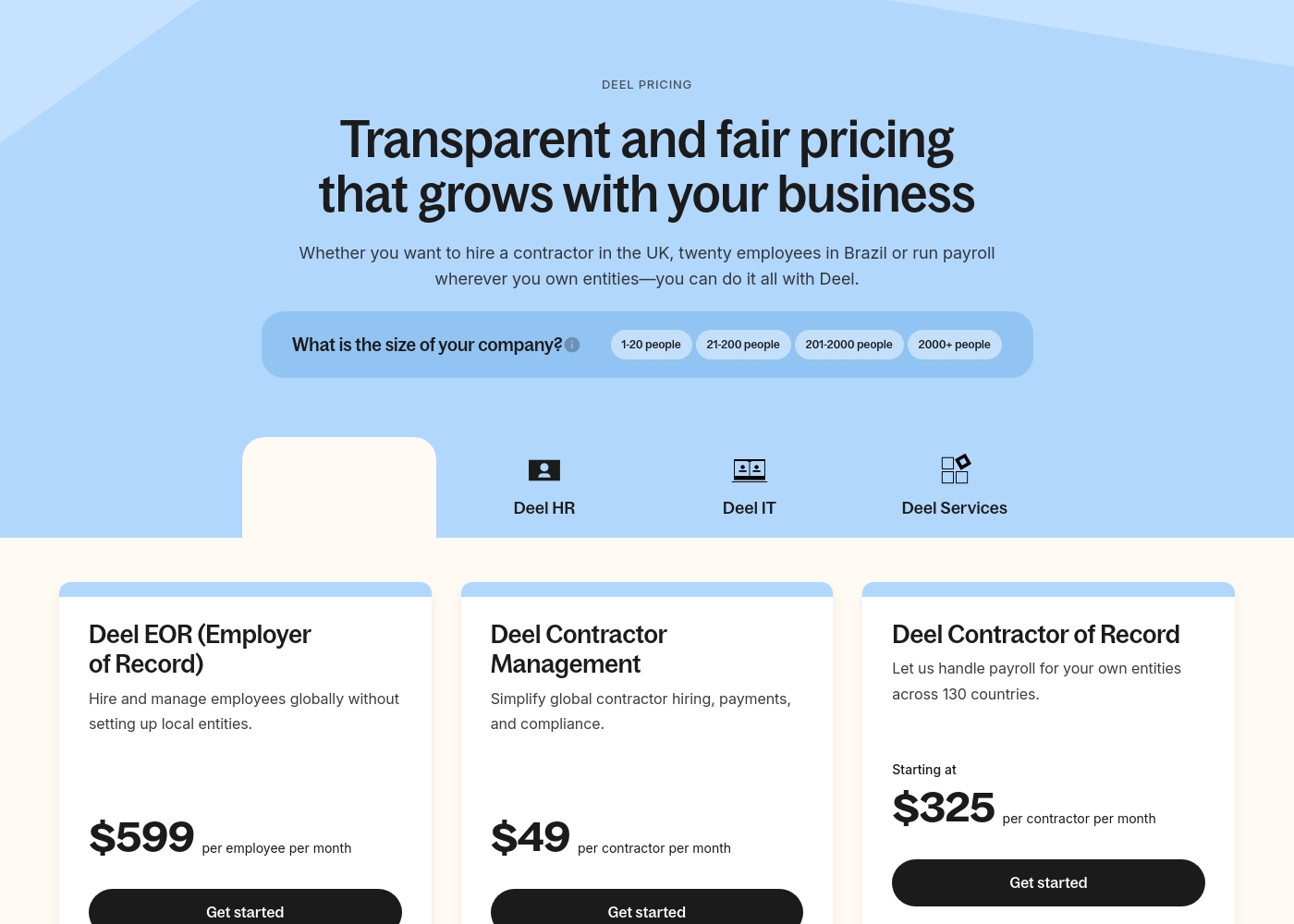
Deel costs between $29 per employee per month and $599 per employee per month with six solutions: Deel Global Payroll starting at $29, Deel Contractor Management at $49, Deel Contractor of Record starting at $325, and Deel EOR at $599.
Below you'll find a detailed breakdown of costs for Deel's comprehensive global HR and payroll services.
Deel EOR (Employer of Record)
Price: $599 per employee per month Best For: Hiring and managing full-time employees globally without setting up local entities. Other Features:
- Full legal employment in over 150 countries.
- Local tax, payroll, and labor compliance handled.
- Automated payroll processing and benefits administration.
- Seamless onboarding and contract generation.
- Continuous HR and legal support.
- Full legal employment in 150+ countries
- Local tax, payroll, and labor compliance
- Benefits administration
- Automated contract generation and onboarding
- Continuous HR and legal support
- Automated localized contract generation
- Compliant payments in 150+ currencies
- Tax document management
- Streamlined onboarding workflows
- Invoice approvals and expense tracking
- Compliance for contractor classification and worker status
- Tax and labor law adherence internationally
- Reduce misclassification risks
- Automated payment & invoicing
- Local contract management expertise
- Unified payroll processing compliant with local tax regulations
- Multi-currency payment support
- Exchange rate management
- Integrated reporting and analytics
- Employee self-service access
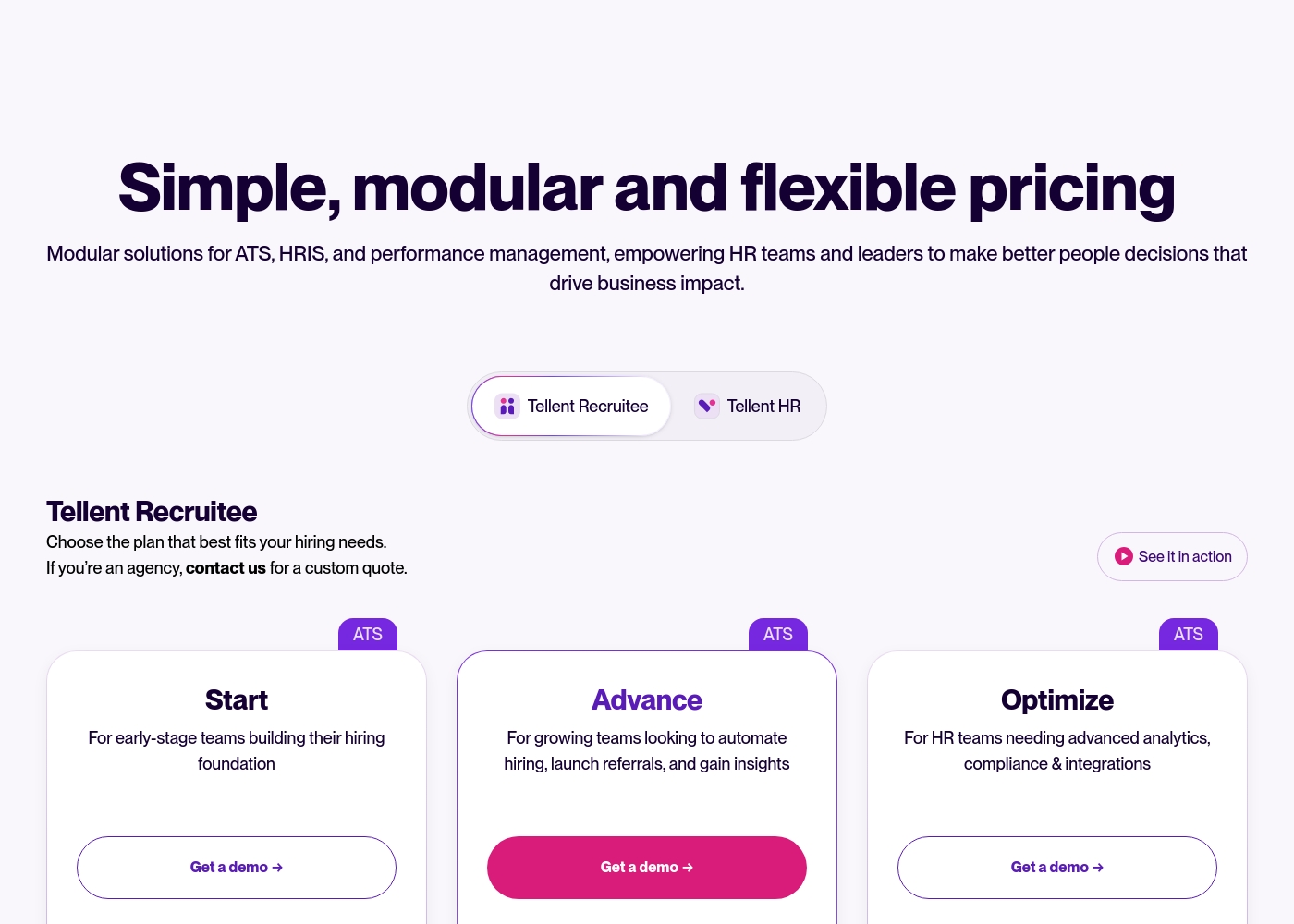
Tellent pricing: Tellent offers modular pricing with specific tiers for recruitment and HR management. Subscription costs increase based on your company's employee count with 20% savings available on annual plans. Plans range: 1–360/month Billing options: Free plan, Free trial, Monthly subscription, Yearly subscription, One-time payment, Usage-based pricing
Pricing Notes
- Deel has transparent, public pricing. Tellent requires contacting sales for a custom quote.
- Deel's EOR is a premium service at $599/employee/month. Tellent's pricing scales with team size.
- Deel offers a free demo and a 90-day trial for PEO. Tellent offers an 18-day free trial of core modules.
- Deel charges per worker type. Tellent charges per employee for the selected HR modules.
Pricing Head-to-Head
User Reviews
Deel enjoys overwhelmingly positive feedback, primarily due to its exceptional user experience and outstanding customer support. Reviewers frequently highlight the platform's intuitive, simple, and clean interface, describing onboarding new team members or setting up contracts as a quick and seamless process requiring only a few clicks.
The ability to manage global operations, enforce compliance, and centralize documentation easily is a major win for multi-national organizations. Reliability in payments is another standout feature; users report that money transfers are consistently reliable, without delays or mistakes, and they appreciate the wide variety of withdrawal methods available, including direct local bank transfers and crypto options.
I had an emergency situation and needed a document quickly. The support team went above and beyond to provide documentation fast, even though the standard response time was longer. They are incredibly helpful and professional.
From external reviews, Tellent receives praise for its intuitive interface and strong customer support, which helps teams onboard smoothly. Users often highlight the ease of use and the platform's ability to streamline recruitment and HR tasks.
However, some feedback points to occasional bugs and a learning curve with advanced features. Pricing can feel steep for smaller teams, and a few reviewers mention delays in support responsiveness during peak times.
The platform is really intuitive. It streamlined our hiring process and saved our team hours each week. Support has been helpful whenever we had questions.
Our Verdict
For most companies with global hiring needs, **Deel** is the more straightforward choice. Its core strength is making international payroll and compliance simple.\n\n**Deel's superpower** is its unmatched global coverage. You can legally hire and pay people in 150+ countries from day one. The Contractor of Record service also uniquely manages misclassification risk.\n\n**Tellent's superpower** is creating a unified internal HR hub. It beautifully connects recruiting, core HR, and performance into one employee journey. Its AI tools save real time on administrative tasks.\n\nThe deciding factor is your core problem. If you need to **pay and comply with external workers** worldwide, Deel is built for that. If you need to **manage and develop your internal team** more efficiently, Tellent is the platform.\n\n**Final Verdict:** Choose **Deel** for global expansion, contractor payments, and EOR. Choose **Tellent** to build a scalable, automated HR system for your growing internal workforce.
Frequently Asked Questions
Which is better for small teams: Deel or Tellent?
Deel is often better for small teams needing to pay a few international contractors. Tellent is better for small teams building their first structured HR and recruiting process.
Can I migrate from Deel to Tellent easily?
Migration depends on your use case. Deel handles external payroll data. Tellent manages internal HR records. You might use both platforms for different purposes.
Is Tellent worth the extra cost over Deel?
Tellent isn't necessarily more expensive; it's priced differently. It's worth it if you need unified recruiting, HR, and performance tools. Deel is better value for pure global payroll and EOR.
Does Deel offer performance management like Tellent?
No, Deel focuses on payroll, compliance, and contractor management. It does not include formal performance review or 360° feedback tools like Tellent's Grow module.
Which platform is easier to set up and use?
Deel is frequently praised for its simple, intuitive interface and fast onboarding. Tellent's modular system is powerful but may require more careful configuration during setup.
Can I use Deel for my internal HR and payroll?
Deel is best for managing external workers or employees via EOR. For pure internal HRIS and payroll for your own entity, Tellent's core modules are more focused.
Ready to Choose?
Both tools have their strengths. Choose based on your specific needs.