Deel vs Parim Workforce Software
Deel and Parim Workforce Software solve very different workforce problems. Deel is your global payroll and compliance engine. Parim is your shift scheduling and time-tracking hub. Your choice depends on whether you manage remote employees worldwide or on-site staff locally.
Best for: Startups and enterprises expanding globally, Companies hiring remote contractors in multiple countries
Best for: Security firms with large, mobile teams, Event staffing agencies managing hundreds of shifts
Seamless Global HR and Payment Engine
We found Deel to be a highly effective Global People Platform that successfully centralizes HR, compliance, and multi-currency payroll. The platform's extensive support for both contractors and EOR employees in over 150 countries minimizes legal risks globally. Overall, this service is backed by strong user sentiment and provides robust infrastructure for international workforce scaling.
Pros
- Extensive global coverage in over 150 countries (EOR and Contractor models).
- Extremely user-friendly interface and intuitive navigation.
- Fast and seamless onboarding process for new workers.
- Highly responsive, patient, and dedicated customer support is available 24/7.
Cons
- EOR model is a premium service at $599 per employee monthly.
- Users occasionally suggest reducing the number of necessary logins.
- Recent reports of new fees charged for certain cross-currency withdrawals.
A robust toolkit for shift-heavy operations.
We find Parim Workforce Software to be a comprehensive and well-structured solution for managing complex, shift-based teams. It excels at automating the entire cycle from scheduling to payroll, which can save significant administrative time. Overall, it’s a strong contender for agencies and businesses needing to scale operations with clarity and control.
Pros
- Comprehensive scheduling with templates, patterns, and self-service shifts.
- Automated time tracking, timesheet generation, and payroll calculation.
- Strong compliance features for managing rules, breaks, and certifications.
- Unlimited employees and locations across all plans for predictable scaling.
Cons
- Pricing is custom-quoted, lacking transparency on the website.
- No free trial or standard money-back guarantee mentioned.
- Feature availability depends entirely on the selected tier.
- Requires a demo or call to get detailed information.
AboutDeel
Deel is your all-in-one Global People Platform. It streamlines how you onboard, offboard, and manage your people internationally. This powerful tool supports all required elements like Payroll, HR, Compliance, and Taxes. 💡
This system is built to scale with organizations of all sizes. Whether you are a small team or an enterprise, Deel handles full compliance while you hire worldwide. This platform simplifies processes for paying all types of workers everywhere.
AboutParim Workforce Software
Parim is a comprehensive workforce management platform. It's designed for businesses with complex, shift-based work. This includes security firms, event staffing agencies, warehouses, and hospitality teams. The software helps you schedule, track time, manage payroll, and ensure compliance—all in one place. 💡
Highlights
Feature Comparison
Features Overview
We highlight the main differences and pick a winner for each feature.
Core Purpose
Deel manages global people. Parim manages local shifts. They serve opposite ends of the workforce spectrum.
Deel is an all-in-one Global People Platform. It handles international payroll, HR, compliance, and contractor payments for distributed teams. Parim Workforce Software is an operations-focused tool. It's built for scheduling, time tracking, and payroll for shift-heavy businesses like warehouses or security firms. The key difference is geographic scope vs. operational depth. Deel goes wide across 150+ countries. Parim goes deep into scheduling logic for specific sites. If you hire remotely worldwide, Deel is your system. If you manage on-site staff with complex rotas, Parim is your tool.
Global Hiring & Compliance
Deel is built for international expansion. Parim focuses on local labor law compliance.
Deel's Employer of Record (EOR) lets you hire employees in 130+ countries without a local entity. It handles taxes, benefits, and contracts. The Deel Compliance Hub provides real-time alerts on global regulatory changes. This is critical for distributed teams across borders. Parim tracks employee documents and certifications. It has tools for UK SIA badge checks and break-time rules, but its scope is narrower. For global expansion, Deel is the clear choice. Parim is for ensuring local staff meet specific site or industry rules.
Scheduling & Time Tracking
Parim is a scheduling powerhouse. Deel offers basic contractor time approval.
Parim offers advanced scheduling with templates, patterns, and open shifts for self-service. Its Event Module handles hundreds of shifts at once. Employees can clock in via a GPS-enabled mobile app or a kiosk. The system calculates hours, overtime, and holiday pay automatically. Deel's time tracking is simpler. It's mainly for contractor invoice approval and basic hours logging. If scheduling is your daily challenge, Parim is specialized for it. Deel's time features support its payroll engine, not operational management.
Payroll Processing
Both handle payroll, but for very different workforce types and scales.
Deel processes global payroll for employees in 130+ countries. It supports multi-currency payments and exchange rate management. It starts at $29 per employee/month for its own entities. The EOR service is $599 per employee/month for full legal employment. Parim calculates pay based on shifts, rates, and multipliers. It generates timesheets and reports for export, but the payroll run is typically handed off. Deel manages the entire end-to-end payment. Parim automates the calculation for you to process elsewhere.
Reporting & Analytics
Deel offers strategic workforce insights. Parim provides operational shift coverage data.
Deel provides unified reporting on compensation, OKRs, equity, and performance across your entire global team. Parim's analytics focus on shift coverage, absence trends, and timesheet summaries. The Premium plan adds timesheet analytics. The difference is in data type. Deel shows financial and performance metrics for decision-making. Parim shows operational metrics for day-to-day management. Deel's data helps you plan strategy. Parim's data helps you run shifts.
Client & Billing Management
Parim includes tools for staffing agencies. Deel does not.
Parim has a dedicated Client Portal. Clients can request shifts, and you can set specific billing rates for each client or site. The system generates invoicing reports based on those rates, streamlining the billing cycle for agencies. Deel's focus is on paying your workers, not billing your clients. It doesn't have a client-facing portal or project-based invoicing. If you run a staffing agency and need to manage client billing, Parim has built-in tools for that.
User Experience
Deel is praised for its simplicity. Parim's experience is functional but less documented.
Deel's interface is consistently described as clean, intuitive, and easy to navigate. Onboarding takes just a few clicks. Reviews highlight how enjoyable the process is, even for international paperwork. This reduces the learning curve significantly. Parim's user experience is not covered in external reviews. Its feature set suggests a focus on utility over sleek design. For a smoother, more polished daily experience, Deel has a strong reputation.
Customer Support
Deel guarantees rapid support. Parim's support details are unclear.
Deel promises a dedicated point of contact and a guaranteed 1.25-minute first response time for support needs. Users consistently praise the support team as responsive, professional, and willing to go above and beyond. Parim's website mentions 'dedicated staff' but does not specify support channels or response time SLAs. Deel provides transparent, fast support. Parim's support level is something you'd need to confirm during sales.
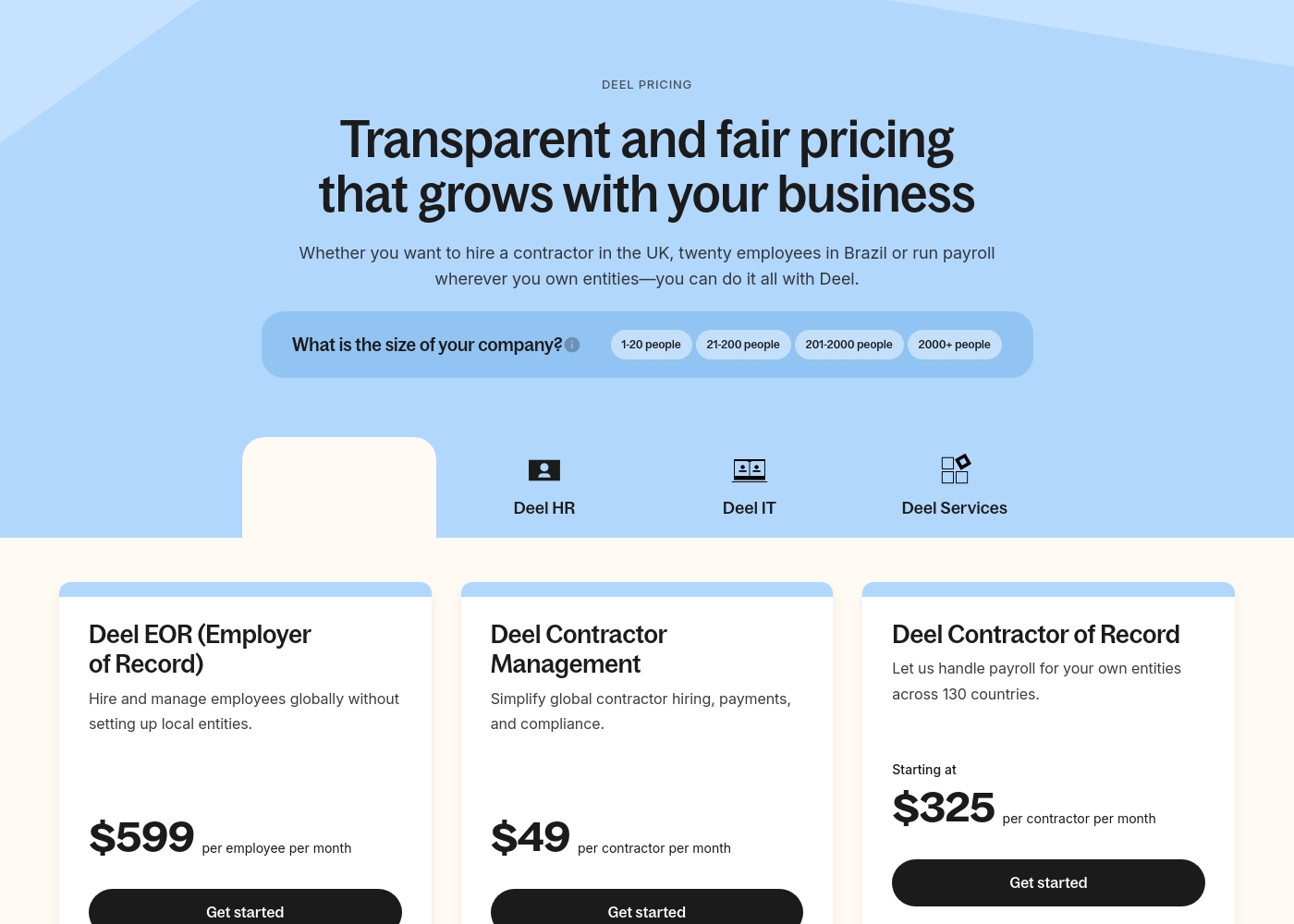
Deel costs between $29 per employee per month and $599 per employee per month with six solutions: Deel Global Payroll starting at $29, Deel Contractor Management at $49, Deel Contractor of Record starting at $325, and Deel EOR at $599.
Below you'll find a detailed breakdown of costs for Deel's comprehensive global HR and payroll services.
Deel EOR (Employer of Record)
Price: $599 per employee per month Best For: Hiring and managing full-time employees globally without setting up local entities. Other Features:
- Full legal employment in over 150 countries.
- Local tax, payroll, and labor compliance handled.
- Automated payroll processing and benefits administration.
- Seamless onboarding and contract generation.
- Continuous HR and legal support.
- Full legal employment in 150+ countries
- Local tax, payroll, and labor compliance
- Benefits administration
- Automated contract generation and onboarding
- Continuous HR and legal support
- Automated localized contract generation
- Compliant payments in 150+ currencies
- Tax document management
- Streamlined onboarding workflows
- Invoice approvals and expense tracking
- Compliance for contractor classification and worker status
- Tax and labor law adherence internationally
- Reduce misclassification risks
- Automated payment & invoicing
- Local contract management expertise
- Unified payroll processing compliant with local tax regulations
- Multi-currency payment support
- Exchange rate management
- Integrated reporting and analytics
- Employee self-service access
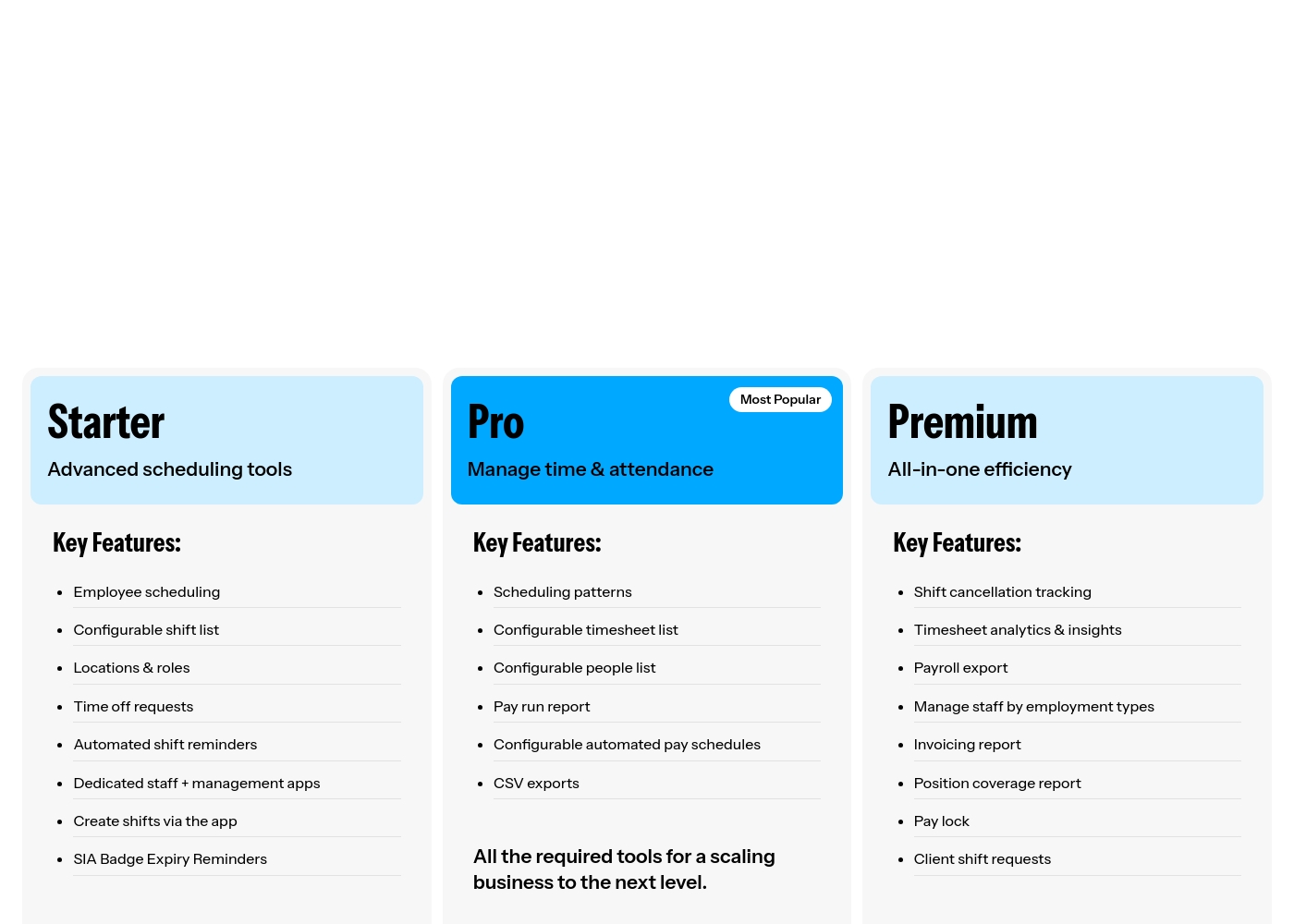
Parim Workforce Software pricing: Parim Workforce Software offers three tiered service levels—Starter, Pro, and Premium—with custom pricing based on your specific business needs. The platform includes unlimited employees and manager seats in every plan to help your operations grow without extra costs per person. 🚀
Take a look at the breakdown of our features below to see which plan fits your workflow best.
Starter
Best For: Advanced scheduling tools Other Features:
- Employee scheduling
- Configurable shift list
- Locations & roles
- Time off requests
- Automated shift reminders
Pricing Notes
- Deel's pricing is transparent and public. Parim requires a custom quote, so you must contact sales.
- Deel charges per worker. Parim offers unlimited employees and locations in all plans.
- Deel's EOR service ($599/employee) is a significant expense. Parim's cost is based on plan features, not headcount.
- Deel offers a free demo and has promotional offers. Parim does not advertise a free trial.
Pricing Head-to-Head
User Reviews
Deel enjoys overwhelmingly positive feedback, primarily due to its exceptional user experience and outstanding customer support. Reviewers frequently highlight the platform's intuitive, simple, and clean interface, describing onboarding new team members or setting up contracts as a quick and seamless process requiring only a few clicks.
The ability to manage global operations, enforce compliance, and centralize documentation easily is a major win for multi-national organizations. Reliability in payments is another standout feature; users report that money transfers are consistently reliable, without delays or mistakes, and they appreciate the wide variety of withdrawal methods available, including direct local bank transfers and crypto options.
I had an emergency situation and needed a document quickly. The support team went above and beyond to provide documentation fast, even though the standard response time was longer. They are incredibly helpful and professional.
Our external review check hit a wall. The Trustpilot page for Parim returned a 403 error, so we couldn't access any user reviews or ratings.
The Capterra page wasn't provided. Therefore, we have no external review data to summarize from these sources.
Our Verdict
The choice between Deel and Parim Workforce Software is clear: they solve fundamentally different problems. Deel's superpower is global scale. It's the fastest way to hire and pay compliantly in 150+ countries. Its transparent pricing and support make international expansion less scary. Parim's superpower is operational depth. It's built to tame complex shift schedules, automate timesheets, and handle the nuts and bolts of on-site workforce management. The deciding factor is your workforce type. Choose Deel if you manage remote employees or contractors across borders. Choose Parim if you manage on-site staff with intricate rotas and time clocks. For most growing companies with a distributed or international team, Deel is the more versatile and critical platform. For businesses with complex, local shift operations, Parim is a specialized tool that can save enormous administrative time.
Frequently Asked Questions
Which is better for small teams: Deel or Parim Workforce Software?
It depends entirely on your team's structure. Choose Deel if your small team is remote and distributed across different countries. Choose Parim Workforce Software if your small team works on-site with complex, shifting schedules.
Does Deel have scheduling features like Parim Workforce Software?
No, Deel does not offer advanced shift scheduling, self-service shifts, or an event management module. Its time tracking is primarily for contractor invoice approval, not operational scheduling.
Is Parim Workforce Software worth the extra cost over Deel?
Parim's pricing is not public, so a direct cost comparison is difficult. Parim uses unlimited user pricing, which may be more cost-effective for large local teams. Deel charges per worker, which adds up with global headcount.
Can I manage both global employees and on-site shift workers with one tool?
Not effectively. Deel and Parim are specialized for opposite ends of the spectrum. Deel is for global payroll and compliance. Parim is for local shift management and time tracking.
Which has better customer support?
Deel explicitly guarantees a 1.25-minute first response time and a dedicated contact. Parim's support channels and response times are not detailed on their website, so you'd need to ask sales.
Does Parim Workforce Software handle international payments?
Parim's focus is on calculating pay based on shifts, not on processing international payments or handling multi-currency payroll. That is a core feature of Deel's platform.
Ready to Choose?
Both tools have their strengths. Choose based on your specific needs.