Assembly vs Hive
Assembly and Hive aren't direct competitors, but they both aim to centralize work. Assembly focuses on client portals for service firms. Hive is a project management hub for internal teams. Choosing between them depends on whether your core challenge is external client experience or internal project coordination.
Best for: Accounting, law, and consulting firms seeking a unified client hub., Marketing and creative agencies wanting a branded client portal.
Best for: Agencies managing multiple client projects, Marketing teams coordinating campaigns
Solid all-in-one client portal
Overall, we find Assembly to be a strong, user-friendly platform for professional firms aiming to centralize client management and present a polished brand. It delivers on its core promise of a modern portal but may require consideration for specific integration needs or advanced customization.
Pros
- Intuitive, modern interface that is easy for clients and staff to navigate.
- Comprehensive all-in-one platform replacing scattered emails, files, and invoices.
- Strong branding and white-labeling options, especially on higher-tier plans.
- Includes key features like invoicing, messaging, and eSignatures without add-ons.
Cons
- Pricing escalates significantly for team seats and advanced features like HIPAA.
- Some users report navigation friction or layout issues when accessing specific features under time pressure.
- Integration options may require setup work if your specific software isn't listed.
- Not ideal for very simple or infrequent client interactions due to pricing structure.
Powerful hub for connected teams.
We found Hive excels at centralizing work across multiple tools into a single, AI-assisted workspace. Its flexible views and automation are strong assets, though the pricing structure and some user experiences around support warrant careful consideration. Overall, it's a robust choice for teams prioritizing integration and workflow efficiency.
Pros
- Centralizes work from tools like Slack, Salesforce, and email into one unified workspace.
- Offers flexible project views including Kanban, Gantt, Calendar, and Table.
- Integrates Buzz AI for smart search, summaries, and turning conversations into tasks.
- Provides a free forever tier and a free trial with no credit card required.
Cons
- Some users report confusion or dissatisfaction with billing and subscription management.
- Advanced features and support are often reserved for higher-tier, more expensive plans.
- Requires upfront integration setup to realize its full value, which may not suit all teams.
- Pricing details for some modules or support levels are not fully transparent upfront.
AboutAssembly
💡 Assembly is a client portal and back-office platform for professional service firms. It's built for businesses in accounting, law, marketing, real estate, and tech. The goal is to replace clutter with a single, client-friendly hub.
AboutHive
Hive is a project management platform built for teams of all kinds. From agencies and marketing teams to non-profits and education groups, it’s designed to organize collaboration and automate workflows. It’s not just a task list; it’s a connected system where your work happens. 💡
Highlights
Feature Comparison
Features Overview
We highlight the main differences and pick a winner for each feature.
Core Purpose
Assembly is for managing external clients. Hive is for managing internal projects.
Assembly provides a modern, branded client portal. Your clients log in to share files, sign contracts, and pay invoices. It's designed to replace scattered emails and create a professional impression. Hive creates a central workspace for your team. It pulls tasks, messages, and files from apps like Slack and email into one view. Your team collaborates internally on projects without switching tabs. The key difference is audience. Assembly faces outward to your customers. Hive faces inward to your colleagues.
Project Views
Hive offers rich project visualization. Assembly focuses on client-facing workflows.
Hive gives you multiple ways to see your work: Kanban boards, Gantt charts, calendars, tables, and lists. You can pick the view that fits each project or team member. Assembly's interface is structured around client timelines and portals. It organizes information by client, not by project view. Its focus is on transactional clarity, not complex project roadmaps. If your team thinks in Gantt charts and Kanban boards, Hive is the clear winner. If your workflow is more client-by-client, Assembly's structure makes more sense.
Client Collaboration
Assembly excels at client interactions. Hive is for team collaboration.
Assembly's core feature is a white-labeled client portal. Clients can log in, access documents, send messages, and complete payments. Everything is branded to look like your company. Hive is built for internal team members. It's where you manage tasks, automate workflows, and track project progress together. Client interaction typically happens through separate channels. For professional firms where client experience is paramount, Assembly delivers a dedicated solution. Hive keeps your internal work organized, but client management happens elsewhere.
AI Features
Hive includes a powerful AI assistant. Assembly uses AI for back-office organization.
Hive's Buzz AI can search across your connected apps (like Slack and email), summarize conversations, and even turn emails into tasks. It's an active assistant for your team's workflow. Assembly uses AI to help organize client data and provide visibility into interactions. It's more about automating and structuring information in your back office. Hive's AI is a more proactive, conversational tool for daily work. Assembly's AI is a backend feature for organization and insight.
Pricing Structure
Hive offers a free tier. Assembly starts at $39/month.
Hive has a free forever plan, which is great for small teams testing it out. Paid plans start low per user and scale with features. Assembly has no free tier. Its plans start at $39/month for one user and scale up based on clients, users, and features. Costs can rise quickly with team growth. If budget is your primary concern, Hive's free option gives it an edge. Assembly's value is in its all-in-one client tools, not low-cost entry.
Mobile Experience
Hive has a dedicated mobile app. Assembly relies on mobile browsers.
Hive offers a mobile app for iOS and Android. Your team can manage tasks, comment on projects, and stay updated on the go. Assembly does not have a standalone mobile app. The client portal and work are accessible through a mobile-optimized browser. This can be less convenient for frequent mobile use. For teams needing robust mobile access to projects, Hive is superior. For occasional client access from a phone, Assembly's mobile browser works but is more limited.
Compliance & Security
Assembly offers HIPAA compliance. Hive focuses on general project security.
Assembly's Advanced plan and above include HIPAA compliance with a signed BAA. This is critical for healthcare, legal, and financial firms handling sensitive data. Hive mentions security features but does not advertise specific compliance certifications like HIPAA on its public site. It is built for general business project security. If you need strict regulatory compliance for client data, Assembly provides a clear, dedicated path. Hive is for standard internal project data security needs.
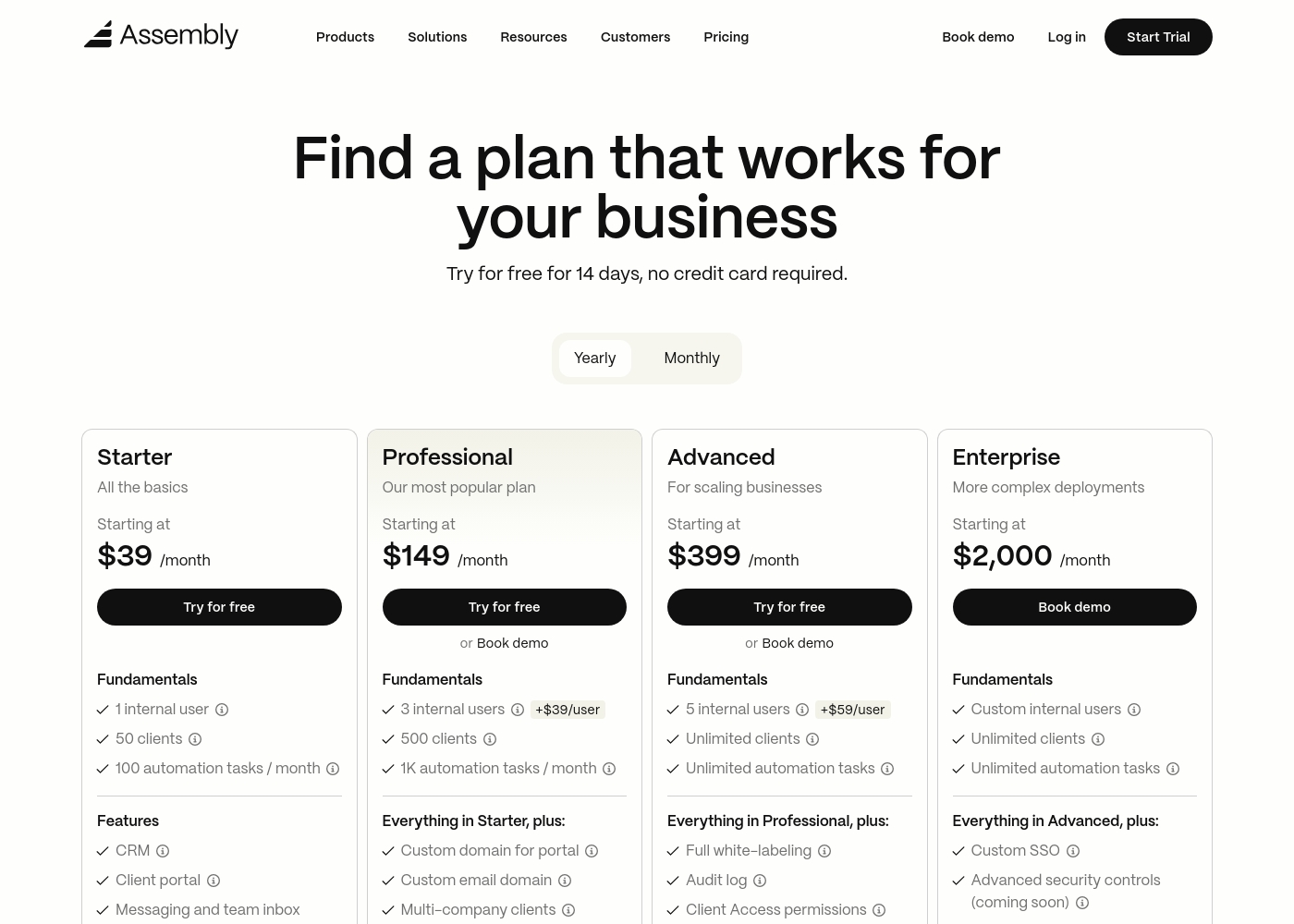
Assembly costs between $39 and $2,000 per month with 4 plans: Starter at $39, Professional at $149, Advanced at $399, and Enterprise at $2,000.
Take a look at the feature breakdown for each tier below.
Starter
Price: $39 / month Best For: Solo entrepreneurs and small service providers Refund Policy: 30-day satisfaction guarantee Other Features: CRM, white-labeled client portal, messaging, invoicing, and task management.
- CRM
- Client portal
- Messaging & inbox
- Invoices & pay links
- Proposals & contracts
- Custom domain
- API & Zapier/Make
- Multi-company clients
- Low payment fees
- Full white-labeling
- Audit log
- HIPAA compliance
- Client access permissions
- Custom SSO
- Sandbox workspace
- Dedicated success manager
- Technical advisor
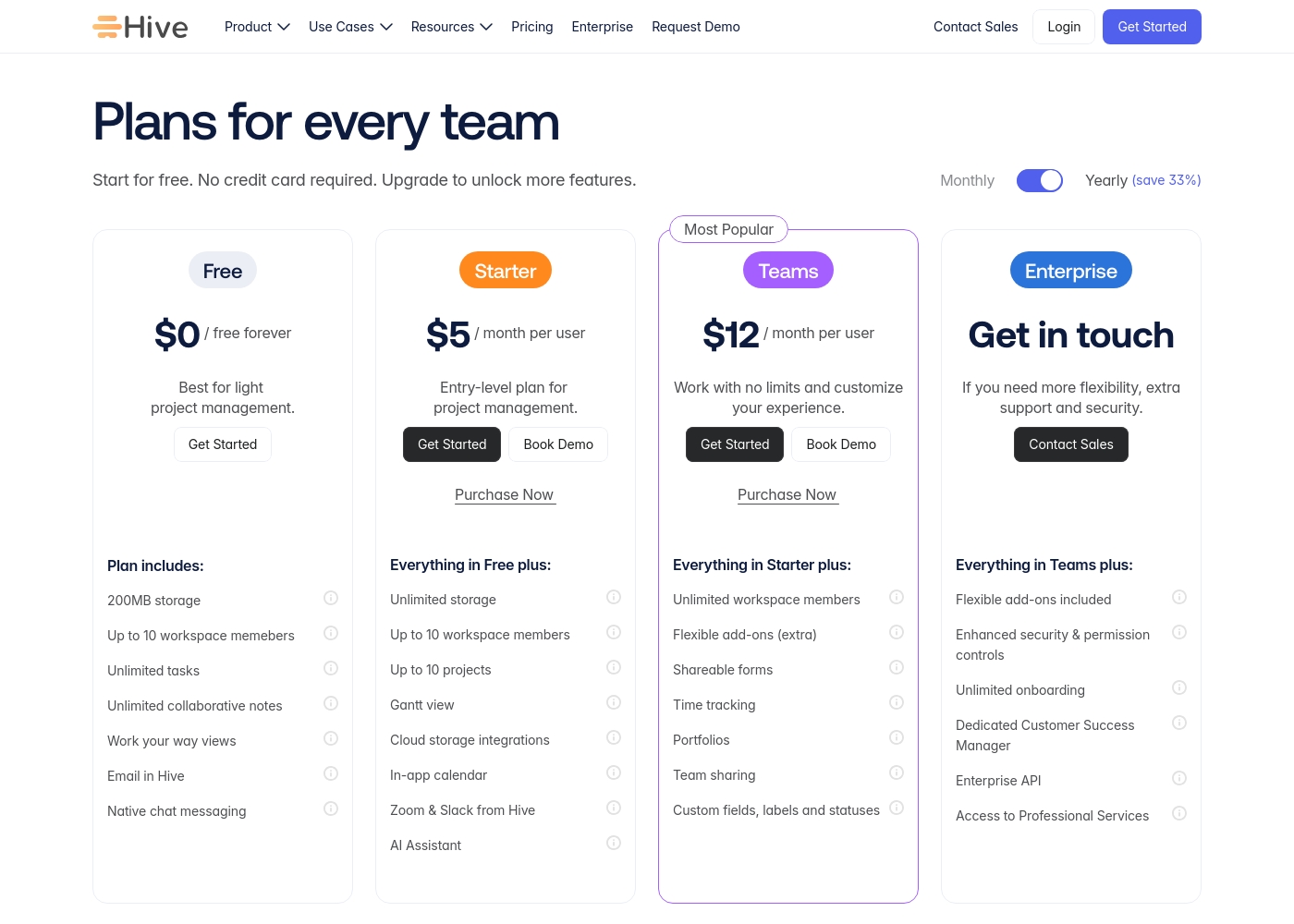
Hive pricing: Hive offers a range of options from a $0 free forever tier to a $12/month per user Teams plan. Subscriptions range from free tools for individuals to robust, feature-rich environments for growing organizations and enterprises alike.
Yearly billing is available to help you save on total costs over time. Monthly plans provide maximum flexibility if you prefer less commitment.
Pricing scales with features, allowing you to pay for only the power you need as your projects grow more complex. Add-ons like Buzz AI and time tracking are extra costs on mid-tier plans, which makes the pricing structure modular and customizable.
Pricing Notes
- Assembly has no free tier; its lowest plan is $39/month. Costs increase with team size and advanced features.
- Hive offers a free forever plan with basic features. Its paid Teams plan is about $12 per user per month.
- Assembly's pricing includes client limits and automation tasks on lower tiers. Hive's pricing scales primarily with the number of users.
- Both offer a 14-day free trial. Assembly also has a 30-day satisfaction guarantee.
- Hive's pricing for some advanced modules (like Buzz AI) is an extra cost. Assembly bundles features into its tiers.
Pricing Head-to-Head
User Reviews
From our research on Trustpilot and Capterra, users consistently praise Assembly for its modern, intuitive interface and the ease with which it centralizes client communication. The platform is frequently described as a clean, all-in-one hub that simplifies operations.
However, some users on Capterra note occasional friction in navigation under time pressure and desire more robust customization. Support responsiveness and the value of included features like invoicing and portals are highlighted as major positives, while pricing for higher tiers is seen as a consideration for scaling firms.
Assembly's interface is quick to navigate and simple to operate. It has been great for keeping our client recognition tasks organized in one place without a steep learning curve.
Reviewing Hive's external reputation, we found Trustpilot reviews to be mixed but often positive regarding the product's functionality and customer service responsiveness. Users frequently praise the platform's ease of use and comprehensive features for project management, noting its helpful support team. 📊 On the other hand, some reviews highlight concerns with pricing transparency and occasional billing issues, which can affect overall value perception. ⭐ Capterra's detailed review page was inaccessible due to security restrictions, preventing a full cross-platform synthesis. Based on the available Trustpilot snippets, the sentiment leans towards appreciation for Hive's core toolset and collaborative environment, though experiences with account management and subscription handling are less consistent.
Hive has been a game-changer for our marketing team. The ability to see all our projects in different views, like Gantt charts, helps us stay on top of deadlines. Customer support has also been very responsive whenever we had questions.
Our Verdict
Picking between Assembly and Hive is about choosing your battlefield. Assembly wins if your main pain is managing external clients. Hive wins if your challenge is internal project chaos. Assembly's superpower is the client experience. It gives your clients a branded, professional portal to interact with your firm. You get invoicing, eSignatures, and secure messaging in one place. Hive's superpower is team connection. It pulls your work from tools like Slack and email into a single view. Its flexible project views and AI assistant keep internal teams aligned. The deciding factor is simple: Who is the tool for? If it's for your clients, choose Assembly. If it's for your team, choose Hive. For a growing accounting firm tired of email chaos, Assembly is a game-changer. For a marketing agency juggling ten client campaigns, Hive saves hours every week.
Frequently Asked Questions
Can I use Assembly and Hive together?
You could, but their purposes differ. Assembly would handle your external client portal and billing. Hive would manage your internal team projects and collaboration. You'd likely use separate logins for each.
Which is cheaper for a team of 10 people?
Hive will likely be cheaper. Its Teams plan is about $12 per user per month. Assembly's Professional plan starts at $149 for 3 users, with extra seats costing $39 each. Hive also offers a free plan.
Does Assembly have project management features like Hive?
Assembly has basic task management for client work. However, it lacks Hive's advanced views like Gantt charts, Kanban boards, and calendar integration. Its focus is on client transactions, not complex project planning.
Is Hive good for client communication?
Hive is built for internal team communication. It's not designed to be a client-facing portal. For structured client interactions like file sharing and payments, Assembly is the dedicated tool.
Which tool is better for freelancers?
It depends on your needs. A solo consultant needing a client portal would prefer Assembly's Starter plan. A freelancer managing multiple project-based clients for different companies would benefit from Hive's views and automation.
Do both tools offer mobile apps?
No. Hive has a dedicated mobile app for iOS and Android. Assembly does not have a mobile app; its portal is accessed through a mobile browser on your phone or tablet.
Ready to Choose?
Both tools have their strengths. Choose based on your specific needs.