Assembly vs Databox
Assembly and Databox serve totally different needs, making this an 'apples vs oranges' comparison. Assembly is your client portal and back-office hub, while Databox is your business intelligence and analytics command center. Your choice depends on whether you need to manage client relationships or analyze performance data.
Best for: Accounting, law, and consulting firms seeking a unified client hub., Marketing and creative agencies wanting a branded client portal.
Best for: Marketing and sales teams, Digital marketing agencies
Solid all-in-one client portal
Overall, we find Assembly to be a strong, user-friendly platform for professional firms aiming to centralize client management and present a polished brand. It delivers on its core promise of a modern portal but may require consideration for specific integration needs or advanced customization.
Pros
- Intuitive, modern interface that is easy for clients and staff to navigate.
- Comprehensive all-in-one platform replacing scattered emails, files, and invoices.
- Strong branding and white-labeling options, especially on higher-tier plans.
- Includes key features like invoicing, messaging, and eSignatures without add-ons.
Cons
- Pricing escalates significantly for team seats and advanced features like HIPAA.
- Some users report navigation friction or layout issues when accessing specific features under time pressure.
- Integration options may require setup work if your specific software isn't listed.
- Not ideal for very simple or infrequent client interactions due to pricing structure.
Smart AI analytics for growing teams.
We found Databox is a capable BI platform that connects to many data sources and uses AI to explain performance. Overall, it's a strong choice for teams needing fast, actionable insights from their data, especially with its unlimited user model.
Pros
- AI-powered Genie provides instant, plain-English answers to data questions.
- Connects to 130+ data sources, creating a single source of truth.
- Unlimited users and dashboards on all paid plans, removing seat-based costs.
- Offers a free plan and a 14-day trial for paid tiers.
Cons
- Pricing starts at $159/month for paid plans, which may be high for small budgets.
- Advanced features like white-labeling are available as paid add-ons.
- Limited external review data was accessible for a full sentiment check.
- The platform's depth might require an onboarding period for full adoption.
AboutAssembly
💡 Assembly is a client portal and back-office platform for professional service firms. It's built for businesses in accounting, law, marketing, real estate, and tech. The goal is to replace clutter with a single, client-friendly hub.
AboutDatabox
Databox is a business intelligence and analytics platform built for teams that need clear, trusted answers fast. It connects directly to over 130 tools you already use, like CRMs and marketing platforms, and turns that data into shared metrics, dashboards, and AI-powered insights. Whether you're a marketing lead, a business analyst, or an agency owner, it's designed to help you understand performance without the technical headaches.
Highlights
Feature Comparison
Features Overview
We highlight the main differences and pick a winner for each feature.
Core Purpose
Assembly is a client management hub. Databox is a business performance analyzer.
Assembly gives your clients a branded portal to connect, pay, and share files. It replaces scattered emails and invoices with one modern hub. Databox connects directly to over 130 tools like CRMs and ad platforms. It turns raw data into clear, AI-powered insights about your business performance. The key difference is audience. Assembly is built for external client interaction. Databox is built for internal team analysis and decision-making.
User Interface
Assembly's UI is client-friendly and modern. Databox's UI is powerful for data exploration.
Assembly focuses on a clean, intuitive experience for both your team and your clients. Users praise its modern look and ease of navigation for common tasks. Databox offers a dashboard builder with over 300 templates. It's designed for self-service, letting non-technical users build views without SQL. The trade-off is complexity. Assembly's interface is simpler but less customizable for deep data analysis. Databox offers more power but may require a learning curve.
Integrations
Assembly integrates with your tools. Databox *is* your data integration layer.
Assembly connects via Zapier, Make, and API on the Professional plan ($149/mo). It's designed to fit into your existing workflow without a full replacement. Databox offers 130+ direct, pre-built connectors to marketing, sales, and finance tools. It pulls data from all of them into a single source of truth. For pure integration volume and depth, Databox is the clear leader. Assembly's integrations are more about extending a client portal.
Automation
Assembly automates client workflows. Databox automates data collection and reporting.
Assembly includes task automation (100-1K tasks/month on lower plans) for client onboarding and follow-ups. It helps automate repetitive client communication. Databox automates data syncing from 130+ sources and report generation. It can alert you to performance changes automatically. They automate completely different things. Assembly automates *client processes*. Databox automates *data aggregation and analysis*.
Reporting & Analytics
Databox is a dedicated analytics powerhouse. Assembly offers basic operational reporting.
Assembly provides visibility into client interactions, invoices, and tasks. Its reporting helps you manage day-to-day client operations. Databox features the AI Analyst (Genie) for instant answers in plain English. You can ask, 'Which campaign had the best ROI?' and get a clear answer. This is Databox's core superpower. For deep business performance analysis, Assembly cannot compete.
Pricing Model
Assembly charges per seat and plan tier. Databox has unlimited users on paid plans.
Assembly starts at $39/mo for 1 user and scales to $2,000/mo. Additional team seats cost extra ($39-$59/user). Pricing is tiered by features and client limits. Databox offers a free plan and paid tiers starting at $159/mo (annual). All paid plans include unlimited users and dashboards, with extra data sources billed separately. For teams, Databox's model can be more predictable and cost-effective as you grow. Assembly's costs rise significantly with team size.
Customer Support
Assembly offers tiered support from email to a dedicated manager. Databox provides standard chat support.
Assembly's support scales with your plan: from standard (Starter) to a dedicated success manager and Slack channel (Enterprise). Priority support is on paid tiers. Databox includes chat support and a help center on all plans. The Premium plan adds priority support, but specifics on response times are not detailed. Assembly offers more structured, higher-touch support options for larger clients. Databox's support is more standardized.
Security & Compliance
Assembly has clear, tiered compliance features. Databox relies on cloud provider certifications.
Assembly offers SOC2 and HIPAA compliance (with a BAA) on the Advanced plan ($399/mo). It includes audit logs and client access permissions. Databox runs on AWS with AES-256 encryption and is GDPR compliant. It inherits AWS's ISO 27001, SOC, and PCI certifications. Assembly's compliance is a proactive, marketable feature for regulated industries. Databox's security is robust but less specialized for client data handling.
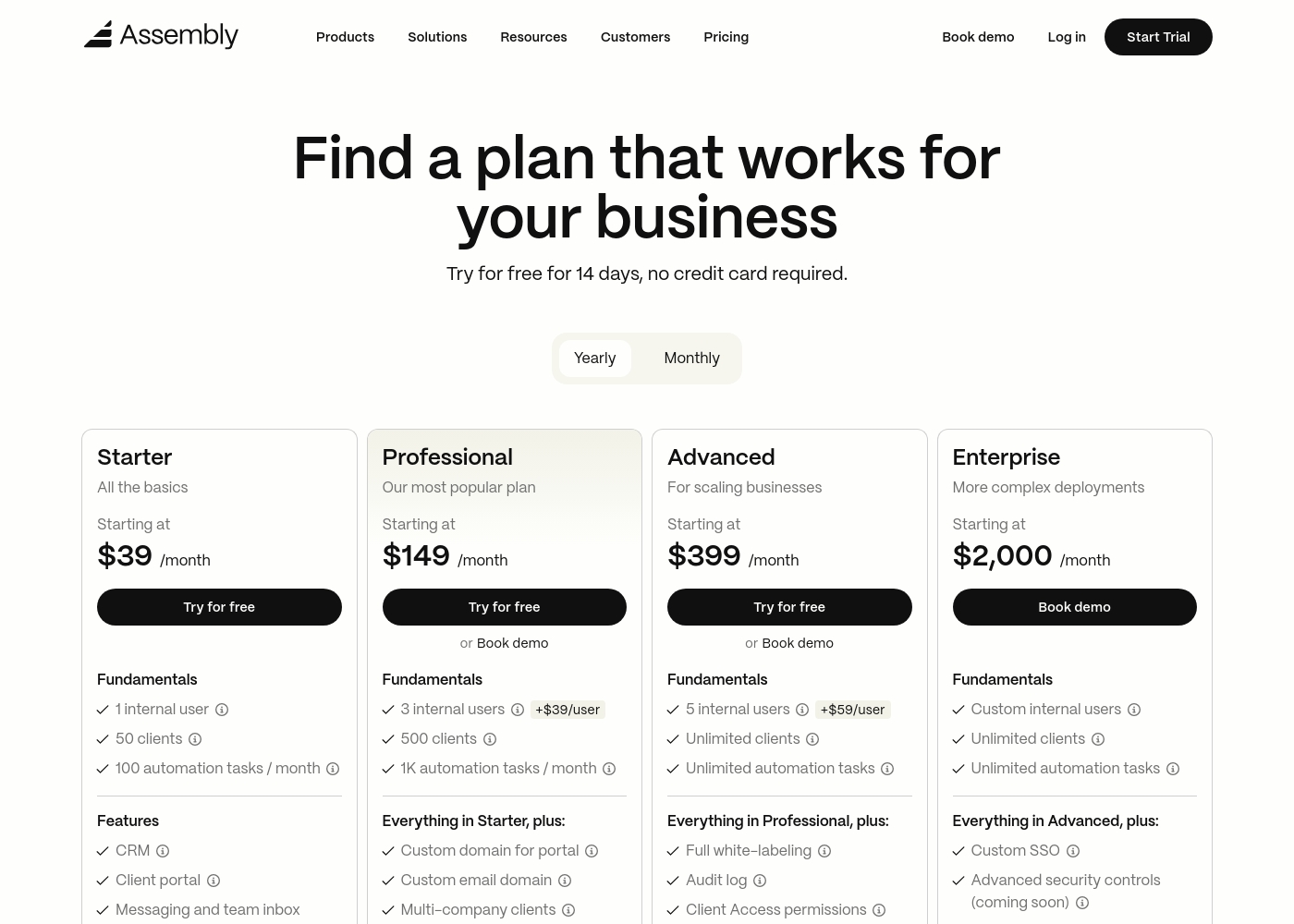
Assembly costs between $39 and $2,000 per month with 4 plans: Starter at $39, Professional at $149, Advanced at $399, and Enterprise at $2,000.
Take a look at the feature breakdown for each tier below.
Starter
Price: $39 / month Best For: Solo entrepreneurs and small service providers Refund Policy: 30-day satisfaction guarantee Other Features: CRM, white-labeled client portal, messaging, invoicing, and task management.
- CRM
- Client portal
- Messaging & inbox
- Invoices & pay links
- Proposals & contracts
- Custom domain
- API & Zapier/Make
- Multi-company clients
- Low payment fees
- Full white-labeling
- Audit log
- HIPAA compliance
- Client access permissions
- Custom SSO
- Sandbox workspace
- Dedicated success manager
- Technical advisor
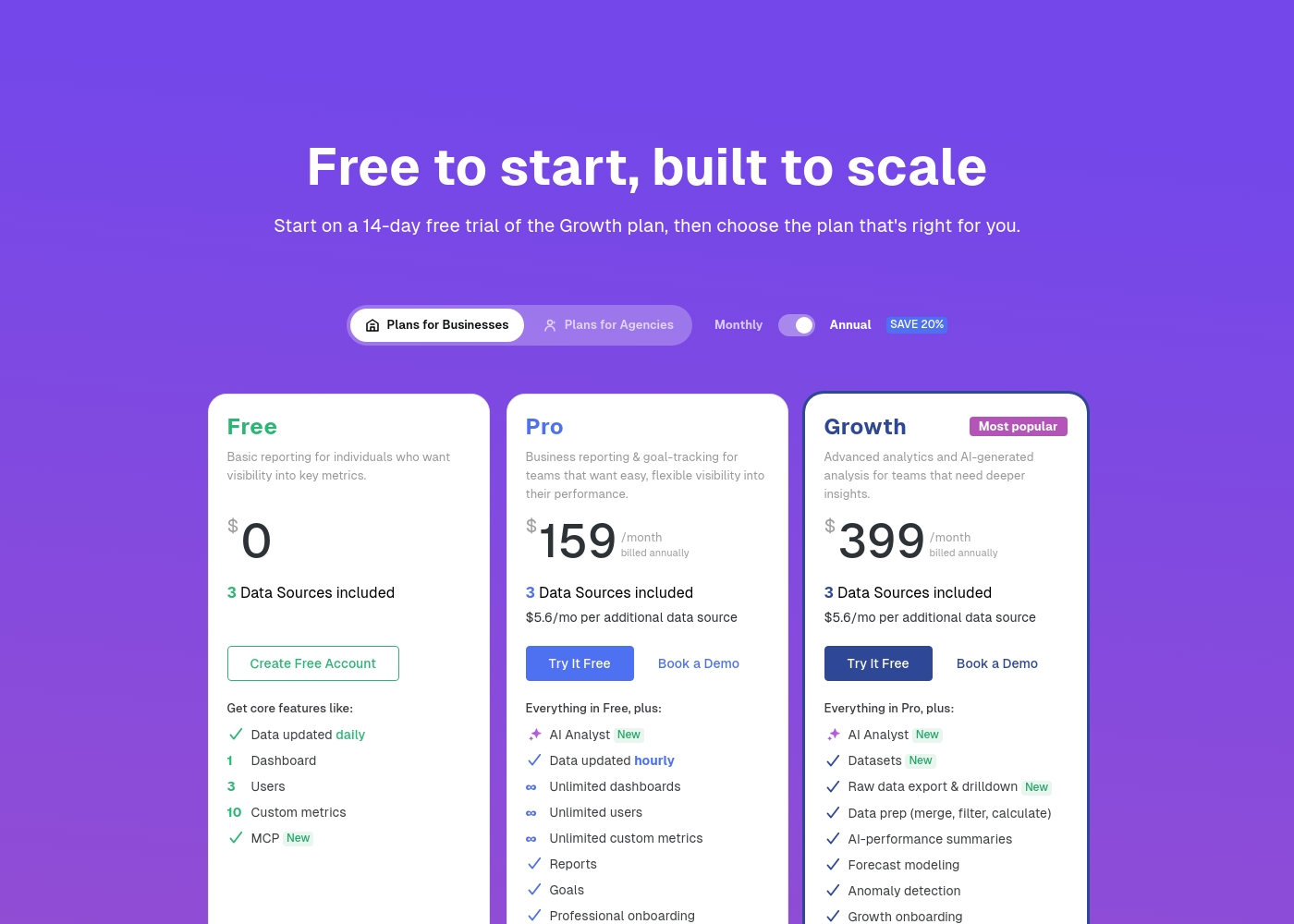
Databox pricing: Databox offers a forever-free plan and three paid tiers starting at $159/month when billed annually. Pricing is based on data features and bundled data sources, with a 20% discount on yearly subscriptions.
All paid plans include unlimited users and dashboards, but extra data sources are billed based on a per-source monthly fee. A 14-day free trial is available for all new users to explore the full-featured platform before committing to a paid plan.
Professional, Growth, and Premium tiers ensure high scalability for teams of any size by removing seat-based pricing and offering advanced analytics, AI-powered reports, and business intelligence features regardless of team complexity or user count. For even more power, you can also add on specialized services like OKRs and white-labeling to truly customize your dashboard experience for your organization or clients' needs and brand standards through their flexible dashboard portal.
Pricing Notes
- Assembly's entry price is lower ($39/mo vs $159/mo for Databox's paid start), but costs escalate quickly with team seats.
- Databox's free plan is a major advantage for individuals or small teams just starting with analytics.
- Both offer 14-day free trials. Assembly also has a 30-day satisfaction guarantee.
- Databox's model of unlimited users on paid plans makes it more cost-effective for larger teams.
- Assembly charges per user ($39-$59/user) on Professional and Advanced plans, which can significantly increase monthly costs.
Pricing Head-to-Head
User Reviews
From our research on Trustpilot and Capterra, users consistently praise Assembly for its modern, intuitive interface and the ease with which it centralizes client communication. The platform is frequently described as a clean, all-in-one hub that simplifies operations.
However, some users on Capterra note occasional friction in navigation under time pressure and desire more robust customization. Support responsiveness and the value of included features like invoicing and portals are highlighted as major positives, while pricing for higher tiers is seen as a consideration for scaling firms.
Assembly's interface is quick to navigate and simple to operate. It has been great for keeping our client recognition tasks organized in one place without a steep learning curve.
We found external review snippets were blocked by security checks on both Trustpilot and Capterra, preventing us from gathering specific user feedback from these sources. Therefore, our assessment is based solely on the provided website content and pricing information, which highlights key features like AI-powered analytics, extensive integrations, and unlimited users on paid plans.
Our Verdict
This isn't a close race—it's a choice between two different tools for two different jobs. Assembly and Databox are built to solve completely separate business problems. Assembly's superpower is creating a beautiful, modern client portal. It gives your clients a single hub to message you, sign contracts, pay invoices, and share files. It replaces the chaos of scattered emails. Databox's superpower is turning business data into instant, AI-powered answers. It connects to 130+ tools and lets you ask questions like 'Which campaign worked best?' in plain English. It's your team's analytics command center. The deciding factor is your primary pain point. If your clients are lost in email threads and you need a professional front door, choose Assembly. If your team is drowning in spreadsheets and data silos, choose Databox. For most professional service firms like agencies, consultants, and law offices, **Assembly is the clear choice** to improve client relationships. For marketing teams, sales ops, or any data-driven group needing performance clarity, **Databox is the tool to pick**.
Frequently Asked Questions
Can I use Assembly and Databox together?
Yes, they serve different purposes. Assembly could manage client relationships, while Databox analyzes your marketing performance data. They might integrate if Databox pulls data from Assembly.
Which is better for small teams: Assembly or Databox?
It depends on the team's role. A small consulting team would benefit from Assembly's client portal. A small marketing team would benefit from Databox's analytics and free plan.
Is Databox worth the higher starting price over Assembly?
If you need deep business analytics and have multiple data sources, yes. Databox's $159/mo plan includes unlimited users. Assembly's $39/mo plan is for a single user with client portal tools.
Does Assembly have AI features like Databox?
No. Assembly's strength is client management and operations. Databox's core feature is its AI Analyst (Genie) for instant data insights.
Which tool is easier to set up for a non-technical user?
Both aim for ease of use. Assembly's setup is guided for creating a portal. Databox offers 300+ templates to quickly build dashboards from connected data sources.
Can I migrate my client data from Assembly to another tool later?
Assembly includes API access on paid plans, which allows for data export and migration. You should confirm specifics with their support team.
Ready to Choose?
Both tools have their strengths. Choose based on your specific needs.