Sapling

Sapling review

Word-level AI detection with highlighted evidence for ChatGPT and Gemini text.

Sapling costs from $15/mo · 4 plans · Free plan available · prices checked Oct 13, 2026

By Ciroapp Editorial Team · Updated Sep 16, 2026

Commission may apply at no extra cost

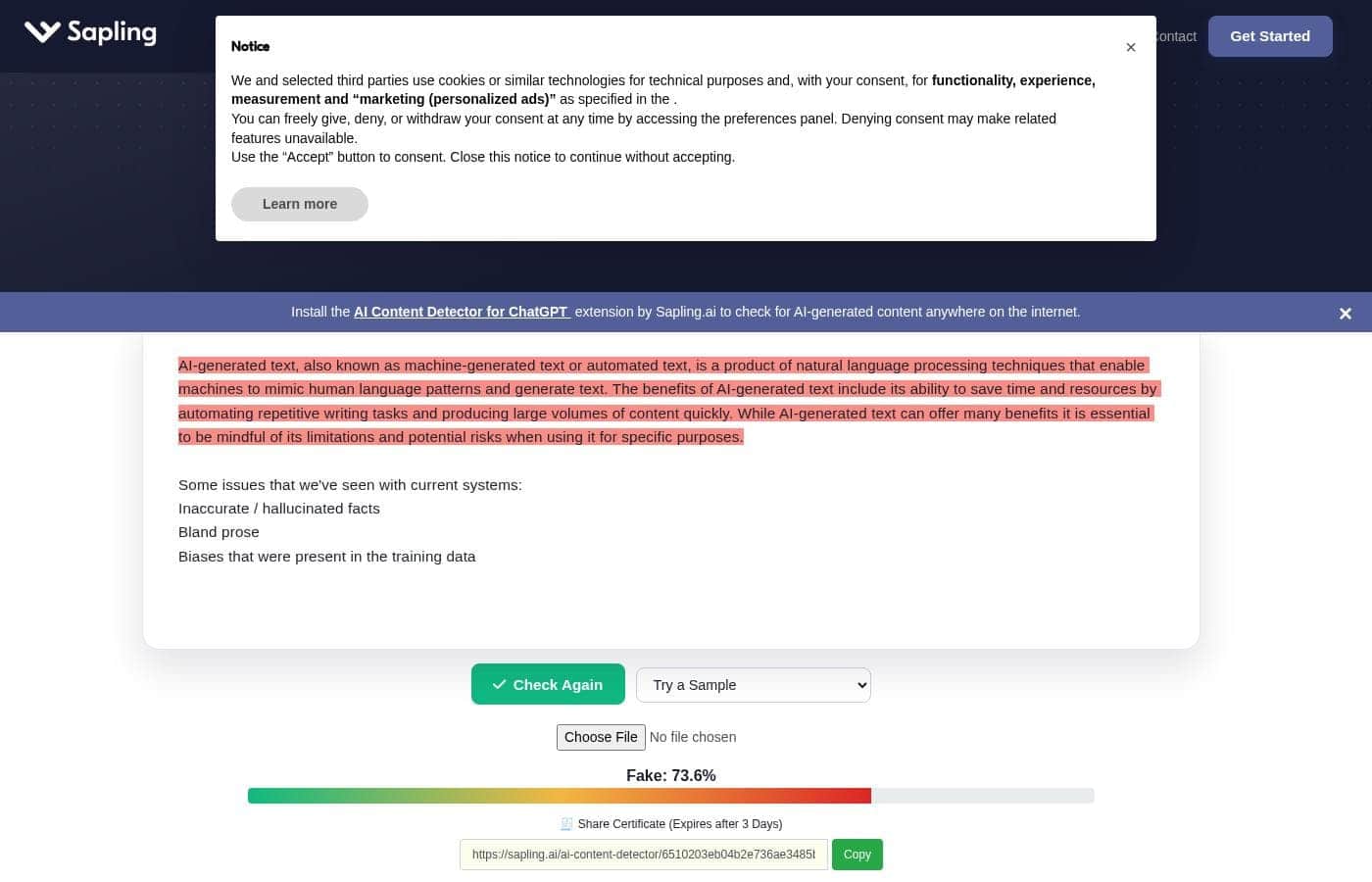
Sapling homepage screenshot

At a glance

Quick overview for Sapling: rating, pricing summary, key features, and highlights.
Pricing verified Oct 13, 2026

Ciroapp score

3.5/ 5

Sapling shows you which words and sentences look machine-generated instead of handing over one opaque score, though its probabilistic calls can false-flag formulaic human writing and no third-party reviews verify its accuracy. Overall, it's a sensible free-to-try pick for educators and editors who need visible reasoning behind an AI flag.

Pros

  • Pros:Provides per-word probability estimates rather than just a single document score, letting reviewers see exactly which tokens look machine-generated.
  • Pros:Highlights suspect passages inline, making it much faster to locate and discuss AI-written sections in long documents.
  • Pros:Flags low-perplexity sentences as a second signal, catching the simplistic or clichéd phrasing typical of raw AI output.

Cons

  • Cons:Detection is probabilistic and can produce false positives—particularly on writing by non-native English speakers or formulaic human prose—so flagged text still requires human review.
  • Cons:Accuracy is calibrated against current mainstream models like ChatGPT and Gemini; newer, fine-tuned, or heavily paraphrased AI output may evade detection.
  • Cons:No third-party review data from platforms like G2, Capterra, or Trustpilot was available at review time, so real-world accuracy could not be independently verified.
Best for
  • Educators and academic integrity staff who need sentence-level evidence before raising AI-use concerns with students
  • Editors and content managers screening freelance or AI-assisted drafts for machine-written passages
  • Practitioners reviewing large volumes of synthetic text who need fast, visual triage by score and highlighting
This section is a summary. Detailed sections about features, use cases, pricing, and reviews follow below.

What is Sapling?

Sapling's AI Content Detector estimates how likely a piece of text was produced by large language models such as ChatGPT or Gemini. Rather than returning a single opaque verdict, it scores the whole passage and highlights the individual words and sentences most likely to be machine-generated, including low-perplexity phrasing that reads as generic. That granularity makes it practical for educators checking student work and for teams reviewing large volumes of synthetic content.

Sapling AI Content Detector is a web-based detection tool built on a Transformer-based machine learning system. It analyzes submitted text and estimates the probability that each word or token was generated by an AI model, then aggregates those estimates into an overall score for the document. Results are presented visually: an overall text score, highlighted portions of the original input, and flags on individual sentences with low perplexity—a signal often associated with simplistic or cliché-heavy phrasing.
Should you choose Sapling?

Quick buyer guidance before you compare plans or click through.

Choose it if

  • Educators and academic integrity staff who need sentence-level evidence before raising AI-use concerns with students
  • Editors and content managers screening freelance or AI-assisted drafts for machine-written passages
  • Practitioners reviewing large volumes of synthetic text who need fast, visual triage by score and highlighting

Skip it if

  • Situations where a detector score alone must serve as proof—Sapling's output is a probability estimate, not a verdict
  • Reviewers who need attribution to a specific AI model or version rather than a machine-generated likelihood
  • Writers whose natural style is highly formulaic, since low-perplexity human prose can resemble AI patterns and trigger flags

Next steps before buying

  1. 1Go to sapling.ai/ai-content-detector and paste the text you want to check into the detector—no installation required
  2. 2Review the overall score first, then scan the highlighted words and sentences to see where machine generation is most likely
  3. 3Note any low-perplexity sentence flags and read those sentences manually for clichéd or generic phrasing
  4. 4If you'll be checking content regularly, test the free plan or trial, then compare subscription and usage-based tiers as your volume grows

Sapling Key Features

✨ Transformer-Based Token Probability Analysis

Sapling runs submitted text through a specialized Transformer-based machine learning system trained to estimate, for every word or token, the probability that it was machine-generated. This token-level approach is what allows the tool to point at specific phrases instead of issuing only a document-wide guess, and it underpins both the overall score and the inline highlights you see in the results view.

✨ Visual Results with Highlighted Passages

Detection results are presented visually rather than as a bare number. You see an overall probability score for the whole text alongside highlighted portions of the original input, so you can immediately locate the sections that drove the verdict. For anyone who has to explain or defend a detection result, this side-by-side evidence is far more actionable than a percentage alone.

✨ Low-Perplexity Sentence Flagging

Beyond generator probability, Sapling flags individual sentences with low perplexity—phrasing that is statistically predictable. This catches a different failure mode: human-sounding but simplistic or clichéd writing, which is common in raw AI output even when it doesn't trip the generator classifier. It serves as a useful second signal when reviewing drafts for formulaic prose.

✨ Multi-Model Coverage

The detector is designed to evaluate text produced by widely used large language models, including ChatGPT and Gemini. Coverage of the dominant model families means one tool can serve mixed content pipelines where drafts may originate from different generators, without switching between specialized checkers.

Use Cases

💡 Upholding Academic Integrity

Educators can run student essays and assignments through the detector to gauge whether machine generation played a role. Word-level scores and highlighted passages give instructors concrete passages to discuss with students, turning a vague suspicion into a specific, reviewable finding—an important distinction when academic consequences are on the line.

💡 Editorial Screening of Freelance and AI-Assisted Drafts

Content teams receiving work from freelancers or AI-assisted workflows can paste drafts into the detector before acceptance. Sentence-level flags for low-perplexity, cliché-heavy phrasing point editors to the exact paragraphs that need a human rewrite, shortening revision cycles and protecting publication standards.

💡 Auditing Synthetic Content at Scale

Practitioners who review large volumes of synthetic text—moderators, data annotators, compliance reviewers—can use the visual scoring to triage. Documents with high overall scores and dense highlighting can be escalated for manual review, while clean passages move through the pipeline faster.

💡 Improving Human-Written Copy

Writers can use low-perplexity flags as an editorial signal: if a sentence is statistically predictable enough to be flagged, it may read as generic to human readers too. Running a draft through the detector before publication offers a quick pass for formulaic phrasing and overused constructions.

Sapling pricing

From$15/mo

  • From the vendor's pricing page, checked Oct 13, 2026
  • 4 plans
  • Free plan available

Prices checked on Oct 13, 2026 from Sapling's pricing page

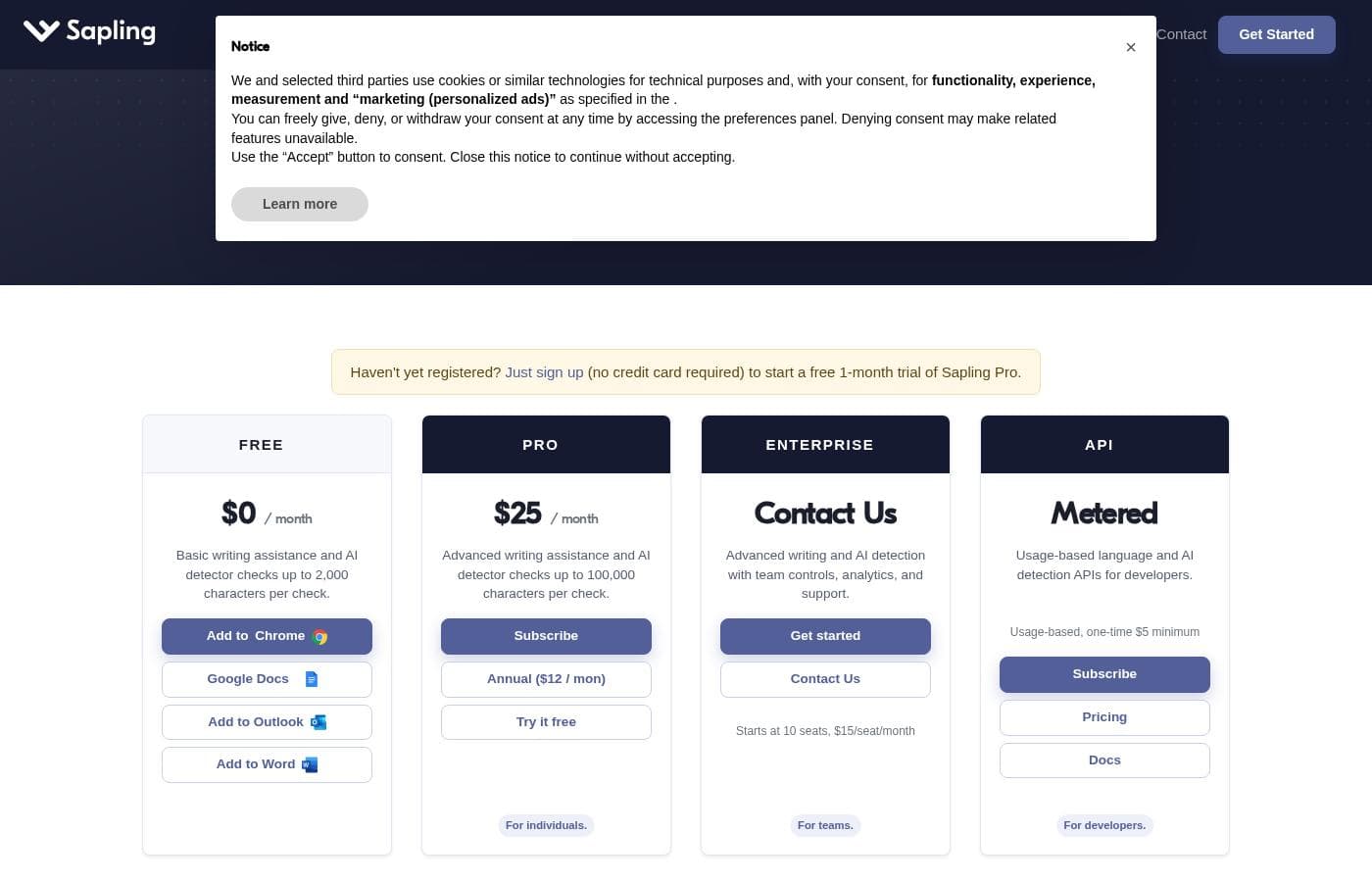
Sapling pricing page screenshotView pricing page screenshot
PlanBilled monthlyBilled annuallyIncludes
Free
Free
—
Pro
$25/mo
—
Metered
$5
—
Custom
per user
$15/mo
—
per user

Price history

Tracking prices since Oct 1, 2026. No price change detected yet.

Pricing types: Free plan, Free trial, Monthly subscription, One-time payment, Usage-based pricing

Pricing notes

Sapling pricing: Plans from $0/month Billing options: Free plan, Free trial, Monthly subscription, One-time payment, Usage-based pricing

Cost calculator

Estimate what Sapling costs for your team.

Billing
Per month
$25
Per year
$300

Pro states no user limit: shown as one price for the whole account. Check the price for 5 users with the vendor. Estimate based on published list prices, before taxes, add-ons and discounts.

How to pay less for Sapling

  • Start on the free plan and upgrade only when you hit its limits.
  • Some plans are priced per user: only pay for seats people actually use.
Visit Sapling

Email me when Sapling changes price

One email when we detect a price change on the vendor's pricing page. No newsletter, no deals. Unsubscribe in one click.

User Reviews

No reviews yet.

Write a Review

Write a Review for Sapling
0/100 characters
0/2000 characters

Why use Sapling?

Most detectors hand you a single percentage and leave you to guess where the AI writing actually is. Sapling narrows that gap by showing exactly which words and sentences drove the score, which matters when you need to justify a decision to a student, an editor, or a client.

For practitioners handling high volumes of synthetic text, sentence-level flags for low-perplexity phrasing offer a fast way to spot formulaic passages without reading every line.

Sapling alternatives

Other tools in the AI Detector category

View all AI Detector tools
Pangram Labs

Pangram Labs

AI Detector4.3/5

Pangram is an AI content detection tool for text and images. It flags writing from models like ChatGPT, Claude, Gemini, Grok, and Llama, shows how much of a document is AI, and highlights sections edited with AI assistance. It also includes plagiarism checking. It's built for teachers, universities, publishers, enterprises, and anyone who needs to verify written work is human.

GPTZero

GPTZero

AI Detector4.2/5

GPTZero is a dedicated AI content checker that recognizes machine-generated text in any document. This powerful proprietary model helps you identify exactly which parts of a text originated with a large language model (LLM). How does it work? It analyzes text for key patterns that distinguish machine writing from human writing. These factors include checking for predictability (perplexity), variation in sentence structure (burstiness), and whether the tone is overly generic or repetitive. Since its founding in January 2023, GPTZero has quickly become essential. It has served over 10 million users and is used by hundreds of institutions, especially in education. It is truly built for contexts where authentic and quality writing matters most.

Copyleaks

Copyleaks

AI Detector4.1/5

Copyleaks is a robust platform focusing on digital authenticity. It uses advanced AI technology to analyze unique text patterns. This focus allows the system to flag content created by various Large Language Models (LLMs), including GPT-5, Gemini, Claude, and dozens more. The tool helps you clearly identify AI writing because it looks for signals left behind by statistical modeling. You can also get detailed reports that separate elements written by humans from AI-generated text, even when both are mixed. The platform is truly built for accuracy and scalability.

Writer

Writer

AI Detector4.1/5

The Writer AI Content Detector is a straightforward tool designed for speed and accuracy. It quickly examines your text to determine if it was created by artificial intelligence. This is perfect for writers, editors, and publishers who need simple verification. You can paste your text or even submit a URL for analysis. It gives you the information you need to feel confident before you hit "publish."

Originality.AI

Originality.AI

AI Detector4/5

Originality.ai is a specialized tool developed to authenticate content origin. It’s built on technology that determines if text is created by a person or an advanced AI model, such as ChatGPT-3. The system scans the material and provides a clarity score, specifically ranging from 0 to 100. 💡 This tool is useful for anyone relying on external writers, including marketing managers and web publishers. It helps you ensure that the content you receive is authentic and meets your standards for originality and expertise.

Winston AI

Winston AI

AI Detector3.6/5

Winston AI is a comprehensive integrity solution designed to verify whether text was created by a human or generated by artificial intelligence. Institutions, publishers, and professionals primarily choose it for its industry-leading accuracy rates. It empowers everyone, from large educational bodies to individual SEO writers, to confirm content authenticity. You can create a free account to begin checking for AI content immediately. It serves as a complete solution combined with plagiarism detection and AI image detection capabilities.

Sapling FAQ

How much does Sapling cost?

Sapling's cheapest paid plan, Custom, costs $15 per month. Paid plans range from $15 to $25 per month. Prices checked on Oct 13, 2026 from the vendor's pricing page.

Does Sapling have a free plan?

Yes. Sapling has a free plan (Free); paid plans start at $15 per month.

Has Sapling's price changed recently?

No. We have not detected a price change since we started tracking on Oct 1, 2026.

How does Sapling's AI Content Detector determine whether text is machine-generated?

It runs your text through a Transformer-based machine learning system that estimates, for each word or token, the probability that it was generated by a model such as ChatGPT or Gemini. Those token-level estimates roll up into an overall score for the document, and the interface highlights the specific portions that look most machine-generated. Sentences with low perplexity—statistically predictable phrasing—are flagged separately as a sign of simplistic or clichéd writing.

Is the Sapling AI Content Detector free?

Yes, there is a free plan and a free trial, so you can test the detector without paying.

Can Sapling tell me which AI model wrote a piece of text?

Not precisely. The detector estimates the probability that text was machine-generated, naming ChatGPT and Gemini as the types of models it is designed to catch. Treat the output as a likelihood assessment rather than definitive attribution to a specific tool or model version.

What should I do if a passage is flagged as AI-generated?

Treat the flag as a starting point for review rather than a verdict. Examine the highlighted words and low-perplexity sentences to see whether the phrasing is genuinely formulaic, then weigh context such as the writer's background and whether the text was edited after generation. Because detection is probabilistic, human judgment should make the final call, especially when grades or contracts are at stake.

Ready to try Sapling? Check out the official site or pricing.

Are you Sapling? Claim this listing · Get the badge