ERPNext

ERPNext review

Open-source ERP where you pay for hosting, not users.

ERPNext costs from ₹5/mo · 5 plans · Free plan available

By Ciroapp Editorial Team · Updated Sep 16, 2026

Commission may apply at no extra cost

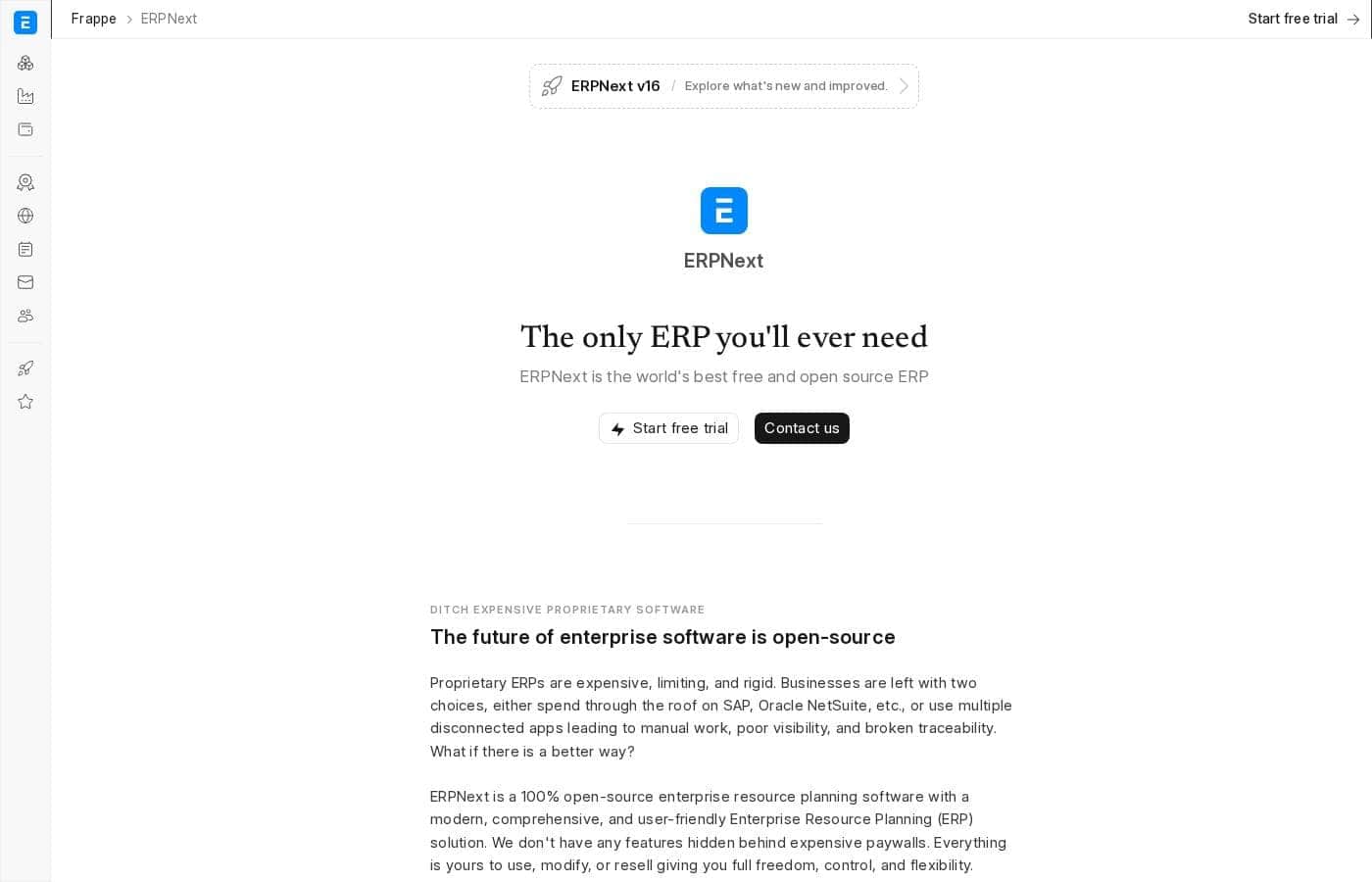
ERPNext homepage screenshot

At a glance

Quick overview for ERPNext: rating, pricing summary, key features, and highlights.
Vendor page checked Oct 5, 2026

Ciroapp score

4.2/ 5

ERPNext packs accounting, inventory, manufacturing, CRM, and HR into one open-source system with compute-based pricing instead of per-user fees. Setup is the catch: rollouts often run two to eight weeks, and partner costs aren't published upfront. Overall, it's a strong pick for growing teams willing to invest time or budget in implementation.

Pros

  • Pros:No per-user pricing — costs are based on hosting compute on Frappe Cloud (Sites from $5/mo, Servers from $20/mo, Premium Dedicated Servers from $125/mo), so software spend doesn't grow with headcount
  • Pros:One integrated system covering accounting, inventory, manufacturing, CRM, projects, POS, HR, payroll, and support, cutting double entry across departments
  • Pros:100% open source under AGPL-3.0, so you can self-host for free, modify the code, or resell it with no vendor lock-in

Cons

  • Cons:Implementation takes real effort — Frappe itself recommends certified partners, most small-business rollouts take 2–8 weeks, and manufacturing or custom workflows take longer
  • Cons:Partner and implementation pricing isn't published upfront, so total cost beyond hosting requires a quote
  • Cons:Lower hosting tiers have trade-offs — the Sites plan runs on shared servers only, and the Servers plan has limited uptime guarantees with incident-only support
Best for
  • Small and medium businesses tired of per-user SaaS pricing
  • Manufacturers that need multi-level BOMs, work orders, and quality checks
  • Distributors and retailers managing stock, POS, and invoicing together
Free trial
Yes — 14 days
This section is a summary. Detailed sections about features, use cases, pricing, and reviews follow below.

What is ERPNext?

Most ERPs force a bad choice: pay a fortune for SAP or NetSuite, or juggle disconnected apps that hide what's happening in your business. ERPNext takes a different route. It's 100% open-source, covers accounting through manufacturing in one system, and skips per-user fees entirely.

You pay for hosting, not seats.

ERPNext is a free, open-source ERP platform from Frappe. It brings accounting, sales, purchasing, inventory, manufacturing, projects, POS, CRM, HR, payroll, quality, and support into one system. It's built with small and medium businesses in mind, works for most industries and countries, and includes a low-code builder for custom tweaks.

More than 30,000 companies use it today.

Should you choose ERPNext?

Quick buyer guidance before you compare plans or click through.

Choose it if

  • Teams that want ERP breadth without seat-based fees — you pay only for hosting or compute
  • Businesses that want accounting, inventory, sales, and CRM connected in one system
  • Companies that need customization via low-code tools, custom workflows, and granular permissions
  • Operations with multi-company, multi-currency, and consolidated reporting needs
  • Teams already using Shopify, Stripe, PayPal, or WooCommerce that want fewer data silos

Skip it if

  • Buyers who want plug-and-play simplicity — Frappe's own site warns that any ERP is complex to implement on your own
  • Businesses in countries whose tax compliance isn't supported out of the box — a paid partner may be needed to build it
  • Small teams wanting guided setup everywhere — Success Packs suit under-50-user companies but are only available in limited regions
  • Complex deployments — the site cites 2–8 weeks for most small businesses, with manufacturing or custom workflows taking longer
  • Anyone expecting zero cost — the software is free, but hosting isn't, and implementations often involve partner fees

Next steps before buying

  1. 1Review ERPNext's pricing page and estimate Frappe Cloud hosting costs for your expected usage and user count
  2. 2Check whether your country's tax and compliance setup is supported out of the box or requires a partner
  3. 3Confirm your key integrations — Shopify, Stripe, PayPal, WooCommerce, and others — are documented or available as marketplace apps
  4. 4Compare your three implementation paths: a certified partner, an SMB Success Pack (under 50 users), or self-implementation with docs and Frappe School
  5. 5Skim the free documentation and community forum to gauge how much setup effort you can realistically handle

Ease of use

Frappe describes the interface as intuitive and says many small businesses self-implement using free docs, videos, and the community forum. Frappe School offers hundreds of free and paid courses. That said, the company itself recommends certified partners for the best implementation results, and most small-business rollouts take 2–8 weeks.

ERPNext Key Features

✨ One system for every department

ERPNext brings accounting, sales, purchasing, inventory, manufacturing, projects, POS, CRM, HR, and support into one platform. Everyone works from the same data, which cuts double entry and manual work. It fits most industries and countries out of the box.

From a lead to a delivery, records stay connected instead of scattered across apps.

✨ Shape it to your workflow — no developers needed

You can reshape ERPNext to fit how you actually work. The built-in low-code, no-code builder handles most changes, so you're not waiting on custom development for every tweak. For example:

  • Drag-and-drop automation for repetitive tasks
  • Custom multi-level approval workflows
  • Granular roles and permissions to safeguard data

Forms, reports, print formats, and dashboards are customizable too.

🌍 Built for global operations

Running several companies or currencies? ERPNext handles multiple subsidiaries, branches, and currencies in one system, with consolidated reports for the full picture. Tax compliance for many countries comes standard, and you can configure it for almost anywhere else.

If your country's setup isn't covered out of the box, the global partner network can help build it.

🔌 Plays well with your stack

ERPNext is API-first, so it talks to other systems easily. Documented integrations cover Shopify, WooCommerce, Stripe, PayPal, and Amazon, plus authentication, backups, banking, and communication tools. Marketplace apps extend things further.

The payoff: fewer data silos, less manual re-entry, and one connected record of what's happening across your channels.

✨ Quality checks where the work happens

Product quality is easier to prove when checks live in the same system as stock and production. ERPNext adds quality plans, inspections, and non-conformance reporting across the end-to-end material flow. Serial and batch tracking in the stock module ties every item to its history.

Manufacturers and distributors get traceability without a separate tool.

Use Cases

🏭 Run production end to end

A manufacturer builds multi-level BOMs, plans production, and tracks work orders and job cards in one place. Quality checks and inspections catch problems before they ship.

Expected outcome: cleaner traceability from raw material to finished goods.

🛒 Sell in store and online

A retailer runs cloud POS across stores with shift management, while stock levels, serial and batch tracking, and invoices stay in sync. Shopify or WooCommerce orders flow in through documented integrations.

Expected outcome: fewer data silos and less double entry.

🧾 Turn timesheets into invoices

A consultancy tracks projects, tasks, timesheets, and expenses, then links them to revenue recognition and invoicing. The help desk auto-assigns tickets and honours SLAs, with a customer portal for clients.

Tip: Start with Project and Support, then add modules as you grow.

🌍 Scale without per-seat fees

A growing business adds users freely because pricing is based on hosting, not headcount. Multiple subsidiaries and currencies consolidate into one report, with tax compliance for many countries out of the box.

Expected outcome: software costs that don't climb with every hire.

ERPNext pricing

From₹5/mo

  • 5 plans
  • Free plan available

Vendor page checked on Oct 5, 2026; confirm current prices on ERPNext's pricing page

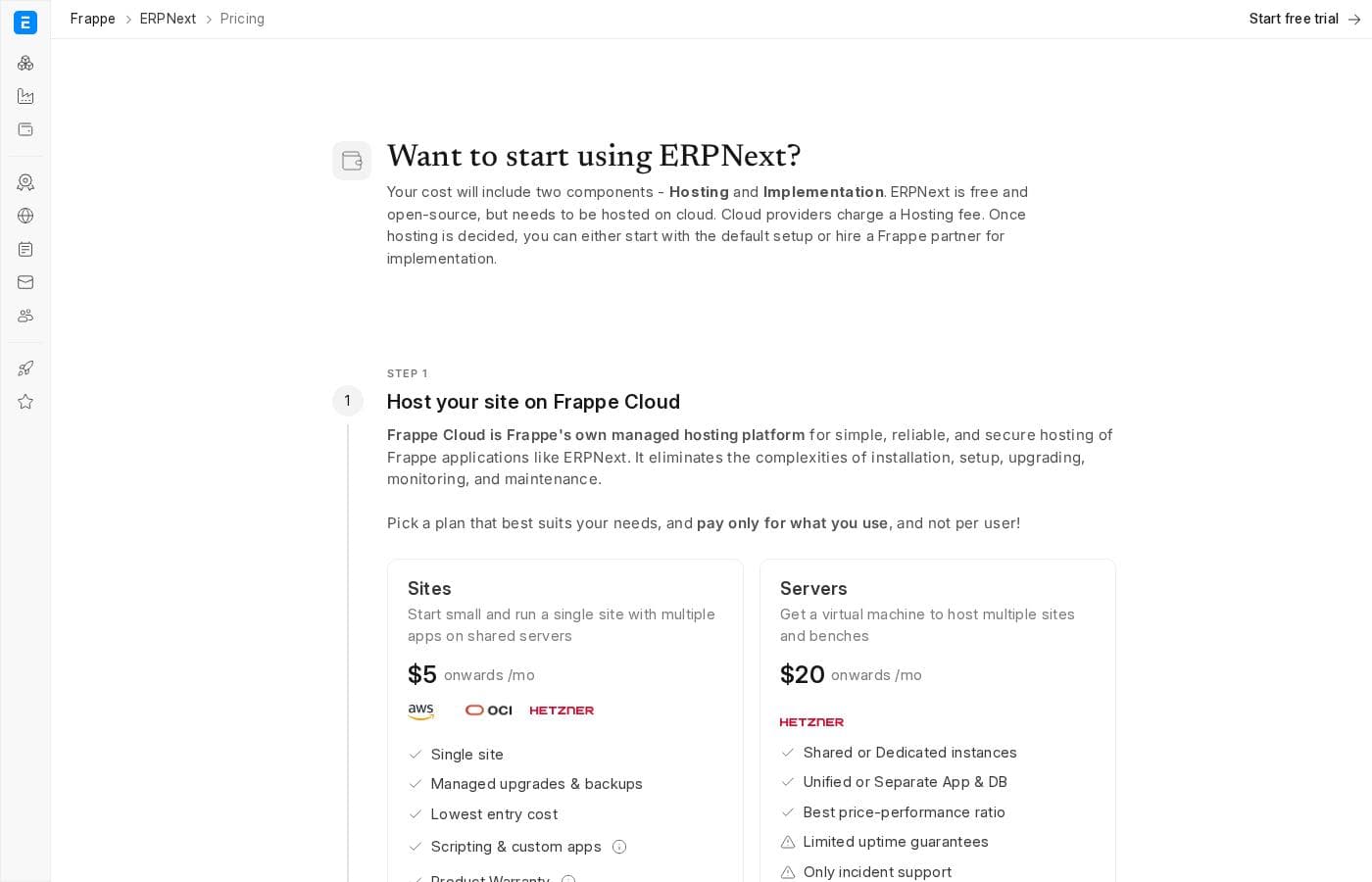
ERPNext pricing page screenshotView pricing page screenshot
PlanBilled monthlyBilled annuallyIncludes
Sites
₹5/mo
—
One site; hosting on shared servers only
  • Single site with multiple apps on shared servers
  • Managed upgrades & backups
  • Lowest entry cost
  • Scripting & custom apps
  • Product Warranty (bug-fix support from Frappe engineers)
Servers
₹20/mo
—
Limited uptime guarantees; incident support only
  • Virtual machine hosting multiple sites and benches
  • Shared or dedicated instances
  • Unified or separate app & database
  • Best price-performance ratio
Premium Dedicated Servers
₹125/mo
—
  • Everything in Hetzner, plus superior dedicated server isolation
  • Advanced features like server snapshots and autoscaling
  • Stronger reliability guarantees
  • Global data centre locations
  • Product Warranty
Self-Hosting
Free
—
You manage installation, upgrades, and maintenance yourself
  • Deploy on your own server using installation scripts
  • Full source code available on GitHub
  • No hosting fees
Starter Pack (Implementation)
See vendor page
See vendor page
For small businesses with fewer than 50 users; available in limited regions
  • Simplified ERPNext implementation for small teams
  • Certified partner guidance for setup, training, and support
  • Standard features, no heavy customisation

Some plans are listed in another currency and are left out of the totals.

Price history

Tracking prices since Oct 1, 2026. No price change detected yet.

Pricing types: Free plan, Free trial, Monthly subscription, Yearly subscription, Usage-based pricing

Pricing notes

ERPNext is free, open-source software — you only pay for hosting and optional implementation help. Frappe Cloud hosting starts at $5/month with compute-based pricing (no per-user fees), a 14-day free trial, and partner-led setup packages sold separately.

ERPNext costs between $5 and $125+ per month for hosting, with three Frappe Cloud plans: Sites from $5/mo, Servers from $20/mo, and Premium Dedicated Servers from $125/mo — plus a free self-hosted option.

The software itself is free and open source. You pay for hosting and, if you want it, expert setup. Here's how each option breaks down.

Sites

Price: From $5/month (₹410 onwards) Websites Supported: 1 site Best For: Small teams that want the lowest entry cost Other Features:

  • Single site with multiple apps on shared servers
  • Managed upgrades and backups
  • Scripting and custom apps supported
  • Product Warranty (bug fixes from Frappe engineers)

Sites is the simplest way to get ERPNext online. You share servers with other customers, which keeps costs low, but you still get managed upgrades, backups, and custom app support. If you're a freelancer or a small business testing the waters, this is your starting point. 👍

Servers

Price: From $20/month (₹1,800 onwards) Websites Supported: Multiple sites and benches Best For: Growing businesses that need more control Other Features:

  • Virtual machine on Hetzner that hosts multiple sites
  • Shared or dedicated instances
  • Unified or separate app and database
  • Best price-performance ratio

Servers gives you a full virtual machine instead of a shared slot, so you can run several sites side by side. There are trade-offs to know about: uptime guarantees are limited and you only get incident support. It's a solid middle ground when one shared site no longer cuts it.

Premium Dedicated Servers

Price: From $125/month (₹5,400 onwards) Best For: Businesses that need strong reliability and global reach Other Features:

  • Everything in Hetzner, plus superior dedicated server isolation
  • Advanced features like server snapshots and autoscaling
  • Stronger reliability guarantees
  • Global data centre locations
  • Product Warranty included

This tier adds dedicated isolation, stronger reliability, and data centres around the world. Larger companies running critical operations will get the most from it. Smaller teams with modest traffic can comfortably stay on the cheaper plans.

Self-Hosting

Price: Free (AGPL-3.0 licence) Best For: Companies with their own tech team Other Features:

  • Deploy on your own server using installation scripts
  • Full source code available on GitHub
  • No hosting fees, ever

Because ERPNext is 100% open source, you can run it on hardware you control at zero software cost. You'll handle installation, upgrades, and maintenance yourself, so it suits teams with technical skills.

Implementation (sold separately)

Best For: Anyone who wants expert help going live Other Features:

  • Self-implement for free with docs and the community forum
  • Starter Packs from certified partners for small businesses (under 50 users)
  • 200+ global partners for enterprise setups, customisations, and migrations

Hosting is only half the picture — setup is the other half, and partners charge a fee for it. Partner pricing isn't published upfront, so ask for a quote before you commit.

Try before you buy: every Frappe Cloud start comes with a 14-day free trial with full ERPNext access. After that, pay by card, prepaid wallet credits, or an annual wire transfer. There's no money-back guarantee listed, but education institutes and non-profits can request a discount — and the software itself will always be free.
Cost calculator

Estimate what ERPNext costs for your team.

Billing
Per month
₹5
Per year
₹60

Sites states no user limit: shown as one price for the whole account. Check the price for 5 users with the vendor. Estimate based on published list prices, before taxes, add-ons and discounts.

How to pay less for ERPNext

  • Start on the free plan and upgrade only when you hit its limits.
  • Use the 14-day free trial before you pay.
Start free trial

Email me when ERPNext changes price

One email when we detect a price change on the vendor's pricing page. No newsletter, no deals. Unsubscribe in one click.

User Reviews

No reviews yet.

Write a Review

Write a Review for ERPNext
0/100 characters
0/2000 characters

Why use ERPNext?

If your software bill keeps climbing every time you hire someone, ERPNext flips the model. Pricing is based on compute, not headcount — and the whole platform is open-source.

  • No per-user fees. The site stresses that costs don't grow linearly as you scale. You pay for hosting capacity, not seats.
  • One system for the whole business. Accounting, stock, manufacturing, CRM, projects, and support share the same data, cutting double entry and manual work.
  • Built for global operations. Multi-subsidiary, multi-currency, and consolidated reporting come standard, with tax compliance for many countries out of the box.
  • Customize without heavy development. Drag-and-drop automation, multi-level approval workflows, granular roles and permissions, and custom print formats are all included.
  • Plays well with your stack. It's API-first, with marketplace apps and documented integrations for Shopify, WooCommerce, Stripe, PayPal, Amazon, and more.
  • No vendor lock-in. Everything is open-source — you can use, modify, or resell it. Frappe even offers a first-party warranty on Frappe Cloud hosting.

ERPNext alternatives

Other tools in the ERP category

View all ERP tools
Odoo

Odoo

ERP4.1/5

Odoo is a comprehensive platform designed to handle nearly all aspects of your business operations. It combines a vast collection of apps that are perfectly integrated and ready to install with a single click. If you identify an issue or process you want to improve, there is likely an app for that purpose. Odoo offers ultimate flexibility, catering to companies from micro businesses to large enterprises. It comes in two versions: the Community edition, which is 100% free and open source, and Enterprise, which includes extra apps, infrastructure, and professional services. This robust system is supported by a global developer community of over 100,000 people.

BILLmanager

BILLmanager

ERP3.8/5

BILLmanager is a billing and service automation platform from ISPsystem, built for hosting companies, cloud providers, and service businesses. It covers the customer journey from ordering on your website to provisioning, billing, and support. A separate Enterprise edition handles internal billing and cost tracking for organizations running their own infrastructure. The vendor says one installation is certified for 50 million subscribers.

Zedonk

Zedonk

ERP3.8/5

Zedonk is a cloud-based, affordable and modular PLM, ERP, and digital showroom platform for fashion brands. Trusted by 1,000+ labels worldwide, it streamlines product development, production, sales and inventory in one easy system. With secure access, excellent customer support, and free onboarding and training, Zedonk helps brands manage their entire business efficiently.

DualEntry

DualEntry

ERP3.5/5

DualEntry is a full-GL accounting software classified in the ERP category, meaning it handles the complete general ledger rather than a subset of accounting tasks. Its distinguishing trait is an AI-first architecture: automation and intelligent assistance are core to how transactions are recorded, reviewed, and reported, instead of being bolted on later. It is purpose-built for high-growth enterprises that need depth, control, and scalability in their accounting stack.

ERPNext FAQ

How much does ERPNext cost?

ERPNext's cheapest paid plan, Sites, costs ₹5 per month. Paid plans range from ₹5 to ₹125 per month.

Does ERPNext have a free plan?

Yes. ERPNext has a free plan (Self-Hosting); paid plans start at ₹5 per month.

Does ERPNext offer a free trial or a money-back guarantee?

ERPNext offers a 14-day free trial.

Has ERPNext's price changed recently?

No. We have not detected a price change since we started tracking on Oct 1, 2026.

Which tools can ERPNext connect to?

It's API-first, with documented integrations for Shopify, WooCommerce, Amazon, Stripe, PayPal, Razorpay, Plaid, Twilio, LDAP, and more. Marketplace apps add extra options. If something's missing, your team or a partner can build it via the REST API.

What support and SLA can I expect?

Hosting plans include Product Warranty: Frappe engineers fix software bugs through a ticket portal with a stipulated response time. It doesn't cover functional help. The $20 Servers plan offers incident support only, with limited uptime guarantees.

How are my data and backups handled?

Frappe Cloud manages upgrades and backups for you, and you can extend backups to Dropbox, Google Drive, or Amazon S3. You control roles and permissions inside ERPNext. Self-hosting keeps everything on your own server.

Ready to try ERPNext? Check out the official site or pricing.

Are you ERPNext? Claim this listing · Get the badge