Shopify POS vs Zettle
Shopify POS and Zettle are both excellent POS systems targeting different business needs. Shopify POS specializes in deep, unified e-commerce and retail synchronization. Zettle focuses successfully on low-cost, mobile payments and transaction simplicity. Choosing one depends entirely on your need for omnichannel capability versus cost control.

Best for: Retailers running complex e-commerce and multiple physical stores, Businesses prioritizing seamless online-to-offline inventory management (omnichannel)
Best for: Mobile sellers or pop-up shops primarily needing low-cost payment acceptance, New businesses seeking zero recurring software fees and low monthly overhead

Powerful omnichannel, constrained by support and cost.
Shopify POS excels at unifying online and physical sales, offering features like automatic inventory sync and centralized management that modern retailers need. Overall, we must apply a significant discount to the rating due to the universally reported failures in customer support and the high recurring cost required to access advanced retail features via POS Pro.
Pros
- Achieves true omnichannel synchronization across all sales channels.
- Inventory levels are updated automatically with every transaction.
- Manage all aspects of the business from a single back office.
- Platform offers a robust app ecosystem for customization.
Cons
- Customer support is consistently reported as non-existent or unhelpful.
- Advanced retail features require POS Pro, adding $89/month per location.
- Users report platform instability and occasional reliability issues.
- Highly complex tiered pricing structure can become costly quickly.
Simple Payment Processing, Needs Hardware Stability.
We find Zettle excels at providing straightforward, pay-as-you-go payment acceptance ideal for small sellers. Overall, while the transparent pricing and accessible customer support are excellent, persistent Bluetooth and proprietary hardware reliability issues must be addressed for consistent daily operation.
Pros
- Simple, pay-as-you-go pricing starting at 1.75% per transaction.
- Free core POS app available for inventory and reporting.
- Customer support is often responsive, knowledgeable, and easy to reach by phone.
- Mobile-ready system including convenient Tap to Pay functionality.
Cons
- Frequent connectivity issues, including slow Bluetooth pairing.
- Hardware reliability concerns (devices locking out or battery failure).
- Limited customer service availability on weekends (peak trading times).
- Higher transaction fees (up to 2.5%) for remote payments and invoices.
AboutShopify POS
Shopify POS is a complete system blending powerful hardware and software designed for seamless in-person sales. It provides the tools necessary to processes transactions and accept payments anywhere. This POS system is flexible enough to support retailers of every size, from new stores to those running multiple locations. If you sell products both online and in person, this tool is specifically designed to unify those channels. Your entire business is managed from a single back office, helping you simplify daily tasks and save time. ✅
AboutZettle
PayPal Point of Sale, formerly Zettle by PayPal, provides modern tools for business owners. It focuses on making every workday easier by combining payment acceptance and sales tracking in one simple place. These products are made specifically to help you handle transactions smoothly and keep reliable records. ✅
A key component is the new PayPal Reader. This reader features a large touchscreen for a professional and smooth checkout experience. You can connect it via Bluetooth or use a stable connection with the included USB-C cable. New, eligible business users can get this card reader starting from £29 (excluding VAT). Additional readers are priced at £69 (excluding VAT).
Highlights
Feature Comparison
Features Overview
We highlight the main differences and pick a winner for each feature.
Pricing Model
Zettle offers true pay-as-you-go; Shopify POS requires significant monthly subscription fees.
Shopify POS employs a highly complex tiered structure starting at $5 and rising sharply in cost. Accessing robust retail features often requires adding $89/month per POS Pro location. The total cost model for Shopify POS can quickly become very expensive. Zettle delivers its necessary core POS app entirely free of charge to all users. Users pay only a simple transaction fee when a payment is processed. This usage-based model eliminates high, recurring software overhead costs. Zettle is clearly the winner for small sellers needing minimum operational expenses and transparency. Shopify POS charges significantly more upfront for the privilege of a unified ecosystem. If minimizing monthly expense is your top priority, Zettle offers unbeatable financial simplicity.
Transaction Fees
Zettle's flat 1.75% rate is substantially cheaper than Shopify POS's typical fees.
Shopify POS's standard in-person card rates start high at 2.6% + 10¢ per transaction. Even the $399/month Advanced plan only drops the rate to 2.4% + 10¢. Lowering fees substantially requires a massive monthly investment in Shopify POS. Zettle maintains a competitive, straightforward rate of 1.75% for all standard in-person card transactions. High-volume sellers can negotiate even lower custom rates with Zettle's sales team. This transaction rate is immediately superior. Zettle offers far better value on payment processing, regardless of the plan utilized. Shopify POS relies on charging higher fees until you subscribe to a costly top-tier plan. For maximizing net profit per sale, Zettle's low 1.75% rate makes a clear financial difference.
Omnichannel Capabilities
Shopify POS offers seamless online/offline unification; Zettle excels at simple mobility.
Shopify POS is designed specifically for true omnichannel synchronization across all selling venues. Inventory levels refresh instantly whether you sell online or in person via Shopify POS. This feature simplifies complex operations and avoids overselling. Zettle focuses on mobile-first efficiency, allowing you to use Tap to Pay on your smartphone immediately. It is ideal for pop-up events and markets requiring maximum portability. Zettle's emphasis is on simple transaction capture. The core value of Shopify POS is connecting your physical store deeply with the robust Shopify ecosystem. Zettle is primarily a payment processor with integrated POS features. If flexible customer options like Buy Online, Pick Up In-Store (BOPIS) are critical, Shopify POS is the undeniable solution.
Customer Support
Zettle provides highly responsive, helpful support; Shopify POS support is widely criticized.
Shopify POS users frequently report that customer support is non-existent, unhelpful, or chatbot-reliant. This lack of support makes resolving critical account or platform errors extremely frustrating. Reliability fears are exacerbated by poor support access. Zettle reviews consistently praise the support team for being responsive and knowledgeable by phone. Users describe speaking to a real person quickly, which helps resolve issues efficiently. This is a critical differentiator for daily operations; Zettle offers human help during business hours. Shopify POS seems to leave complex business problems to automated systems. Trusting your POS to Zettle is safer, knowing reliable help is available when crucial issues arise during a busy workday.
Hardware Reliability
Shopify POS has higher reported uptime; Zettle users report persistent connectivity problems.
Shopify POS benefits from the parent platform's 99.9% uptime, ensuring transactions are reliable. Its integrated hardware is often seen as robust and designed to work right out of the box. Zettle users frequently cite frustrating Bluetooth dropouts and unstable connections with the card reader. Battery failure causing eventual lockouts is also reported, forcing expensive hardware replacement. Although Zettle hardware is modern and professional, its reported instability is a concern for busy retailers. Shopify POS offers stability linked directly to the massive Shopify infrastructure. If continuous reliability during peak transactions is essential, the reported stability issues with Zettle must be carefully considered.
Staff Management
Shopify POS provides granular staff control; Zettle offers basic staff performance tracking.
Shopify POS offers advanced security and control through definable staff permissions. Higher-tier plans include up to 15 staff accounts for secure access and management. This is essential for controlling P.O.S. access. Zettle includes a robust feature to 'Track staff performance' within its free POS app. This functionality helps managers monitor productivity easily. However, it lacks deep access permissions. Shopify POS is superior for growing retail teams needing secure access controls across multiple users and locations. Zettle works best for small teams needing performance metrics on shared hardware. For scaling retail operations with many employees, the secure controls offered by Shopify POS are highly valuable.
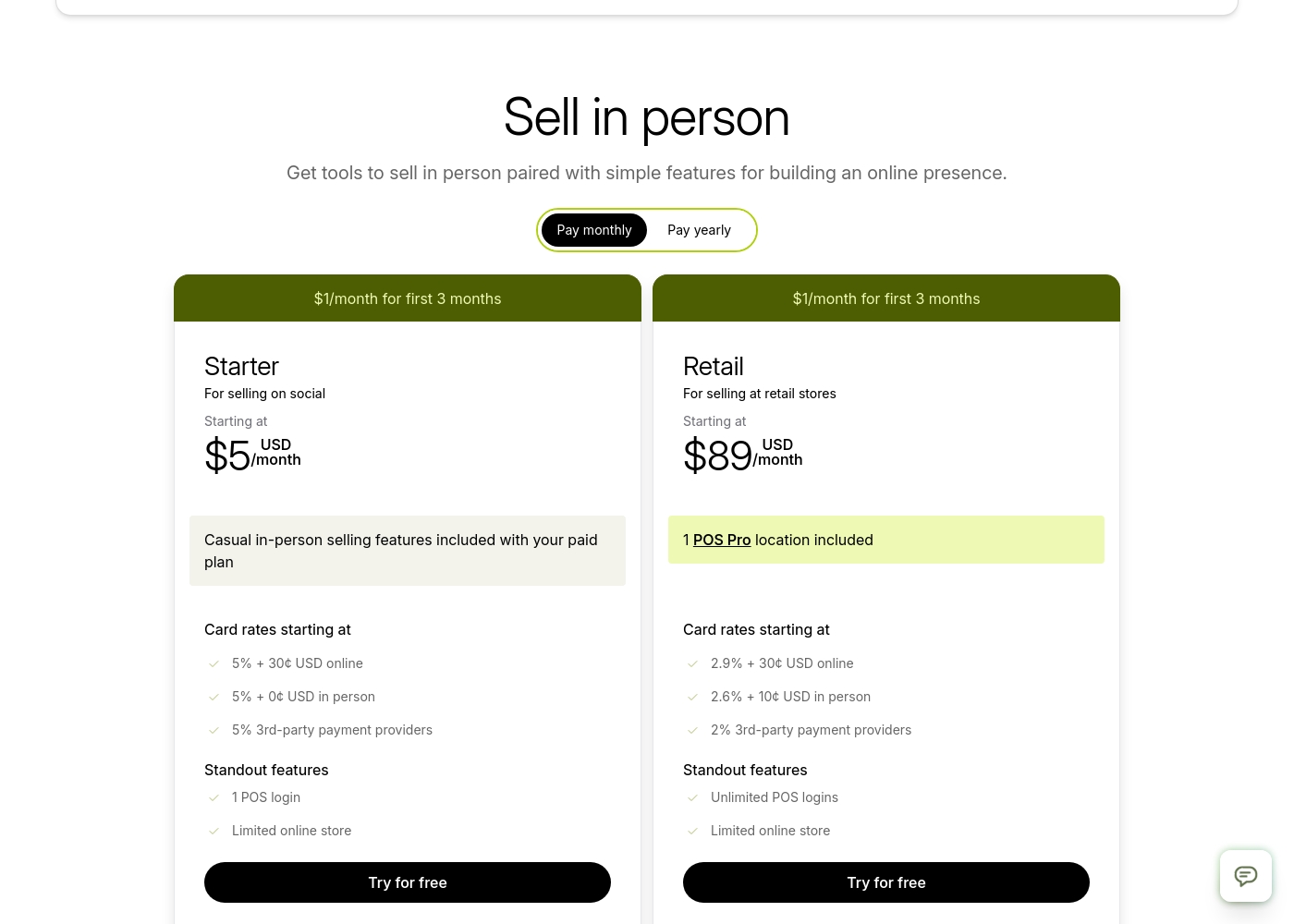
Shopify POS costs between $5 and $399+ per month with 5 main plans (excluding POS Pro add-ons): Starter at $5/month, Retail at $89/month, Basic at $39/month, Grow at $105/month, and Advanced at $399/month.
Below you can review the specific details for these monthly subscription rates, including what they offer for selling both online and in person.
Starter
Price: $5 USD per month Websites Supported: Limited online store Best For: Selling on social/Casual in-person selling Other Features:
- 1 POS login
- Highest card rates (5% + 0¢ USD in person)
- Casual in-person selling features included
- 1 POS login
- Limited online store
- Casual in-person selling features included
- Card rates starting at 5% + 0¢ USD in person
- 1 POS Pro location included
- Unlimited POS logins
- Limited online store
- Card rates starting at 2.6% + 10¢ USD in person
- Unlimited POS logins
- Full-featured online store
- Card rates starting at 2.6% + 10¢ USD in person
- Requires $89 USD/month for each POS Pro location
- 5 staff accounts
- Unlimited POS logins
- Full-featured online store
- Card rates starting at 2.5% + 10¢ USD in person
- Requires $89 USD/month for each POS Pro location
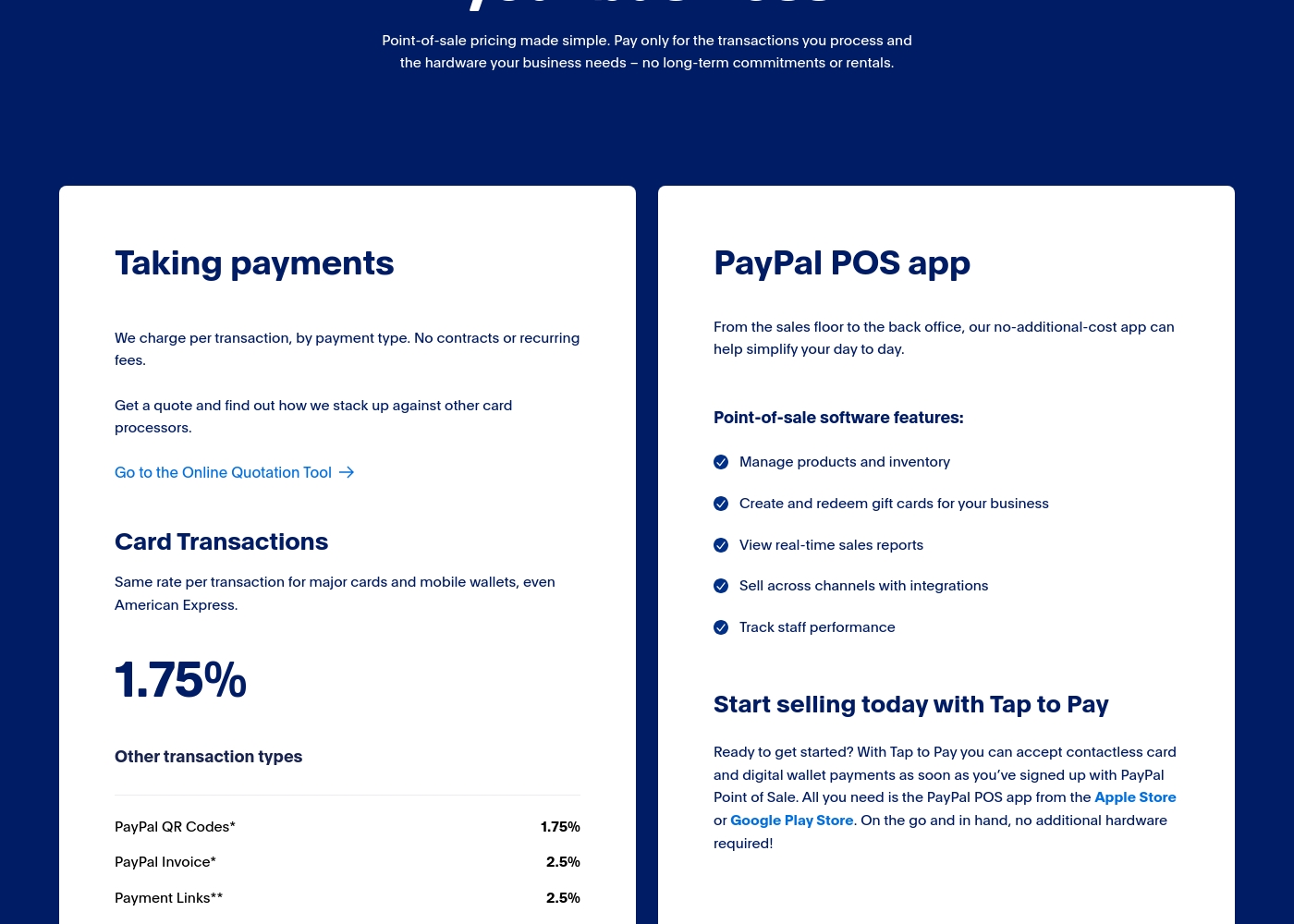
Zettle focuses on simple, transaction-based pricing. You only pay for the payments you process and the hardware your specific business needs. There are no long-term contracts or recurring fees for the software.
PayPal POS App (Software)
Price: No additional cost Best For: Businesses needing core POS functions without monthly subscription costs. Other Features:
- Manage products and inventory
- Create and redeem gift cards
- View real-time sales reports
- Sell across channels with integrations
- Track staff performance
This app acts as your central POS hub. It's included at no additional cost and provides robust tools to handle sales, inventory, and staff management right from your mobile device. Just sign up and download the app to streamline your daily operations. You can even start taking payments right away using Tap to Pay on your existing phone or tablet.
- No additional cost
- Manage products and inventory
- Real-time sales reports
- Tap to Pay enabled
- 1.75% rate for card transactions
- Includes major cards and mobile wallets
- Includes PayPal QR Codes
- No contracts or recurring fees
- Tailored fee structure
- Requires monthly card transactions over £10,000
- Dedicated sales assistance
Pricing Notes
- Zettle operates on a zero-monthly-fee model, charging only transaction fees (Standard 1.75%).
- Shopify POS requires a recurring base plan ($5–$399/month), plus expensive transaction fees.
- Advanced retail features in Shopify POS are locked behind the $89 USD/month POS Pro add-on per location.
- Shopify POS's transaction fees only become competitive when subscribing to their most expensive plans.
- Zettle remote payments (Invoices/Links) cost a higher 2.5%, whereas their in-person rate is 1.75%.
Pricing Head-to-Head
User Reviews
User sentiment regarding the Shopify ecosystem is highly critical, primarily concerning customer service and platform reliability 😥. Many independent business owners and consumers report that support is virtually non-existent, unhelpful, or relies heavily on frustrating chatbots, making it nearly impossible to resolve critical issues like billing errors or account access.
A major recurring concern is the perception that Shopify does not adequately vet its merchants, leading non-selling customers to face frequent scams and fraud when purchasing through the platform. This lack of accountability creates serious trust issues for buyers.
I would give zero stars if I could! Customer support does not exist. I am currently paying for an account I cannot log into because they only use a useless chatbot for recovery. This is unacceptable for business owners.
Users generally find the Zettle (PayPal POS) system easy to use and convenient, making it ideal for small or mobile businesses. Many users praise the card reader for its reliability and speed during transactions.
A significant point of positive feedback revolves around customer support. Agents are often described as prompt, knowledgeable, and helpful, often resolving issues quickly with a real person on the line, which is rare in this industry.
Great for payments and we received excellent customer service. They are quick to answer the phone, and you speak to a friendly person, not a bot. They took the time to resolve my issue easily.
Our Verdict
This comparison clearly shows that Shopify POS and Zettle serve two different types of sellers. If you are an established retailer with a strong online presence, Shopify POS is the definite choice. Shopify POS excels at synchronization, making online and physical sales data one unified view. Zettle simply cannot match the deep omnichannel feature set of Shopify POS. Zettle’s superpower, however, is cost effectiveness and simplicity. Zettle offers a truly free POS app and an excellent, low 1.75% transaction fee. Furthermore, Zettle’s customer support is widely reported as responsive and helpful; conversely, Shopify POS struggles immensely here. The deciding factor should be your commitment to e-commerce unification. If you have a complex website and need automated inventory sync, pay the high fees for Shopify POS. If you are a mobile seller or simply need the lowest transaction fees possible, Zettle is your champion. Ultimately, Zettle provides better overall value and fewer headaches for small, independent sellers. But enterprise-focused operations handling high volume across multiple locations must select Shopify POS for its robust scalability features.
Frequently Asked Questions
Which is better for minimizing transaction fees: Shopify POS or Zettle?
Zettle offers a lower standard in-person card rate of 1.75% across the board. Shopify POS rates start higher and only drop slightly on expensive plans. For the cheapest overall processing, Zettle is clearly superior.
Does Zettle require a monthly software subscription like Shopify POS?
No, Zettle operates on a pay-as-you-go model with zero recurring software fees. Shopify POS requires purchasing a monthly plan, costing up to $399 before add-ons. Zettle is much lighter on monthly overhead.
Which system offers better customer support for retailers?
Zettle receives strong praise for providing responsive support from knowledgeable human agents. Shopify POS is widely criticized for having poor or virtually non-existent customer support. Zettle wins easily here.
If I sell mostly online, should I choose Shopify POS or Zettle?
You should choose Shopify POS if selling online is a major focus. Shopify POS seamlessly connects physical sales directly to your full e-commerce store. Zettle’s synchronization capabilities are not as deep.
Can I use the 'Tap to Pay' feature on my smartphone with Zettle and Shopify POS?
Yes, both systems offer Tap to Pay functionality to turn your phone into a terminal. Zettle provides this feature for free via its basic app. Accessing this feature on Shopify POS may depend on your paid plan.
Is Shopify POS expensive to run compared to Zettle?
Yes, Shopify POS is significantly more expensive because of high recurring monthly subscriptions. Zettle’s costs are usage-based, focusing only on transaction fees and hardware purchases. Shopify POS requires extra monthly costs for POS Pro features.
Ready to Choose?
Both tools have their strengths. Choose based on your specific needs.
