Shopify POS vs SumUp
Shopify POS and SumUp are both excellent POS systems, but they serve very different business models. Shopify POS dominates omnichannel operations and detailed inventory syncing for established retailers. SumUp focuses on straightforward, transparent pricing and robust in-person payment tools for small shops and mobile vendors. This comparison helps you decide which path is right for your growth.

Best for: E-commerce businesses seeking true omnichannel synchronization and unified data., Medium to large retailers managing multiple physical locations.
Best for: Small businesses, coffee shops, or fast-casual restaurants prioritizing low overhead., Startups needing dedicated installation and training for a quick launch.

Powerful omnichannel, constrained by support and cost.
Shopify POS excels at unifying online and physical sales, offering features like automatic inventory sync and centralized management that modern retailers need. Overall, we must apply a significant discount to the rating due to the universally reported failures in customer support and the high recurring cost required to access advanced retail features via POS Pro.
Pros
- Achieves true omnichannel synchronization across all sales channels.
- Inventory levels are updated automatically with every transaction.
- Manage all aspects of the business from a single back office.
- Platform offers a robust app ecosystem for customization.
Cons
- Customer support is consistently reported as non-existent or unhelpful.
- Advanced retail features require POS Pro, adding $89/month per location.
- Users report platform instability and occasional reliability issues.
- Highly complex tiered pricing structure can become costly quickly.
Simple payments meet growth tools.
We find SumUp offers a compelling package for small businesses seeking transparent pricing and robust POS tools starting at $99/month. While users consistently praise the intuitive interface and affordable transaction fees, we observed significant recurring concerns regarding hardware reliability and slow customer support response times. Overall, SumUp is a powerful, low-cost solution best suited for users who value simplicity and can tolerate occasional technical glitches.
Pros
- Highly user-friendly app and intuitive interface for easy tracking.
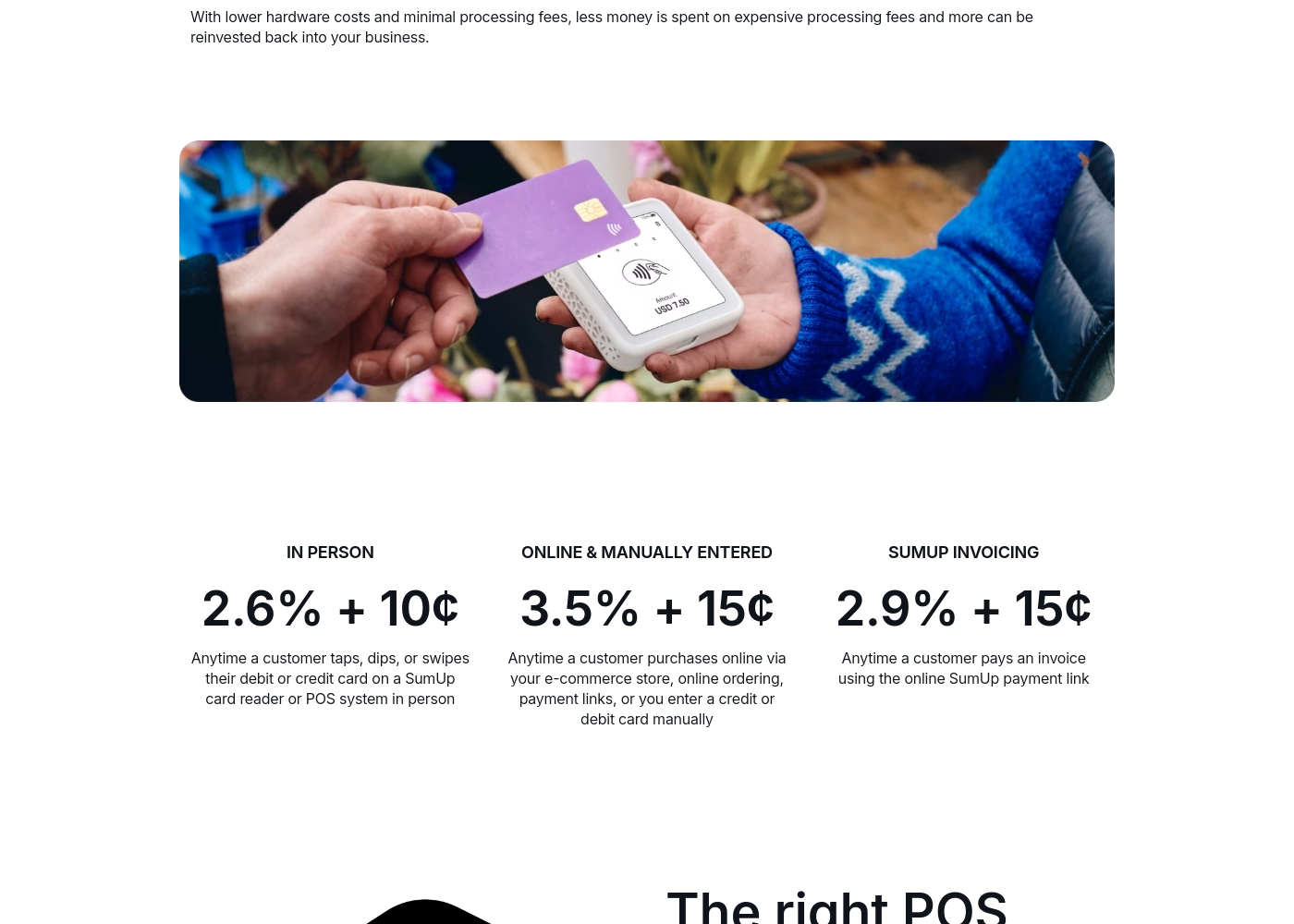
- Transparent pricing with competitive in-person transaction fees (2.6% + 10¢).
- Next-day payouts boost cash flow efficiency.
- Comprehensive POS plans include dedicated installation and training.
Cons
- Customer service is often reported as slow, unhelpful, or inaccessible.
- Mobile/tap-to-pay functions sometimes prove unreliable or slow.
- Connectivity issues reported with card readers and WiFi stability.
- Some users felt surprised by unannounced changes to pricing or features.
AboutShopify POS
Shopify POS is a complete system blending powerful hardware and software designed for seamless in-person sales. It provides the tools necessary to processes transactions and accept payments anywhere. This POS system is flexible enough to support retailers of every size, from new stores to those running multiple locations. If you sell products both online and in person, this tool is specifically designed to unify those channels. Your entire business is managed from a single back office, helping you simplify daily tasks and save time. ✅
AboutSumUp
SumUp provides comprehensive payment solutions including Card Readers and POS Systems. This integrated ecosystem is designed to help you run your entire business smoothly. It manages everything from processing orders to full customer acquisition. Over 4 million businesses worldwide have already chosen SumUp to be their partner 💡.
You can select products based on your specific needs, including powerful POS tools, Card Readers, and Invoicing capabilities. The platform serves a wide range of entrepreneurs, from coffee shops and fast casual restaurants to barber shops and clothing boutiques. Simply download the free SumUp App to access these business solutions quickly.
Highlights
Feature Comparison
Features Overview
We highlight the main differences and pick a winner for each feature.
Core Pricing Model
SumUp offers lower, transparent transaction fees; Shopify POS uses a complex tiered system for rates.
Shopify POS costs $5 to $399/month, plus $89/location for the POS Pro features. Transaction rates are lower only if you pay for the most expensive monthly plans. This complex structure can be hard to budget initially. SumUp offers three fixed monthly POS plans from $99 to $289. In-person processing fees are always a clear 2.6% + 10¢, regardless of your software plan. SumUp guarantees no minimums or annual fees, offering financial predictability. If you value knowing exactly what you pay per transaction for clear budget control, SumUp is the significantly easier choice.
Omnichannel Sync
Shopify POS perfectly unifies web and physical sales; SumUp primarily focuses on efficient in-person sales.
Shopify POS automatically syncs inventory across your physical store and your online store immediately. This automatic update process prevents overselling online while transactions are happening in-store. SumUp is focused on powerful in-person sales and mobile processing via their card readers and cloud POS system. The data provided does not indicate deep integration with major e-commerce platforms. Shopify POS enables essential modern retailing, like buying online and picking up in-store (BOPIS). If your retail model requires a connected online store and a physical shop, Shopify POS is the essential platform for synchronization.
Customer Loyalty
SumUp offers automated marketing and explicit rewards programs; Shopify POS only handles raw customer data capture.
SumUp includes customer rewards, automated marketing tools, and promotes the Fivestars App integration for loyalty. The specialized Pro plan adds unlimited daily AI-enhanced promotions via SMS. Shopify POS captures customer contact details and purchase history right at checkout. Staff must then use this history to provide personalized service or feed external marketing campaigns. SumUp provides the tools to actively drive repeat business embedded within the POS system. Small businesses focused on boosting local traffic should choose SumUp.
Cash Flow & Payouts
SumUp guarantees next-day payouts for rapid fund access; Shopify POS payout timing is not explicitly guaranteed.
SumUp prioritizes rapid fund access by offering next-day payouts when you use their associated SumUp Business Account. Speedy access to funds aids operational planning and managing inventory. Shopify POS emphasizes reliable sales processing and a strong 99.9% uptime. However, there is no explicit guarantee of next-day funding found in the documentation for Shopify POS. For sole traders or small shops managing tight inventory budgets, rapid fund access is critical. If rapid daily funding is essential, SumUp offers a stronger, clearer benefit.
Ease of Setup/Training
SumUp includes professional installation and training; Shopify POS relies on a self-service setup process.
SumUp includes dedicated installation and training resources across all three monthly POS subscription tiers. This ensures your staff is comfortable quickly and reduces setup frustration. Shopify POS assists users with specialized migration apps and customer service help. Otherwise, the setup and learning curve are primarily self-guided. The hands-on, included approach of SumUp significantly reduces the initial learning curve. Small businesses who need white-glove setup support should choose SumUp to ensure a quicker launch.
Ecosystem Integration
Shopify POS offers 100+ retail apps; SumUp's integration ecosystem is notably smaller and less detailed.
Shopify POS provides a rich app ecosystem featuring over one hundred dedicated third-party apps for customization. Essential retail functions like accounting programs, loyalty, and advanced reporting are readily available. SumUp mentions integration with the Fivestars App for customer rewards. Details regarding direct compatibility with external accounting or other systems are not explicitly stated. Retailers needing specialized software hooked up to their POS should strongly consider the flexible Shopify POS ecosystem instead. SumUp is best if you only need the core payment functions and built-in loyalty features.
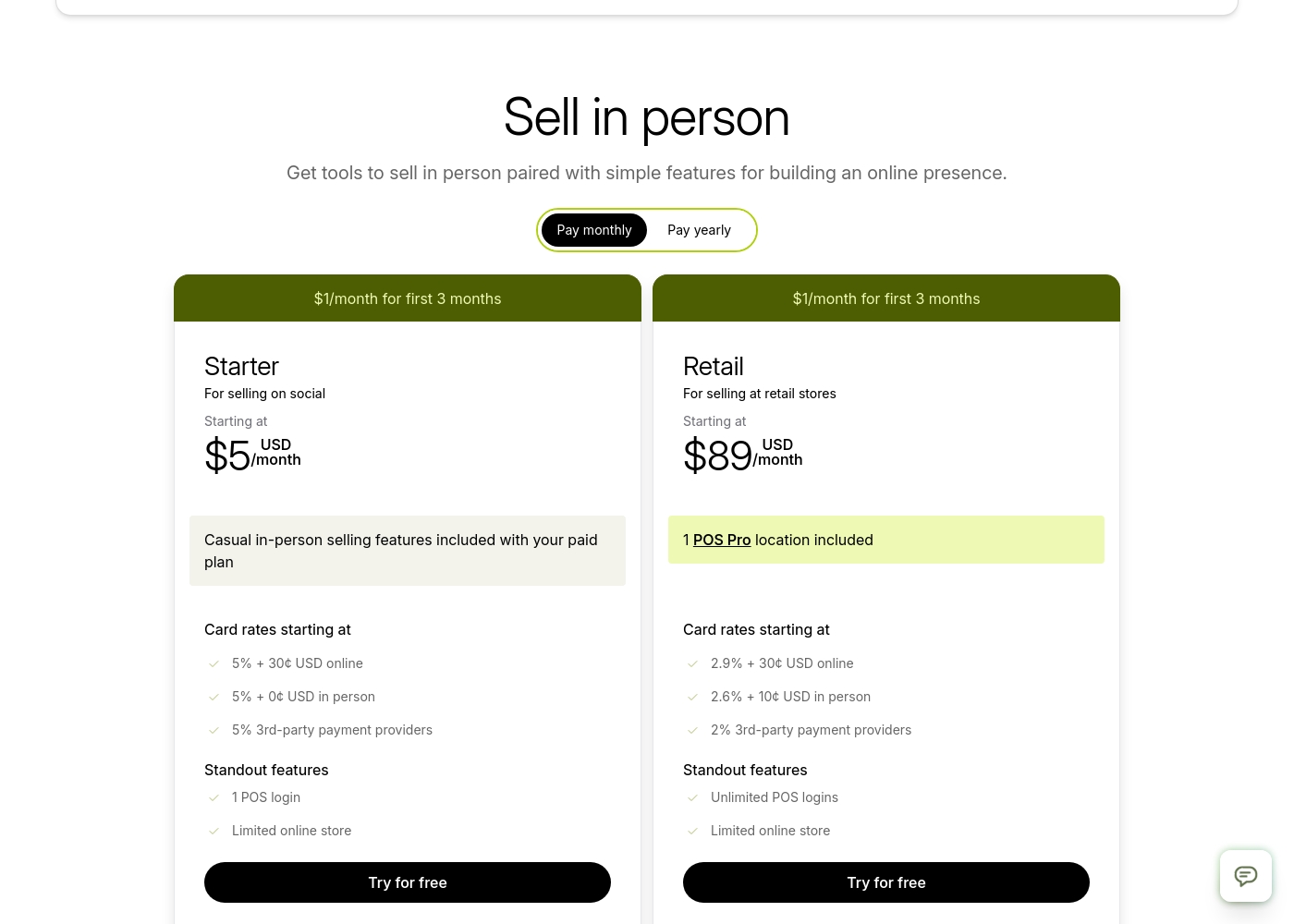
Shopify POS costs between $5 and $399+ per month with 5 main plans (excluding POS Pro add-ons): Starter at $5/month, Retail at $89/month, Basic at $39/month, Grow at $105/month, and Advanced at $399/month.
Below you can review the specific details for these monthly subscription rates, including what they offer for selling both online and in person.
Starter
Price: $5 USD per month Websites Supported: Limited online store Best For: Selling on social/Casual in-person selling Other Features:
- 1 POS login
- Highest card rates (5% + 0¢ USD in person)
- Casual in-person selling features included
- 1 POS login
- Limited online store
- Casual in-person selling features included
- Card rates starting at 5% + 0¢ USD in person
- 1 POS Pro location included
- Unlimited POS logins
- Limited online store
- Card rates starting at 2.6% + 10¢ USD in person
- Unlimited POS logins
- Full-featured online store
- Card rates starting at 2.6% + 10¢ USD in person
- Requires $89 USD/month for each POS Pro location
- 5 staff accounts
- Unlimited POS logins
- Full-featured online store
- Card rates starting at 2.5% + 10¢ USD in person
- Requires $89 USD/month for each POS Pro location
SumUp offers POS solutions ranging from $99/month to $289/month, with three structured plans: POS with Connect Lite at $99/month, POS with Connect Plus at $199/month, and POS with Connect Pro at $289/month.
We want to help guide you to the right system for your business and budget. Here is a detailed comparison of the monthly subscription tiers available.
POS with Connect Lite
Price: $99/month Best For: Starting a business and streamlining operations Other Features:
- Cloud-based POS
- Customer Database
- Dedicated installation and training
- Standard POS software
- Standard POS software
- Cloud-based POS
- Customer Database
- Dedicated installation and training
- Money Back Guarantee*
- Cloud-based POS
- Customer Database
- Dedicated installation and training
- Customer rewards and automated marketing
- Money Back Guarantee*
- Cloud-based POS
- Customer Database
- Dedicated installation and training
- Customer rewards and automated marketing
Pricing Notes
- To access advanced retail features, Shopify POS requires the $89/month POS Pro add-on per location.
- SumUp transaction rates are fixed at 2.6% + 10¢ in-person, offering reliable cost predictability.
- Shopify POS transaction fees decrease on higher-priced monthly subscription plans, requiring high volume to justify costs.
- SumUp guarantees no admin costs, annual renewal fees, or minimum transaction requirements, ensuring financial clarity.
Pricing Head-to-Head
User Reviews
User sentiment regarding the Shopify ecosystem is highly critical, primarily concerning customer service and platform reliability 😥. Many independent business owners and consumers report that support is virtually non-existent, unhelpful, or relies heavily on frustrating chatbots, making it nearly impossible to resolve critical issues like billing errors or account access.
A major recurring concern is the perception that Shopify does not adequately vet its merchants, leading non-selling customers to face frequent scams and fraud when purchasing through the platform. This lack of accountability creates serious trust issues for buyers.
I would give zero stars if I could! Customer support does not exist. I am currently paying for an account I cannot log into because they only use a useless chatbot for recovery. This is unacceptable for business owners.
SumUp earns high marks from most users, who consistently praise the platform's ease of use and intuitive interface. Users find the app simple to navigate, making transaction tracking and sending receipts hassle-free.
The transparent pricing and affordable transaction fees, especially the 2.6% + 10¢ for in-person sales, are seen as exceptional value for small businesses and sole traders. Features like payment links and next-day payouts support efficient operations.
I’m completely new to using a card reader and Apple Pay payment methods. Using SUMUP has been intuitive and easy to use. I’m impressed with the app and the communications.
Our Verdict
Choosing between Shopify POS and SumUp depends entirely on your business structure and priorities. If your operation is deeply intertwined with e-commerce, Shopify POS is essential for robust inventory syncing. However, if you run a physical shop focused on simple, cost-effective payments, SumUp offers better value. Shopify POS’s superpower is unification and flexibility. It instantly syncs sales, inventory, and customers across your online and physical stores flawlessly. This platform supports high-growth retailers who need detailed staff permissions and can utilize a massive app ecosystem. Shopify POS is built to scale complex, multi-channel businesses, but it is expensive. SumUp's superpower is financial clarity and accessibility for small businesses. They offer fixed, transparent transaction fees (2.6% + 10¢) and explicitly guarantee no hidden annual fees. SumUp speeds cash flow with guaranteed next-day payouts and includes professional setup training for every plan. Their built-in loyalty and marketing tools are also great for boosting local traffic. The deciding factor is sales complexity versus cost predictability. Choose Shopify POS if seamless omnichannel inventory syncing is non-negotiable for your growth. Select SumUp if simplicity, predictable low costs, and fast cash flow are more critical than deep e-commerce integration. Neither Shopify POS nor SumUp provides reliable, high-quality customer support, so be prepared for self-service issues.
Frequently Asked Questions
Which is better for small, single-location shops: Shopify POS or SumUp?
SumUp is generally better for small, single-location shops like boutiques or coffee shops. SumUp offers transparent, fixed transaction fees and includes dedicated installation and training. Shopify POS requires expensive add-ons ($89/month) for key retail features needed by single-location businesses.
Does SumUp handle complex inventory management like Shopify POS?
No. Shopify POS excels at complex, automatic inventory syncing between online and physical stores. SumUp provides cloud POS functionality but does not offer the same deep, unified omnichannel inventory management. If cross-channel inventory is critical, choose Shopify POS.
How do the transaction fees compare between Shopify POS and SumUp?
SumUp offers a clear, fixed rate of 2.6% + 10¢ for in-person transactions on all plans. Shopify POS transaction rates are extremely complex and decrease only if you pay for the highest-tier monthly subscriptions ($105 - $399/month). SumUp offers more predictable processing costs.
Can I get next-day payouts with Shopify POS or SumUp?
SumUp explicitly guarantees next-day payouts when you use their associated SumUp Business Account. Shopify POS features stable processing, but the availability of guaranteed next-day funding is not specified in the documentation. SumUp offers a stronger cash flow benefit.
Why is customer support criticized for both Shopify POS and SumUp?
User reviews for both companies frequently cite significant frustration with customer service response times and effectiveness. Users of both Shopify POS and SumUp report that support can be slow, unhelpful, or inaccessible. Do not expect rapid issue resolution from either platform.
Is Shopify POS worth the extra cost for the POS Pro add-on?
The POS Pro add-on ($89/location) is required for advanced features like dedicated staff controls in Shopify POS. It is worth the cost only if your business runs multiple locations or requires the explicit benefits of full omnichannel inventory syncing.
Ready to Choose?
Both tools have their strengths. Choose based on your specific needs.
