Shiftie vs Toggl
Shiftie and Toggl tackle different problems. Shiftie handles staff scheduling and time tracking for operational teams. Toggl focuses on project time tracking and business reporting. Your choice depends on whether you're managing a team's shifts or your company's billable hours.
Best for: Hospitality managers scheduling shift work, Retail teams needing automated timesheets
Best for: Service-based agencies tracking billable hours, Enterprise teams needing custom reporting and SSO
Simple, effective staff scheduling.
We found Shiftie to be a straightforward and focused platform for employee scheduling and time tracking. It clearly solves core administrative headaches for teams in sectors like hospitality. Overall, it's a solid, no-fuss tool that delivers on its promise to simplify workforce management.
Pros
- Clear, per-user pricing with no hidden fees.
- Generous 28-day free trial without needing card details.
- Intuitive drag-and-drop scheduling with conflict detection.
- Automatic timesheet generation simplifies payroll.
Cons
- Limited external user reviews make social proof difficult to assess.
- May lack advanced features for very large, complex organizations.
- Integrations and deeper reporting capabilities are not detailed.
- Support is UK-based, which could affect time zones for other regions.
Generous Free Tier, Unstable Service Reliability.
Toggl offers a feature-rich, cross-platform tracking tool emphasizing custom reports and enterprise integration for teams up to five users under the Free plan. We appreciate the clear pricing and the potential for deep profitability analysis in higher tiers. Overall, reliability concerns and extremely poor customer support repeatedly expressed by recent users indicate caution is necessary before large-scale deployment.
Pros
- Generous and permanent Free plan, supporting up to five users.
- Effective cross-platform sync across web, desktop, and mobile devices.
- Offers advanced enterprise features like SSO and integrations with Jira/Salesforce.
- Simple user interface makes basic time tracking easy to adopt.
Cons
- Extremely poor customer service, often non-responsive to urgent inquiries.
- Users report significant product deterioration, including laggy UI and data loss/bugs.
- Lacks core features needed by freelancers (e.g., tracking billed vs. unbilled time).
- Sales team has been accused of harassing users on the Free plan.
AboutShiftie
Shiftie is a modern, all-in-one platform for scheduling employees and managing time & attendance. It’s built for managers and teams in sectors like hospitality, leisure, and retail who want to ditch outdated systems. Think of it as your digital rota, timesheet generator, and team hub combined. 👥
AboutToggl
Toggl is time tracking software designed specifically for organizational teams. It is built around the idea that raw data must translate into actionable business insights. ✅ Toggl specializes in building custom, detailed reports directly from your team's tracking data.
This tool is especially suited for managing larger and enterprise teams. It provides the flexible reporting required for employees and projects across departments. By ensuring easy time tracking adoption, Toggl gives you the accurate data needed to make strong, confident decisions.
Highlights
Feature Comparison
Features Overview
We highlight the main differences and pick a winner for each feature.
Scheduling & Planning
Shiftie offers full staff scheduling; Toggl doesn't schedule at all.
Shiftie provides drag-and-drop shift planning with templates and team volunteering. It includes conflict detection and shift swaps for last-minute changes. Toggl has no scheduling features. It's purely for tracking time against projects and tasks. You can't build rotas or manage team availability. The key difference is operational vs. project management. Shiftie runs your daily team operations; Toggl tracks time for billing and analysis. If you need to schedule a retail team of 20, Shiftie is the only option here. Toggl is irrelevant for scheduling.
Time Tracking & Clock-In
Both track time, but Shiftie focuses on employee attendance; Toggl on project hours.
Shiftie's clock-in uses phones or a portal with optional GPS. It auto-generates timesheets for payroll approval. Great for hourly staff. Toggl's tracking is for project time. Employees start/stop timers for tasks. It includes automated tracking for easier adoption. Better for professionals logging project hours. Shiftie is built for shift workers clocking in/out. Toggl is for freelancers or teams tracking billable work. Different use cases entirely. A barista needs Shiftie to clock in. A designer needs Toggl to track 3 hours on a client logo.
Reporting & Analytics
Toggl excels at custom business reports; Shiftie provides operational insights.
Shiftie shows live labor costs and hours as you build schedules. It helps manage staffing and budgets in real-time. Simple but effective. Toggl offers deep custom reports on profitability, productivity, and workload. Premium plans include scheduled reports and data accuracy checks. Enterprise-level analysis. Toggl wins here for depth. Shiftie's reporting is tied to scheduling decisions. Toggl's reporting drives business strategy and billing. If you need to prove project profitability to a client, Toggl is essential. Shiftie just tells you if you're overstaffed.
Integrations & Ecosystem
Toggl connects to 100+ tools; Shiftie has limited integration info.
Shiftie mentions DigiTickets in a testimonial but no full list. The data doesn't detail other integrations. Likely limited. Toggl integrates with 100+ tools, including Jira and Salesforce on Premium. It has a powerful API for custom builds. Extensive ecosystem. Toggl's integration ecosystem is vastly larger. Shiftie's integration details are sparse and unclear from the provided data. If your team uses Jira or Salesforce, Toggl plugs right in. Shiftie doesn't mention these connections.
Customer Support
Shiftie offers reliable UK support; Toggl has recent support complaints.
Shiftie provides 7-day-a-week support (08:00-20:00 UK time). Users praise its responsiveness and helpfulness. Included in the plan. Toggl's support is heavily criticized. Users report non-responsive emails, ignored data deletion requests, and generic responses. Very poor recent reviews. Shiftie is clearly better here. Reliable support is crucial for operational tools. Toggl's support failures are a major red flag. If your team needs help at 10 PM on a Sunday, Shiftie is there. Toggl users often wait or get no reply.
Pricing & Value
Shiftie has simple per-employee pricing; Toggl has tiered per-user plans with a free option.
Shiftie costs £2.75 per active employee/month. One plan includes all features. No hidden fees. 28-day free trial. Toggl has a free plan for up to 5 users. Paid plans start at $9/user/month. Premium is $18/user/month. 30-day trials on paid plans. Shiftie's value is in simplicity. Toggl offers more flexibility with tiers, but costs scale per user. A free option is a big plus for tiny teams. For a team of 10, Shiftie costs ~£27.50/month. Toggl Starter would cost $90/month. Different cost structures.
Mobile Experience
Both offer mobile apps, but Shiftie's is built for shift workers.
Shiftie's mobile app lets employees clock in/out and view shifts. It's designed for quick, on-the-go access. Users praise its ease of use. Toggl's mobile app is for time tracking. It syncs across web, desktop, and mobile. It's effective for logging project hours away from a desk. Both are mobile-friendly. Shiftie's app is more about daily attendance; Toggl's is about project time logging. Different purposes. A server can use Shiftie's app to clock in. A consultant uses Toggl's app to track billable hours on a client call.
Learning Curve
Shiftie is intuitive for scheduling; Toggl is simple for time tracking.
Shiftie is designed to be drag-and-drop and visual. It replaces spreadsheets for shift planning. Users report it's easy to adopt. Toggl's basic time tracking is straightforward. You click to start/stop. The interface is simple. Advanced reporting may require learning. Both have low barriers for core functions. Shiftie may feel familiar to anyone who's managed a roster. Toggl is simpler for one-person time logging. Switching from paper schedules to Shiftie is quick. Using Toggl for the first time is also easy.
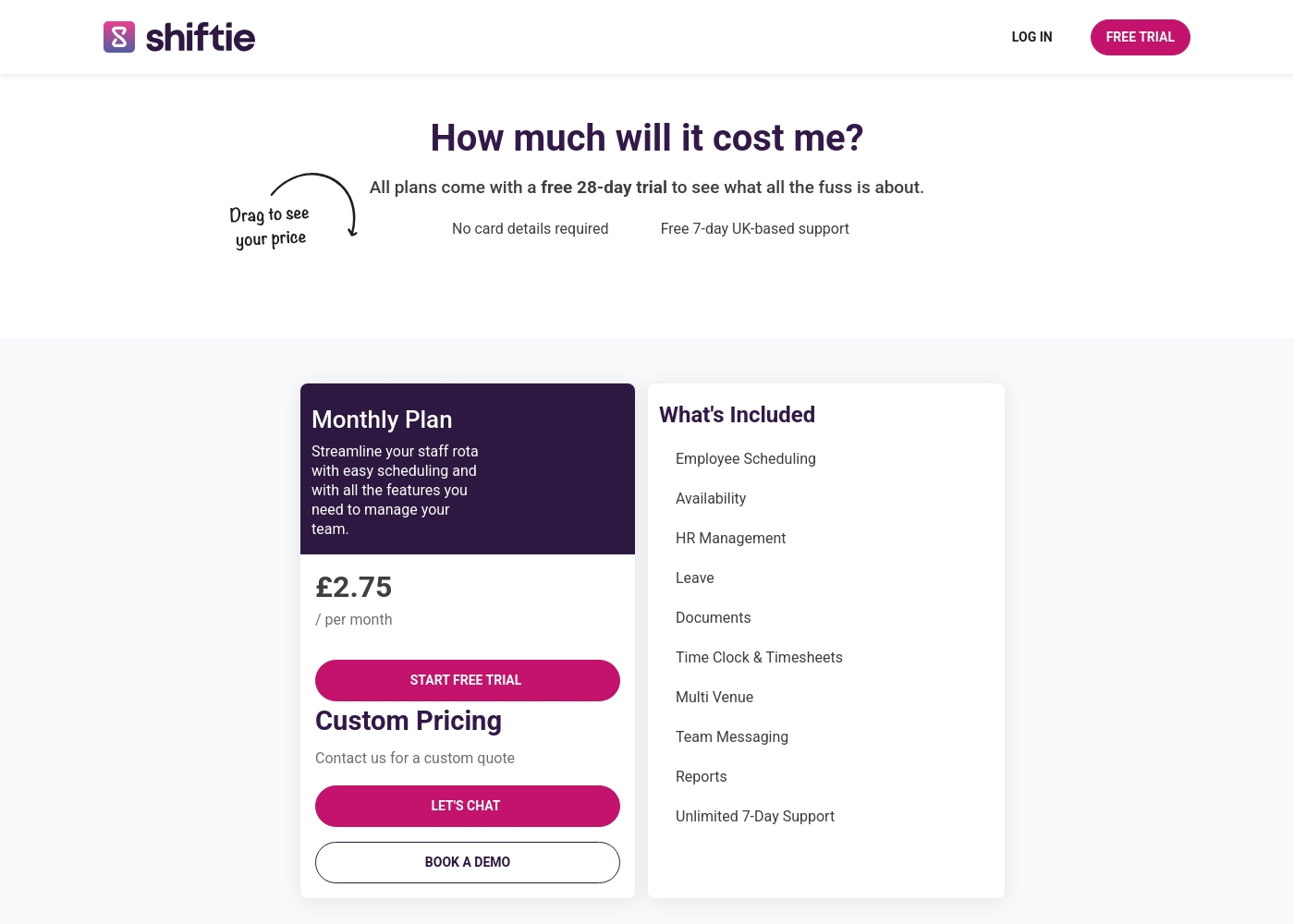
Shiftie pricing: Shiftie keeps things simple with a monthly plan starting at £2.75 per employee. You'll get full access to all scheduling and HR features with no upfront card details required for your trial period.
To help your team hit the ground running, we offer a generous 28-day free trial along with seven-day UK-based support to answer any questions you might have. It's built to be flexible, so you're only billed for the active users on your account each month.
Plus, you can cancel at any time directly through your billing settings if your needs change. This approach ensures your costs scale naturally as your team grows or shrinks, keeping your budget predictable and your admin time low.
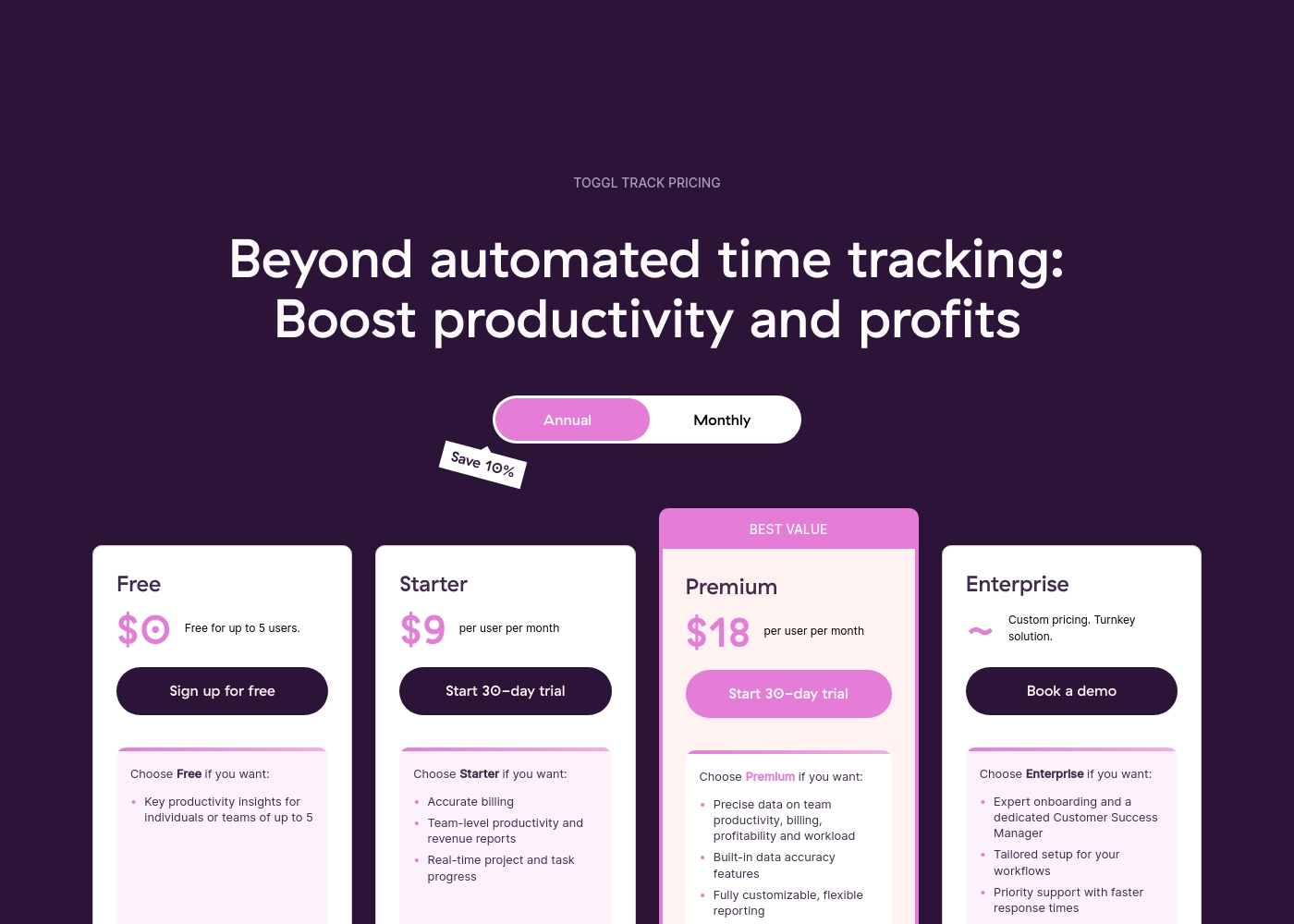
Toggl costs between $0 and Custom Pricing per month with four plans: Free at $0 (for up to 5 users), Starter at $9 per user per month, Premium at $18 per user per month, and Enterprise with custom pricing.
Let's break down what's included in each plan so you can find the perfect fit for your team. You can save 10% on paid plans by opting for annual billing.
Free
Price: $0 per month Best For: Individuals or small teams up to 5 users Other Features:
- Key productivity insights
- Time tracking on web, desktop, and mobile
- Integration with 100+ tools
- Free for up to 5 users
- Key productivity insights
- Time tracking on web, desktop, and mobile
- Productivity reports
- Calendars integrations
- Accurate billing
- Team-level productivity and revenue reports
- Real-time project and task progress
- Billable rates and project time estimates
- Team collaboration features
- Precise data on team productivity, billing, profitability and workload
- Built-in data accuracy features
- Fully customizable, flexible reporting
- Timesheet approvals and Scheduled reports
- Jira, Salesforce integrations
- Expert onboarding and a dedicated Customer Success Manager
- Tailored setup for your workflows
- Priority support with faster response times
- Custom solutions and Multiple workspaces
- Volume discounts for large teams on annual plan
Pricing Head-to-Head
User Reviews
We couldn't access any external user reviews for Shiftie on Trustpilot or Capterra during our research. The Capterra page returned a security error, and Trustpilot had no available data. Without this external feedback, our assessment is based solely on the product's features and the company's own presentation. We encourage you to try the free trial to experience the software firsthand and gather your own user feedback.
We switched from spreadsheets and the difference is night and day. Shiftie has saved our management team at least a few hours every week on scheduling alone.
Toggl presents a highly split user experience, reflected in its current poor Trustpilot rating of 2.3. While many satisfied, long-term users praise the generous free tier, multi-platform accessibility, and simplicity for basic needs, recent feedback highlights significant reliability and support failures.
Current users report severe product deterioration, including a laggy UI, bugs, lost entries, and race conditions that mess up data 📉. The most consistent critical issue involves customer support, which users describe as non-responsive, sending generic emails, or being impossible to reach.
I’ve been using the free version daily for about a year, and it’s fantastic for simple tracking. I use it for multiple projects and clients, relying on the keyboard shortcut to toggle the timer on and off. It’s definitely easy to use.
Our Verdict
This is a tale of two tools with zero overlap. Shiftie and Toggl serve completely different needs. It's like comparing a shift roster to a project timesheet—they just aren't the same. Shiftie's superpower is managing your team's daily grind. It schedules shifts, tracks clock-ins, and handles leave. For a café or hotel, it's a lifesaver. Toggl's superpower is turning time into money. It tracks project hours, generates profitability reports, and integrates with 100+ tools. For agencies and service businesses, it's essential. The deciding factor is simple: Do you need to schedule people or track time? If your team works shifts, pick Shiftie. If you bill clients by the hour, pick Toggl. So, the verdict is clear. Choose Shiftie if you manage a team of 5-50 shift workers in retail or hospitality. Choose Toggl if you run a service business needing detailed time and billing reports.
Frequently Asked Questions
Which is better for small teams: Shiftie or Toggl?
It depends on your needs. Shiftie is better for small teams needing to schedule shifts and manage attendance. Toggl's free plan is great for up to 5 users needing basic time tracking. Choose Shiftie for operations; choose Toggl for project time.
Does Shiftie have advanced reporting like Toggl?
No, Shiftie's reporting focuses on operational data like labor costs and hours. Toggl offers custom financial reports, profitability analysis, and scheduled reports on premium plans. Toggl is stronger for business intelligence.
Is Toggl worth the extra cost over Shiftie?
They serve different purposes, so cost isn't directly comparable. Shiftie costs £2.75/employee/month. Toggl Starter is $9/user/month. If you need project profitability reports, Toggl may be worth it. If you need shift scheduling, Shiftie is the choice.
Can I migrate from Shiftie to Toggl easily?
Probably not directly, as they handle different data. Shiftie stores schedules and attendance; Toggl stores project time logs. Migration would involve exporting/importing different data types. Contact support for specific help.
Which tool has better customer support?
Shiftie clearly wins on support. It offers 7-day-a-week help and users praise it. Toggl's support is frequently criticized as unresponsive and poor. This is a major difference.
Does Toggl integrate with tools like Jira and Salesforce?
Yes, but only on the Premium plan or higher. Toggl integrates with 100+ tools overall. Shiftie's integrations are not detailed in the provided data, so Toggl has a much larger ecosystem.
Ready to Choose?
Both tools have their strengths. Choose based on your specific needs.