Sellfy vs Shopify
Sellfy and Shopify both power online stores but serve vastly different needs. Sellfy is focused on high profit retention and simplicity for creators. Shopify is a massive, complex commerce platform built for multi-channel sales and limitless scaling. Choosing one depends entirely on your business size and revenue goals.
Best for: Solo entrepreneurs and creators, Anyone selling large digital courses or video files

Best for: High-volume businesses exceeding $200k in annual sales, Multi-channel retailers needing integrated POS selling
Zero fees, simple selling for creators.
We found Sellfy to be an incredibly efficient, all-in-one platform tailored for creators who prioritize simplicity and cost savings. Its zero-transaction-fee model and built-in marketing tools offer exceptional value, starting at just $22 per month when billed annually. Overall, we confidently recommend Sellfy for easily scaling digital or physical product sales while maintaining total control.
Pros
- No platform transaction fees, improving profitability immediately.
- Extremely fast setup and user-friendly interface for first-time sellers.
- Supports digital, subscriptions, physical, and high-quality print-on-demand products.
- Includes essential growth tools like affiliate marketing and conversion features.
Cons
- Limited payment processing options (primarily Stripe and PayPal Business).
- Store designer offers basic functionality for advanced users seeking complex customization.
- Users report difficulty when trying to implement additional languages.
- Custom shipping labels cannot be fully branded.

Powerful Platform, Critical Service Gaps
We recognize Shopify offers an enterprise-level platform with impressive scaling tools and high-converting technology for merchants of all sizes. However, user reviews indicate systemic failures in support, billing practices, and marketplace fraud protection. Overall, Shopify provides powerful infrastructure but currently struggles to deliver a reliable, secure, or user-focused experience for many customers.
Pros
- Comprehensive commerce platform built for scaling and global growth.
- Unique Shopify Checkout converts 15% higher than competing platforms.
- Lower credit card transaction fees on Grow and Advanced plans.
- Access to Shopify Capital for loans without sacrificing equity.
Cons
- Customer support is frequently reported as unresponsive, slow, or useless (often relying on chatbots).
- Platform often fails to protect buyers and merchants from fraudulent stores.
- Frequent reports of unauthorized billing and confusing cancellation procedures.
- Complexity makes site setup difficult for non-technical beginners.
AboutSellfy
Sellfy is an ideal, all-in-one platform built specifically for skilled creators and modern online businesses. It focuses on simplicity without sacrificing the results you need. If you hate complexity, Sellfy makes getting started easy.
You can upload and sell almost anything right away. This includes digital downloads like courses, music, art, and videos. You can also manage complex needs like physical products inventory or use the simple print-on-demand service. Sellfy helps you replace multiple tools with one efficient dashboard. 💡
AboutShopify
Shopify is the powerful commerce platform designed to handle every aspect of modern selling. It serves everyone, from solo entrepreneurs launching their first product to large global enterprises. This platform manages your sales whether you are selling direct-to-consumer or handling wholesale B2B transactions. You get an organized, fully centralized Shopify Admin to control everything, from the back office to the front of the store. Millions of merchants trust Shopify; together, they have reached over $1 trillion in collective sales. ✨
Highlights
Feature Comparison
Features Overview
We highlight the main differences and pick a winner for each feature.
Platform Transaction Fees
Sellfy charges 0% fees, ensuring maximum profit retention. Shopify levies fees unless you use their payment system.
Sellfy's business model is explicitly built around zero platform transaction fees. This means that 100% of your sales revenue stays with you immediately. You only cover standard payment processor charges from PayPal or Stripe for instant payouts. Sellfy’s pricing is tied solely to your subscription tier based on annual sales volume. Shopify charges a tiered monthly subscription fee ranging from $29 up to $299+. If you use a third-party payment gateway, Shopify adds a transaction fee of up to 2%. Choosing Sellfy means guaranteed maximized profit margins on every single sale. Shopify forces you to use their specified payment system to avoid these additional transaction costs. Sellfy offers more predictable profit calculation for high-volume creators.
E-commerce Scalability
Shopify supports unlimited growth well past the creator stage. Sellfy caps its top plans at $200k in annual sales.
Sellfy successfully supports businesses up to $200,000 in annual sales on its Premium plan. Growth beyond this revenue point requires contact for specialized, non-standard offers. Sellfy is primarily built for creators and growing small businesses that value profit margins. Shopify is designed for limitless scaling, supporting large enterprises with its Advanced and Plus tiers. Shopify offers expansive features like localized global selling via Shopify Markets and B2B functionality. If you anticipate rapid, massive growth toward $1M in sales, Shopify is the necessary long-term platform. Sellfy is perfect until you hit that $200k growth cap.
Digital Product Delivery
Sellfy excels with large files and built-in subscriptions. Shopify requires apps for deep digital product features.
Sellfy is highly specialized for digital creators selling content and courses. The top Premium plan supports individual file sizes up to 20GB. Sellfy also includes built-in tools for digital subscriptions to stabilize monthly income. Shopify is a general commerce tool that handles digital goods. However, specialized functions and large file hosting often require relying on its extensive app ecosystem. If you sell large video courses, Sellfy's immense file capacity capability gives it a core advantage. Sellfy is simply better equipped to handle the file logistics required by creators.
Marketing Tools Value
Sellfy bundles critical marketing tools natively starting at basic tiers. Shopify focuses on advanced audience targeting features.
Sellfy provides a complete marketing suite even on its lower-cost plans. This includes powerful features like product upselling, affiliate marketing, and cart abandonment recovery. Sellfy also bundles significant email marketing credits, offering up to 50,000 on its Premium plan. Shopify integrates tools like Shopify Audiences and robust analytics for customer insights. Shopify relies more on its app store for specific conversion tools like advanced upselling. Sellfy offers ready-to-use growth features, making it a better value for the price. This immediately helps creators increase average order value.
Customer Support Quality
Sellfy has highly rated, responsive customer support. Shopify users frequently report unresponsive, poor quality support.
Sellfy reviews consistently praise staff responsiveness and timely issue resolution. All paid plans guarantee 24/7 dedicated support via email for peace of mind. Premium Sellfy users benefit from Priority Support access when urgent issues arise. Shopify reviews often cite customer service difficulties as a major weakness. Merchants report unresponsive teams, slow issue escalation, and ongoing payout hold problems. Good support is vital for any e-commerce business. Sellfy appears to offer a significantly more reliable support experience for merchants.
Ecosystem & Customization
Shopify provides unparalleled customization via 13,000+ apps. Sellfy relies on simplicity and limited core integrations.
Shopify’s core strength is its massive third-party ecosystem, featuring over 13,000 available apps. This allows for complex, specialized solutions like headless commerce using Hydrogen. Sellfy keeps its platform tight and simple for easy use. It integrates cleanly with Stripe and PayPal but does not advertise a wide third-party app library. If you need hyper-specific features (e.g., custom loyalty programs, specialty shipping apps), use Shopify. Sellfy is ideal if you value simplicity and avoiding external app subscription costs.
Unified Commerce (POS)
Shopify unifies online, in-person (POS), and multi-channel selling. Sellfy is strictly limited to online web sales.
Shopify enables true unified commerce through its centralized Shopify Admin system. Merchants can manage both physical, in-person sales (POS) and online orders smoothly. Shopify supports multi-channel publishing across social media and search results easily. Sellfy allows you to embed your entire shopping experience onto any existing website. However, Sellfy does not offer integrated in-person selling capabilities or native POS hardware support. If your business includes pop-up shops or physical retail locations, Shopify is the only viable option here.
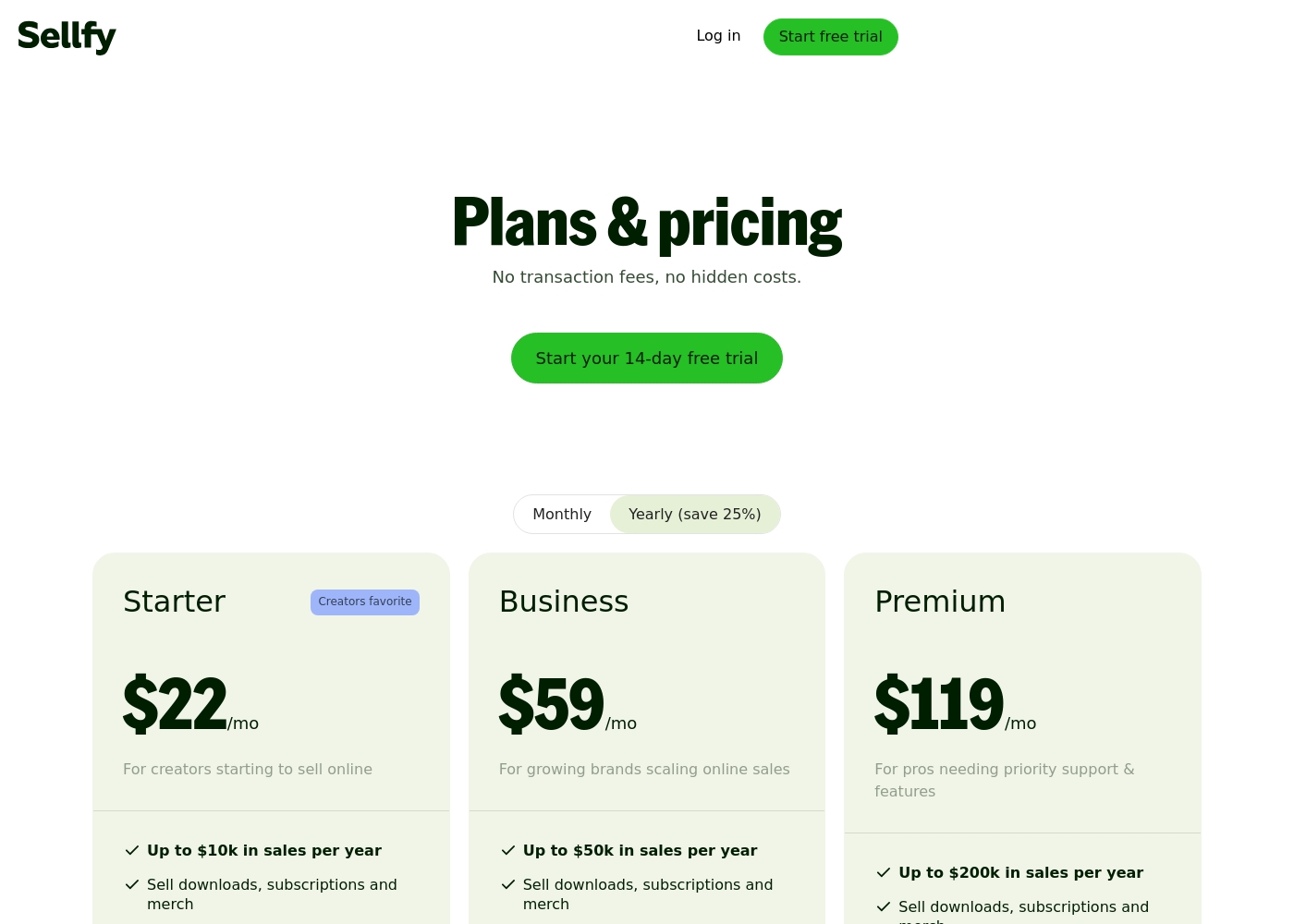
Sellfy costs between $22 and $119 per month (when billed yearly) with three plans: Starter at $22/month, Business at $59/month, and Premium at $119/month.
These plans are designed to scale alongside your business growth. When you choose annual billing versus monthly, you will save 25% on your total subscription cost.
Starter
Price: $22/mo (billed annually) or $29/mo (monthly) Best For: Creators starting to sell online Refund Policy: 30-day money-back guarantee Other Features:
- Up to $10k in sales per year
- Unlimited products (downloads, subscriptions, merch)
- Email marketing with 2,000 free credits
- Maximum product file size is 10GB
- 0% transaction fees
- Sell downloads, subscriptions, and merch
- Unlimited products
- Email marketing (2,000 credits)
- Core marketing features
- 0% transaction fees
- All core features
- Email marketing (10,000 credits)
- Custom fields
- Growth features (Product upselling, Cart abandonment, Affiliate marketing)
- 0% transaction fees
- All Business features
- Email marketing (50,000 credits)
- Advanced options
- Product and design migration
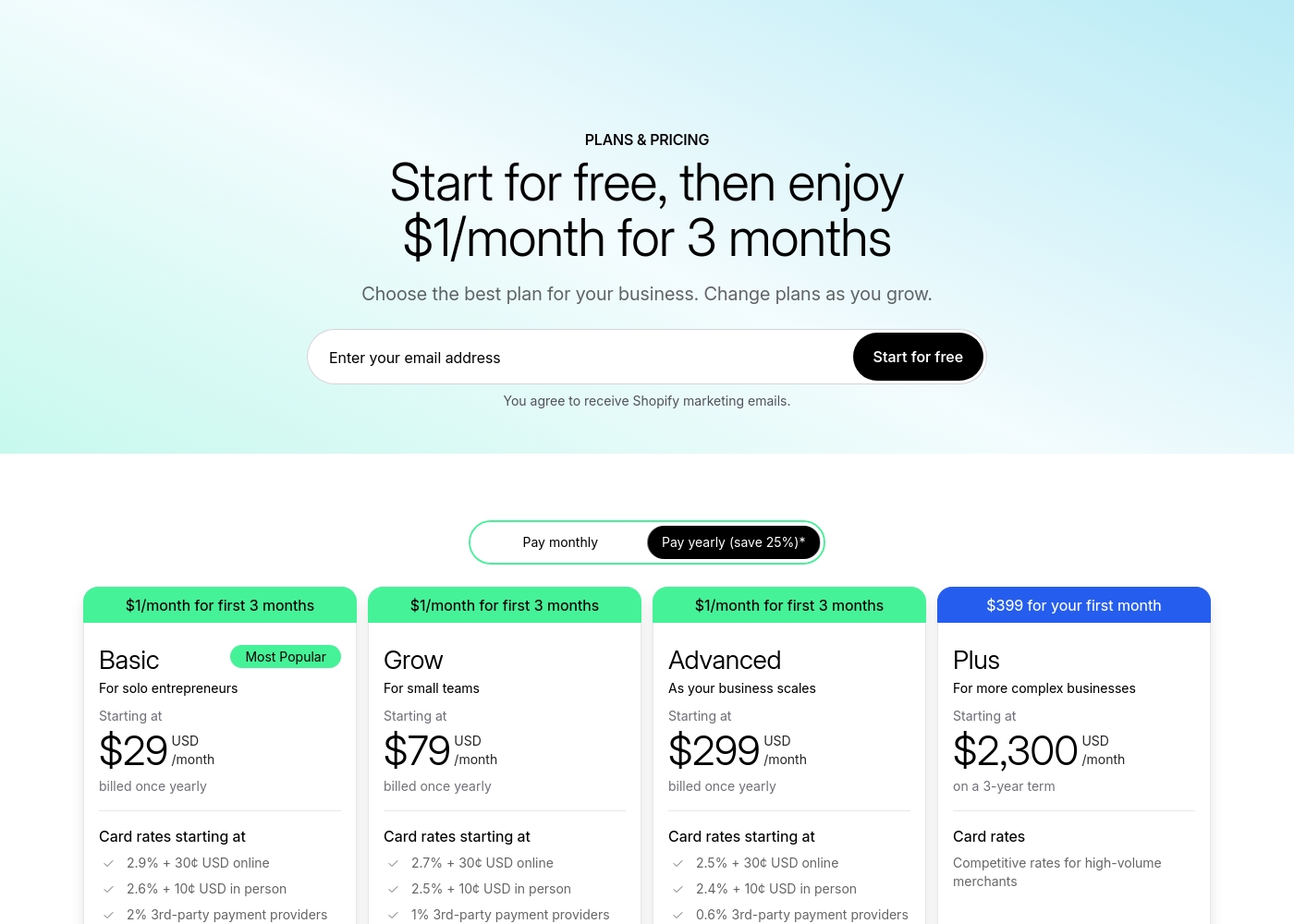
Shopify costs between $5 (Starter) and $2,300 (Plus) per month with six key plans: Starter at $5/month, Basic at $29/month (billed yearly), Grow at $79/month (billed yearly), Advanced at $299/month (billed yearly), Retail at $89/month, and Plus at $2,300/month (on a 3-year term).
Here’s a detailed look at the core subscription options designed to help your business evolve and scale.
Starter
Price: $5 USD / month Best For: Selling instantly through social media and messaging apps Other Features: Simple online store, Learn more link
- Sell instantly through social media and messaging apps
- Simple online store access
- For solo entrepreneurs - Most Popular
- 2.9% + 30¢ USD online card rates
- Up to 77% shipping discount
- 10 inventory locations
- 24/7 chat support
- For small teams
- 5 staff accounts
- 2.7% + 30¢ USD online card rates
- Up to 88% shipping discount and insurance
- 1% 3rd-party payment provider fees
- As your business scales
- 15 staff accounts
- 2.5% + 30¢ USD online card rates
- 3rd-party calculated shipping rates
- Enhanced 24/7 chat support
Pricing Notes
- Sellfy offers 0% platform transaction fees on all tiers, significantly increasing profit retention.
- Shopify charges up to 2% transaction fees if you use a payment provider other than Shopify Payments.
- Sellfy’s plans are capped by annual sales volume, maxing out at $200k on the Premium plan.
- Shopify is necessary for high-volume merchants needing scalability beyond the $200k Sellfy limit.
- Sellfy offers a 14-day free trial; Shopify only offers 3 days (though they often have promotions).
Pricing Head-to-Head
User Reviews
Reviewers overwhelmingly praise Sellfy for its user-friendliness and affordable structure, highlighting that setup, product uploading, and sales management are quick and easy, even for first-time sellers. Customers frequently mention the platform’s great pricing, noting it's more affordable than competitors because it charges no transaction fees.
Users value its comprehensive features, which successfully support digital products, subscriptions, and even reliable print-on-demand services. Customer support is consistently commended for being helpful and responsive; specific staff members received praise for their timely assistance.
This is the best platform I’ve tried for my mini business. It offers a full set of features for digital, physical, and print-on-demand products. The functionality, speed, and instant money transfer are all perfect.
While Shopify is recognized as an exceptionally powerful commerce platform that enables aggressive scaling, external feedback indicates significant user dissatisfaction. Customers frequently cite severe issues with customer support, emphasizing that interactions are often negative, slow, or handled by unhelpful chatbots.
A major recurring theme, especially on Trustpilot, focuses on platform reliability and integrity, with many users openly classifying Shopify as a 'fraudsters paradise' that fails to protect consumers from scam stores operating on the platform. Furthermore, the pricing structure and billing accuracy generate major complaints.
The platform is expensive and gives minimal customer support. You often learn how things work by making costly mistakes. Given their high fees, they should offer much better service.
Our Verdict
The choice between Sellfy and Shopify boils down to simplicity versus scale. If you are a creator focused purely on maximizing profit, Sellfy is the clear answer. Shopify is the only choice necessary for massive, complex e-commerce operations. Sellfy’s superpower is definitely its zero platform transaction fee model. This structure guarantees that you keep 100% of your earned revenue immediately. Sellfy also offers superior support and great value, bundling upselling and email marketing tools. Its specialized ability to handle massive digital files up to 20GB is unmatched by Shopify. Shopify’s power lies in its vast operational depth and immense scalability potential. Shopify effortlessly supports unlimited enterprise revenue by offering specialized Plus plans. Shopify is essential if you need unified commerce, combining online sales with in-person POS retail. Its massive 13,000+ app ecosystem allows total functional customization. The deciding factor is your projected revenue ceiling. If you expect to stay under $200k, Sellfy offers a better, simpler, and more profitable solution. Choose Shopify if you require B2B, comprehensive POS, or limitless international growth capability. Sellfy is the best friend of the solo creator; Shopify is the infrastructure for enterprise retail.
Frequently Asked Questions
Which platform offers better value for money: Sellfy or Shopify?
Sellfy offers much better value for money, especially for high-volume sales under $200k. Sellfy charges 0% platform transaction fees, boosting your profit margin immediately. Shopify requires using their payment system to avoid third-party transaction fees.
Can I sell in person using Sellfy like I can with Shopify?
No, Sellfy primarily focuses on streamlined online sales and website embedding functions. Shopify is built for unified commerce and offers dedicated Shopify POS integration. Choose Shopify if you need to manage physical, in-person transactions.
Which is better for selling a large digital course or video file?
Sellfy is better suited for selling large files like courses or software downloads. Sellfy supports individual file sizes up to 20GB on its top paid plan. Shopify usually relies on external apps for specialized large-capacity digital delivery.
How long is the free trial for Sellfy versus Shopify?
Sellfy gives you a generous 14-day free trial to test the full platform. Shopify currently only offers a shorter 3-day free trial to new users. Sellfy allows you more time to experiment before committing.
Does Sellfy include marketing tools that Shopify makes you pay extra for?
Yes, Sellfy bundles native growth tools like affiliate marketing and product upselling starting at lower tiers. Shopify often requires purchasing apps from its ecosystem to gain similar specialized conversion features. Sellfy includes up to 50,000 free email credits.
What is the biggest limitation of Sellfy compared to Shopify?
The biggest limitation is Sellfy's sales cap of $200,000 annually on its Premium plan. Shopify offers unlimited scalability for merchants growing into the enterprise level. Shopify also has a drastically wider app ecosystem.
Ready to Choose?
Both tools have their strengths. Choose based on your specific needs.
