Qustodio vs Webwatcher
Qustodio focuses on digital wellbeing and active screen time management for the whole family. Webwatcher is built specifically for discreet, focused monitoring of risky teen behavior. Your decision rests on whether you prioritize prevention or forensic supervision. Qustodio is generally the less risky choice for long-term family use.
Best for: Large families needing unlimited device protection, Parents focused on teaching healthy digital habits
Best for: Parents needing extreme discreet monitoring of one single teenager, Users focused on forensic data collection rather than active control
Robust features, unreliable performance, poor support.
We find Qustodio’s feature set impressive, offering tailored control regarding digital wellbeing across unlimited devices with its Complete plan. However, external feedback suggests serious concerns regarding core reliability and customer support responsiveness, especially dealing with technical issues and easy circumvention by children. Overall, we recommend caution due to significant reported performance flaws that undermine its comprehensive approach.
Pros
- Comprehensive digital wellbeing tools and detailed activity reports.
- The Complete plan offers coverage for an unlimited number of devices.
- Features AI-powered real-time alerts for concerning online activity.
- Provides unified supervision from a central, easy-to-use dashboard.
Cons
- Software is easily circumvented, uninstalled, or disabled by children/teens.
- Core functionality like time limits often fails or provides inaccurate usage reports.
- Customer support is widely reported as slow, non-existent, or unhelpful for paid users.
- Can interfere with mobile data and cause connectivity loss due to VPN architecture.
Extreme risk due to billing and support issues.
We found Webwatcher markets itself strongly on guaranteed functionality and comprehensive support for parental monitoring needs. However, our review of public user feedback showed severe, concrete accusations of fraudulent billing, refusal to issue refunds, and complete non-response from customer support. Overall, the serious financial and reliability risks reported by consumers necessitate a very low rating.
Pros
- Advertised compatibility across major devices (Android, iPhone, PC, Mac).
- Unlimited data storage is included in the current subscription plan.
- Setup is claimed to be quick and easy (under five minutes).
- Functionality is officially guaranteed with a full refund if issues cannot be resolved.
Cons
- Users report being refused refunds despite the official money-back guarantee.
- Specific claims of fraudulent double billing and funds theft were reported.
- Customer support was reported as non-responsive or misleading ('runaround').
- Product allegedly failed to work properly for some customers.
AboutQustodio
Qustodio is a comprehensive parental control tool designed specifically for modern families. It's an easy-to-use solution trusted by over eight million parents worldwide. The goal is to give parents peace of mind while fostering positive digital habits for their children. You manage everything from one simple dashboard, allowing supervision the way you want to. Because it's focused on digital wellbeing, it supports creating a risk-free environment for kids as they grow. ✨
AboutWebwatcher
WebWatcher is a specialized parental monitoring app. It is primarily aimed at supervising teenagers who may be involved in risky online behavior. The software gives parents necessary visibility into their child's digital footprint.
It works across major platforms including Android, iPhone, PC, and Mac devices. You can monitor everything seamlessly from anywhere using your secure, web-based online account. The application is designed to be discrete and tamper-proof once it's correctly installed. 💡
Highlights
Feature Comparison
Features Overview
We highlight the main differences and pick a winner for each feature.
Screen Time Control
Qustodio actively manages time; Webwatcher offers zero time controls.
Qustodio specializes in setting consistent daily time limits for better digital habits. Users can create custom screen time routines, perfect for study time or bedtime. You can also instantly pause internet access across all devices swiftly. This makes Qustodio excellent for active habit formation and structure building. Webwatcher does not include any screen time limitations or scheduling functionality. Its design is strictly focused on discreetly collecting activity logs. If you need to enforce limits, Webwatcher will not support that use case. Qustodio wins here easily. The key trade-off is active prevention versus passive data collection. Qustodio lets you prevent overuse and distractions effectively. Webwatcher only shows you the data after the fact. This is a critical distinction for parents prioritizing digital wellbeing versus simple behavior surveillance.
Device Coverage & Value
Qustodio covers unlimited devices; Webwatcher charges per device.
Qustodio offers impressive scalability with its Complete plan. This top tier covers an unlimited number of devices for one annual price ($99.95). It costs the same whether you monitor 3 or 15 devices. The Basic plan still covers five devices for $54.95 annually. Webwatcher is priced per device monitored, which quickly gets expensive. The advertised 3-Month Subscription only covers one single device. Monitoring multiple children requires buying multiple separate licenses from Webwatcher. Qustodio provides far superior value for money, especially for larger families. Webwatcher's per-device model limits its practical use for expansive needs. Check Qustodio if you need widespread coverage. Qustodio's yearly unlimited coverage offers crucial budget predictability. Webwatcher's cost quickly multiplies with every added device.
Discretion & Stealth
Webwatcher is designed for stealth; Qustodio is reportedly easy to bypass.
Qustodio is a visible solution focused on active management and limits. Unfortunately, users often report that children can easily circumvent the app. Teens can often uninstall or disable Qustodio with little effort, rendering the protection useless. Webwatcher is intentionally designed to be discrete and tamper-proof upon proper installation. The application aims to operate reliably in the background without detection. This stealth capability is essential for monitoring high-risk teenage behavior. This comparison pits active visibility against passive stealth monitoring. Webwatcher offers higher likelihood of remaining operational and undetected. If your priority is supervision that the child cannot easily bypass, Webwatcher is the better technical option.
Financial Trust & Safety
Qustodio is stable but buggy; Webwatcher carries extreme financial risk.
Qustodio users report significant issues regarding technical reliability and slow support response. Connectivity problems and inaccurate time limits are common complaints with Qustodio. However, these issues are mostly technical flaws. Webwatcher faces severe public allegations of predatory business practices. Users frequently report refusal to honor refunds and claims of fraudulent double billing. These reports suggest high consumer financial risk. Reliability issues plague both platforms, but the nature of the complaints differs entirely. Qustodio has performance bugs; Webwatcher faces accusations of financial malpractice. Choosing Qustodio means accepting technical frustration. Choosing Webwatcher means accepting potential billing issues and refusal of service.
Social App Monitoring
Webwatcher excels on Android Snapchat; Qustodio provides general social alerts.
Qustodio includes social monitoring features and AI-powered alerts. These tools flag concerning activity or searches across various platforms. The specific depth of monitoring for ephemeral chats is not emphasized by Qustodio. Webwatcher focuses on specialized deep monitoring of high-risk apps. On Android, Webwatcher captures received messages and takes screenshots of Snapchat activity. This provides thorough inspection capabilities. Webwatcher targets the specific monitoring challenges of disappearing message apps. This makes Webwatcher technically superior for this specific functionality on Android. If catching risky, hidden communications on Snapchat is a core necessity, Webwatcher provides better forensic tools.
Content Filtering
Qustodio actively blocks bad content; Webwatcher is passive data collection.
Qustodio allows parents to actively filter and block inappropriate websites and apps. It promotes a safer digital environment from the start. You build custom rules to ensure only child-friendly content is accessible. Webwatcher tracks and logs the websites visited and search terms used. It does not possess any active filtering or blocking mechanisms. You only review the data after the content has been accessed. Qustodio focuses on prevention, stopping exposure before it happens. Webwatcher focuses on observation and subsequent intervention. For younger children requiring active content roadblocks, Qustodio is the only viable option.
Customer Support Access
Qustodio offers promised priority support; Webwatcher support is often non-responsive.
Qustodio includes Priority Phone Support (Care Plus) free in its Complete plan. This suggests a dedicated path for faster resolution for high-tier users. Standard users receive email support, which is often reported as slow. Webwatcher advertises 'great customer care' but user reviews severely contradict this claim. Multiple consumers reported non-responsive agents and getting the 'runaround' on critical issues. While both tools have customer experience issues, Qustodio at least offers an incentivized path for priority help. Webwatcher's support seems universally problematic. If support is essential, Qustodio provides a clearer operational structure for guaranteed access.
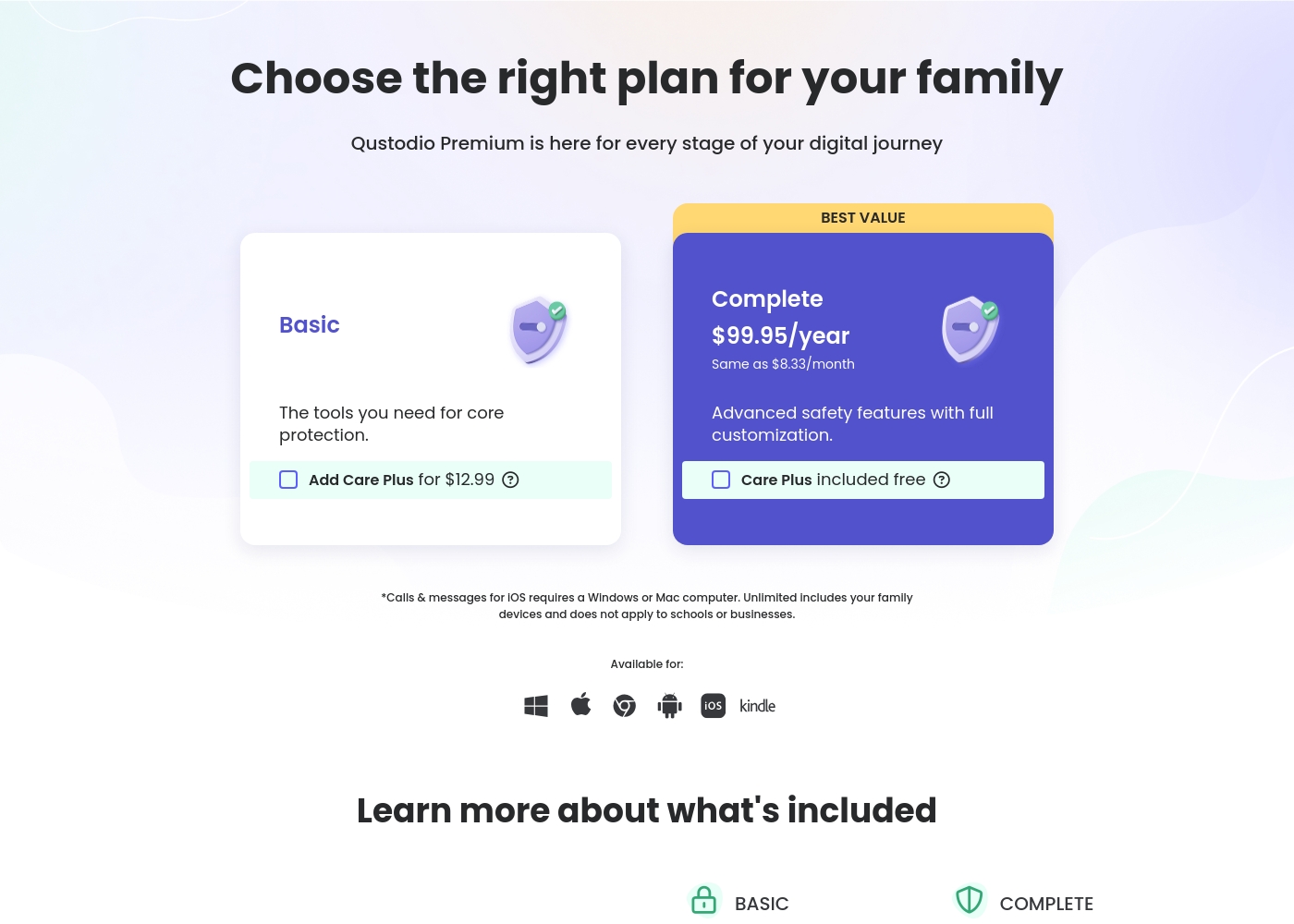
Qustodio costs between $54.95 and $99.95 per year with 2 Premium plans: Basic at $54.95/year and Complete at $99.95/year.
Let's look closely at what each Premium plan offers your family.
Basic
Price: $54.95/year (also listed as $67.94/year in some sections) Best For: Core protection or small families Refund Policy: 30-day money-back Other Features:
- Games & apps blocking
- Daily time limits
- Web filtering and location monitoring
- Pause internet access
- AI-powered alerts and social monitoring
- Games & apps blocking
- Daily time limits
- Web filtering
- Location monitoring
- Pause internet access
- All Basic features included
- Unlimited devices protected
- Calls & messages monitoring*
- Care Plus included free (Priority support, check-ins, personalized help)
- Custom rules for web, apps and games
- Basic protection features
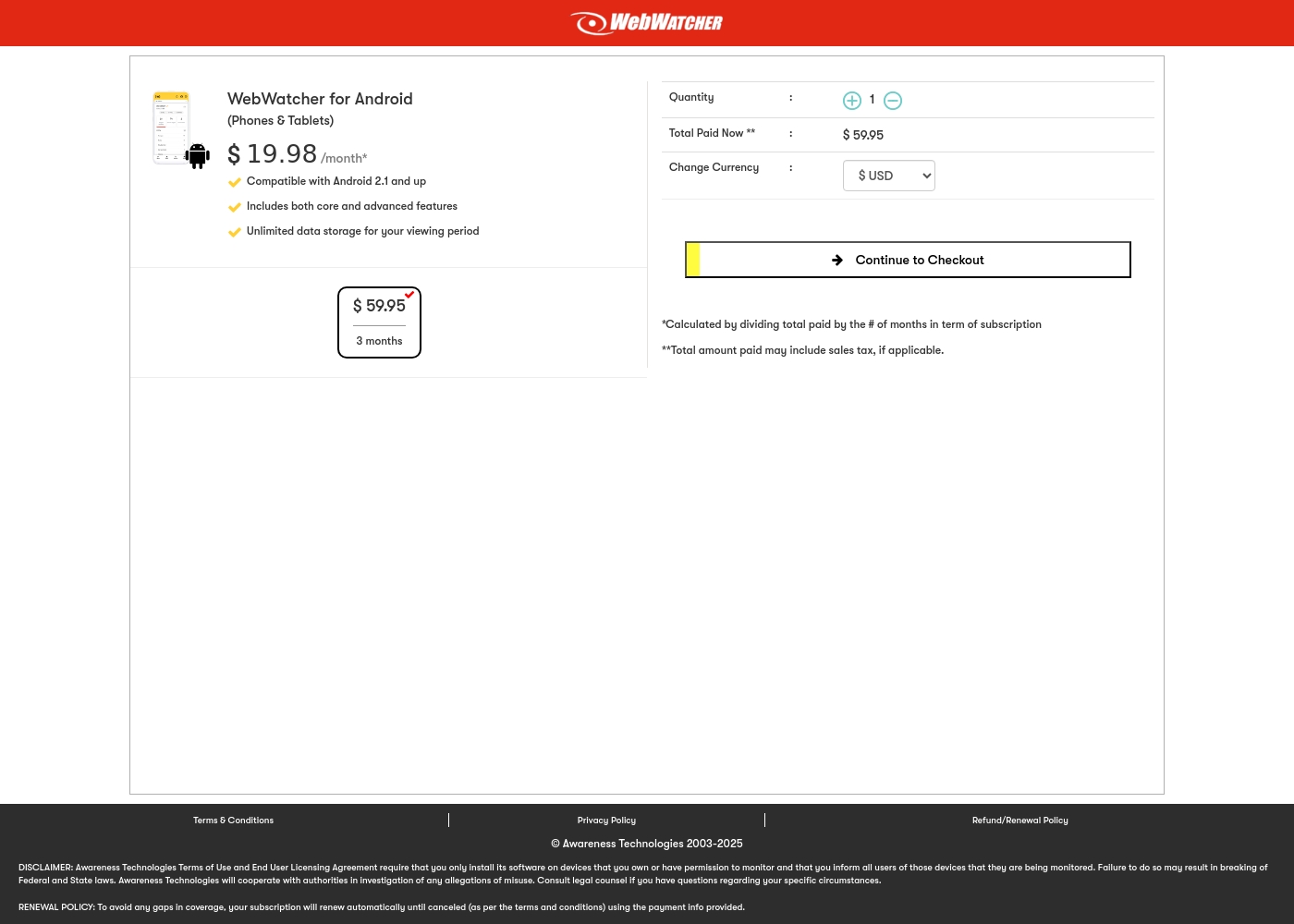
Webwatcher costs $19.98 per month with one explicitly priced plan: the 3-Month Android Subscription at $59.95 total.
Finding the right monitoring solution for your family is simple. Here is a detailed look at the pricing and features available in the current purchase flow.
3-Month Android Subscription
Price: $59.95 (paid every 3 months, calculated at $19.98/month) Best For: Parents monitoring Android phones and tablets Refund Policy: Full refund guaranteed if issues cannot be resolved Other Features:
- Compatible with Android 2.1 and newer versions
- Includes both core and advanced features
- Unlimited data storage for your full viewing period
- Compatible with Android 2.1 and up
- Includes both core and advanced features
- Unlimited data storage for your viewing period
Pricing Notes
- Qustodio offers a better budget structure for large families; the Complete plan covers unlimited devices for $99.95/year.
- Webwatcher charges on a per-device basis, making it very expensive if you monitor more than one child.
- Webwatcher requires purchasing 3 months ($59.95) upfront to achieve the $19.98 monthly rate.
- Qustodio offers a free version and a 30-day money-back guarantee.
- Consumers should assume extremely high financial risk with Webwatcher due to repeated allegations of billing fraud and refund denials.
Pricing Head-to-Head
User Reviews
User feedback on Qustodio is highly polarized, resulting in a low average rating (2.5/5 on Trustpilot). While the platform offers appealing features like comprehensive monitoring and time management, users frequently report major reliability issues.
A recurring critical complaint is that the software is easily disabled or uninstalled by children—sometimes by simply ending the process in Task Manager—rendering the expensive Premium subscription useless. Customers also struggled with core functionality; many noted that screen time limits were often inaccurate or failed to apply correctly, occasionally reporting usage during sleeping hours.
Zero customer support despite paying for the premium subscription. It was impossible to recover forgotten passwords. Plus, my 13-year-old son uninstalled the app in 15 seconds, making it useless right away.
Webwatcher’s external feedback is extremely limited, stemming only from two reviews which resulted in a very low 2.9 TrustScore. While the platform advertises a strong 'risk-free' guarantee and promises excellent, responsive customer care, the limited user reports strongly contradict these claims.
Both reviewers cited severe issues primarily centered on billing and refunds. Users claim they were refused refunds entirely, even when requested within the advertised refund window, despite the monitoring product reportedly failing to work properly.
They refused to honor the risk-free money-back guarantee, even though I submitted the request properly. Furthermore, the product I purchased never actually worked for me as advertised. I absolutely feel like they are ripping me off.
Our Verdict
Qustodio and Webwatcher serve very different parental control needs, making the selection difficult. While Qustodio targets family digital wellbeing, Webwatcher focuses on deep, discreet supervision. For most parents seeking active management, **Qustodio is the safer and more versatile choice,** offering much less financial risk than Webwatcher. Qustodio's superpower is comprehensive time management and superb scaling. Its Complete plan covers unlimited devices for one annual fee, excellent for large households. Qustodio allows you to set schedules and instantly pause internet access. This actively promotes healthier screen habits for your kids. Webwatcher shines with its intended discretion, specifically for high-risk teens on one device. It is built to be tamper-proof and includes specialized monitoring. This lets Webwatcher efficiently capture ephemeral messages and activity on apps like Snapchat (Android). The deciding factor must center on trust and integrity. Qustodio has reported technical glitches but is financially stable. Webwatcher users report constant fraudulent charges and denial of refunds. Avoid Webwatcher unless extreme discretion outweighs the high financial uncertainty. Choose Qustodio if you need active filtering and multi-device limits for the whole family. If deep, discreet supervision for one high-risk device is essential, Webwatcher is the technical choice, but exercise extreme caution during payment.
Frequently Asked Questions
Which is better for active screen time management: Qustodio or Webwatcher?
Qustodio is significantly better for managing screen time. It allows you to set custom schedules, daily time limits, and instantly pause the internet. Webwatcher does not offer any active screen time control features.
Can Qustodio monitor unlimited family devices like Webwatcher?
Yes, Qustodio's Complete plan allows protection for an unlimited number of devices. Webwatcher is licensed per device, typically covering only one single device per subscription. Qustodio offers far better scalability and coverage.
Does Webwatcher have features that Qustodio lacks?
Webwatcher prioritizes discretion and specialized monitoring. It is advertised as tamper-proof, unlike Qustodio, which is reported to be easily circumvented. Webwatcher also performs deeper Snapchat monitoring on Android.
Is Qustodio more reliable than Webwatcher based on user reviews?
Yes, Qustodio is considered safer despite its bugs. While Qustodio users report technical issues affecting accuracy, Webwatcher users report extreme claims of financial fraud and refusal to issue promised refunds.
Which software offers active content filtering and blocking?
Qustodio provides robust tools to actively filter and block inappropriate content and apps. Webwatcher only records browsing history and searches, acting as a passive data collection tool.
Who benefits from paying for the Complete plan offered by Qustodio?
The Complete plan is best for large families who need unlimited device coverage. It includes priority phone support (Care Plus) and advanced monitoring features. This plan provides the maximum control using Qustodio.
Ready to Choose?
Both tools have their strengths. Choose based on your specific needs.