Quadient vs Splunk
Quadient and Splunk solve very different problems for very different teams. Quadient automates financial workflows like AP and AR. Splunk is a powerhouse for analyzing machine data for security and operations. The choice depends entirely on whether you need to move money or move data.
Best for: Enterprise finance teams automating AP and AR workflows, Customer communications managers handling omnichannel document delivery
Best for: Security operations centers (SOC) needing SIEM and threat detection, IT operations teams troubleshooting application performance
Powerful automation, but support concerns us.
We find Quadient offers robust tools for automating AP/AR and managing customer communications at scale. However, persistent user complaints about customer support and contract flexibility temper our recommendation. Overall, it's a capable suite for larger enterprises, but smaller teams should proceed with caution.
Pros
- Automates end-to-end AP and AR workflows.
- Strong omnichannel document creation and delivery.
- Empowers business users, reducing IT dependency.
- Scales well for high-volume, complex needs.
Cons
- Significant concerns about customer service and support responsiveness.
- Contracts and billing terms can be rigid or difficult.
- May be too complex or costly for small businesses.
- Onboarding and integration can present challenges.
Powerful but complex data platform.
We find Splunk offers a robust, unified platform for security and observability with extensive integrations and scalability. However, its pricing structure is opaque and usage-based, which can make cost planning challenging. Overall, it's a strong choice for enterprises needing deep data analysis, but smaller teams may find it complex and expensive.
Pros
- Unified platform for security and observability.
- Over 2,000 integrations with various data sources.
- AI and automation for threat response.
- Handles massive data volumes at scale.
Cons
- Opaque pricing requires consultation with sales.
- Can be complex to set up and learn.
- Usage-based models may lead to unpredictable costs.
- External review access was blocked, limiting user sentiment data.
AboutQuadient
Quadient is a suite of process automation solutions focused on two core areas: customer communications management (CCM) and financial workflow automation. It's designed for mid-to-large enterprises that need to design, manage, and deliver personalized documents and messages across digital, print, and mobile channels, while also automating key AP and AR processes. 💡
AboutSplunk
Splunk is a unified platform for security and observability. It's designed for teams that need to search, analyze, and act on data from any source. Whether you're a security analyst hunting threats or an engineer troubleshooting app performance, it brings everything together in one place. ✨
Highlights
Feature Comparison
Features Overview
We highlight the main differences and pick a winner for each feature.
Primary Use Case
Quadient automates financial processes. Splunk analyzes all your machine data.
Quadient specializes in automating accounts payable, accounts receivable, and customer communications. It's built for finance and marketing teams to streamline document-heavy workflows. Splunk is designed for security analysts and IT operations. It ingests and analyzes logs, metrics, and traces from any source to provide real-time insights. The core difference is domain: Quadient is for business process automation. Splunk is for data analysis and monitoring. If your goal is to pay invoices faster, choose Quadient. If you need to hunt for security threats, choose Splunk.
Integration Ecosystem
Splunk connects to thousands of data sources. Quadient focuses on core financial integrations.
Quadient offers standard integration options designed for connecting to your financial systems and document workflows. Splunk boasts over 2,000 pre-built integrations and supports OpenTelemetry. It connects to virtually any data source, from firewalls to cloud databases. Splunk's ecosystem is vastly larger, reflecting its role as a central data platform. Quadient's integrations are more targeted to its specific use cases. For a hybrid IT environment, Splunk's breadth is unmatched. For plugging into your ERP, Quadient provides the necessary connections.
Ease of Use
Quadient aims to empower business users. Splunk has a powerful but steep learning curve.
Quadient is designed to let business users manage templates and workflows without heavy IT involvement. This reduces bottlenecks for marketing and finance teams. Splunk is a complex, powerful platform. Mastering its query language and dashboard building requires significant training and technical expertise. The trade-off is power versus accessibility. Quadient offers a more guided experience for its specific tasks. Splunk offers ultimate flexibility but demands more skill. A new hire can likely be productive in Quadient's template editor faster than they can build a complex Splunk dashboard.
Security & Compliance
Splunk is built for security operations. Quadient handles secure document delivery.
Splunk is a core security tool. It provides SIEM capabilities, threat detection, and compliance reporting for audits like SOC 2. Quadient focuses on the security of document creation and delivery, ensuring communications are compliant and data is handled properly. Splunk's security features are a primary product function. For Quadient, security is a feature supporting its main workflow automation purpose. If your team's job is cybersecurity, Splunk is essential. If you need to securely send 10,000 personalized bills, Quadient does that job.
Reporting & Analytics
Splunk excels at real-time data analysis. Quadient provides workflow and document insights.
Splunk allows you to search, analyze, and visualize any machine data in real time. You can build custom dashboards to monitor anything. Quadient provides analytics on your communication and financial workflows, like Days Sales Outstanding (DSO) and document delivery metrics. Splunk's analytics are open-ended and exploratory. Quadient's analytics are focused on improving specific business process KPIs. For troubleshooting app performance, Splunk's real-time analysis is superior. For tracking invoice payment cycles, Quadient's targeted reports are more useful.
Pricing Transparency
Both require a sales call. Splunk's usage model can be unpredictable.
Quadient uses custom quotes. Pricing is tailored to your specific workflow and needs, with unlimited users included in its AP module. Splunk's pricing is based on either data volume ingested or observability activity. Costs can spike if your data usage increases unexpectedly. Both platforms lack transparent public pricing, but Splunk's usage-based model introduces more variables. Quadient's quote is more tied to your process scale. A sudden surge in log data could dramatically increase your Splunk bill. A surge in invoices wouldn't necessarily change a fixed Quadient subscription.
Customer Support
User reports highlight significant support issues for Quadient. Splunk's support details are less public.
External reviews for Quadient consistently complain about slow, unresponsive customer service and support. This is a major pain point for users. Splunk's support options and SLAs are not detailed on their public site. You must contact sales for specifics. The available evidence points to a clear weakness for Quadient. The lack of information makes Splunk's support quality harder to judge from the outside. If reliable, fast support is critical, you should verify Splunk's offerings directly. For Quadient, you should proceed with caution based on user feedback.
Scalability
Both are enterprise-grade, but for different types of scale.
Quadient is built to handle high volumes of documents and financial transactions for large organizations. Splunk is designed to ingest and analyze petabytes of machine data from across global enterprises. Both scale, but Splunk's scale is about data volume, while Quadient's is about transaction volume. They operate in different domains. Scaling a company's invoice processing is Quadient's challenge. Scaling monitoring for a cloud infrastructure is Splunk's challenge.
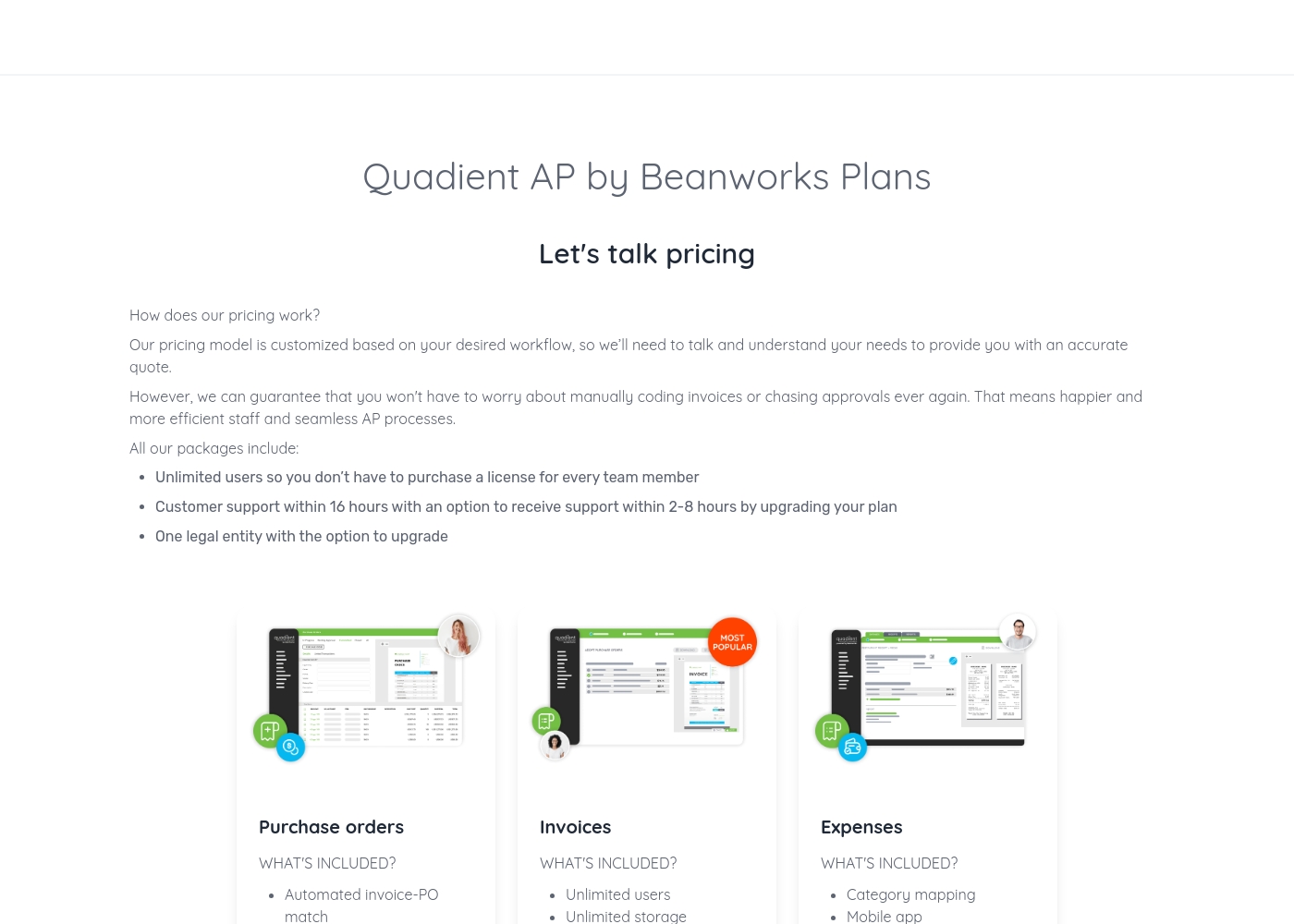
Quadient pricing: Quadient AP by Beanworks uses a custom pricing model based on your specific workflow and needs. They offer feature-specific packages for purchase orders, invoices, and expenses to ensure you only pay for what you use.
All plans include unlimited users and standard support, with the option to upgrade for faster response times or more entities. This tailored approach allows the platform to scale with your business while removing the burden of manual AP processes once and for all.
Contact them for a personalized quote today and discover how much you could save by automating your business's workflows. Their team of experts is ready to help you find the perfect solution for your accounts payable needs, whether you're a small business or a large corporation.
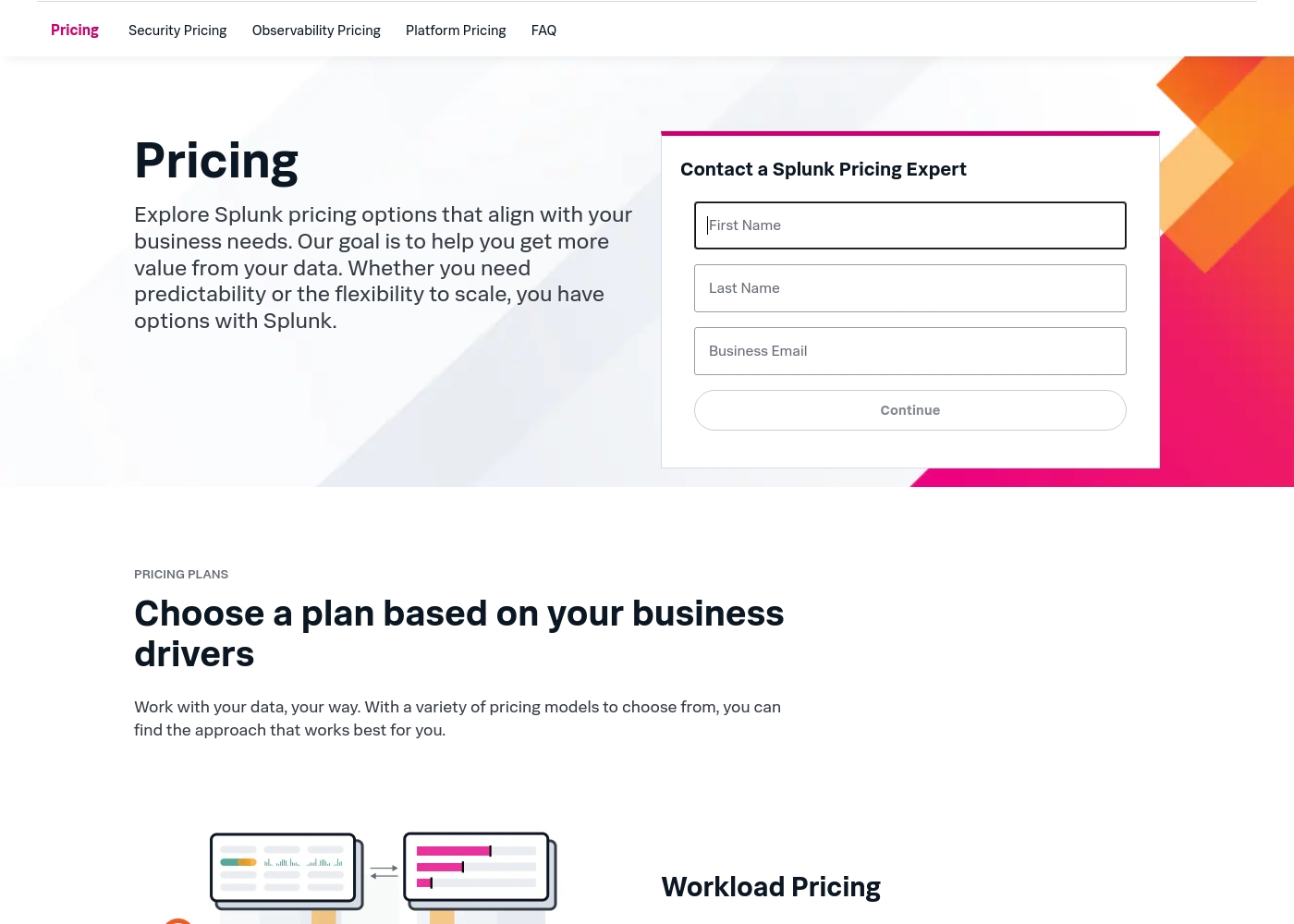
Take a look at the different ways you can manage your data costs below.
Ingest Pricing
Best For: Teams needing predictable costs for high-volume data ingestion Other Features: Simple predictable approach, Economical search scaling, Broad data ingestion
This plan is a great fit if you want a straightforward bill based on the amount of data you bring into the platform. It makes it easy to run extra searches without worrying about hidden fees. It's built for consistency and long-term planning.
- Search and analyze machine data
- Expanded use cases on ingested data
- Standard data ingestion
- Metric time series (MTS)
- Traces analyzed per minute
- Sessions monitoring
- Uptime requests
Pricing Notes
- Both platforms require contacting sales for a specific quote. Neither lists public, fixed pricing tiers.
- Quadient's AP module includes unlimited users, which can be cost-effective for larger teams.
- Splunk's usage-based pricing (by data volume or activity) can lead to unpredictable costs if your data intake spikes.
- Splunk offers a free trial to explore its UI. Quadient does not advertise a free trial.
- For Quadient, costs are tied to your specific workflow needs and chosen modules.
- For Splunk, costs are tied to either the volume of data you ingest or the number of observability activities you process.
Pricing Head-to-Head
User Reviews
External reviews for Quadient are mixed. On Trustpilot, users frequently complain about poor customer service, slow support, and billing issues, creating a frustrating experience.
💔 Some mention difficult contracts and a lack of responsiveness. However, on Capterra, the limited feedback for the Impress platform is more positive, with a user praising its document creation capabilities and template management as highly important features.
The software itself might work, but the customer service is a nightmare. Getting any help or a simple question answered takes forever. We've wasted so much time trying to get support.
Based on the provided external sources, we couldn't retrieve detailed user reviews for Splunk due to access restrictions. Trustpilot and Capterra both returned verification or security pages, preventing us from gathering specific sentiment on accuracy, ease of use, support, or pricing.
This means our review is based solely on the official product information and pricing details provided. We recommend checking these review sites directly for the latest user feedback before making a decision.
Our Verdict
This isn't a fair fight—it's a category clash. Quadient and Splunk solve completely different problems. Choosing between them is like choosing between a specialized accounting software and a giant data analytics engine. Quadient's superpower is automating complex financial workflows. It shines when your finance team is drowning in paper invoices or needs to send personalized statements to thousands of customers across print and digital channels. Splunk's superpower is making sense of massive, chaotic data streams. It's the go-to platform when your security team needs to hunt threats or your engineers need to debug performance issues across a sprawling cloud infrastructure. The deciding factor is your core problem. If you need to move money faster and automate document-heavy processes, Quadient is built for that. If you need to analyze machine data to keep systems running and secure, Splunk is the industry leader. For most business leaders, the choice is clear. Finance and operations teams should explore Quadient for AP/AR and CCM automation. IT and security teams should evaluate Splunk for observability and threat detection. They are tools for different jobs.
Frequently Asked Questions
Is Splunk worth the cost for small businesses?
Probably not. Splunk is a powerful, enterprise-focused platform with usage-based pricing that can become expensive. Its complexity also requires technical expertise. Small businesses with simple data needs should look at more affordable alternatives first.
Which is easier to get started with, Quadient or Splunk?
Quadient is likely easier for its target users (business teams). Splunk has a notoriously steep learning curve. Both are complex enterprise platforms, but Splunk's power comes with greater initial setup and training demands.
Can I switch pricing models with Splunk?
Yes, Splunk states you can explore options to move between their pricing programs. You can discuss switching from an ingest-based to an activity-based model (or vice versa) with their sales team to better fit your evolving needs.
Is Quadient only for large enterprises?
It's primarily targeted at mid-to-large enterprises with high-volume needs. The complexity and custom pricing may be overkill for small businesses with simple AP or communication requirements.
Ready to Choose?
Both tools have their strengths. Choose based on your specific needs.