Proton Drive vs Tresorit
This comparison pits two giants of zero-knowledge privacy against each other. Proton Drive leverages its comprehensive ecosystem and generosity with a 5 GB free plan. Tresorit focuses keenly on robust organizational compliance and specialized security features like eSign. Both suffer from reported customer service and performance issues, making the choice about feature priority.
Best for: Privacy-focused users storing sensitive personal files, Professionals who need encrypted file sharing
Best for: Organizations that must adhere to specific data residency requirements (e.g., GDPR compliance), Businesses needing secure, custom-branded data rooms for collaboration with external clients
Private cloud storage with collaboration tradeoffs to test
Proton Drive is strong for encrypted storage and secure sharing, but buyers should compare app maturity, collaboration needs, and storage economics before replacing an existing cloud suite.
Pros
- End-to-end and zero-access encryption are central to the product rather than add-ons.
- Free 5 GB plan lets users test the workflow before upgrading.
- Paid plans include useful storage tiers for individuals, families, and businesses.
- Secure sharing and Proton ecosystem bundles can reduce tool sprawl for privacy-focused users.
Cons
- Collaboration features may feel less mature than Google Drive or Microsoft 365 for heavy teams.
- Exact checkout prices can vary by currency and billing term.
- Users who only want cheap storage may find better raw-capacity deals elsewhere.
- Some public user feedback still points to platform and sync maturity concerns.
Ultra-Secure Platform with Usability Hurdles
Tresorit provides industry-leading zero-knowledge encryption, effectively securing sensitive data for compliance-heavy organizations. We recognize its complex structure targets users who prioritize full control over interface simplicity, but we found consistent reports of slow sync speeds, migration difficulties, and unresponsive customer support. Overall, Tresorit is a specialized tool best suited for organizations where absolute security outweighs functional refinement.
Pros
- Absolute security guaranteed by zero-knowledge, end-to-end encryption.
- Strong compliance features and options for custom data residency (e.g., Swiss data centers).
- Specialized products available for collaboration or secure cloud storage.
- Integrated tools like eSign and document scanning (mobile app) streamlines workflows.
Cons
- Consistently reported issues with slow upload and synchronization speeds.
- Customer support is frequently unresponsive and ignores critical technical issues.
- High cost compared to mainstream cloud storage alternatives.
- Functionality is spotty and less user-friendly than competitors.
AboutProton Drive
Proton Drive is an end-to-end encrypted cloud storage service from Proton. It lets users store files, photos, and documents, recover previous versions on paid plans, share files securely, and use Proton Docs and Proton Sheets. Proton says not even Proton can access user files and folders or see their names without permission.
AboutTresorit
Tresorit is a comprehensive, end-to-end encrypted platform built for control. It helps organizations protect their digital environment and manage sensitive data flow. You handle crucial tasks—like storing, sharing, scanning, and signing—securely in a single location 🔒. This system supports staying productive through integrations with tools like Google and Outlook. Trusted by over 11,000 organizations, Tresorit offers a proven way to work securely, internally and externally.
Highlights
Feature Comparison
Features Overview
We highlight the main differences and pick a winner for each feature.
Zero-Knowledge Security
Both offer top-tier E2EE security, but Proton Drive offers open-source transparency.
Proton Drive uses end-to-end encryption; files and metadata are encrypted locally on your device. This protection is backed by strict Swiss privacy laws, offering robust legal defense. Tresorit utilizes zero-knowledge E2E encryption, ensuring Tresorit cannot access or view your content. It appeals strongly to organizations needing absolute data control. While both secure your data profoundly, Proton Drive offers open-source transparency which Tresorit does not explicitly mention. The security commitment in both platforms means maximum protection against data breaches and corporate surveillance efforts.
Cost & Free Access
Proton Drive offers a permanent free tier; Tresorit requires customized quotes after a trial.
Proton Drive provides a generous, permanent Free plan that includes 5 GB of secure storage. This allows testing everything risk-free for life. Tresorit offers a 14-day free trial to explore its full capabilities before requiring a purchasing commitment. You must request a custom quote afterwards. Proton Drive offers clear tiered plans allowing easy upgrades, whereas Tresorit's pricing is opaque and customized by specialized products. If budget and accessing free, secure storage are critical, Proton Drive is the clear and immediate choice for individuals.
Data Residency
Tresorit allows choosing physical data storage location, crucial for regulatory mandates.
Proton Drive is based solely in Switzerland, relying on strong Swiss law to protect all user data. This is great for privacy but lacks residency options. Tresorit offers custom data residency options, allowing users to select Swiss, GDPR-compliant, or other overseas locations. For large organizations needing to meet complex international compliance standards, Tresorit’s flexibility is a huge advantage. This feature is often mandatory for businesses that must physically keep data within specific geographic borders for legal reasons.
Advanced Collaboration
Tresorit offers specialized data rooms and eSign; Proton Drive provides basic document editing.
Proton Drive provides a basic online document editor for real-time writing and sharing within the secure platform. File syncing is also available primarily for Windows users. Tresorit offers specialized products like Engage, which establishes confidential, branded data rooms for client collaboration. Tresorit further enhances collaboration with an integrated eSign feature for managing document approvals efficiently in one place. Tresorit is designed structurally as a secure collaboration suite, while Proton Drive is primarily secure storage with basic teamwork functions.
Ecosystem Value
Proton Drive bundles its entire security suite; Tresorit connects with productivity apps.
Proton Drive integrates deeply with the entire Proton product suite (Mail, VPN, Password Manager). The Unlimited plan gives you access to everything. Tresorit integrates with external productivity tools like Google and Outlook for streamlined workflow management. Choosing Proton Drive means buying into a holistic, interconnected security platform maintained by one excellent vendor. Tresorit users benefit from tools like the Email Encryption add-on to secure emails sent through traditional providers like Outlook.
Performance & Sync
Both services are heavily criticized by users for frustratingly slow upload and synchronization speeds.
Proton Drive reviews frequently cite very slow upload speeds and general operational reliability issues. Data recreation from old backups has unfortunately been necessary for some users. Tresorit users also report consistently slow synchronization and upload speeds compared to standard cloud providers. Glitches can cause files to vanish temporarily on occasions. The latency issue likely relates to the intense, mandatory client-side zero-knowledge encryption process used by both providers. Neither platform wins on raw speed, indicating that maximum privacy requires a patience trade-off in both cases.
Customer Support
Neither platform performs well here; both face severe complaints about unresponsiveness.
Proton Drive support is widely criticized as painfully slow, unhelpful, and providing only generic replies to complex issues. Billing complaints and slow resolution times are common. Tresorit support is frequently deemed unresponsive, ignoring critical technical issues for months, even for paying business clients. Users report feeling "ghosted" by both companies when major technical problems or billing disagreements arise. If reliable, timely customer support is a necessity for your business, neither Proton Drive nor Tresorit currently appears trustworthy.
External Sharing Control
Tresorit offers more granular control over external file sharing via watermarks and limits.
Proton Drive lets you secure shared links using passwords, auto-set expiration dates, and offers instant access revocation. Tresorit adds powerful controls like file watermarks, limits on how many times a file can be opened, and enforced passwords. Tresorit is clearly superior when sharing highly sensitive final documents externally where leakage prevention is critical. For basic secure sharing, Proton Drive works well, but Tresorit provides the full suite of leakage prevention safeguards.
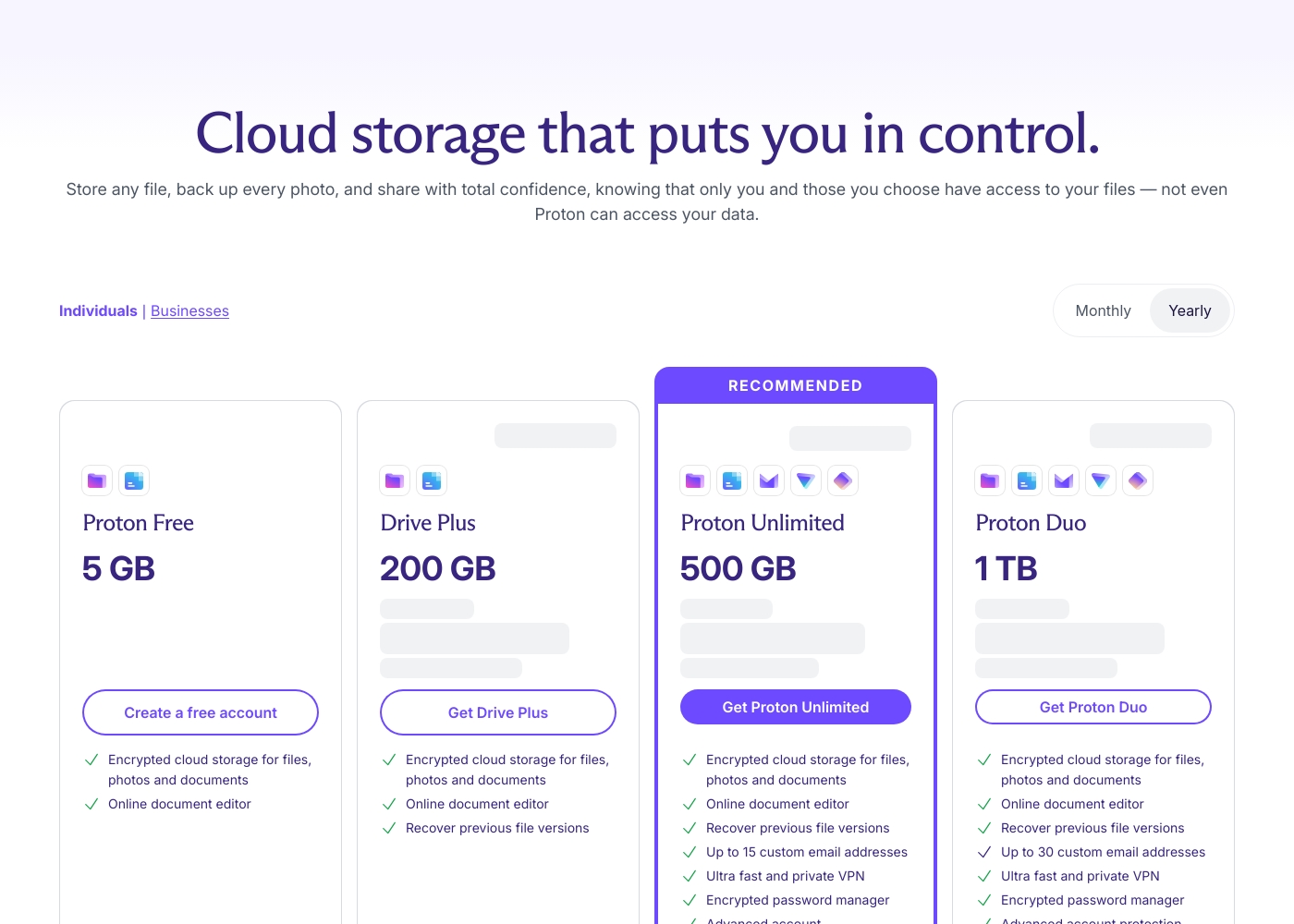
Proton Drive offers a free 5 GB plan and multiple paid options. Current public plan labels include Drive Plus with 200 GB, Proton Unlimited with 500 GB, Proton Duo with 2 TB, Proton Family with 3 TB for up to 6 users, and Drive Professional with 1 TB per user. Proton also displays a 30-day money-back guarantee on the pricing page. Exact prices can vary by currency, billing term, country, and promotion, so verify checkout before purchase.
- 5 GB storage
- Encrypted cloud storage
- Online document and spreadsheet editor
- 200 GB storage
- Encrypted storage for files, photos, and documents
- Version recovery
- Docs and Sheets
- 500 GB storage
- Drive plus Proton Mail, VPN, Pass, and account protection features
- Family storage for up to 6 users
- Business storage per user
- Encrypted sharing and productivity tools
These specialized products focus on secure collaboration, cloud storage, and file exchange. You will need to select a product to find the plan with the right features tailored to your requirements.
Tresorit Engage
Best For: Client and partner management using secure, encrypted data rooms. Other Features:
- Build client trust with encrypted data rooms
- Collaborate confidently and exchange files securely
- Encrypted, branded space
If your primary focus is secure external collaboration and building client trust, choose Tresorit Engage. This plan helps manage sensitive partnerships using dedicated, encrypted data rooms. It’s designed to streamline your workflows from prospect to partner.
- Encrypted data rooms
- Client collaboration features
- Branded collaboration spaces
- Store, sync, and share sensitive files
- End-to-end (e2e) encryption
- Zero-knowledge protected cloud platform
- Secure file exchange when storage is outsourced
- Protect shared files with password, watermark, and open limit controls
- End-to-end control
Pricing Notes
- Proton Drive offers a generous, permanent 5 GB free tier, offering significant value compared to Tresorit’s limited 14-day trial.
- Tresorit uses a specialized product model (Engage, SecureCloud) requiring organizations to request a custom, opaque quote.
- Proton Drive provides transparent tiered plan structures (Plus, Unlimited, Family) even if exact prices are not published.
- Beware: Users of both Proton Drive and Tresorit report complaints about confusing billing and difficult refund processes.
Pricing Head-to-Head
User Reviews
Proton Drive is one of the clearest choices for privacy-first cloud storage. The main question is not whether it is secure, but whether its app maturity and collaboration model fit the reader workflow.
The product is amazing, particularly the VPN and Mail. I love the privacy ethos of the company and the value offered by the subscription is excellent. I'm excited for their future updates.
Tresorit receives deeply polarized feedback from users across Trustpilot and Capterra. Many users who prioritize absolute data security laud the platform, calling it the best option available for zero-knowledge, end-to-end encryption storage.
They note features like turning any folder into a secured cloud space are excellent, and the resulting peace of mind often justifies the high cost. However, the majority of negative reviews center on severe issues with reliability and customer service responsiveness.
I’ve been a Premium subscriber for years. If you need genuinely secure storage with no backdoor and end-to-end encryption, it's the best option available. The support team is fast and helpful, and the iOS app is easy to navigate.
Our Verdict
Ultimately, the choice between Proton Drive and Tresorit hinges on your specific security needs. Proton Drive is the stronger choice for individuals and small teams seeking holistic digital privacy. Tresorit is better suited for corporate environments demanding specialized regulatory control and compliance features. Proton Drive’s superpower is its unified security ecosystem, offering 5 GB free storage plus integrated access to Proton Mail and VPN. It operates completely on open-source code and secures user data under strict Swiss privacy laws. If comprehensive, transparent privacy is your goal, Proton Drive delivers excellent value. Tresorit's superpower is deep organizational control and specialization, evident in tools like integrated eSignatures and secure data rooms (Engage). Furthermore, Tresorit offers custom data residency, a non-negotiable feature for highly regulated businesses worldwide. Your budget and regulatory obligation are the deciding factors. If complex legal compliance or digital signing is necessary, Tresorit is the superior platform. If you want maximum security bundled with other essential privacy tools, Proton Drive is the clear winner for value. Be warned, customer support reviews are abysmal for both Proton Drive and Tresorit.
Frequently Asked Questions
Which is better for individual users: Proton Drive or Tresorit?
Proton Drive is generally better for individuals due to its generous, permanent 5 GB free plan. Tresorit focuses more on custom organizational solutions and requires specialized quotes. Proton Drive also integrates seamlessly with the full Proton security ecosystem.
Is Tresorit worth the extra cost over Proton Drive?
Tresorit is worth the cost if you need advanced features like integrated document eSignatures or custom data residency options. If you only need secure storage and sharing, Proton Drive offers better immediate value and features transparency. Pricing for Tresorit is opaque and requires a quote.
Does Proton Drive offer the same advanced file sharing controls as Tresorit?
Proton Drive offers secure links with passwords and auto-set expiration dates for sharing. Tresorit adds superior controls, including enforced file watermarks and limits on how many times a document can be opened. Tresorit is better for external leakage prevention.
Why do users complain about performance for both Proton Drive and Tresorit?
Both services employ intense zero-knowledge encryption directly on your device before uploading. This mandatory client-side process significantly increases the upload and synchronization time. Maximum E2EE security requires a patience trade-off for both Proton Drive and Tresorit.
Which platform has better customer support: Proton Drive or Tresorit?
Based on user reviews, both Proton Drive and Tresorit receive widespread, poor feedback regarding customer service. Users report slow, unhelpful, and unresponsive support experiences on both sides. Expect potential challenges if you encounter technical issues.
Can organizations choose where their data is physically stored?
Tresorit allows organizations to choose their physical data residency location, which is crucial for compliance mandates like GDPR. Proton Drive stores all user data in Switzerland under strong Swiss legal protection only.
Ready to Choose?
Both tools have their strengths. Choose based on your specific needs.