Proof vs Zoho PageSense
Proof and Zoho PageSense are both website optimization tools, but they have very different superpowers. Proof is laser-focused on social proof and personalization to boost conversions. Zoho PageSense is a full-suite conversion rate optimization (CRO) powerhouse. Here's how they stack up.
Best for: Startup marketers looking to increase website conversions., Growth teams wanting to personalize user experiences.
Best for: Teams needing a full CRO toolkit (analytics, testing, engagement), Businesses using other Zoho applications for integrated workflows
Solid personalization tool, but reviews missing.
We reviewed Proof as a website personalization platform aimed at boosting conversions. It offers clear features and structured pricing for growth-focused teams. Overall, we find it a promising tool for targeted marketing, but the lack of accessible user reviews makes it hard to fully validate its real-world performance and support.
Pros
- Offers a 14-day free trial to test core features.
- Usage-based pricing scales with your monthly visitors.
- Features like A/B testing and analytics are included in higher tiers.
- Provides educational resources and case studies for learning.
Cons
- External user reviews are unavailable or inaccessible.
- No public money-back guarantee is stated.
- Pricing can become costly for high-traffic sites.
- May require a strategic setup, not a plug-and-play solution.
Comprehensive CRO in the Zoho Ecosystem.
Zoho PageSense provides a complete, no-code CRO toolkit ideal for tracking visitor behavior and running complex optimization experiments. We appreciate the flexible, visitor-based pricing and its tight integration into the wider Zoho ecosystem, simplifying workflow management. Overall, this is a powerful and accessible optimization platform well-suited for businesses focused on achieving data-driven growth.
Pros
- All-in-one suite for CRO, personalization, and engagement.
- Simple, accessible, and requires no code for setup and use.
- Pricing is flexible and scales based strictly on visitor volume.
- Uses a unified code to prevent slowing down website loading speed.
Cons
- Exact dollar pricing is determined by visitor volume and is not explicitly published.
- Running experiments stops automatically if visitor volume limits are exceeded.
- Some general users report mixed or poor experiences with customer service responsiveness.
- Potential high risk of account lockouts due to faulty MFA reset processes reported across Zoho.
AboutProof
Proof is a platform focused on website personalization. 🎯
It's designed for marketers and growth teams at startups and fast-growing companies. The idea is to move beyond a one-size-fits-all website. Instead, you can tailor content, offers, and messaging to different visitor segments. This can help you increase conversions and engage your audience more effectively.
AboutZoho PageSense
Zoho PageSense is an all-in-one platform built for maximizing conversions. It’s a powerful tool designed to help you analyze website metrics and deep dive into visitor behavior. You can fully understand visitor patterns without needing technical skills or writing a single line of code. This platform lets you track, analyze, optimize, personalize, and engage your audience effectively. It serves as a unified solution ideal for target audiences like Ecommerce and B2B Marketers. 💡
Highlights
Feature Comparison
Features Overview
We highlight the main differences and pick a winner for each feature.
Core Focus
Proof specializes in social proof notifications. Zoho PageSense offers a complete conversion optimization suite.
Proof's core mission is to show visitors that others are engaging with your site. It uses social proof notifications like 'Recent Activity' and 'Hot Streaks' to build trust and urgency. Zoho PageSense is a broader platform. It provides tools for analytics, testing, engagement, and personalization all in one place. You can track behavior, run experiments, and personalize experiences. The key difference is scope. Proof is a focused tool for a specific tactic. PageSense is an all-in-one platform for a full optimization strategy.
Analytics & Testing
Proof offers basic conversion analytics. Zoho PageSense provides deep, professional-grade testing tools.
Proof includes conversion analytics and A/B testing on its Pro plan. This lets you measure impact and compare versions of your personalized content. Zoho PageSense provides a full analytics suite. You get web analytics, funnel analysis, session recording, heatmaps, and form analytics. Testing includes A/B and Split URL tests. Zoho PageSense is clearly more advanced here. It gives you the data to understand exactly what's happening on your site.
Social Proof & Engagement
Proof is built for social proof notifications. Zoho PageSense focuses on proactive engagement tools.
Proof's standout feature is its social proof notifications. These are real-time pop-ups showing recent sign-ups, purchases, or visitor counts to create trust. Zoho PageSense offers engagement tools like polls, pop-ups, banners, and push notifications. These are designed to interact with visitors and capture leads directly. Both tools engage visitors, but differently. Proof uses social proof as a passive trust signal. PageSense uses more active, direct engagement tactics.
Ease of Use
Both tools aim to be accessible. Zoho PageSense explicitly emphasizes a no-code, straightforward interface.
Proof provides educational resources and case studies to help you get started. It implies a focus on learning the strategy behind personalization. Zoho PageSense highlights its no-code tools and simple UI. It states that setup is effortless for non-technical users. It also uses a unified code to prevent slowing down your site. PageSense makes a stronger case for being plug-and-play. Proof seems to require a bit more strategic setup, though it offers learning support.
Integrations & Ecosystem
Proof's integration details are not provided. Zoho PageSense offers deep integration with the Zoho suite.
The provided data for Proof does not specify its integration ecosystem. You would need to check its site or contact support for compatibility. Zoho PageSense integrates seamlessly with other Zoho apps and third-party business tools. This creates a unified workflow if you already use Zoho products. If you're in the Zoho ecosystem, PageSense is a natural fit. For Proof, you'll have to do more research to see if it works with your stack.
Pricing & Value
Both are usage-based. Zoho PageSense offers a larger free trial and clearer savings on annual plans.
Proof's pricing ranges from $29 to $129+ per month. You can save 20% with annual billing. It offers a 14-day free trial. Zoho PageSense's exact prices aren't shown, but it scales by visitor volume. You save 40% with annual billing and get a 15-day free trial with no credit card required. PageSense appears to offer better long-term value with 40% savings. Its longer, no-card trial is also a plus for testing.
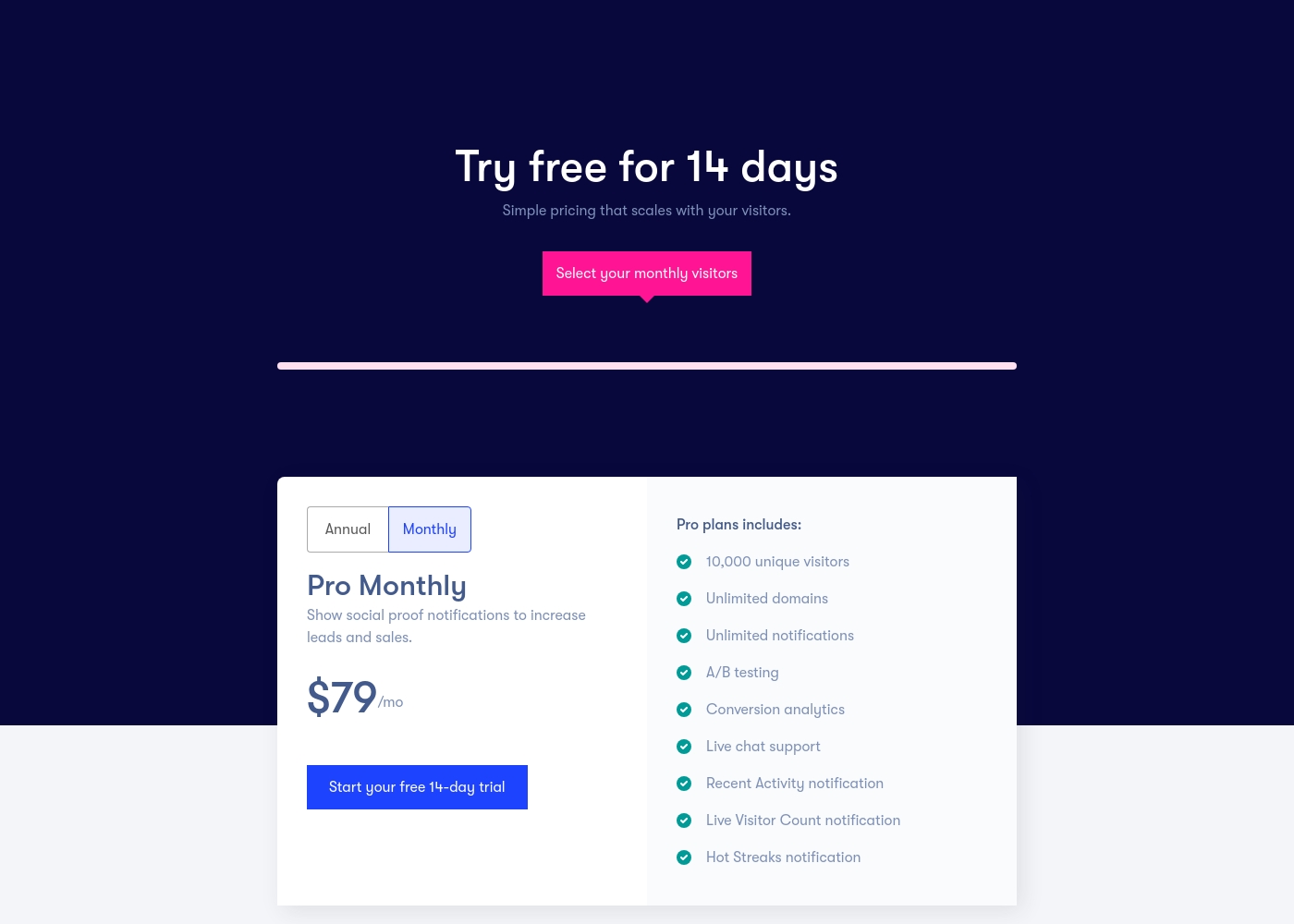
Proof costs between $24 and $108 per month billed annually with at least 5 plans: Basic at $24/mo, Pro at $66/mo, Business at $108/mo, Premium, and Platinum.
Choose the plan that fits your monthly traffic to start growing your conversion rates.
Basic
Price: $29/mo or $24/mo billed annually Best For: Small sites starting with social proof Other Features: Recent Activity notifications, Lead increase tools
- Show social proof notifications
- Recent Activity notifications
- Unlimited domains
- A/B testing
- Conversion analytics
- Live chat support
- Everything in Pro
- Unlimited notifications
- Hot Streaks notification
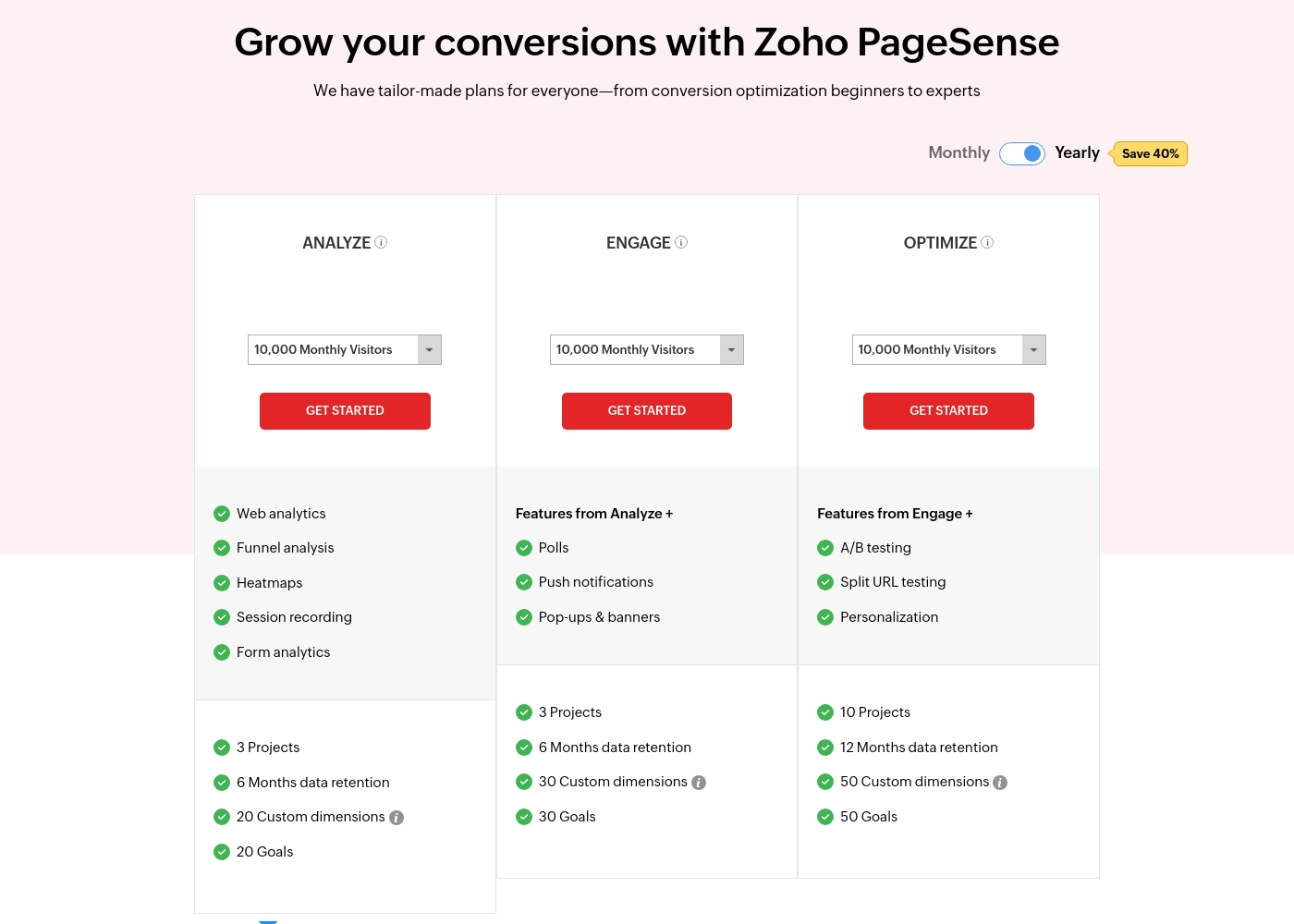
Since pricing is based on the volume of monthly visitors, the exact cost isn't shown here. Let's look at the features and scope included in each plan, based on the foundational 10,000 monthly visitor tier information.
Analyze
Best For: Conversion optimization beginners, quick website insights, visitor behavior data. Other Features:
- Web analytics and Funnel analysis
- Heatmaps and Session recording
- Form analytics
- 3 Projects, 6 Months data retention
- 20 Custom dimensions and 20 Goals
The Analyze plan is perfect for beginners who need foundational insights into website performance. It gives you quick access to visitor behavior data like heatmaps and crucial session recordings.
- Web analytics
- Funnel analysis
- Heatmaps
- Session recording
- Form analytics
- All Analyze features
- Polls
- Push notifications
- Pop-ups & banners
- All Engage features
- A/B testing
- Split URL testing
- Personalization
Pricing Notes
- Proof's pricing is clear: $29/month for 1K visitors up to $129/month for 50K visitors.
- Zoho PageSense's exact dollar amounts are not provided, only that they scale by visitor volume starting at 10K.
- Zoho PageSense offers a 40% discount for annual billing, compared to Proof's 20%.
- Proof's free trial is 14 days. Zoho PageSense's is 15 days and doesn't require a credit card.
- Exceeding your visitor limit in PageSense will pause your running experiments.
Pricing Head-to-Head
User Reviews
We found external reviews for Proof to be limited and mixed, with a notable absence of substantive feedback from major review platforms. ⚠️ On Trustpilot, the profile is largely empty, offering no clear user sentiment.
Capterra returned a security error, preventing access to any reviews. Consequently, we lack concrete user feedback on key themes like accuracy, ease of use, or support.
Reviewers consistently rate the overall Zoho ecosystem highly, reflecting a 4.1 TrustScore. While specific feedback for PageSense is limited, users generally praise Zoho’s suite products, like Zoho Social, for their user-friendly interfaces and intuitive design.
Many highlight that Zoho tools are affordable and offer comprehensive features, making them excellent, cost-effective alternatives for managing complex tasks in one centralized place. Customers appreciate the clean dashboards and the ability to streamline workflows, saving significant time and effort.
The platform is incredibly user-friendly, with easy management available via web or mobile app. This makes planning and organizing our content straightforward and delightful to update.
Our Verdict
For most people, Zoho PageSense is the more powerful and complete choice. Proof's superpower is simplicity in social proof. It makes it easy to show notifications that build trust and urgency. If that's your only need, it's a solid, focused tool. Zoho PageSense's superpower is being an all-in-one CRO command center. It combines deep analytics, advanced testing, and engagement tools. You can truly understand and optimize your entire conversion funnel. The deciding factor is your goal. Pick Proof if you want quick social proof wins and basic personalization. Choose Zoho PageSense if you want to build a comprehensive, data-driven optimization strategy. Final verdict: Go with Proof for a targeted boost in trust signals. Choose Zoho PageSense to become a conversion optimization powerhouse.
Frequently Asked Questions
Which is better for small teams: Proof or Zoho PageSense?
Proof might be simpler for a small team just wanting to add social proof notifications. Zoho PageSense is better if that small team is dedicated to learning and running full CRO experiments. PageSense's no-code setup can also be easier for beginners.
Does Proof have heatmaps and session recording like Zoho PageSense?
No, Proof does not offer heatmaps or session recording. These advanced visitor behavior tools are key features of Zoho PageSense's analytics toolkit.
Is Zoho PageSense worth the extra cost over Proof?
It depends on your needs. Zoho PageSense provides a much broader set of tools. If you need analytics, testing, and engagement features beyond social proof, then PageSense's comprehensive suite justifies its value.
Can I use both Proof and Zoho PageSense together?
It's technically possible, but not recommended. Using both would be redundant, as both offer website personalization. It would be better to pick one tool that aligns with your primary goal: social proof (Proof) or full CRO (PageSense).
Which tool has a better free trial?
Zoho PageSense's 15-day trial is slightly longer and doesn't require a credit card. Proof's trial is 14 days and gives full access to your chosen plan's features.
How does annual billing work for Proof vs Zoho PageSense?
Both offer savings. Proof gives you up to 20% off. Zoho PageSense offers a more significant 40% discount for paying annually.
Ready to Choose?
Both tools have their strengths. Choose based on your specific needs.