Proof vs VWO
Proof and VWO both boost website performance, but they're built for different battles. Proof nails social proof pop-ups and personalization for startups. VWO is a heavyweight for deep A/B testing and user analytics.
Best for: Startup marketers looking to increase website conversions., Growth teams wanting to personalize user experiences.
Best for: Marketing and product teams running rigorous A/B tests, UX researchers needing heatmaps and session recordings
Solid personalization tool, but reviews missing.
We reviewed Proof as a website personalization platform aimed at boosting conversions. It offers clear features and structured pricing for growth-focused teams. Overall, we find it a promising tool for targeted marketing, but the lack of accessible user reviews makes it hard to fully validate its real-world performance and support.
Pros
- Offers a 14-day free trial to test core features.
- Usage-based pricing scales with your monthly visitors.
- Features like A/B testing and analytics are included in higher tiers.
- Provides educational resources and case studies for learning.
Cons
- External user reviews are unavailable or inaccessible.
- No public money-back guarantee is stated.
- Pricing can become costly for high-traffic sites.
- May require a strategic setup, not a plug-and-play solution.
Robust Experimentation Platform with Excellent Support
We find VWO delivers a powerful, connected platform that supports large-scale conversion rate optimization, backed by highly engaged customer success teams. Overall, while the feature set is strong and scalable, we noted significant customer concerns regarding data reliability, poor UI/UX, and intrusive sales methods that require careful consideration.
Pros
- Comprehensive suite includes A/B testing, heatmaps, and session recordings.
- Dedicated Customer Success Managers are highly responsive and offer proactive testing suggestions.
- Allows UX teams to run A/B tests quickly with minimal technical or developer dependency.
- Offers advanced personalization and AI-driven optimization features (VWO Copilot).
Cons
- Tracking errors reported, leading to unreliable A/B test data results that require manual verification.
- Intrusive sales tactics target users immediately after only visiting the pricing page (via cookies).
- Account cancellation process is reported to be difficult, frustrating, and manipulative.
- Critical data results can be paywalled, requiring upgrades to higher-tiered plans (bait and switch).
AboutProof
Proof is a platform focused on website personalization. 🎯
It's designed for marketers and growth teams at startups and fast-growing companies. The idea is to move beyond a one-size-fits-all website. Instead, you can tailor content, offers, and messaging to different visitor segments. This can help you increase conversions and engage your audience more effectively.
AboutVWO
VWO is a comprehensive experimentation platform built for maximizing digital conversions. It helps thousands of businesses globally understand evolving user behavior through qualitative analytics. You can easily transform these insights into testable hypotheses and run robust A/B tests. This allows you to deliver tailored experiences across your websites, mobile apps, and product features. The platform is designed to unite your optimization program, supporting diverse teams like Engineers, Growth Marketers, and Product Managers. ✅
Highlights
Feature Comparison
Features Overview
We highlight the main differences and pick a winner for each feature.
Core Focus
Proof builds trust with real-time activity pop-ups. VWO dives deep into testing every element of your user journey.
Proof specializes in showing social proof notifications. These include 'Recent Activity' pop-ups and 'Hot Streaks' to create urgency. It's designed for quick wins in trust and conversions. VWO is a full conversion rate optimization suite. It offers A/B testing, multivariate testing, and feature flags. You can test everything from button colors to entire page layouts. The key difference is specialization vs. breadth. Proof is a focused tool for a specific tactic. VWO is a broad platform for systematic optimization. If your main goal is to show visitors that others are buying, Proof is faster to implement. For deep user behavior analysis, VWO is necessary.
Analytics & Insights
Proof gives you conversion analytics for your personalizations. VWO provides a full toolbox of qualitative and quantitative data.
Proof includes conversion analytics on higher plans. This lets you see how many people clicked a social proof pop-up. It's basic but clear for its specific purpose. VWO offers heatmaps, session recordings, and funnel analysis. You can see exactly where users click and where they drop off. This qualitative data is powerful for understanding 'why'. VWO's toolkit is vastly more comprehensive. It's built for teams that run continuous experiments and need deep behavioral data. Proof's analytics are more limited in scope. For diagnosing complex user journey problems, VWO is the clear choice. Proof's analytics are fine for measuring its own feature's impact.
Ease of Use
Proof is simpler for its core social proof feature. VWO has a steeper learning curve due to its vast capabilities.
Proof's setup is focused on adding notification pop-ups. Users report it's relatively straightforward for its intended use case. The platform includes learning resources to help. VWO is a powerful but complex platform. New users might need time to learn its many features, like visual and code editors. The interface has received mixed reviews for bugs. Proof wins for getting a specific feature live quickly. VWO requires more investment to learn but offers much more flexibility. For a non-technical marketer wanting quick social proof, Proof is easier. For an experimentation team, the learning curve of VWO is a worthwhile investment.
Pricing & Value
Proof's pricing is simple and scales with your traffic. VWO's pricing is complex and can jump significantly for features.
Proof uses visitor-based pricing from $29 to $129+/month. The structure is easy to understand. You pay for the traffic tier you're in. VWO has a free Starter plan for low traffic. Paid plans like Growth start at $665/month (billed annually). The jump between tiers is substantial. VWO offers a free entry point, which Proof does not. However, its advanced features come at a premium price point. Proof's model feels more predictable for small budgets. For startups on a tight budget, Proof's lower entry point for advanced features may be better. For companies with optimization budgets, VWO's free tier is a great way to start testing.
Customer Support
Proof offers live chat on its Pro plan. VWO provides tiered support with faster response times on higher plans.
Proof provides live chat support starting with the $79/month Pro plan. The Basic plan only mentions standard support. No specific response time guarantees are listed. VWO has structured support tiers. The free plan gets 12-hour email responses. Enterprise plans get 24/7 support with a 4-hour response time. Dedicated CSMs are available. VWO's support system is more formalized with clear SLAs. Proof's support seems more basic and tied to higher-tier plans. VWO's CSMs are frequently praised in reviews. For mission-critical testing, VWO's guaranteed response times are valuable. Proof's live chat is a helpful feature for its Pro users.
Integration & API
Proof has limited listed integrations. VWO offers robust integrations and API access on higher tiers.
Proof's integration details are not prominently listed. Users may need to check compatibility with their specific platform manually. VWO integrates with many tools. The Pro plan allows pulling data via integrations. Full API access is available on Enterprise or via an add-on for Growth/Pro plans. VWO is built for connecting into a larger tech stack. Its event-driven architecture unifies data from apps and third parties. Proof appears more standalone. For teams needing to sync data with a CRM or analytics platform, VWO is much stronger. Proof is simpler if you just need a standalone social proof tool.
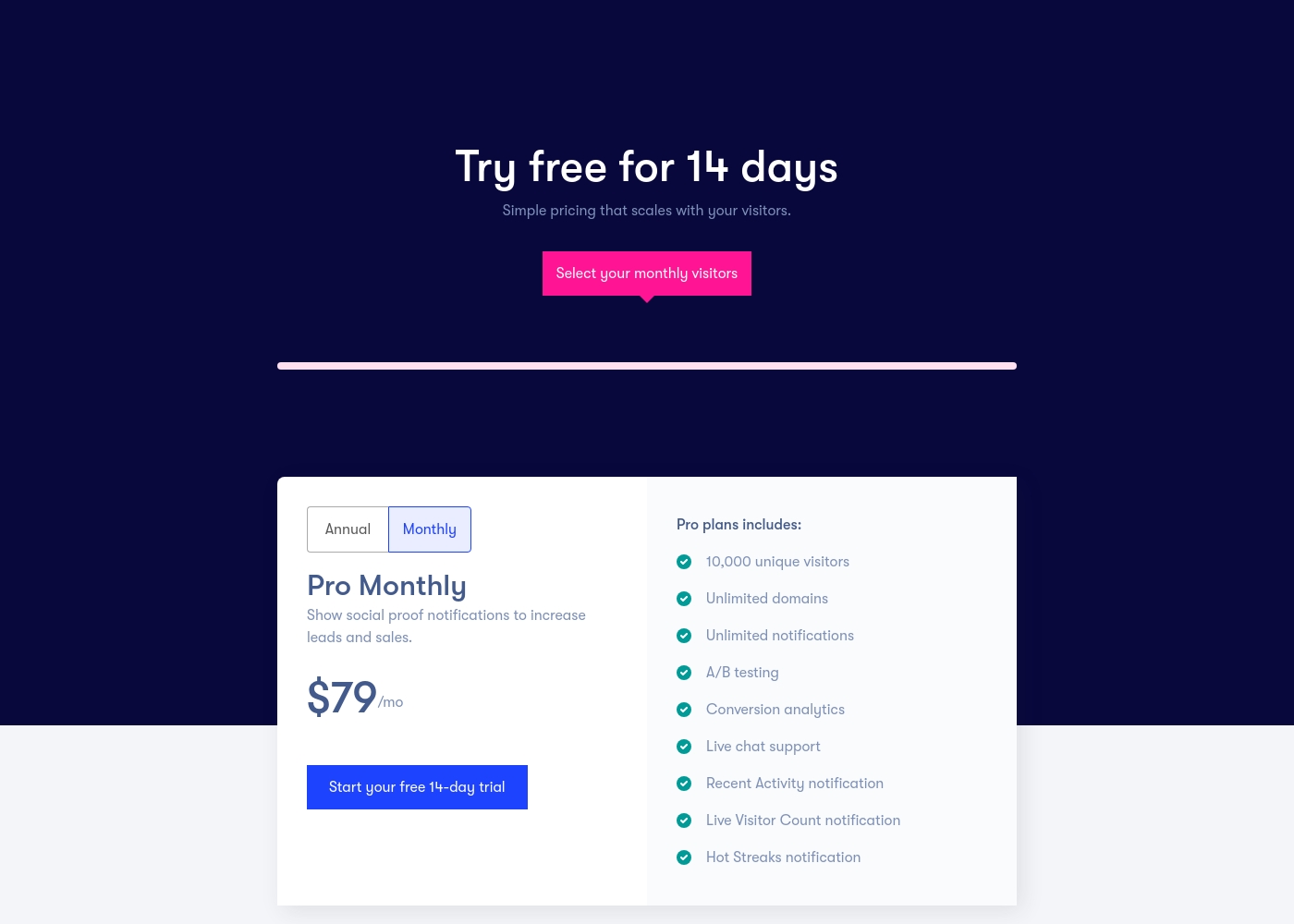
Proof costs between $24 and $108 per month billed annually with at least 5 plans: Basic at $24/mo, Pro at $66/mo, Business at $108/mo, Premium, and Platinum.
Choose the plan that fits your monthly traffic to start growing your conversion rates.
Basic
Price: $29/mo or $24/mo billed annually Best For: Small sites starting with social proof Other Features: Recent Activity notifications, Lead increase tools
- Show social proof notifications
- Recent Activity notifications
- Unlimited domains
- A/B testing
- Conversion analytics
- Live chat support
- Everything in Pro
- Unlimited notifications
- Hot Streaks notification
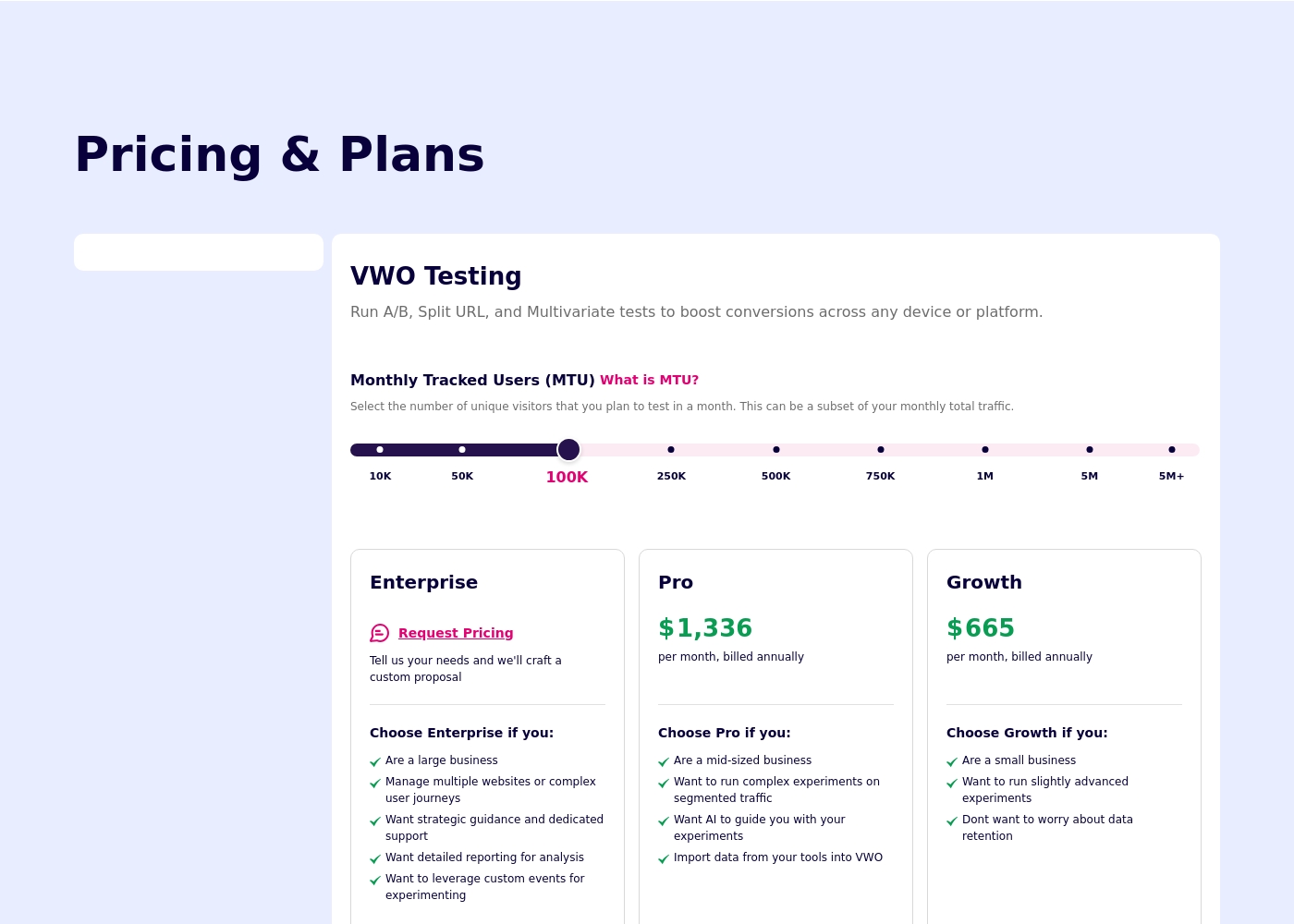
VWO Testing costs between $0 and a custom rate per month with four plans: Starter (free for low MTU), Growth at $665/month (billed annually), Pro at $1,336/month (billed annually), and Enterprise (custom pricing).
Let's review what's included in these VWO Testing plans. Note that the non-Enterprise pricing displayed is based on a volume of 100,000 Monthly Tracked Users (MTU).
Starter
Price: Free Websites Supported: 1 domain Best For: Getting started with experimentation Other Features: Unlimited Experiments, Basic Targeting (URL & Device), Visual & Code Editor, 30 Days Data Retention, Email Support (12-hour response).
- Unlimited Experiments
- Visual & Code Editor
- Basic Targeting (URL & Device)
- Email Support (12-hour response)
- Unlimited Variation & Metrics
- No Data Retention Restriction
- Enhanced Targeting (Traffic Source, OS)
- Basic AI CoPilot Features
- Enhanced Support (24/5 Email & Chat, 8-hour response)
- Advanced Targeting & Reporting (Geo, UTM)
- Advanced AI CoPilot Features
- Multi Variate Testing (MVT)
- Pull Data via Integrations
- Advanced Support (24/5 Phone support, 6-hour response)
- Dedicated CSM & 1:1 Training
- All Targeting & Reporting Options
- Single Sign On (SSO)
- API Access
- 24x7 Support (4-hour response time)
Pricing Notes
- Proof's pricing is straightforward, scaling with monthly unique visitors from $29 to $129+.
- VWO offers a free Starter plan for low-traffic sites, but paid plans like Growth start at $665/month billed annually.
- Both tools are usage-based, but VWO's pricing model (MTU) and plan jumps are more complex.
- Proof includes a 14-day free trial on all plans. VWO's free plan is its only no-cost option.
- VWO requires annual billing for its Growth and Pro plans, which is a significant upfront commitment.
Pricing Head-to-Head
User Reviews
We found external reviews for Proof to be limited and mixed, with a notable absence of substantive feedback from major review platforms. ⚠️ On Trustpilot, the profile is largely empty, offering no clear user sentiment.
Capterra returned a security error, preventing access to any reviews. Consequently, we lack concrete user feedback on key themes like accuracy, ease of use, or support.
Trustpilot feedback is sharply divided, resulting in a 3.1-star rating, which reflects both high praise and severe criticism. Many long-term users highly commend VWO's extensive CRO tools, including A/B testing, personalization, and powerful analytics like heatmaps and screen recordings.
Excellent customer support is a persistent positive theme; users routinely recognize dedicated Customer Success Managers (CSMs) for their responsiveness and proactive help with test ideas. Users also appreciate that the tool empowers UX teams to run experiments independently, minimizing reliance on developers.
We have been using VWO for almost three years now. Working with the tool and the dedicated professional team, especially our CSM Vikas, has been a really great experience overall.
Our Verdict
It's a classic case of a focused tool versus a full-suite platform. Proof is the social proof specialist, while VWO is the conversion optimization powerhouse. Proof's superpower is simplicity. You can quickly add trust-building pop-ups showing recent sign-ups or purchases. This is perfect for startups needing a quick credibility boost. VWO's superpower is depth. It offers a complete lab for testing user behavior with heatmaps, recordings, and advanced A/B tests. It's built for teams that treat optimization as a core discipline. The deciding factor is your goal. Choose Proof if you want a simple, tactical win. Choose VWO if you need a strategic, data-driven optimization program. For most startups needing quick trust, Proof is the fast lane. For growing companies ready to invest in systematic testing, VWO is the long-term platform.
Frequently Asked Questions
Which is better for small teams: Proof or VWO?
Proof is often better for small, agile teams. Its focus on social proof is easier to implement quickly. VWO's depth might be overkill unless you're dedicated to experimentation.
Does Proof have heatmaps like VWO?
No, Proof does not offer heatmaps or session recordings. These qualitative analytics tools are a core part of VWO's platform. Proof focuses on personalization and social proof notifications.
Is VWO worth the extra cost over Proof?
It depends on your needs. VWO's higher cost buys a complete experimentation suite. For just social proof, Proof is more cost-effective. For deep CRO, VWO's value lies in its advanced tools.
Can I run A/B tests with Proof?
Yes, but only on its Pro plan ($79/month) and above. VWO includes A/B testing in its free Starter plan and scales up to multivariate testing. VWO's testing capabilities are more advanced overall.
Which tool is easier to set up?
Proof is generally easier for its specific purpose. You can be showing social proof pop-ups in minutes. VWO requires more planning to set up tests, though its visual editor helps.
Does VWO have a free trial?
VWO offers a free Starter plan instead of a traditional trial. This lets you experiment with basic features for low traffic. Proof offers a 14-day free trial on all its paid plans.
Ready to Choose?
Both tools have their strengths. Choose based on your specific needs.