Plutio vs Wrike
Plutio and Wrike both manage complex projects and client work, but for different audiences. Plutio is an intuitive all-in-one suite perfect for agencies and freelancers. Wrike is built for large, complex enterprise work management and advanced scale. Choosing the winner depends entirely on your specific team size and workflow complexity.
Best for: Solo entrepreneurs managing contracts and billing, Creative agencies focused on client-facing workflows
Best for: Large enterprises (200+ users) needing high-level security (SOC2), Cross-functional teams requiring 360° resource capacity visibility
Flexible all-in-one business management platform.
We found Plutio delivers exceptional value by unifying critical business tools like invoicing, project management, and proposals into one customizable platform. The pricing model is flexible for freelancers and agencies seeking to reduce their subscription costs significantly. Overall, we recommend Plutio for growing teams that prioritize feature depth and centralized workflow management.
Pros
- Replaces multiple tools (proposals, PM, time tracking) for high value.
- Highly customizable interface and workflow settings.
- Flexible pricing tiers scale easily for solo users to agencies.
- Includes professional tools such as contracts and branded invoicing.
Cons
- Some users reported significant bugs impacting client trust and reliability.
- Development consistency has been questioned by a few long-term users.
- The foundational Solo plan does not include collaborator seats.
- No refunds are issued upon cancellation of service.
Enterprise Power Meets Complex Commitment.
We find Wrike is an exceptionally versatile project solution, noted for scaling efficiently across corporate environments up to 3000 users and unifying communication across highly complex workflows. Overall, the software offers a powerful feature set for advanced visibility and customization, but we caution users regarding the rigid annual subscriptions and documented difficulties with managing auto-renewal and pricing increases.
Pros
- Transforms and streamlines complex corporate workflows efficiently.
- Highly customizable for various methodologies (e.g., Holacracy, OKR).
- Excellent collaborative transparency and 360° project visibility.
- Provides fast and helpful customer support regarding implementation and bugs.
Cons
- Pricing practices are reported as aggressive, often resulting in significant renewal increases.
- Subscriptions are difficult to cancel, and users report trouble stopping automatic renewal.
- Some teams report challenging adoption and setup processes.
- Users report instances of being oversold on features bundles they did not need.
AboutPlutio
Plutio is the helpful all-in-one solution built for running your entire business. It works whether you’re a solo professional, managing a team, or working primarily with clients. It centralizes essential tools like forms, project management, contracts, and proposals onto a single platform. This centralization means no more juggling between apps and fewer subscription payments. With Plutio, you're unifying your entire workflow to boost productivity and growth.
AboutWrike
Wrike is a trusted end-to-end enterprise work management solution. It's designed for organizations ready to transform manual processes into interconnected, automated workflows. Teams from 20 to 20,000 thrive here because Wrike is highly adaptable to any industry or size. It brings multiple teams into the same place for game-changing visual collaboration. Wrike is where you can easily align strategy and effectively execute your projects and programs. 💡
Highlights
Feature Comparison
Features Overview
We highlight the main differences and pick a winner for each feature.
Scope & Architecture
Plutio is a unified business hub; Wrike is an organization-wide platform.
Plutio is an all-in-one suite combining PM, invoicing, and contract tools. It aims to unify your entire business workflow completely. Plutio replaces multiple costly subscriptions with one clean interface. Wrike is an end-to-end work management solution for internal teams. It focuses on transforming complex processes into automated, interconnected workflows. Wrike is built for organizational alignment and high-level project visibility. Plutio offers holistic client-facing tools, unlike Wrike's internal orientation. Choose Plutio to simplify your tooling; choose Wrike for enterprise-level optimization. If you manage budgets, proposals, and delivery, Plutio offers integrated support. Wrike is better for coordinating efforts across siloed corporate departments.
Pricing Model
Plutio is flexible and tiered; Wrike demands annual, per-user commitment.
Plutio provides transparent flat rates; the Solo plan starts at $19/month. You can select monthly billing and add contributors individually for $5/month. Plutio includes all features regardless of your chosen price tier. Wrike requires demanding annual subscriptions for all paid plans starting at $10/user/month. Licenses are often sold in specific user batches, complicating team growth. Wrike’s model makes it much harder to scale flexibly. Plutio offers superior pricing flexibility essential for growing agencies and small businesses. Wrike’s rigidity leads to customer complaints about high renewal costs and cancellation difficulty. If avoiding vendor lock-in is a priority, Plutio’s monthly option and simple scaling are far friendlier.
Client Management
Plutio excels at client interaction; Wrike focuses on internal execution.
Plutio provides built-in tools like professional, branded proposals. It includes legally binding contracts requiring electronic signatures. Plutio's Studio plan allows unlimited client invitations readily. Wrike focuses on internal execution and uses guest 'collaborators' for basic feedback. Wrike requires third-party ecosystem tools to handle client billing or contracts. The emphasis is on project delivery, not client relationship management. Plutio is explicitly built to impress clients and secure billing through its platform. Wrike's client features are rudimentary compared to Plutio's robust client portal capabilities. Professional services looking for one system to manage sales, contracts, and projects should strongly consider Plutio.
Advanced Features
Wrike leverages AI; Plutio focuses on simplicity.
Plutio offers a unified feature set covering PM, finance, and client tools. It allows high customization of the interface and adapts views quickly. Plutio's simplicity means quick adoption for smaller teams. Wrike integrates Generative AI, Wrike Copilot, and advanced analytics for decisions. It provides sophisticated tools for Resource and Capacity Planning across departments. Wrike’s Enterprise tiers offer advanced security controls and SSO authentication. If minimizing tool count is a priority, Plutio wins; if future-proofing with AI analysis is key, choose Wrike. Wrike offers features essential for large organizations that Plutio does not provide. Teams needing predictive risk assessment and capacity allocation should invest in Wrike's advanced AI features.
Creative Proofing
Wrike has dedicated proofing; Plutio has basic collaboration.
Plutio facilitates project discussion and general file sharing with clients. It supports basic task assignments and project tracking views quickly. Plutio is not designed for detailed graphic asset management. Wrike includes streamlined Proofing and Approvals for creative departments. Wrike supports review cycles for over 30 file types, including video and HTML proofing. The platform accommodates guest approvals for rapid external feedback. For marketing and design agencies, Wrike significantly accelerates asset review cycles. Plutio saves time by unifying tools, but Wrike saves time on asset delivery. Wrike is superior for managing high-volume creative assets. If your team is constantly needing approval feedback on videos and designs, Wrike is the better choice.
Ease of Adoption
Plutio is intuitive; Wrike often requires guided professional setup.
Plutio has a low barrier to entry and allows users to turn features on/off instantly. The interface is highly customizable and designed for quick personalization. Users report high team adoption rates with Plutio. Wrike is complex and recommends Professional Services for guided setup for teams over 20. Its powerful features require significant configuration effort initially. Some users report challenging adoption processes within Wrike. Plutio allows you to start working immediately with minimal overhead or training involved. Wrike offers more power but demands a greater resource investment for implementation. Plutio is easier to learn and implement quickly. If implementation time and budget are critical, Plutio provides a faster, lighter option.
Scalability & Limits
Wrike handles vastly more users; Plutio is best below 100 members.
Plutio's largest plan (Agency) supports a maximum of 100 total contributors. This limit is typically sufficient for most specialized agencies and SMBs. It scales primarily based on client and contributor quotas. Wrike is designed to scale from 20 users up to 20,000 users seamlessly. Its Enterprise plans offer unlimited users and robust feature sets for scale. Wrike is optimized for large corporate ecosystem needs. If you anticipate rapidly growing past 100 employees, Wrike is the safer, more robust choice. Plutio serves the agency and small business segment perfectly with its capacity limits. Wrike provides the necessary governance required for massive organizations. Plutio is fantastic for controlled growth; Wrike is the powerhouse for exponential corporate expansion.
Integration Options
Wrike integrates easily with 400+ apps; Plutio is built on internal unity.
Plutio's value comes from unifying typically separate business functions internally. It promotes robust features within its own all-in-one ecosystem for efficiency. Plutio focuses on replacing systems, not just connecting them. Wrike Integrate allows rapid data sync and automation with over 400 popular apps. Wrike helps you fully automate complex custom workflows across external tools. Seamless integration prevents context switching between disconnected systems. If your team relies heavily on tools like Jira, Salesforce, or Adobe, Wrike is better integrated. Plutio wants you to use its internal invoicing and tracking tools primarily. Wrike is superior for creating bespoke integration flows. Choose Wrike if your workflow relies heavily on syncing data across dozens of different applications regularly.
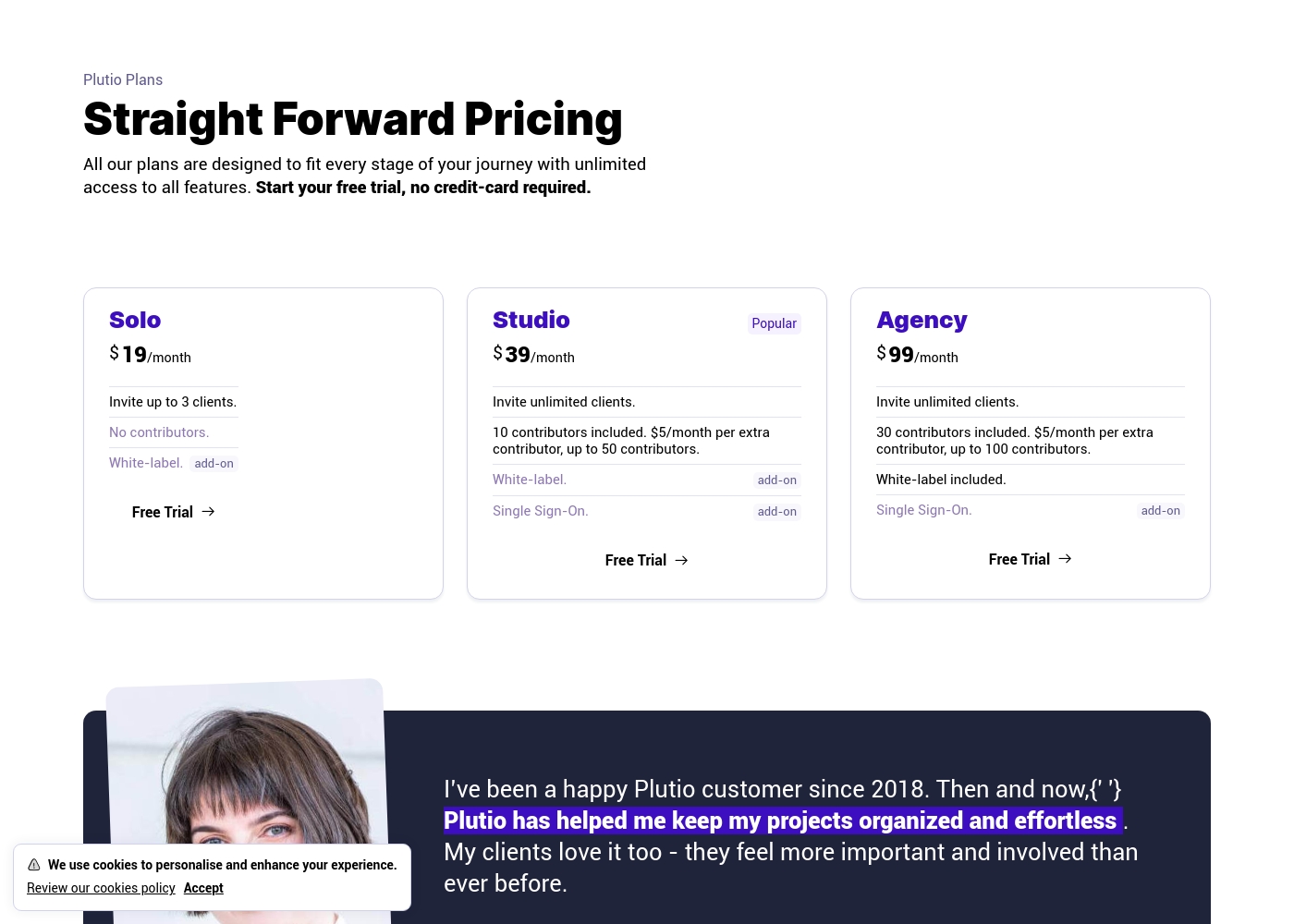
Plutio costs between $19 and $99 per month with three main plans: Solo at $19/month, Studio at $39/month, and Agency at $99/month.
All Plutio plans are built to provide unlimited access to every single feature, ensuring you have the complete toolkit regardless of your business size. You can easily upgrade or downgrade your plan anytime as your needs change.
Solo
Price: $19/month (or $190/year) Best For: Solopreneurs and freelancers Refund Policy: Cancellation possible, but no refund issued Other Features:
- Invite up to 3 clients
- No included contributors
- White-label available as an add-on ($9/month)
- Unlimited access to all features
- Invite up to 3 clients
- Unlimited access to all features
- Invite unlimited clients
- 10 contributors included
- Unlimited access to all features
- Invite unlimited clients
- 30 contributors included
- White-label included
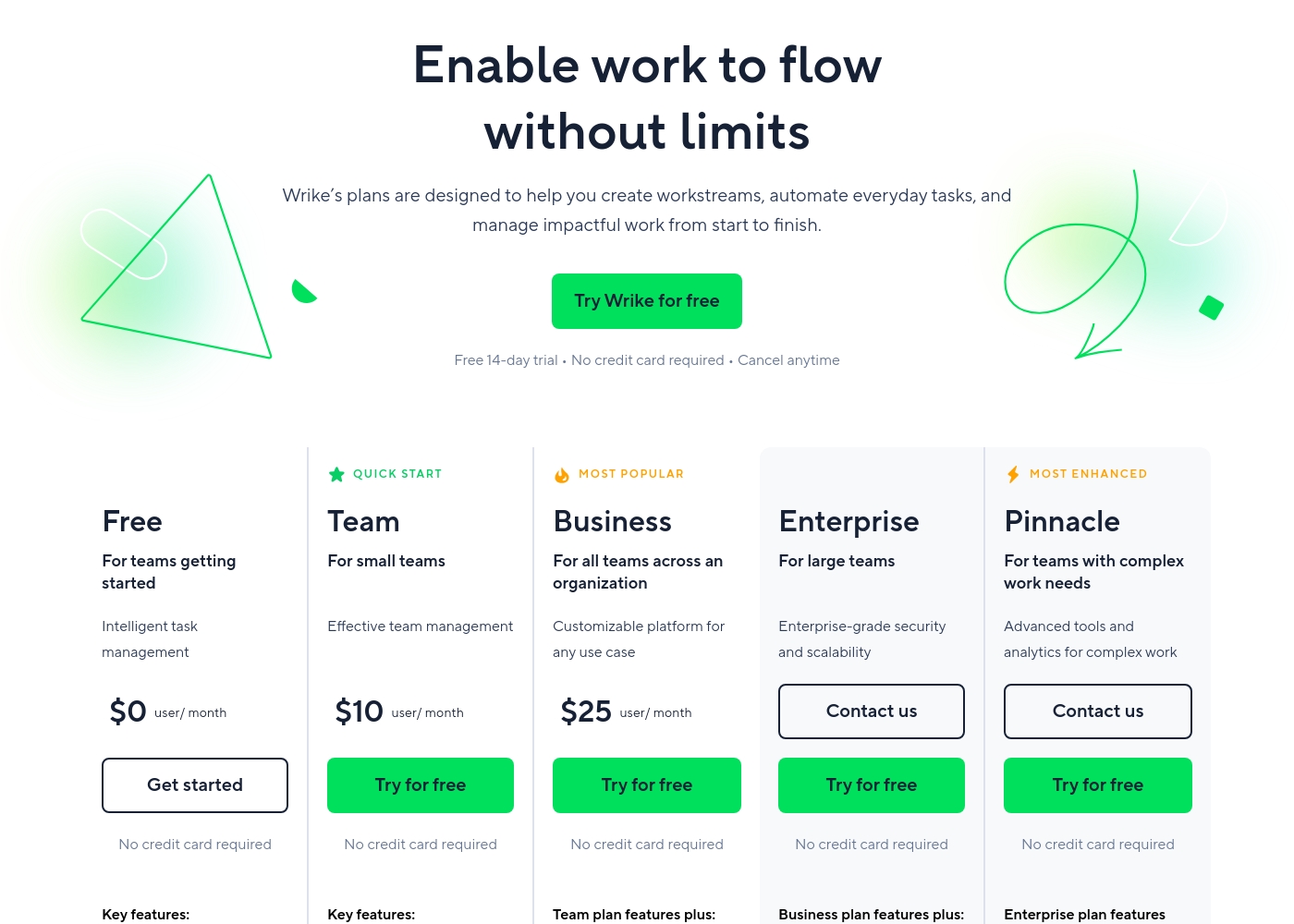
Wrike costs between $0 and $25 per user/month, with five plans: Free at $0/user/month, Team at $10/user/month, Business at $25/user/month, and Enterprise and Pinnacle which require users to contact sales.
- Web, desktop, and mobile apps
- Project and task management
- Board view (Kanban)
- Table view (spreadsheet format)
- Folders structure & nested projects
- Unlimited projects, tasks, & subtasks
- Gantt charts, Calendar & Chart view
- Generative AI, 2 GB storage per user
- Project Blueprints and Unlimited request forms
- Approvals & guest approvals
- Resource & Capacity Planning
- File and video proofing (30+ file formats)
- Real-time reports
- SAML-based SSO and Two-Factor Authentication (2FA)
- Password policies and custom access roles
- Customizable user types and Admin permissions
- User audit reports
Pricing Notes
- Plutio offers monthly payment options, providing crucial financial flexibility.
- Wrike requires annual commitment for all paid subscriptions (Team and above), locking customers in.
- Plutio includes all features in every plan; Wrike gates crucial features like resource planning to higher tiers.
- Wrike customers report significant difficulties with cancellation and aggressive pricing tactics, unlike Plutio.
- Plutio allows flexible individual contributor scaling at $5/month above included seats.
- Wrike sells user subscriptions in specific batches, which complicates purchasing licenses for small increments.
Pricing Head-to-Head
User Reviews
Users generally see Plutio as a highly effective all-in-one solution that successfully replaces multiple point systems, like dedicated proposal and time tracking software. The external sentiment is largely positive, with users praising its impressive feature depth, which includes proposals, robust invoicing, and customizable project workflows.
Many reviewers confirm that the system is easy for teams to adopt 🚀. Pricing is consistently cited as a major value driver, especially for small business owners and agencies seeking centralized control.
Plutio is an outstanding piece of software. We were able to combine multiple expensive tools, like our proposal software, into this single platform. This unification offers massive savings and better workflow efficiency.
Users consistently praise Wrike's powerful capabilities in transforming workflow management and driving organizational efficiency. Many reviewers, including team leads and large enterprise users, call it one of the best project management systems available, noting its strong suitability for high-level customization for specific methodologies like OKR.
Its ability to centralize communication, provide 360° visibility, and manage collaboration across large global teams is frequently highlighted as second to none. Furthermore, customer support is often described as exemplar, particularly regarding implementation and quick bug fixes.
Using Wrike for three years has completely changed how we manage our workflows. The biggest transformation is how streamlined and fast our operations have become. It's truly efficient for our large team.
Our Verdict
The choice between Plutio and Wrike is a classic decision between flexibility and raw enterprise power. Plutio is the elegant, cost-effective all-in-one solution built for simplification. Wrike is the robust, complex machinery designed for massive internal work management at scale. If you are a freelancer or an agency with up to 100 people, Plutio is the clear choice for comprehensive value. Plutio unifies crucial features like invoicing, proposals, contracts, and PM into one customizable roof. This integration delivers massive savings by allowing you to cancel multiple existing subscriptions. Plutio is also much easier to learn and provides much-needed flexible monthly payment options for growing businesses. Wrike’s superpower is handling organizational complexity and supporting huge teams. Wrike provides advanced AI, resource capacity planning, and serious enterprise security compliance. It is ideal for large corporations managing thousands of users and cross-functional teams. Wrike excels at accelerating sophisticated internal workflows significantly. The key deciding factor is whether you serve external clients or manage internal process complexity. If client-facing tools, branded invoicing, and contracts matter most, stick with Plutio. If AI-driven risk analysis and enterprise-grade security are essential, then Wrike is your best option. Plutio delivers exceptional value for SMBs; Wrike is the powerful engine for large, established organizations.
Frequently Asked Questions
Which is better for small teams: Plutio or Wrike?
Plutio is designed specifically for solo users and growing small teams. Plutio offers flexible monthly plans starting at only $19/month. Wrike's paid tiers require a rigid annual commitment, which is less flexible for small businesses.
Does Plutio include built-in invoicing and contract features?
Yes, Plutio is an all-in-one business management solution. It includes built-in drag-and-drop editors for professional client proposals. Plutio also handles multi-currency invoicing and legally binding contracts. Wrike relies on external integrations for these essential functions.
Are there mandatory annual contracts for Wrike and Plutio?
Plutio offers both monthly and annual payment options for maximum agility. Wrike requires customers to purchase an annual subscription for all paid plans. Wrike’s contracts often mandate specific seat purchases in large batches.
What are the key differences in platform security?
Wrike provides enterprise security with audited certifications like SOC2 Type II and ISO 27001. Plutio uses general bank-grade security measures to protect user data. Wrike's security standards are more formally defined for large organizations.
How advanced is the automation in Plutio versus Wrike?
Wrike offers significantly more advanced automation and AI features. Wrike plans include specific quotas of automation actions per user monthly. Plutio focuses on unifying functions but offers less custom process automation capacity.
Which software is better for managing creative proofing and approvals?
Wrike excels here with dedicated Proofing and Approvals features. It supports review cycles for over 30 file formats, including video proofing. Plutio offers basic document sharing, not specialized asset review tools.
Ready to Choose?
Both tools have their strengths. Choose based on your specific needs.