Paylocity vs Tellent
Paylocity and Tellent both aim to unify HR, but they take very different paths. Paylocity is a broad, modular giant covering HR, Finance, and IT. Tellent is a focused, agile suite for recruiting and core HR. This comparison breaks down which one actually fits your team.
Best for: Large enterprises needing unified HR, finance, and IT, Companies with complex global payroll needs
Best for: Growing companies needing a scalable, modular HR suite., HR teams seeking to automate manual tasks and centralize data.
Strong Platform, Severely Lacking Support.
Paylocity offers a highly comprehensive platform uniting HR, Finance, and IT capabilities, which is flexible and modular for various business needs. We noted the powerful feature set, but external feedback consistently highlights serious execution failures in critical areas like customer service and implementation quality. Overall, we recommend approaching Paylocity cautiously due to significant, recurring issues with tax accuracy and client support responsiveness.
Pros
- Unified platform covering core HR, Finance, and IT management functions.
- Flexible, modular pricing allows businesses to select only necessary solutions.
- Comprehensive features including global payroll support and integrated expense management.
- Supports 24/7 access through a dedicated employee self-service mobile application.
Cons
- Critically poor and highly non-responsive customer service and support teams.
- Implementation and onboarding processes are reportedly slow, complicated, and tedious.
- Frequent reports of high error rates in quarterly payroll and state tax filings (up to 30%).
- Lack of consistent, properly trained, or dedicated account representatives.
Strong modular suite for growing teams.
We find Tellent offers a powerful, integrated platform for automating HR and recruitment. Its modular design is ideal for mid-sized companies scaling their operations. Overall, it's a solid choice for centralizing people data, though implementation requires planning.
Pros
- Unifies recruiting, HR, and performance management in one platform.
- Offers strong automation and AI features to reduce manual tasks.
- Provides a flexible, modular system that scales with company growth.
- Features a large partner ecosystem (500+ integrations) for connectivity.
Cons
- Pricing is not transparent publicly and requires contacting sales.
- The modular setup may involve a complex initial configuration.
- May not be cost-effective for very small businesses or solopreneurs.
- Advanced customization and deeper technical features can have a learning curve.
AboutPaylocity
Paylocity is designed as the ultimate platform for today's workforce. It unifies essential business functions—HR, Finance, and IT—to empower your internal teams. The flexible solutions enable smarter decisions, fuel growth, and inspire confident leadership. Paylocity proudly supports businesses across the board, from small teams (1-99 employees) up through midsize and large enterprises (500+). Paylocity helps transform your workforce and ensures employees access everything daily, often right within the dedicated app. 💡
AboutTellent
It's a People Decision Platform. Think of it as a single, connected suite for recruiting, core HR, and performance management. It's built for mid-sized and growing companies (they mention 7,000+ customers globally) that want to streamline operations. The system is modular, so you can start with what you need, like the ATS, and add an HRIS or performance tools later. 💡
Highlights
Feature Comparison
Features Overview
We highlight the main differences and pick a winner for each feature.
User Interface
Tellent is praised for being intuitive. Paylocity's recent updates have frustrated users.
Paylocity's interface has drawn significant criticism. Users report excessive clicking to perform simple tasks after recent platform changes. One user needed 15 clicks just to view data. Tellent users highlight the platform as intuitive and easy to navigate. The focus is on streamlining workflows and reducing admin work. The key difference is user experience. Paylocity's complexity is a major pain point, while Tellent prioritizes simplicity. For teams that value daily usability, Tellent's cleaner interface is a clear advantage.
Automation & AI
Both use AI, but for very different functions.
Paylocity's AI shines in finance. It powers touchless expense management and receipt capture for finance teams. Tellent's AI is built for recruiting. It automates candidate emails, translates job posts, and summarizes interview feedback. Paylocity automates financial workflows. Tellent automates the hiring process. Your choice depends on which problem you need solved first: financial admin or recruiting admin.
Reporting & Analytics
Paylocity offers broader data. Tellent focuses on people metrics.
Paylocity provides data for HR, finance, and IT. You can use payroll data for headcount planning and real-time spending visibility. Tellent centralizes people data for clearer workforce insights. It connects recruiting, performance, and HR data. Paylocity gives you company-wide operational data. Tellent gives you a deep view of your employee lifecycle. If you need financial forecasting, Paylocity wins. For talent pipeline analysis, Tellent is stronger.
Customer Support
Tellent reports high satisfaction. Paylocity's support is a major complaint.
Paylocity's support is a crisis point. Reviews cite unreturned calls, unresolved issues, and untrained reps. Critical payroll errors went unaddressed for weeks. Tellent advertises 97.1% customer satisfaction. Higher-tier plans include a dedicated Customer Success Manager. The contrast is stark. Paylocity's support failures can cripple operations. Tellent's model aims to prevent that. For teams that need reliable support, this is likely the deciding factor.
Implementation & Onboarding
Paylocity implementation is slow. Tellent offers partner-assisted setup.
Paylocity's onboarding is described as terrible and agonizingly slow. One user waited over two months just to set up an accounting import. Tellent has a network of 500+ service partners to assist implementation. They offer localized support worldwide. Paylocity's slow start can delay critical financial balancing. Tellent's ecosystem is designed to make the transition smoother. If a fast, reliable setup is crucial, Tellent's approach is better.
Integration Ecosystem
Tellent lists a huge partner count. Paylocity has deep technical options.
Paylocity offers a Marketplace with API/EDI/SFTP support and developer libraries. This allows for deep, custom technical integrations. Tellent boasts a network of over 500 tech and service partners. This focuses on connecting to existing payroll and HR tech. Paylocity gives IT teams more raw power to build. Tellent offers a broader catalog of ready-made connections. Your choice depends on whether you need custom development or plug-and-play integrations.
Since Paylocity builds a solution just for you, they do not publish standardized price lists. We recommend requesting a quote to get pricing tailored to your requirements.
HR & Payroll Solutions
Best For: Organizations needing a unified platform for payroll, workforce management, and employee experience. Other Features:
- Automated and custom payroll workflows, including global payroll for over 100 countries.
- 24/7 access through an employee self-service portal.
- Automated time and attendance tracking.
- Centralized document management and compliance dashboards.
- Tools for talent management and performance feedback.
This suite is perfect if you need an all-in-one system to manage your people from hiring to departure. It minimizes HR risks while efficiently paying employees and encouraging engagement.
- Automated and custom payroll workflows
- Global payroll support for 100+ countries
- Digital expense management
- 24/7 access through self-service portal
- Talent Management tools (surveys, 360-degree feedback)
- AI-powered, touchless expense management
- Virtual and physical corporate cards with policy controls
- Accounts Payable automation (touchless invoice capture)
- Guided procurement processes
- Headcount planning and collaborative forecasting
- Access Management (secure SSO and MFA authentication)
- Automated software provisioning by role
- Asset Management (tracking employee devices)
- Integrated CDW storefront for restocking hardware
- Integrations and Developer APIs (robust API libraries)

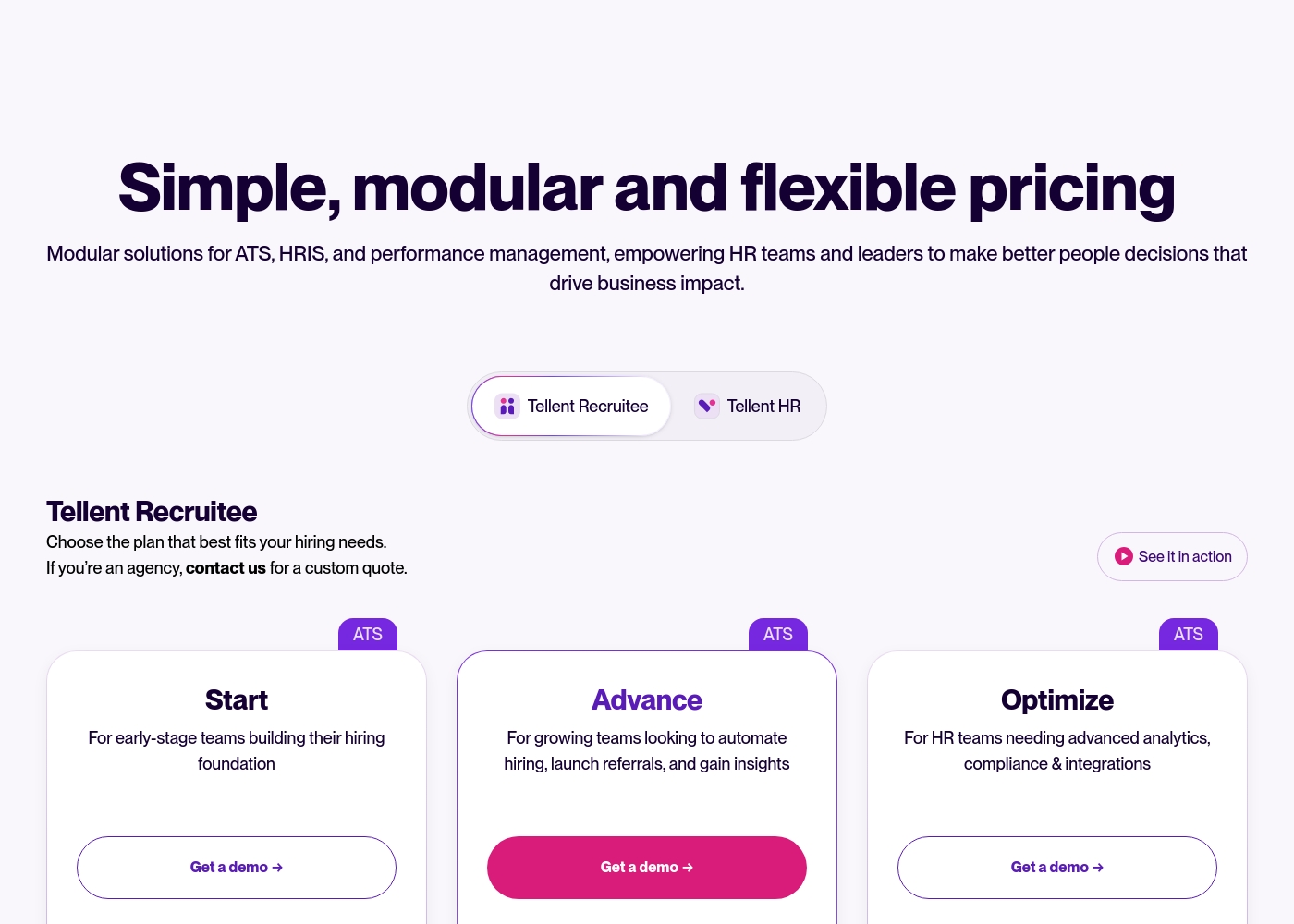
Tellent pricing: Tellent offers modular pricing with specific tiers for recruitment and HR management. Subscription costs increase based on your company's employee count with 20% savings available on annual plans. Plans range: 1–360/month Billing options: Free plan, Free trial, Monthly subscription, Yearly subscription, One-time payment, Usage-based pricing
Pricing Notes
- Paylocity pricing is completely opaque. You must request a custom quote.
- Tellent offers a clear starting price (€1/month) but scales with employee count.
- Tellent's free trial lets you test core modules for 18 days.
- Paylocity does not advertise any free trial or free tier.
- Both are modular, so you only pay for what you use.
Pricing Head-to-Head
User Reviews
External reviews for Paylocity are overwhelmingly negative, marked by a low 1.3/5 Trustpilot score. A primary concern is the catastrophic breakdown in customer support.
Users frequently report unread emails, unreturned calls, and critical payroll or HR issues left unresolved for weeks. Many users feel they lack a qualified or dedicated account representative, often getting new, untrained staff.
I had 60 payroll accounts where the average error rate on quarterly reports was about 30%. That is unacceptable. They now refuse to send me proof of payment for an old tax case, which has led to thousands in fines.
From external reviews, Tellent receives praise for its intuitive interface and strong customer support, which helps teams onboard smoothly. Users often highlight the ease of use and the platform's ability to streamline recruitment and HR tasks.
However, some feedback points to occasional bugs and a learning curve with advanced features. Pricing can feel steep for smaller teams, and a few reviewers mention delays in support responsiveness during peak times.
The platform is really intuitive. It streamlined our hiring process and saved our team hours each week. Support has been helpful whenever we had questions.
Our Verdict
For most growing teams, Tellent is the clear winner. It offers a focused, user-friendly suite that solves the core pain of recruiting and HR admin. Paylocity is a powerful but flawed giant. Paylocity's superpower is its breadth. It's the only option here that unifies HR, Finance, and IT on one platform. If you need corporate card controls and asset tracking, Paylocity is unique. Tellent's superpower is its focus. It's built to automate recruiting and centralize people data. Its 18-day free trial lets you prove the value before you buy. The deciding factor is your biggest pain. Is it fragmented financial systems? Or is it a slow, manual hiring process? Choose Paylocity if you're a large enterprise needing a single system for finance and IT. Choose Tellent if you're a growing team that wants to hire smarter and scale HR without the complexity.
Frequently Asked Questions
Which is better for a small business, Paylocity or Tellent?
Paylocity supports small businesses (1-99 employees), but its opaque pricing and complex platform may be overkill. Tellent's modular approach and starting price of €1/month can be a more accessible entry point for smaller, growing teams.
Does Paylocity have an ATS like Tellent?
No. Paylocity's platform does not include a dedicated Applicant Tracking System. Tellent's core offering is its ATS, which is designed to automate and streamline the entire recruiting workflow.
Is Tellent really cheaper than Paylocity?
Tellent has transparent pricing starting at €1/month. Paylocity requires a custom quote, so costs are unclear upfront. However, Paylocity includes finance and IT tools that Tellent does not, so the comparison isn't direct.
Can I integrate Paylocity with my existing accounting software?
Yes. Paylocity's Marketplace offers API, EDI, and SFTP support for custom integrations. They also have prebuilt connections. You would need to verify specific compatibility with your accounting tool.
Which platform has better customer support?
Tellent reports 97.1% customer satisfaction and offers dedicated CSMs. Paylocity's support is frequently criticized in reviews for being unresponsive and unhelpful, which is a major risk.
Does Paylocity offer a free trial?
No. Paylocity does not advertise a free trial. You must contact them for a demo or pilot program. Tellent offers a free 18-day trial of its core modules.
Ready to Choose?
Both tools have their strengths. Choose based on your specific needs.