OpenVPN vs Surfshark
OpenVPN and Surfshark target totally different audiences in the VPN space. OpenVPN offers serious, compliant enterprise security for businesses. Surfshark provides an easy, feature-rich consumer VPN for unlimited devices. This comparison helps you pick the right tool for your specific security needs.
Best for: Enterprise organizations with 500+ employees, Healthcare businesses requiring strict HIPAA compliance
Best for: Households with many devices and budget-conscious individuals, Users seeking an Antivirus and VPN security bundle (Surfshark One)
Flexible security built for compliance.
We see OpenVPN provides a strong foundation for Zero Trust access, featuring flexible deployment options and robust security controls that meet strict compliance goals like HIPAA and SOC 2. Overall, it is a feature-rich solution economical for businesses, but they must weigh the compliance focus against reported issues related to functional reliability and performance lag.
Pros
- Provides flexible security solutions (CloudConnexa or Access Server).
- Robust Zero Trust features and access controls are implemented.
- Meets strict regulatory compliance standards (HIPAA, SOC 2).
- Feature-rich Free plan is available for up to three seats.
Cons
- External users report serious issues with platform lag and poor UX.
- Setup and onboarding can be difficult and time-consuming.
- Customer support responsiveness is reported as inadequate by users.
- Self-hosted Access Server is considered extremely overpriced by some clients.
Robust Security Suite for Unlimited Devices
We find Surfshark offers extensive value, combining a high-speed VPN with crucial identity protection tools like Incogni and Antivirus coverage for all your gadgets. External feedback confirms users appreciate the seamless multi-device coverage and consistently highlight the exceptional speed and patience of the customer support team. Overall, Surfshark stands out as a leading choice for users prioritizing extensive coverage and robust security features backed by excellent human assistance.
Pros
- Protects an unlimited number of simultaneous devices.
- Customer support is exceptionally fast, professional, and helpful.
- Comprehensive cybersecurity bundles (Surfshark One) available.
- Easy to install and simple user experience across multiple platforms.
Cons
- Users occasionally report VPN connection dropouts.
- Some third-party applications may conflict, requiring exclusion lists.
- Setup can be complex with non-standard logins (e.g., Amazon ID) or specific devices (e.g., Fire Stick).
AboutOpenVPN
OpenVPN is a trusted provider of secure networking solutions tailored for small, medium, and enterprise businesses. It's recognized as the #1 Business VPN and is specifically trusted by over 20,000 organizations. This widely used solution provides a protected, encrypted tunnel for sensitive data. It ensures your devices can securely connect to business assets, even when crossing unsecured public networks. The core product is a high-performance, fast-deploying Zero Trust VPN solution. 💡
AboutSurfshark
Surfshark offers a complete toolkit for defending your digital life. The core service is a robust VPN that secures your connection and works tirelessly wherever you go. This intuitive design means you will master it quickly. 💡
Beyond the VPN, Surfshark shields your entire device with Antivirus. This real-time defense works in the backstage, scanning files before you open them to keep malicious threats out. It even includes webcam protection. Finally, identity tools like Incogni and Alternative ID help guard your personal information. Incogni removes your data from the lists of data brokers. Alternative ID gives you a virtual phone number and email address to use for online registrations instead of your private details. It’s an easy-to-use app you can download on all your devices.
Highlights
Feature Comparison
Features Overview
We highlight the main differences and pick a winner for each feature.
Target Audience
OpenVPN focuses on enterprise teams; Surfshark is built for personal consumer protection.
OpenVPN targets businesses needing secure, compliant remote access solutions. They focus on complex IT infrastructure and corporate resource security. Over 20,000 organizations trust OpenVPN for their connectivity needs. Surfshark is designed for the modern individual and household user. Its tools are simple and address specific consumer security concerns. Surfshark aims to protect a user's entire digital life, not just the company network. These tools operate and excel in fundamentally different security environments. OpenVPN enables businesses; Surfshark enables consumers. If you are a corporate IT team, OpenVPN is your clear choice. If you are protecting your family, Surfshark is better.
Compliance & Audits
OpenVPN meets HIPAA/SOC 2 standards; Surfshark focuses on user privacy audits.
OpenVPN is built to meet governance standards like HIPAA and SOC 2. It provides the secure foundation needed for organizational industry compliance. This is crucial for healthcare or financial service compliance objectives. Surfshark has a strict, audited No-logs policy confirmed by Deloitte. It ensures Surfshark never tracks or stores any user activity data. This focus provides absolute privacy for individual users. OpenVPN handles the external regulatory burden for organizations dealing with sensitive data. Surfshark provides verifiable trust regarding its user privacy operations. If regulatory adherence is required, OpenVPN is specifically designed for success in this area.
Device Coverage
Surfshark protects unlimited devices; OpenVPN uses a per-seat business model.
OpenVPN is priced per seat or concurrent connection required for the business. The CloudConnexa Growth plan costs $11 per seat monthly, billed annually. Scaling OpenVPN quickly increases the total overall cost. Surfshark provides an incredible value proposition for personal users. A single Surfshark subscription protects an unlimited number of devices simultaneously. This makes it perfect for large families or households with many gadgets. This difference is the most massive pricing factor between OpenVPN and Surfshark. OpenVPN scales linearly with user count; Surfshark scales indefinitely for home use. For maximal protection across a dozen household devices, Surfshark offers vastly superior value.
Deployment Flexibility
OpenVPN offers self-hosted control; Surfshark is limited to a managed service only.
OpenVPN provides unparalleled deployment flexibility for IT professionals. You can choose the fully managed CloudConnexa or the self-hosted Access Server option. Access Server allows deployment on IaaS, Docker, or Linux for maximum control. Surfshark offers a fully managed, easy-to-install service across major operating systems. Options for self-hosting or architectural customization are not available. Users simply download the client and connect quickly. OpenVPN gives IT teams the fundamental choice of where and how their VPN solution runs. Surfshark focuses on making setup incredibly seamless and fast for the user. If you need to deploy on your own custom infrastructure, OpenVPN Access Server is the only option.
Ease of Use (UX/Support)
Surfshark is easy and fast with great support; OpenVPN users report lag and complexity.
Surfshark provides an easy, intuitive user experience across all consumer devices. Users praise the simple installation and seamless client applications. Customer support is consistently reviewed as fast and professional 24/7. OpenVPN users frequently report issues with poor UX and platform lag. Setup on complex platforms is cited as being cumbersome and highly time-consuming. Customer support responsiveness is also often criticized by external reviewers. Surfshark is designed for effortless usability by the general consumer. OpenVPN requires higher technical proficiency for configuration and management. If you are a consumer prioritizing simplicity, Surfshark will provide a much less frustrating experience.
Advanced Security Scope
OpenVPN provides Zero Trust network access; Surfshark provides a full Antivirus security bundle.
OpenVPN's security focus is strictly on network access and resource control. It enforces Zero Trust principles using identity and device verification. CloudConnexa also includes advanced content filtering and Intrusion Prevention Systems (IDS/IPS). Surfshark offers the Surfshark One bundle protecting the device itself. This includes a real-time Antivirus, webcam protection, and data breach alerts. This goes beyond simple network encryption alone. OpenVPN secures the perimeter and internal access flow for businesses. Surfshark defends the user's endpoint and identity comprehensively. For protection against viruses and identity theft, the Surfshark One bundle is the superior consumer offering.
Identity Protection
Surfshark removes data via Incogni; OpenVPN focuses on identity-based access control.
OpenVPN uses identity and device context for enforcing access policies. This control ensures only authorized users reach sensitive company resources. Built-in two-factor authentication (2FA) is also standard. Surfshark includes Incogni, an automated service to contact data brokers rapidly. Incogni works tirelessly to remove your personal data from these broker lists. Surfshark also offers 'Alternative ID' for proxy registrations. OpenVPN uses identity to restrict access within an organization. Surfshark uses identity tools to protect the individual user from external identity theft. If clearing your digital footprint from data brokers is your goal, only Surfshark offers the Incogni tool.
Advanced VPN Features
Surfshark offers IP rotation and MultiHop; OpenVPN focuses on reliable encrypted tunneling.
OpenVPN ensures protected, encrypted tunneling using OpenVPN and IPsec protocols. Its core feature set emphasizes robust, scalable connectivity globally. It supports the secure routing of all sensitive network traffic. Surfshark uses Nexus technology features for advanced anonymity. This includes the IP Rotator, which changes your IP address every ten minutes. Dynamic MultiHop allows users to create custom server chains. OpenVPN's advanced features prioritize corporate security and management functionality. Surfshark's features are aimed at high-end consumer anonymity and control. For users requiring dynamic IP changes and custom tunnel pairing, Surfshark is the clear choice.
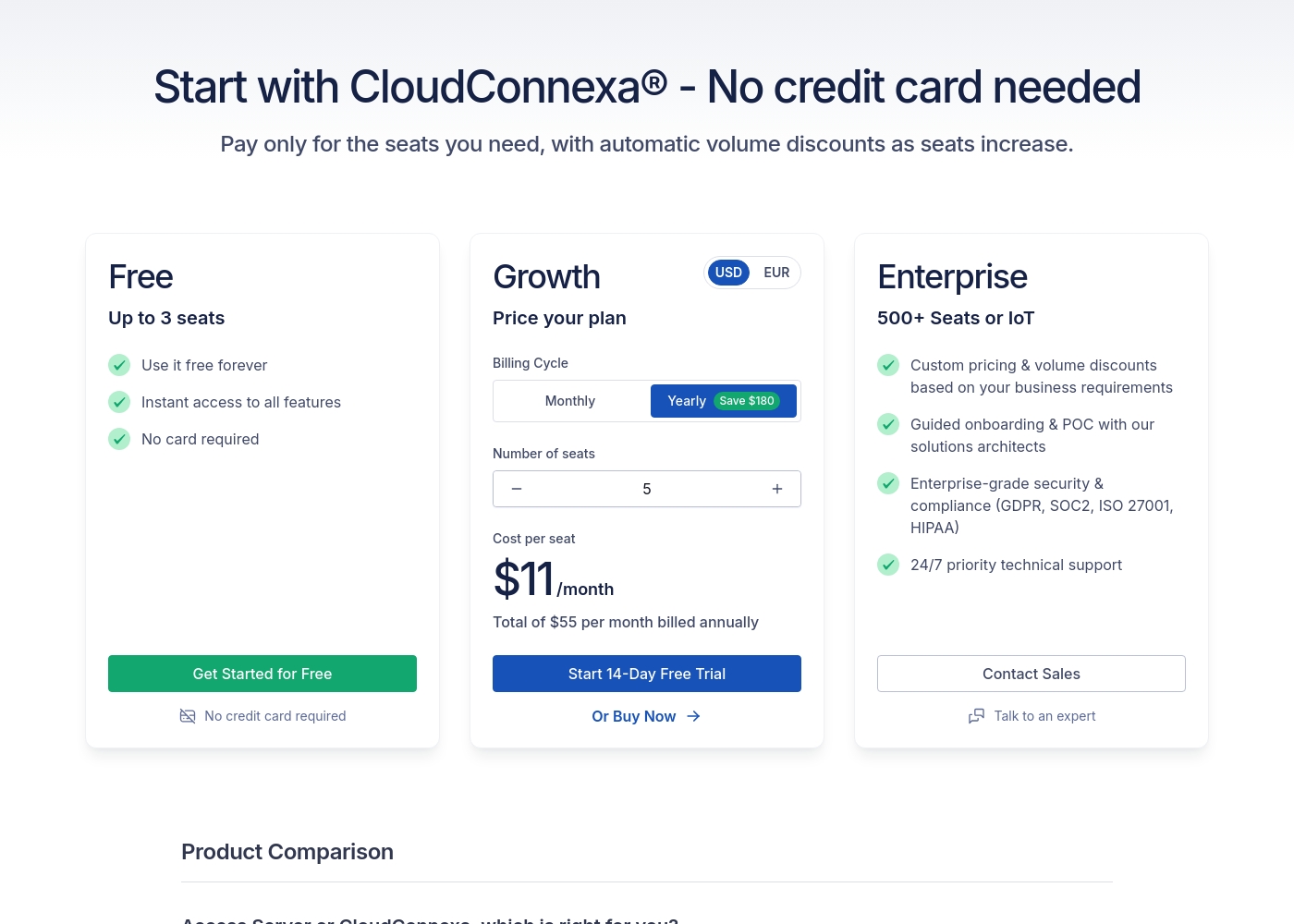
OpenVPN CloudConnexa costs between Free and Custom per year with 3 plans: Free (up to 3 seats), Growth ($11/seat/month billed annually), and Enterprise (Custom Pricing).
OpenVPN also offers two solutions—CloudConnexa and Access Server—but the most straightforward pricing structure is provided for the cloud-delivered CloudConnexa plans detailed below.
Free
Price: Free forever Best For: Small teams or testing Other Features:
- Up to 3 seats
- Use it free forever
- Instant access to all features
- No credit card required
- Up to 3 seats
- Use it free forever
- Instant access to all features
- No card required
- Pay only for the seats you need
- Automatic volume discounts
- Includes 14-Day Free Trial
- Scale seats up or down on demand
- Custom pricing & volume discounts
- Guided onboarding & POC with solution architects
- Enterprise-grade security & compliance (GDPR, SOC2, ISO 27001, HIPAA)
- 24/7 priority technical support
Here are the details for the bundles, focusing on what protection and tools they include. This information helps you decide which level of protection fits your needs best.
Surfshark VPN
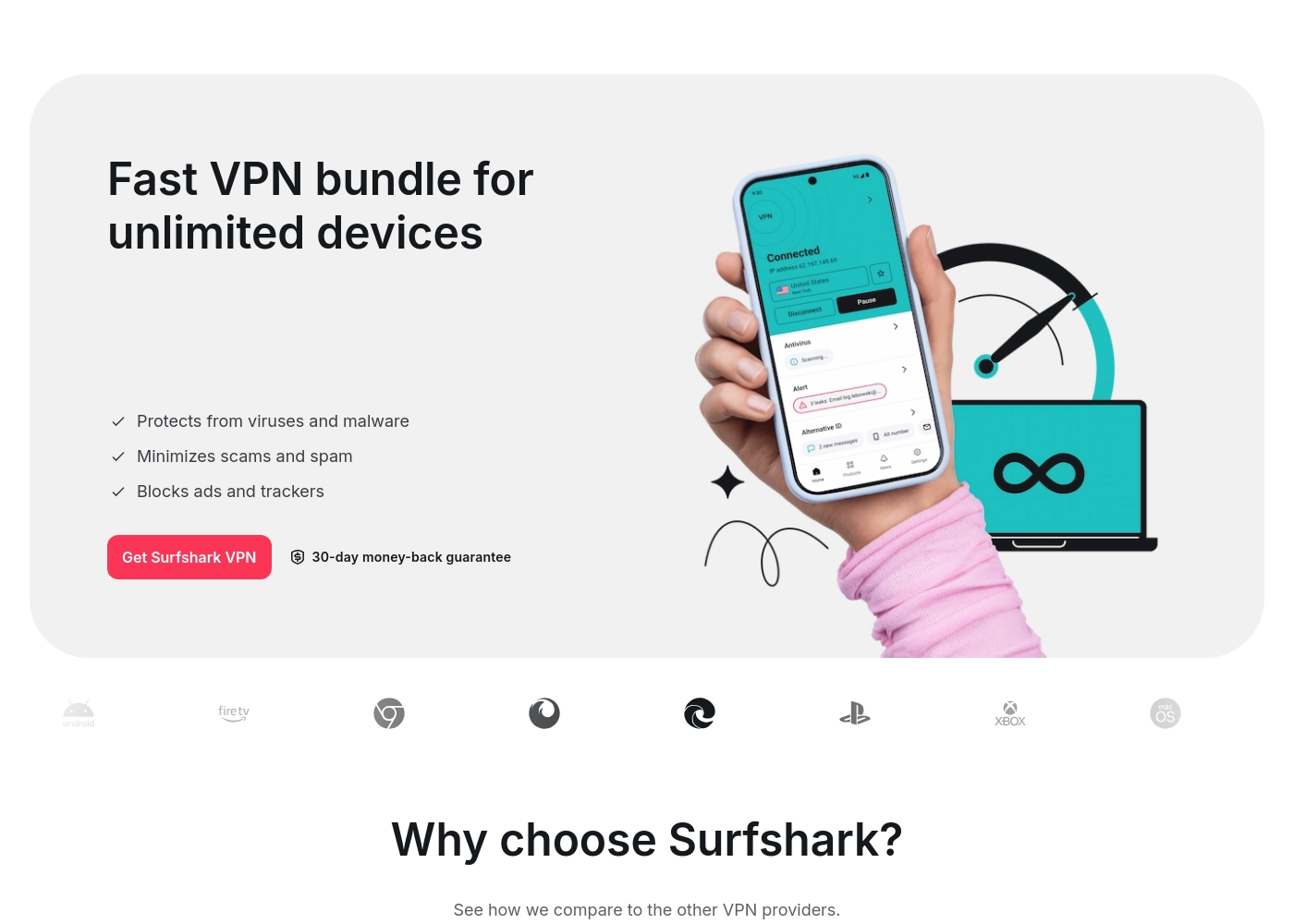
Websites Supported: Unlimited Best For: Fast, fundamental security and privacy for daily browsing. Refund Policy: 30-day money-back guarantee Other Features:
- VPN secure connection
- Connects unlimited devices simultaneously
- Protects from viruses and malware
- Minimizes scams and spam
- Blocks ads and trackers
- 3200+ RAM-only servers in 100 countries
- Strict no-logs policy
This is the perfect choice if you primarily need exceptional speed and powerful VPN coverage for your whole family. It provides crucial protection against common online threats like malware and unwanted tracking.
- VPN secure connection
- Connect multiple devices simultaneously (Unlimited)
- Protects from viruses and malware
- Minimizes scams and spam
- Blocks ads and trackers
- All VPN features included
- Surfshark Antivirus (real-time defense, webcam protection)
- Alert (data breach detection)
- Alternative ID (proxy email/identity)
- Search (private search engine)
Pricing Notes
- OpenVPN offers a generous Free CloudConnexa plan supporting up to three seats forever.
- Surfshark does not offer a free trial but provides a reliable 30-day money-back guarantee.
- OpenVPN's paid CloudConnexa plans start at $11/seat/month when selecting annual billing.
- Surfshark's key value is unlimited devices included in one subscription cost.
- OpenVPN also offers a lower-cost Access Server option starting at $7 per connection monthly.
Pricing Head-to-Head
User Reviews
User feedback on Trustpilot paints a largely negative picture, although this reflects a small sample size of nine reviews. The recurring themes critically focus on reliability and user experience.
Several users describe the platform as "extremely laggy," noting poor UX, especially with the browser authentication process. Functionality is also strongly challenged; one reviewer claimed the platform is fundamentally broken and fails to block expected threats like viruses or DDoS attacks, contradicting its advertising claims.
The user experience for the browser authentication is very poor and complex. It is constantly extremely laggy, which makes daily operations unnecessarily frustrating for mandated users.
Surfshark receives outstanding external feedback, earning an average 4.4-star rating across over 27,000 Trustpilot reviews. Reviewers consistently praise the service's ease of use and reliable performance across various devices, often highlighting the significant boost in online security they feel after subscribing.
However, the most recurring theme is the exceptionally prompt and helpful customer service. Multiple support agents (including Lucian Montgomery, Phoenix Harrington, and Tristan Langley) are frequently named for their professionalism, patience, and ability to quickly resolve technical challenges, including subscription and specific setup problems.
My PS account was hacked twice before I started using Surfshark. Since subscribing, I feel totally safe online and also get a far better streaming experience. It truly helps reclaim digital security.
Our Verdict
This comparison is fundamentally about securing an enterprise versus protecting a family. Surfshark is the overwhelming winner for personal and household use. OpenVPN is built to dominate complex business deployments and regulatory requirements. You must define your audience: an IT department or a consumer with many gadgets. OpenVPN acts as the highly secure backbone for modern business security architecture. It offers unparalleled flexibility with self-hosted Access Server or cloud-managed CloudConnexa. Organizations needing strict HIPAA or SOC 2 compliance must choose OpenVPN. It is built to implement Zero Trust access controls effectively and reliably. However, user reviews frequently mention complex setup and platform performance issues with OpenVPN. Surfshark delivers a refreshingly easy-to-use, feature-packed security bundle for everyone else. Surfshark protects unlimited devices for one simple price, offering immense value. The Surfshark One bundle includes a powerful Antivirus and Incogni, which removes your data from brokers. Surfshark’s customer support is fast, professional, and consistently earns 5-star praise. The core deciding factor is architectural control versus comprehensive consumer defense. Choose OpenVPN if your IT team needs architectural control and regulatory compliance today. Pick Surfshark if you need hassle-free security, Antivirus, and identity protection for all your personal devices. For consumers prioritizing features and ease of use, Surfshark is the superior product and overall experience.
Frequently Asked Questions
Is OpenVPN or Surfshark better for large businesses?
OpenVPN is superior for large businesses needing compliance features. It supports Zero Trust controls and certifications like HIPAA and SOC 2. Surfshark is geared toward individual consumers and household protection.
Which solution provides better value for protecting many devices?
Surfshark provides better value because one subscription covers unlimited simultaneous devices. OpenVPN uses a per-seat or per-connection pricing model that increases in cost as your device count grows.
Does Surfshark offer a self-hosted option like OpenVPN Access Server?
No, Surfshark only provides a fully managed, easy-to-use VPN service. OpenVPN offers the self-hosted Access Server for IT teams needing full architectural control over deployment.
Is Surfshark One comparable to OpenVPN's enterprise features?
Surfshark One is a bundle of robust consumer tools (VPN, Antivirus, Incogni). OpenVPN focuses on ZTNA, compliance, and securing business network traffic. They serve entirely different defensive purposes.
Which tool is easier to set up and use?
Surfshark is significantly easier, featuring seamless installation and intuitive client applications. OpenVPN is frequently criticized by users for complex setup and performance lag issues.
Can OpenVPN automatically remove my data from data brokers?
No, OpenVPN focuses on securing your corporate network access and traffic. Surfshark offers the Incogni feature specifically designed for automated data removal from brokers.
Ready to Choose?
Both tools have their strengths. Choose based on your specific needs.