Omnisend vs Reply.io
Omnisend and Reply.io are built for fundamentally different business models and audiences. Omnisend excels at integrated email and SMS marketing automation for e-commerce. Reply.io is the clear leader for specialized B2B sales outreach and sophisticated multichannel sequencing. Choosing between Omnisend and Reply.io depends entirely on whether you sell products or sell solutions.
Best for: E-commerce businesses aiming to integrate email and SMS marketing, Shopify and WooCommerce store owners
Best for: B2B Sales Development Representative (SDR) teams, Lead generation agencies managing multiple clients
Exceptional support meets powerful, intuitive automation.
We found Omnisend to be a high-value marketing platform, excelling due to its comprehensive permanent free tier and customer support praised across all user plans. The intuitive interface makes complex automation workflows accessible for growing e-commerce teams, driving significant sales. Overall, we recommend Omnisend strongly, particularly for businesses seeking robust email and SMS features combined with unmatched reliability.
Pros
- Exceptional 24/7 customer support is provided across all pricing tiers.
- The platform is highly intuitive, featuring easy drag-and-drop email design and workflow setup.
- The permanent free plan includes full feature access, including automation tools, essential for startups.
- Automation features are powerful, flexible, and include functionality like dynamic discount codes.
Cons
- Advanced integrations (like Shopify vs. WooCommerce) may offer different levels of feature depth.
- Some users seek expanded multilingual support options within the platform.
AI-powered multichannel outreach with industry-best support.
Reply.io is a dependable, AI-powered platform designed to supercharge sales outreach using sophisticated multichannel sequences. We found its pricing structure highly flexible, scaling from essential email volume plans starting at $49 per user up to fully automated AI SDR services. Overall, based on its robust feature set, deep deliverability tools, and industry-leading customer support, we consider Reply.io a top choice for scaling complex sales campaigns.
Pros
- Exceptionally responsive customer support (often minutes, not hours).
- Robust and reliable platform for scaling multichannel campaigns (email and LinkedIn).
- Comprehensive suite of AI tools, including advanced personalization and the Jason AI SDR agent.
- Strong deliverability focus with unlimited email warm-up and anti-spam features.
Cons
- A significant initial learning curve due to the tool's complexity and customization options.
- Users occasionally report temporary issues where features do not function logically.
- Technical problems, while rare, sometimes require extensive time and back-and-forth communication to resolve fully.
AboutOmnisend
Omnisend is an integrated platform for email and SMS marketing designed to engage your shoppers wherever they are. It’s an excellent option for small or medium-sized businesses looking to consolidate their marketing efforts.
The platform provides intuitive tools, making advanced marketing less intimidating. Every template is 100% customizable, ensuring your customer experience is always on-brand and personalized. You can connect Omnisend to your ecommerce platform with a single click. Switching is easy, and you can even be up and running in 30 minutes. 💡
AboutReply.io
Reply.io is a dependable AI sales platform built to help sales teams sell smarter and scale their outreach. In fact, over 3,000 businesses worldwide trust our services.
We bring together audience discovery, AI personalization, and unified communication in one place. It's truly your secret weapon for closing more deals and filling up your sales pipeline. 💡
Highlights
Feature Comparison
Features Overview
We highlight the main differences and pick a winner for each feature.
Target Audience
Omnisend serves e-commerce businesses; Reply.io is built specifically for B2B sales development.
Omnisend focuses entirely on the needs of online stores and DTC brands. This means powerful integrations with Shopify and WooCommerce are standard. The entire feature set of Omnisend handles welcome series and post-purchase follow-ups perfectly. Reply.io is designed for sales teams, SDRs, and lead generation agencies. Its tools specialize in finding new leads and executing B2B outreach campaigns at scale. This is the most critical difference between Omnisend and Reply.io; they solve different sides of the revenue equation. If you sell physical goods, Omnisend is your clear choice for conversion. If you sell services or software, Reply.io provides the necessary sales tools.
Pricing Model
Omnisend uses contact size; Reply.io charges per user seat and active contacts.
Omnisend’s pricing scales cleanly based on the size of your contact list. You pay more as your list grows larger, which feels intuitive for marketing platforms. Omnisend also offers a powerful permanent Free plan with all features up to 250 contacts. Reply.io requires a specific seat license for every user conducting outreach. Pricing also increases based on the volume of 'active contacts' reached monthly. Reply.io’s per-user cost structure better suits defined B2B sales teams who need individual reporting. Omnisend is better for marketing teams scaling contact volume affordably.
Multichannel Sequencing
Reply.io offers sophisticated sequencing; Omnisend integrates only email and SMS messaging.
Reply.io allows complex, conditional outreach sequences across many channels. Sequences can combine automated emails, manual steps, LinkedIn messages, and even SMS/call steps easily. This provides serious power for dedicated sales organizations using Reply.io. Omnisend’s 'omni' channel refers to combining text and email campaigns within their platform. While highly effective (47.7% higher conversion), it lacks LinkedIn or native sales call integration. Omnisend shines when converting existing or warm e-commerce leads. The advanced capabilities of Reply.io are essential for cold B2B outreach. Omnisend provides simpler, high-converting workflows for direct-to-consumer businesses.
B2B Prospecting
Reply.io includes a contact database; Omnisend focuses on converting existing customers.
Reply.io excels at list building and lead sourcing with its Audience Discovery tool. Users can access over 1 billion global B2B contacts with intent signals for sharp outreach. Reply.io also provides extensions to verify emails quickly from LinkedIn and Gmail interfaces. This makes finding contact information simple. Omnisend assumes you already have a customer base or lead acquisition strategy. Its tools focus on capturing new subscribers via pop-ups and forms on your website. Omnisend is not designed for prospecting new cold B2B contacts. Reply.io is the designated platform for high-volume list building and prospecting efforts.
E-commerce Automation
Omnisend features crucial pre-built e-commerce workflows; Reply.io focuses on sales sequences.
Omnisend provides reliable, pre-built automations for essential e-commerce events. This includes highly effective abandoned cart recovery workflows and dynamic discount codes. Omnisend users see high conversion rates from these specialized triggers. Reply.io’s automations are designed around sales actions, like booking a meeting or following up. It does not natively handle product catalog sync or e-commerce specific triggers like Omnisend. If your business relies on recovering lost revenue from shopping carts, Omnisend is the superior choice. Reply.io's power is wasted if you primarily sell B2C products.
Customer Support
Omnisend offers 24/7 support across all tiers; Reply.io is known for fast response times during business hours.
Omnisend provides award-winning, 24/7 customer support via live chat and email. This coverage is available even to users on the permanent Free plan, which is unusual. Omnisend makes reliable help accessible to everyone. Reply.io also boasts exceptional support responsiveness via in-app chat. They target a response time of under 15 minutes during EST business hours. If worldwide, round-the-clock availability is critical, Omnisend has the advantage. Both Reply.io and Omnisend have highly praised support staff in user reviews.
AI Capabilities
Reply.io has autonomous AI agents; Omnisend uses segmentation and standard automation features.
Reply.io offers sophisticated AI tools, notably the Jason AI SDR Agent. Jason operates autonomously 24/7, handling lead generation and response management. Reply.io also employs AI Variables for hyper-personalized email generation. Omnisend leverages data for intelligent segmentation and behavioral triggers. However, Omnisend lacks the generative AI or fully autonomous outreach agents found in Reply.io. Your need for cutting-edge AI outreach will determine the winner here. Reply.io offers true AI sales automation; Omnisend provides powerful, data-driven marketing automation.
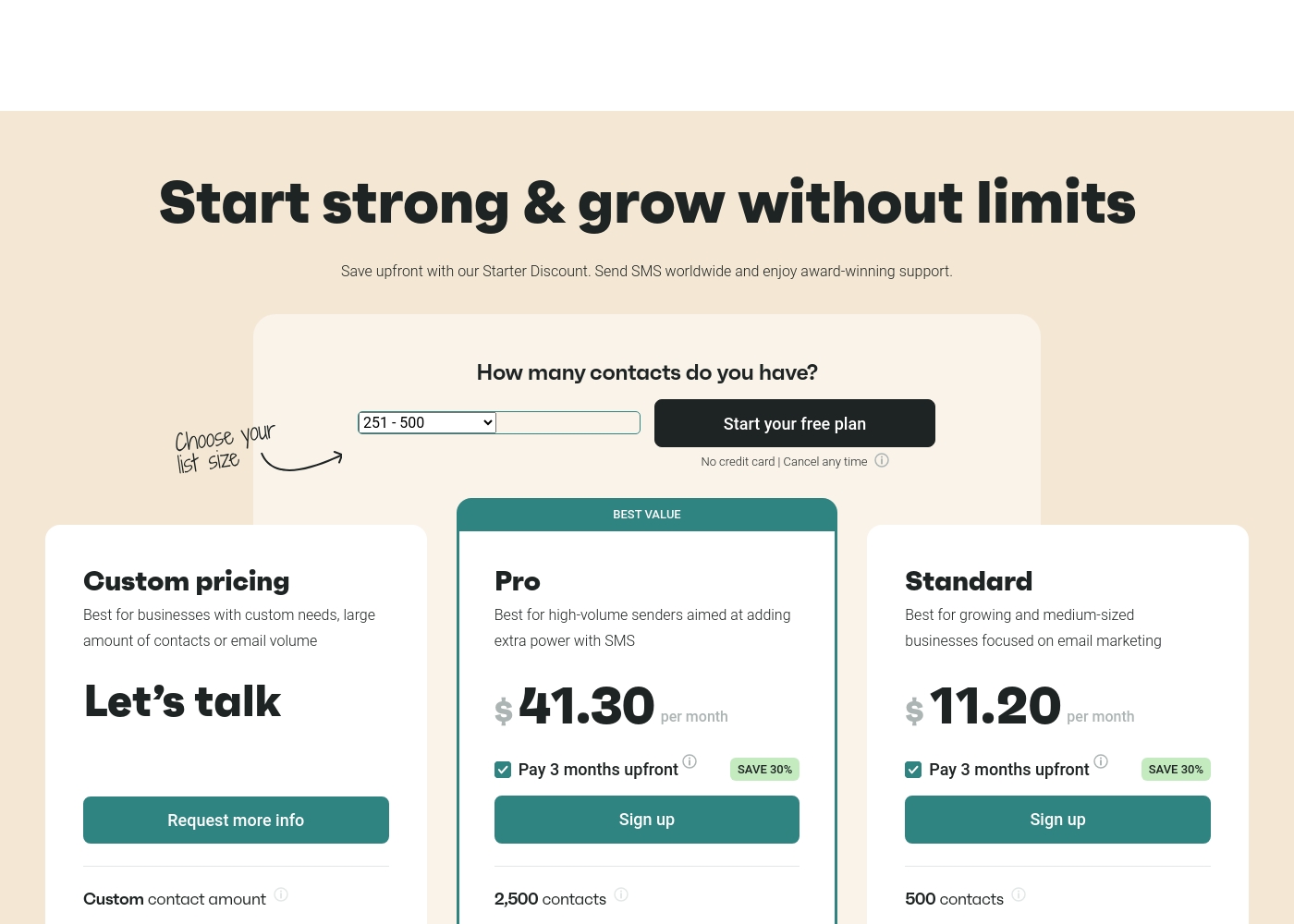
Omnisend costs between $0 and Custom Pricing per month, with three featured monthly plans: Free at $0, Standard starting at $11.20 (discounted rate), and Pro starting at $41.30 (discounted rate).
Omnisend plans are primarily determined by your contact list size, ensuring the plan scales naturally as your business grows. Let’s review the four available options, including the permanent Free tier and the paid growth plans.
Free
Price: $0 per month Best For: Small stores just starting out or merchants wanting to explore Omnisend features. Other Features:
- Reach up to 250 contacts
- Send 500 emails per month
- Includes $1 in free SMS credits to try the channel
- Access to all Omnisend features (including automation, segmentation, and forms)
- 500 emails/month
- 500 web push notifications/month
- $1 in free SMS to try
- Includes all Omnisend features
- 6,000 emails / month
- Unlimited web push notifications
- 24/7 Priority support
- Advanced reporting
- Unlimited emails
- Unlimited web push notifications
- Monthly bonus SMS credits equal to plan price
- Advanced reporting
- Personalized content ADD-ON
- Custom contact amount
- Unlimited emails and web push notifications
- Free migration and dedicated onboarding specialist
- Account Expert support (for spending >$400/month)
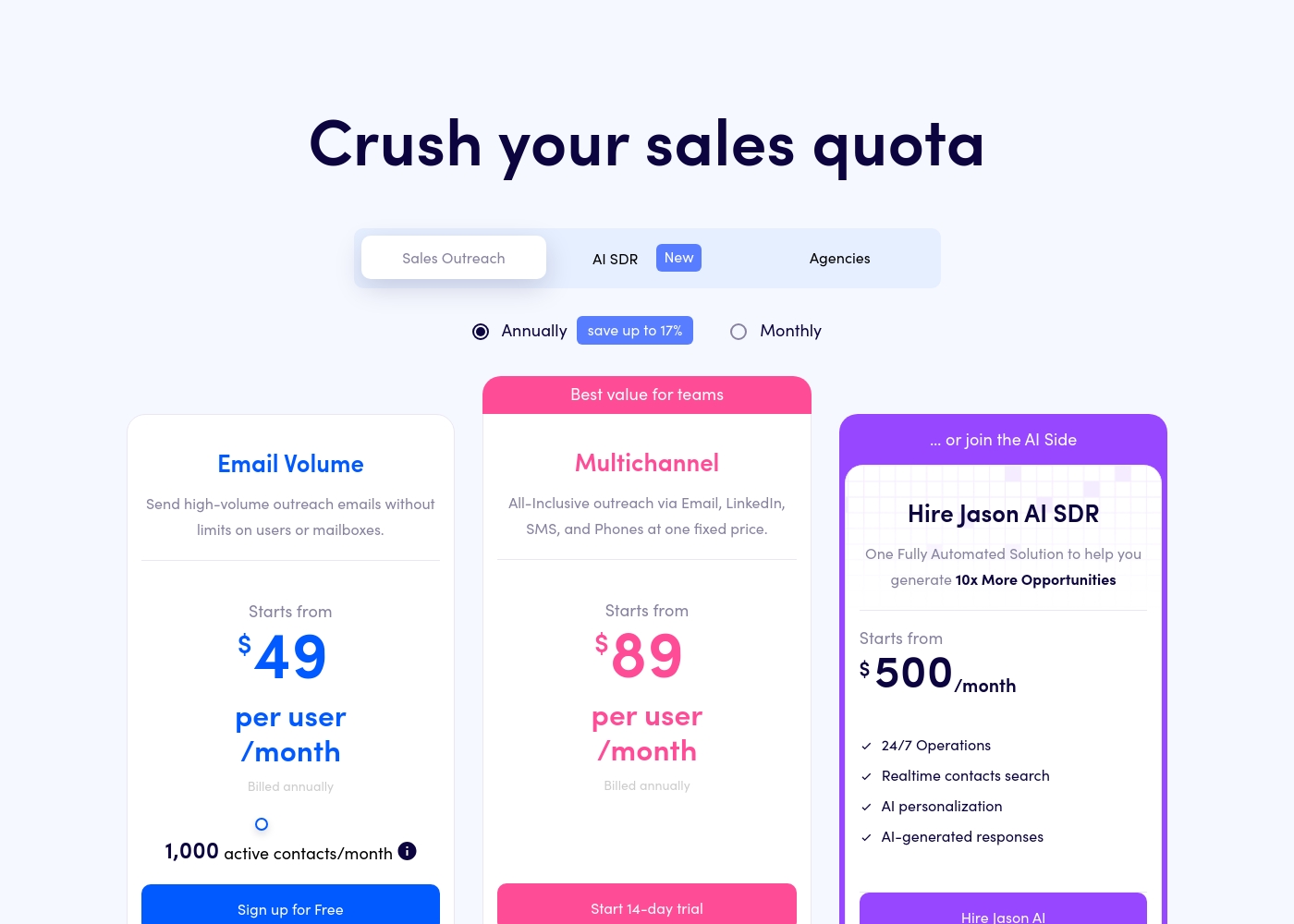
Reply.io costs between $49/user/month and $3000/month across four main entry points: Email Volume starting at $49/user/month, Multichannel starting at $89/user/month, AI SDR starting at $500/month, and Agency Starter beginning at $166/month.
The following section details the primary pricing tiers available. Remember, selecting annual billing often provides savings up to 17% or more compared to monthly rates.
Email Volume
Price: Starts at $49 per user/month (Billed annually) Best For: High-volume outreach focused purely on email. Other Features:
- Unlimited mailboxes and email warm-up.
- Unlimited emails sent to active contacts.
- 50 Live data credits each month.
- Anti-spam and deliverability suite included.
- Unlimited mailboxes
- Unlimited email warmup
- Unlimited emails
- Anti-spam & deliverability suite
- Email Automation (10 mailboxes)
- LinkedIn Automation (Paid subscription required)
- Calls & SMS Automation (Paid subscription required)
- Unlimited active contacts and email warmup
- Hire Jason AI (Fully Automated Solution)
- AI personalization & generated responses
- Multichannel automation
- Unlimited mailboxes & warm-ups
- Unlimited clients and users
- Unlimited email warm-up
- Centralized inbox
- Dedicated support and custom roles/permissions
Pricing Notes
- Omnisend offers a permanent free plan with full feature access for up to 250 contacts.
- Reply.io’s pricing scales based on the number of users and the volume of 'active contacts' reached monthly.
- Omnisend’s Pro plan includes monthly SMS credits equal to the plan cost, increasing overall value for omnichannel users.
- Reply.io has significantly higher entry-level pricing due to its per-user model, starting at $49/user/month.
- The specialized AI SDR plans from Reply.io start at $500/month, reflecting their high-value automation.
Pricing Head-to-Head
User Reviews
Omnisend receives overwhelmingly positive feedback, primarily centered around its powerful features, exceptional ease of use, and award-winning support. Users frequently highlight the intuitive interface, praising the drag-and-drop functionality and the simplicity of setting up complex automation workflows.
Many reviewers praise Omnisend for offering better options and pricing compared to competitors like Klaviyo and Mailchimp. The customer service team is consistently commended, described often as “superb” and “exceptional,” providing personalized, responsive, and highly knowledgeable assistance, especially during complicated tasks like DNS setup and complex migrations.
By far the best email/marketing automation software I've used, having tried many alternatives. The platform is super easy and the free tier is essential for small businesses just starting out. I cannot stress enough how much I prefer Omnisend.
Reply.io users consistently report a positive experience, highlighting outstanding customer support as a major strength. Reviewers frequently note that the support team is incredibly responsive, often providing immediate help via chat and resolving complex issues quickly—sometimes within minutes.
This strong support helps users navigate the platform’s powerful features. Functionally, users praise Reply.io’s reliability and robust capabilities for scaling outreach.
Reply.io’s support team is truly exceptional. The human interaction I have with them is better than any other software I currently use for my job. The chat assistant also provides great intake support.
Our Verdict
Deciding between Omnisend and Reply.io is quite simple: they serve fundamentally different functions. Omnisend is purpose-built for the entire e-commerce marketing cycle. Reply.io is a powerhouse designed solely for scaling B2B sales outreach systems. Omnisend’s superpower is making complex e-commerce automation workflow easy and affordable. It offers a permanent Free plan and superior integration with platforms like Shopify and BigCommerce. Omnisend helps you convert warm traffic and recover lost abandoned cart revenue effectively. Reply.io is an absolute beast when it comes to sophisticated B2B prospecting and AI integration. Features like the Jason AI SDR agent and its 1 billion contact database are essential sales tools. Reply.io ensures top deliverability through unlimited warm-up tools. Your primary business model dictates the winner: B2C demands Omnisend, B2B requires Reply.io. If you sell direct-to-consumer, Omnisend’s structure gives you better value and support from day one. However, if you rely on SDRs and outbound sequences, the per-user model of Reply.io is perfect. If you run an online store, choose Omnisend for its intuitive interface, free plan, and 24/7 support. Select Reply.io if you need a specialized platform to fuel complex, multichannel sales pipelines fast.
Frequently Asked Questions
Which software is better for e-commerce and retail: Omnisend or Reply.io?
Omnisend is the superior choice for e-commerce and retail businesses. Its features are tailored for online sales, including abandoned cart automation. Reply.io focuses on the B2B sales process and lacks key retail integrations.
Does Omnisend or Reply.io offer a better free plan option?
Omnisend offers a permanent Free plan that includes access to all core features. This is capped at 250 contacts per month. Reply.io only offers a standard 14-day free trial period instead of a permanent free option.
Which tool provides better support for multichannel outreach?
Reply.io provides superior support for multichannel outreach, including LinkedIn and calls/SMS capabilities. Omnisend primarily focuses on powerful integrated email and SMS sequences. Reply.io offers more channels for B2B engagement.
Is Reply.io worth the higher per-user cost compared to Omnisend?
If you are running B2B sales development, Reply.io is worth the per-user cost for its specialized tools. These include AI agents and contact databases not found in Omnisend. Omnisend is lower cost but only fits B2C marketing needs.
Which platform offers better AI features?
Reply.io offers significantly more advanced AI features than Omnisend. Its platform includes the Jason AI SDR agent for autonomous outreach. Reply.io also uses AI variables for hyper-personalization in emails.
How do Omnisend and Reply.io handle team size and scaling?
Reply.io is structured for sales teams, charging per user seat and scaling based on active contacts. Omnisend scales based on your total contact list size. Omnisend is better for scaling marketing volume; Reply.io is better for scaling sales headcount.
Ready to Choose?
Both tools have their strengths. Choose based on your specific needs.