Nickel vs Quadient
Nickel and Quadient solve different money problems. Nickel unifies payments, bill pay, and credit into one simple dashboard. Quadient automates complex AP/AR workflows and customer communications for larger enterprises.
Best for: Small to medium businesses unifying payments, bills, and credit, Teams wanting to eliminate ACH fees and speed up cash flow
Best for: Enterprise finance teams automating AP and AR workflows, Customer communications managers handling omnichannel document delivery
Solid for payments and cash flow.
Overall, we find Nickel to be a capable platform for consolidating payment collection, bill pay, and basic credit operations into a single dashboard. Its strong value lies in the free ACH tier and clear pricing, though teams needing advanced reporting or very fast support may encounter some limitations.
Pros
- Free core plan with unlimited ACH transfers.
- Clean, intuitive interface for managing payments.
- Strong integration with QuickBooks Online.
- Transparent, scalable pricing with no hidden fees.
Cons
- Customer support response times can vary.
- Advanced reporting and analytics are somewhat limited.
- Learning curve for setting up credit decision workflows.
- Transaction limit on the free tier may be restrictive.
Powerful automation, but support concerns us.
We find Quadient offers robust tools for automating AP/AR and managing customer communications at scale. However, persistent user complaints about customer support and contract flexibility temper our recommendation. Overall, it's a capable suite for larger enterprises, but smaller teams should proceed with caution.
Pros
- Automates end-to-end AP and AR workflows.
- Strong omnichannel document creation and delivery.
- Empowers business users, reducing IT dependency.
- Scales well for high-volume, complex needs.
Cons
- Significant concerns about customer service and support responsiveness.
- Contracts and billing terms can be rigid or difficult.
- May be too complex or costly for small businesses.
- Onboarding and integration can present challenges.
AboutNickel
Nickel is a unified payment and credit platform built for businesses. It replaces your fragmented stack of financial tools. ✅
You can accept payments, pay bills, and offer net terms to customers—all from a single dashboard. It's designed to give you full control over your money cycle.
AboutQuadient
Quadient is a suite of process automation solutions focused on two core areas: customer communications management (CCM) and financial workflow automation. It's designed for mid-to-large enterprises that need to design, manage, and deliver personalized documents and messages across digital, print, and mobile channels, while also automating key AP and AR processes. 💡
Highlights
Feature Comparison
Features Overview
We highlight the main differences and pick a winner for each feature.
Pricing & Value
Nickel offers transparent, tiered pricing starting at $0. Quadient uses custom quotes with annual contracts.
Nickel's pricing is clear. The Core plan is free forever. You can upgrade to Plus for $35/month annually for faster payouts and unlimited users. Quadient provides no public pricing. You must contact sales for a custom quote, which often means annual contracts. External reviews warn of rigid terms. Nickel is built for cost-conscious businesses. The free tier removes financial barriers to entry. Quadient is an enterprise investment. Its value comes from automating high-volume workflows, but the upfront commitment is higher. The key trade-off is predictability vs. scale. Nickel gives you known costs from day one. Quadient's cost is tailored to your complexity, but you'll need to negotiate carefully.
Ease of Use
Nickel is designed for simplicity. Quadient has a steeper learning curve for complex automation.
Nickel's interface is praised for being clean and intuitive. Users can manage payments and bills quickly without extensive training. Quadient's platform is powerful but complex. Onboarding can be challenging and may require significant internal resources. For a small team, Nickel's simplicity means faster adoption. For a finance department, Quadient's complexity allows for deep workflow customization. The trade-off is power vs. accessibility. Nickel is ready to use quickly. Quadient requires more planning and setup to unlock its full potential.
Payment Processing
Nickel excels at direct payment acceptance and transfers. Quadient automates payment workflows within larger systems.
Nickel lets you accept cards and unlimited free ACH transfers instantly. You can pay vendors via ACH, card, or check. Quadient's AP module automates the process from invoice to payment, but you're not directly accepting customer payments in the same way. Nickel is about moving money directly. You get paid faster, with next-day funding on paid plans. Quadient is about automating the approval and payment of bills you receive. The focus is different. Choose Nickel for direct cash flow control. Choose Quadient to automate your existing bill payment pipeline.
Accounts Payable
Quadient offers robust, end-to-end AP automation. Nickel provides basic bill pay features.
Nickel's bill pay includes sending payments and setting up approval workflows. It's straightforward and effective for small to medium businesses. Quadient AP automates the entire lifecycle: purchase orders, invoice matching, expense management, and final payment. Quadient is built for high-volume, complex AP needs. It handles POs, 3-way matching, and multi-entity workflows. Nickel is simpler, focusing on paying bills you've already agreed to. For a team drowning in invoices, Quadient's automation saves significant time. For a business that just needs to pay vendors reliably, Nickel is sufficient and cheaper.
Customer Communications
Quadient is a leader in omnichannel communications. Nickel does not offer this feature.
Nickel's communication is limited to payment portals and links. Quadient's CCM module lets you design personalized, compliant documents for digital, mobile, and print from one cloud platform. It's a core part of their offering. Quadient empowers business teams to manage templates without IT, reducing bottlenecks. This is critical for enterprises sending statements, notices, or marketing materials at scale. Nickel has no comparable feature. This is a clear differentiator. If you need to manage customer communications, Quadient is the only option here. Nickel focuses solely on the payment transaction.
Integrations
Nickel has a native, key integration. Quadient's integration details are less transparent.
Nickel boasts a native, real-time sync with QuickBooks Online. Invoices and bills update automatically. This is a major strength for its target market. Quadient mentions integration capabilities but lists no specific pre-built connectors on its public site. For a QuickBooks user, Nickel's integration is a plug-and-play win. Quadient may integrate with your ERP, but you'll need to confirm compatibility directly with sales. The experience is less self-serve. Nickel offers a known, valuable integration out of the box. Quadient's integration story is more complex and customized.
Customer Support
Nickel offers 24/7 support. Quadient receives consistent complaints about slow, unresponsive service.
Nickel states support is available 24/7 via chat and email. External reviews are mixed but generally positive about responsiveness. Quadient's Trustpilot reviews are filled with complaints about poor customer service and long response times. This is a major pain point for Quadient users. Getting help can be slow and frustrating. Nickel's support is highlighted as a reliable benefit. The difference in sentiment is stark. For businesses where support is critical, Nickel has a clear advantage. Quadient's support issues could offset its powerful features.
Scalability
Both scale, but for different reasons. Nickel scales with business growth. Quadient scales with enterprise complexity.
Nickel scales by removing user and transaction limits on paid plans. It's designed for growing small to medium businesses. Quadient scales to handle millions of transactions and complex, multi-department workflows for large enterprises. Nickel's scalability is about more users and faster money movement. Quadient's scalability is about processing volume and integrating deep into corporate finance and comms. They target different sizes. Choose Nickel if your growth is in team size and transaction volume. Choose Quadient if your growth is in operational complexity and communication needs.
Nickel pricing: Nickel offers a range of payment management plans starting from a free tier up to custom enterprise solutions. Pricing is designed to scale with your business needs, featuring unlimited free ACH transfers on all plans and a 20% discount for annual billing on the Plus tier.
- Nickel Core: $0/month
- Nickel Plus: $35/month (billed annually) or $45/month (billed monthly)
- Nickel Pro: Custom pricing for specialized credit operations
All plans include standard card payment processing at a 2.9% flat rate and native QuickBooks Online integration to streamline your financial workflows.
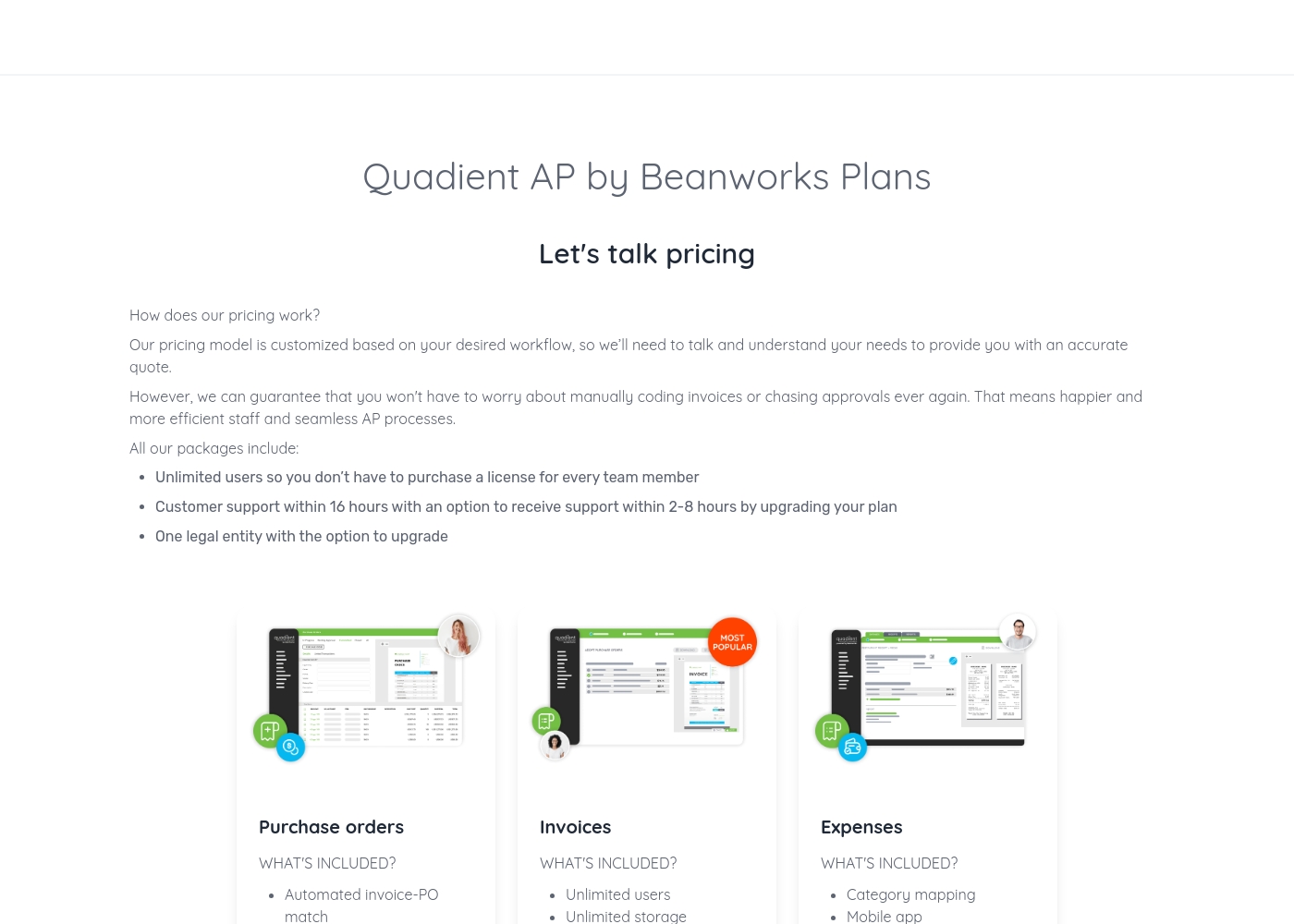
Quadient pricing: Quadient AP by Beanworks uses a custom pricing model based on your specific workflow and needs. They offer feature-specific packages for purchase orders, invoices, and expenses to ensure you only pay for what you use.
All plans include unlimited users and standard support, with the option to upgrade for faster response times or more entities. This tailored approach allows the platform to scale with your business while removing the burden of manual AP processes once and for all.
Contact them for a personalized quote today and discover how much you could save by automating your business's workflows. Their team of experts is ready to help you find the perfect solution for your accounts payable needs, whether you're a small business or a large corporation.
Pricing Notes
- Nickel offers a free forever plan (Core) with unlimited ACH transfers.
- Nickel's paid plans are transparent: Plus is $35-$45/month.
- Quadient requires a custom quote; pricing is not public.
- External reviews mention Quadient often involves rigid, annual contracts.
- Nickel's free plan has a $25,000 per-transaction limit and 3 users.
- Quadient's plans include unlimited users.
Pricing Head-to-Head
User Reviews
We found that external feedback on Nickel is generally positive, with users highlighting its ease of use and impact on cash flow. Many appreciate the intuitive interface for handling payments and the significant time saved through automation and QuickBooks integration.
😊 The free ACH transfers and transparent pricing are frequently praised as major value drivers for small businesses. However, some reviews point to occasional customer support delays and a learning curve for more advanced features like credit management.
Nickel has been a game-changer for our small business. Getting paid via ACH for free and paying our vendors through the same platform saves us so much time and money. The QuickBooks sync is flawless.
External reviews for Quadient are mixed. On Trustpilot, users frequently complain about poor customer service, slow support, and billing issues, creating a frustrating experience.
💔 Some mention difficult contracts and a lack of responsiveness. However, on Capterra, the limited feedback for the Impress platform is more positive, with a user praising its document creation capabilities and template management as highly important features.
The software itself might work, but the customer service is a nightmare. Getting any help or a simple question answered takes forever. We've wasted so much time trying to get support.
Our Verdict
Nickel wins for most small to medium businesses. It's the simpler, more affordable choice for direct payment control. Nickel's superpower is unifying payments, bills, and credit in one dashboard. You get free ACH transfers, a free forever plan, and seamless QuickBooks sync. It's built for speed and simplicity. Quadient's superpower is deep enterprise automation. It handles complex AP/AR workflows and omnichannel communications at scale. It's a powerhouse for larger organizations. The deciding factor is your business size and need. If you're a growing team wanting control over cash flow, pick Nickel. If you're an enterprise automating high-volume processes, pick Quadient. Final verdict: Choose Nickel for transparent pricing and immediate value. Choose Quadient only if you need its specific, large-scale automation capabilities and can tolerate the support risks.
Frequently Asked Questions
Which is better for small teams: Nickel or Quadient?
Nickel is the clear choice for small teams. It has a free plan, transparent pricing, and is designed for simplicity. Quadient is complex, costly, and targets larger enterprises, making it overkill for most small businesses.
Does Nickel automate accounts payable like Quadient?
No. Nickel offers basic bill pay with approval workflows. Quadient provides full end-to-end AP automation from purchase orders to payments. If you need complex AP automation, Quadient is more powerful, but Nickel is simpler and cheaper.
Is Quadient worth the extra cost over Nickel?
It depends on your needs. Quadient is worth it for enterprises needing to automate high-volume AP/AR or manage omnichannel communications. For most other businesses, Nickel's value and simplicity make it the better financial choice.
Which platform has better customer support?
Nickel has better customer support. It advertises 24/7 help and reviews are generally positive. Quadient receives frequent, severe complaints about slow, unresponsive support and difficult contract management.
Can I try Nickel or Quadient for free?
You can use Nickel's free Core plan forever. It includes unlimited ACH transfers. Quadient does not offer a free plan or trial; you must contact sales for a demo and custom quote.
How does the QuickBooks integration compare?
Nickel has a native, real-time sync with QuickBooks Online. Invoices and bills update automatically. Quadient does not list a specific QuickBooks integration, so you would need to confirm compatibility directly with their sales team.
Ready to Choose?
Both tools have their strengths. Choose based on your specific needs.