Motion vs Teamwork
Motion introduces enterprise-grade AI automation to manage your daily tasks automatically. Teamwork focuses on maximizing client profitability and resource utilization for agencies. It's truly a choice between cutting-edge AI orchestration or detailed financial control.
Best for: Solo entrepreneurs and small teams seeking daily task automation, Teams prioritizing intelligent auto-scheduling and reduced mental load
Best for: Marketing and consulting agencies (10+ employees), Professional services firms needing resource planning
AI scheduling that manages your work.
We observed that Motion delivers on its promise of powerful, AI-driven task management and scheduling. Users consistently report massive time savings and reduced cognitive load, but the complex credit and seat pricing structure requires careful study. Overall, Motion is a transformative tool for dedicated users who commit to mastering its full capabilities.
Pros
- Reduces mental load using intelligent auto-scheduling and task prioritization.
- Integrates tasks, projects, and calendar into a single, cohesive productivity suite.
- Helps teams break down major goals into manageable, achievable steps for progress.
- High-quality AI note-taker joins meetings and summarizes them effectively.
Cons
- High price point ($50/month cited as excessive by some single users).
- Steep learning curve requires significant upfront time to fully master the system.
- Reported UX/UI glitches, such as obstructive task preview pop-ups.
- Users note that the mobile app and notification features need improvement.
Powerful features and frustrating business practices.
We found Teamwork offers robust, unified project and resource management tools essential for professional services needing deep profitability tracking and resource forecasting. Overall, the software's powerful feature set is unfortunately being undermined by confusing, opaque upgrade paths and extremely restrictive feature limits in lower tiers.
Pros
- Unified platform combining PM, time tracking, resource forecasting, and budgeting.
- Specifically built to manage complex client work and track project profitability.
- Real-time visibility into staff availability prevents common overbooking issues.
- Simple interface with TONS of functionality and detailed project data scope.
Cons
- Upgrade processing and pricing for Scale plan are opaque and require sales engagement.
- Artificially restrictive feature limits (like budgeting caps) force expensive, premature upgrades.
- Recent new interfaces and UI changes have broken essential functions for some users.
- Customer support availability seems limited primarily to UK business work hours.
AboutMotion
Motion transforms how teams work by offering the world's first AI workforce at your fingertips. ✨ This platform goes far beyond simple automation; it lets you create and deploy enterprise-grade AI Employees specifically built for your business needs. It merges an entire productivity suite—including AI Projects, AI Calendar, and AI Tasks—where all your work is managed and recorded. Motion is trusted by over a million top performers and teams who want a single, powerful platform for managing work efficiently.
AboutTeamwork
Teamwork.com is project and resource management software specifically built for client work and powered by AI. It goes beyond traditional project tools by combining essential functions like resource forecasting, cost control, and profitability reporting into a single platform.
This platform is trusted by professional services businesses globally. These include agencies, consulting firms, IT service providers, and accounting teams. Teamwork helps them efficiently schedule resources, manage billable hours, and track project profitability from start to finish. ✅
Highlights
Feature Comparison
Features Overview
We highlight the main differences and pick a winner for each feature.
Automation & AI Power
Motion uses AI agents to execute work; Teamwork uses AI for project management essentials.
Motion is built around an AI workforce and intelligent daily task auto-scheduling. It eliminates the constant time wasted on rescheduling tasks manually. You can easily create custom AI Employees using simple natural language instructions. Teamwork includes 'Teamwork AI' for project management features and quicker decision-making. However, Teamwork's AI focuses on speeding up project essentials, not deep daily automation. The primary goal of Teamwork is resource optimization and financial tracking, not AI agents. Motion's commitment to AI execution provides transformative time savings for busy individuals. Teamwork's AI features are supplementary to its core resource planning tools. If your main goal is reducing mental load via AI, Motion is the clear choice.
Resource Management
Teamwork offers powerful resource planning; Motion focuses only on individual capacity.
Teamwork provides a Workload Resource Planner and utilization reports for the entire team. It offers real-time visibility into staff availability to prevent costly overbooking. You can use tentative project scenarios and placeholder resources for future planning. Motion tracks individual capacity primarily to feed its auto-scheduler and ensure tasks fit the human's day. Motion lacks the high-level workload forecasting necessary for strategic staffing decisions. Teamwork is essential for firms managing complex client projects and staffing decisions. Motion is better suited for managing an individual or small team's daily task flow. Agencies needing to match people to tasks efficiently should rely on Teamwork for actionable insights.
Pricing Model
Motion uses annual, usage-based pricing; Teamwork is per-user with a free plan.
Motion uses an annual subscription model tied to seats and a complex usage-based AI Credit system. Standard plans range from $29 to $599 per month when billed annually. Scaling AI usage across the team becomes more cost-effective on larger Motion plans. Teamwork offers a free plan and a flexible per-user subscription model starting at $10.99/user/month. Teamwork's pricing is monthly or annual, which is more flexible for scaling teams. However, restrictive limits on budgets often force expensive upgrades prematurely in Teamwork, frustrating users. If you want a free plan or pay monthly, Teamwork is the only option here. Motion forces an annual commitment for its best rates. Carefully calculate your expected AI credit usage in Motion versus potential forced upgrades in Teamwork.
Financial Tracking
Teamwork provides profitability reports and budgeting; Motion focuses only on productivity gain.
Teamwork is designed specifically to track billable hours and manage costs for client work. Grow and Scale plans include crucial features like budgeting, time tracking, and detailed Profitability Reports. This helps firms squeeze more profit from every project. Motion lacks distinct financial management tools or client cost tracking features. Motion measures success by efficiency gains and time saved through task automation. If showing ROI and tracking complex project finances is mission-critical, Teamwork is indispensable. Motion cannot replace dedicated financial analysis systems for client work. Teamwork allows managers great visibility into whether projects are running profitably in real-time.
Learning Curve
Motion requires time to master; Teamwork has a simple UI but complex feature setup.
Motion users consistently report a steep learning curve to fully master its auto-scheduling and AI system. Committing time upfront is necessary to see the full benefits of Motion's integrated suite. Once mastered, the system reduces the daily mental load tremendously. Teamwork offers a simple interface with TONS of functionality, making initial adoption easy. Setting up advanced features like Workload Resource Planner or custom reports requires effort. Motion demands more initial commitment from the individual user to get the system right. Teamwork is less intimidating at the starting line for new teams. For fast team adoption, Teamwork might be smoother, while Motion requires individual dedication for maximum return.
Security & Support
Motion is SOC 2 compliant; Teamwork support is criticized for being opaque and limited.
Motion commits to enterprise-grade security and is SOC 2 Type 2 compliant for data protection. It offers Priority Business Support on its higher-tier plans for quick issue resolution. Support for Motion is generally responsive, especially with billing concerns. Teamwork support is often criticized for being restricted to standard UK business working hours. Worst, multiple users cited issues with high ($500+) costs to export project history or chat data. Motion provides transparency and better compliance for organizations prioritizing security standards. Teamwork's opaque business practices regarding data export are a critical concern. For critical support and data assurance, Motion clearly offers a more professional, reliable structure.
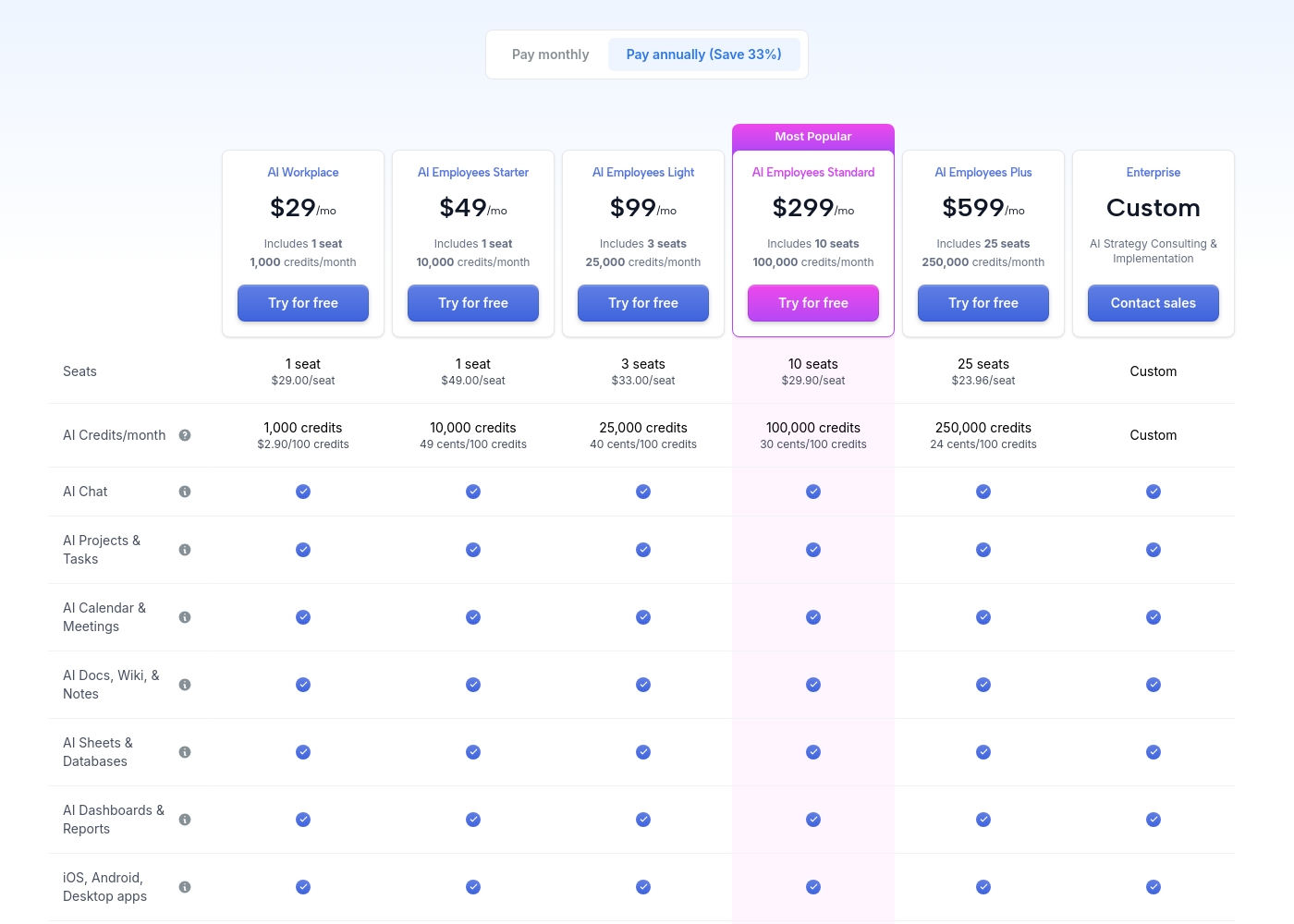
Motion costs between $29 and $599 per month (when billed annually) with 5 primary subscription plans: AI Workplace ($29/mo), AI Employees Starter ($49/mo), AI Employees Light ($99/mo), AI Employees Standard ($299/mo), and AI Employees Plus ($599/mo). There is also a custom Enterprise option.
The prices shown reflect annual billing, which gives you a savings of 33% compared to paying monthly. All plans offer a free trial period.
AI Workplace
Price: $29/mo (billed annually) Best For: Individuals and small startups starting AI integration Other Features:
- Includes 1 seat
- 1,000 credits/month ($2.90 per 100 credits)
- 3 integration connections
- Access to core AI tools (Chat, Projects, Calendar, Docs, Sheets, Dashboards)
- 1 seat
- 1,000 credits/month
- 3 integration connections
- AI Chat, Projects & Tasks, Calendar & Meetings, Docs, Wiki & Notes, Sheets & Databases, Dashboards & Reports
- iOS, Android, Desktop apps
- 1 seat
- 10,000 credits/month
- 5 integration connections
- Everything in AI Workplace
- 3 seats
- 25,000 credits/month
- 10 integration connections
- Everything in AI Employees Starter
- 10 seats (Most Popular)
- 100,000 credits/month
- 20 integration connections
- HTTP Blocks
- Everything in AI Employees Light
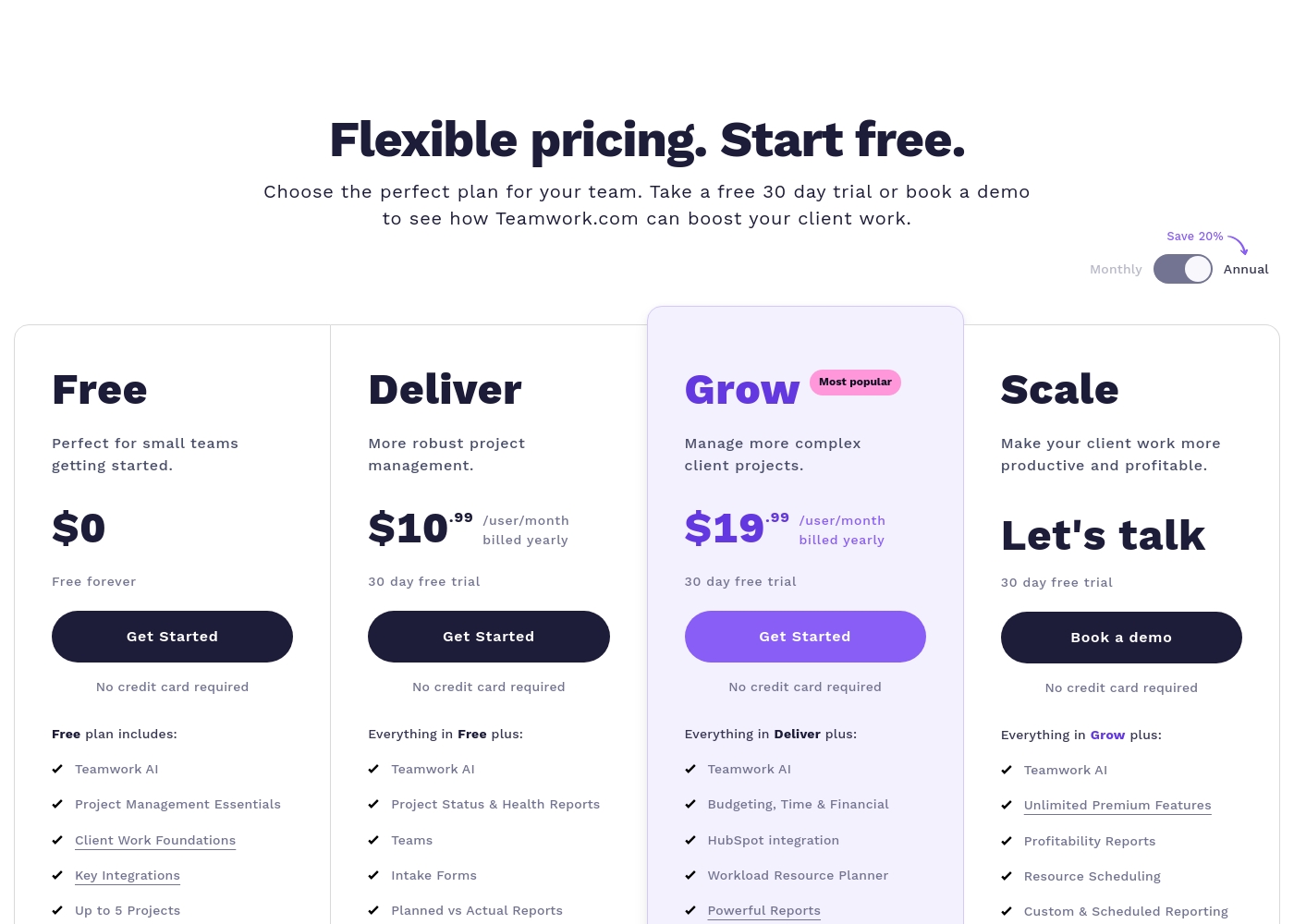
Teamwork costs between $0 and Talk to Sales per month with 4 plans: Free at $0, Deliver at $10.99/user/month, Grow at $19.99/user/month, and Scale at Talk to Sales.
Teamwork offers flexible pricing tailored to your team's size and complexity needs. You can choose to pay monthly or save 20% by selecting an annual subscription.
Free
Price: $0 (Free forever) Best For: Perfect for small teams getting started. Other Features:
- Teamwork AI and Project Management Essentials
- Built-in Time Tracking and Client Work Foundations
- Key Integrations including Slack, Zapier, and MS Teams
- Up to 5 Users and 5 Projects; 100 Automations monthly
- Teamwork AI
- Project Management Essentials
- Client Work Foundations
- Built-in Time Tracking
- Key Integrations (Slack, Zapier, MS Teams)
- Project Status & Health Reports
- Teams
- Intake Forms
- Planned vs Actual Reports
- Integrations (Quickbooks, Harvest and many others)
- Budgeting, Time & Financial
- HubSpot integration
- Workload Resource Planner
- Powerful Reports (Utilization, Time Spent)
- 50 Project Templates
- Unlimited Premium Features
- Profitability Reports
- Resource Scheduling
- Custom & Scheduled Reporting
- Retainer Management (beta)
Pricing Notes
- Motion requires annual commitment to achieve the listed pricing, offering a 33% saving over monthly rates (if available).
- Teamwork offers a free forever plan and provides more flexible monthly payment options for paid tiers.
- Motion utilizes a unique usage-based model tied to AI Credits; scaling requires purchasing higher tiers for more capacity.
- Teamwork's per-user pricing structure scales predictably, but artificially restricted limits on features often force expensive upgrades.
- Teamwork's highest plan, Scale, requires contacting sales for custom pricing.
Pricing Head-to-Head
User Reviews
Motion receives overwhelmingly positive feedback, primarily focused on its powerful auto-scheduling and prioritization features. Users frequently praise the application for reducing mental load and decision fatigue by automatically organizing tasks and project workflows.
Many reviewers, including those dealing with complex schedules or ADHD, state that Motion has revolutionized their workflow, saving significant time and boosting productivity. The ability to break down complex goals into achievable tasks is consistently highlighted as a major benefit, making Motion a game-changer for project management teams and individuals alike.
I was recently diagnosed with ADHD, and Motion has made a huge difference in how I structure my day. It removes the stress of figuring out what to do next. It has been well worth the time invested in learning the system, as the benefits are truly clear.
Teamwork's external feedback presents a sharp contrast. Users consistently praise the core software for its powerful functionality, describing it as having a simple interface and a broad scope of data that is essential for running a business.
Clients reportedly appreciate the transparency it offers. However, positive sentiment is heavily outweighed by severe criticism directed at business practices and pricing.
Teamwork is an excellent tool with an extremely simple interface and TONS of functionality. As a former project manager, the level of detail and broad scope of data available sets this tool apart easily.
Our Verdict
Choosing between Motion and Teamwork comes down to your operational priorities: internal automation or external client profitability. They serve two very different, specific audiences well. You simply must decide whether you need an AI assistant or a financial manager. Motion offers unparalleled AI-driven scheduling that transforms individual productivity. It builds custom AI Employees and integrates a full productivity suite for unified context gathering. Motion users report huge time savings once they overcome the initial steep learning curve. Teamwork is the established powerhouse for managing client services and agency operations. It excels at resource forecasting, cost control, and delivering critical profitability reports. Teamwork ensures you staff projects correctly and maximize your client margins. The deciding factor is the core pain point: is it time management or financial control? If constant task coordination sinks your day, Motion is the answer. If complex client budgets and resource allocation are the headache, pick Teamwork. For solo users wanting AI efficiency, Motion wins easily for its automation. Larger agencies needing rigorous cost tracking should choose Teamwork, provided they understand the opaque upgrade paths.
Frequently Asked Questions
Which is better for small teams: Motion or Teamwork?
If the small team focuses on client work and budgeting, Teamwork is better and offers a Free plan. If the team needs advanced daily task automation and AI assistants, Motion offers superior tools. Remember, Motion starts at $29/month, while Teamwork is free.
Does Motion include resource planning like Teamwork?
No. Motion only tracks individual capacity to feed its auto-scheduler and avoids overbooking. Teamwork includes a dedicated Workload Resource Planner and utilization reports. If you staff teams for client projects, Teamwork is the required tool for forecasting.
Is Teamwork worth the extra cost over Motion for agencies?
Teamwork’s cost is usually lower per user than Motion’s AI plans. However, Teamwork's strength lies in profitability reporting and financial tracking. Motion simply cannot provide the cost control visibility critical for agencies.
Does Motion offer a free plan for individual users?
No. Motion only offers a free trial before requiring a paid annual commitment starting at $29/month. Teamwork, conversely, provides a robust Free plan that is available forever for up to five users.
Which software has better customer support reviews?
Motion has better overall support sentiment; it offers Priority Business Support on higher plans. Teamwork's support is criticized for limited availability and reports of high exit fees to export data.
Can I deploy custom AI employees using Teamwork?
No, that is Motion's unique selling proposition. Motion allows you to build custom AI employees using natural language instructions. Teamwork AI only assists with standard project management tasks.
Ready to Choose?
Both tools have their strengths. Choose based on your specific needs.