memtime vs Toggl
memtime and Toggl both streamline time logging but focus on very different user needs. memtime emphasizes automatic, privacy-first tracking and billable hour recovery. Toggl excels at generating deep, customizable reporting for team profitability and financial oversight.
Best for: Consultants and legal services dependent on maximized billable hours, Teams that prioritize guaranteed user privacy and local data storage
Best for: Startups or small teams up to 5 users needing a permanent free solution, Teams needing cross-platform mobile tracking flexibility
Accurate tracking that pays for itself.
We found memtime to be a robust, privacy-first automatic time tracker that excels at capturing every minute spent on billable work. It runs non-intrusively in the background, fundamentally removing the need for error-prone manual timers and significantly reducing administrative burden. Overall, this is an essential tool for consultants and professionals reliant on accurate utilization data and billable hour recovery.
Pros
- Automatic, non-intrusive time logging (runs quietly in background).
- Highly accurate tracking, even when switching contexts (contact switching).
- Recovers significant missing billable time, increasing revenue.
- Strong privacy focus with data stored locally on the device.
Cons
- Transferring historical data between personal devices is challenging.
- Minor reported loss of reporting functionality in newer versions.
- Can require significant attention for extremely granular timesheet submissions.
Generous Free Tier, Unstable Service Reliability.
Toggl offers a feature-rich, cross-platform tracking tool emphasizing custom reports and enterprise integration for teams up to five users under the Free plan. We appreciate the clear pricing and the potential for deep profitability analysis in higher tiers. Overall, reliability concerns and extremely poor customer support repeatedly expressed by recent users indicate caution is necessary before large-scale deployment.
Pros
- Generous and permanent Free plan, supporting up to five users.
- Effective cross-platform sync across web, desktop, and mobile devices.
- Offers advanced enterprise features like SSO and integrations with Jira/Salesforce.
- Simple user interface makes basic time tracking easy to adopt.
Cons
- Extremely poor customer service, often non-responsive to urgent inquiries.
- Users report significant product deterioration, including laggy UI and data loss/bugs.
- Lacks core features needed by freelancers (e.g., tracking billed vs. unbilled time).
- Sales team has been accused of harassing users on the Free plan.
Aboutmemtime
memtime is an automated desktop application designed to solve the struggles of tedious manual time tracking. This tool eliminates the need for distracting start/stop timers entirely. Instead, it runs passively behind the scenes, memorizing the time you spend in various programs throughout the workday.
It allows you to go back to any day and review precisely what you focused on, when, and for how long. This is especially valuable for anyone who bills by the hour, including consultants, legal services, agencies, and accountants, because it connects to your existing project software for instant time entry export. ✅
AboutToggl
Toggl is time tracking software designed specifically for organizational teams. It is built around the idea that raw data must translate into actionable business insights. ✅ Toggl specializes in building custom, detailed reports directly from your team's tracking data.
This tool is especially suited for managing larger and enterprise teams. It provides the flexible reporting required for employees and projects across departments. By ensuring easy time tracking adoption, Toggl gives you the accurate data needed to make strong, confident decisions.
Highlights
Feature Comparison
Features Overview
We highlight the main differences and pick a winner for each feature.
Automatic Tracking
memtime eliminates manual timers completely; Toggl relies more on start/stop tracking.
memtime runs passively in the background, minimizing manual administrative effort. It tracks everything silently down to the minute, saving users up to 75% on tracking time. You review the detailed activity timeline only when needed to assign accurate time entries. Toggl offers automated tracking options but is commonly known for its popular start/stop timer. Toggl focuses on high user adoption across all device platforms. The core workflow for Toggl often still involves manual interaction with a widget. If you forget to track time often, memtime’s fully automated approach is superior. memtime guarantees every minute is captured without disrupting focus. Toggl requires more active input throughout the workday.
Privacy & Storage
memtime stores data locally for privacy; Toggl uses cloud storage for accessibility.
memtime prioritizes user privacy by storing all activity data locally on your device. This design avoids the uncomfortable feeling of employee monitoring or 'big brother.' This feature is essential for consultants or legal services. Toggl stores time tracking data in the cloud, enabling easy sync across multiple platforms. This accessibility is great but lacks the strict privacy assurances of memtime's local storage. Toggl offers SSO only in its higher, more expensive tiers. The difference is fundamental: memtime for ultra-high privacy, Toggl for multi-device flexibility. Users in sensitive industries will prefer the guaranteed privacy of memtime automatically.
Reporting & Profitability
Toggl offers deep custom reporting; memtime focuses on basic exportable data.
Toggl excels with fully customizable, flexible reporting for deep business intelligence. It provides team-level revenue, workload, and project profitability reports. Toggl helps managers make confident decisions based on reliable usage data. memtime focuses on providing accurate raw capture data and comparing planned versus actual hours. Reporting often relies heavily on efficiently exporting that granular data to external project systems. memtime’s strength is data capture, Toggl’s is data analysis. Toggl is the clear winner for businesses needing to quickly assess financial health and team capacity. The customized reporting in Toggl is superior for identifying efficiency gains. memtime's reports are primarily for accurate invoicing via export.
Mobile Experience
Toggl excels on mobile and desktop; memtime focuses primarily on desktop applications.
Toggl provides robust time tracking across dedicated web, desktop, and mobile applications. This cross-platform support allows tracking regardless of the user's location. Tracking hours on the go is simple using Toggl’s mobile app. memtime is fundamentally a desktop application that runs continuously on Windows, macOS, or Linux. The data confirms no dedicated mobile support exists for memtime. This is because all its activity data is stored locally. If your team is often away from their primary workstation, Toggl is the only viable choice. memtime is best suited for desk-bound professionals like lawyers or accountants. This feature difference defines the target audience: Toggl for mobile flexibility, memtime for secure in-office workflow.
Timesheet Management
Toggl includes timesheet approvals; memtime offers granular passive tracking only.
Toggl Premium plans include essential advanced features like mandatory timesheet approval workflows. This mechanism guarantees that managers review and approve tracked entries before finalization. Toggl helps ensure data compliance and quality control for finance teams. memtime relies on the user reviewing their detailed activity timeline (down to the minute) and assigning the time. memtime does not explicitly offer formal timesheet approval features built into the system. For large teams needing compliance and verified hours, Toggl provides the necessary management tools. memtime assumes the user is responsible for reviewing and assigning their own, highly accurate log. If timesheet sign-off is mandatory for your large organization, Toggl is required.
Reliability & Support
memtime is reliable and well-supported; Toggl faces severe reliability and support issues.
memtime enjoys excellent user reviews (4.4 rating) and is praised for its automatic operation and stability. Users consistently report fast, responsive customer support. memtime is viewed as highly reliable for billable hour recovery. Toggl holds a low 2.6 rating due to recent severe service deterioration, including bugs and laggy UI. Toggl's customer support is widely criticized as non-responsive and often impossible to reach. Choosing memtime guarantees a stable product and accessible support when issues arise. You may risk data loss and massive frustration relying on Toggl’s current instability. Reliability should be a primary concern when tracking critical billable time; memtime is the safer choice based on user feedback.
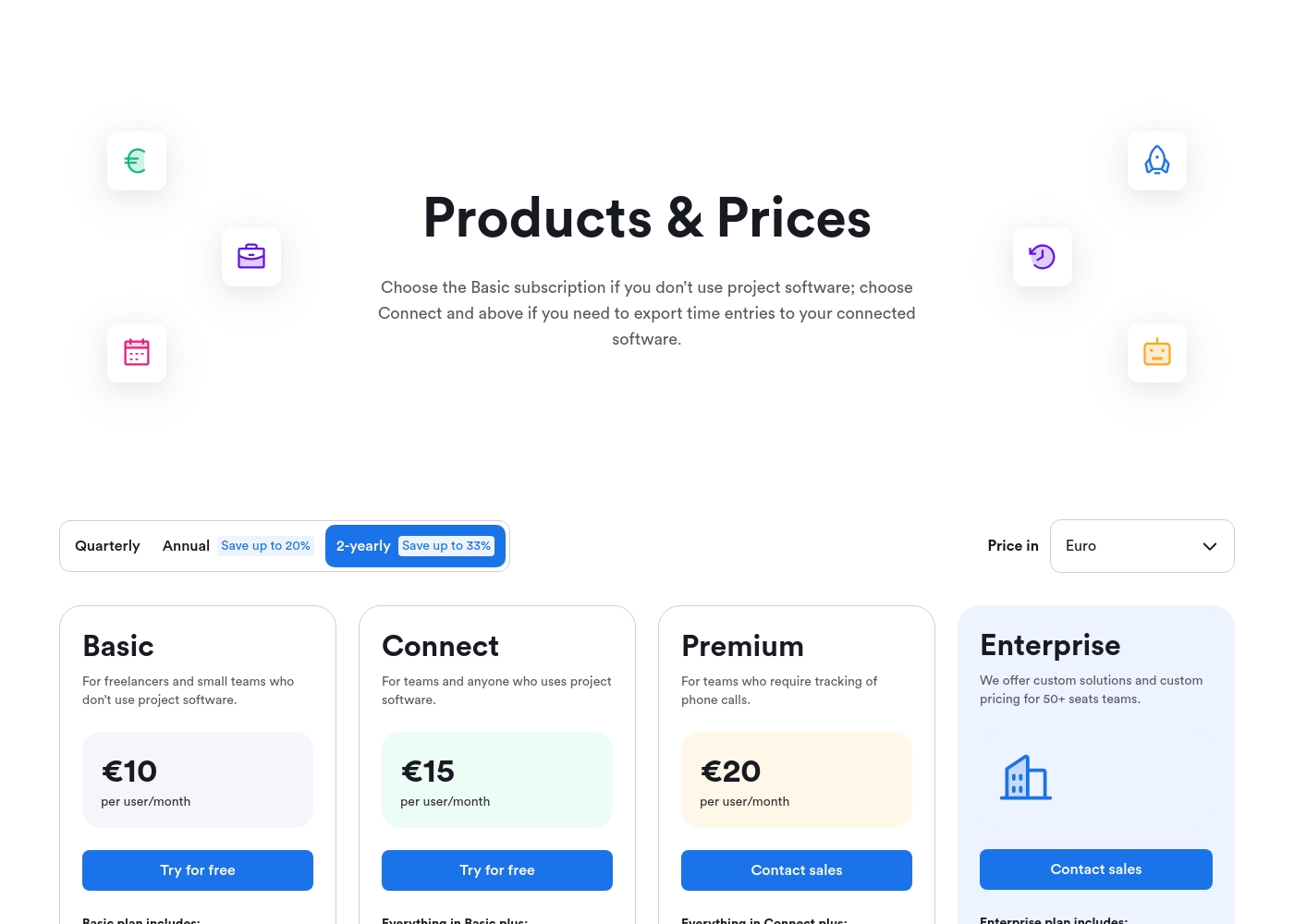
memtime costs between €10 and €20 per user/month (when billed 2-yearly) with 4 plans: Basic at €10, Connect at €15, Premium at €20, and Enterprise (custom pricing).
Below are the annual commitment prices per user/month featured on the product page. Note that these rates reflect the 2-yearly commitment discount, saving you up to 33%.
Basic
Price: €10 per user/month Best For: Freelancers and small teams who don't use project software. Other Features:
- Automatic time tracking and native activity recording
- Calendar sync functionality
- Unlimited devices and historical data storage
- Guaranteed privacy (data stored offline on your device)
- Create custom local Memtime Projects for free
- Automatic time tracking
- Calendar sync
- Memtime Projects (create custom local projects)
- Unlimited devices
- Unlimited historical data
- All Basic features
- Export time entries to connected project software
- All Connect features
- Tracking of phone calls
- Custom integrations
- Custom solutions and pricing
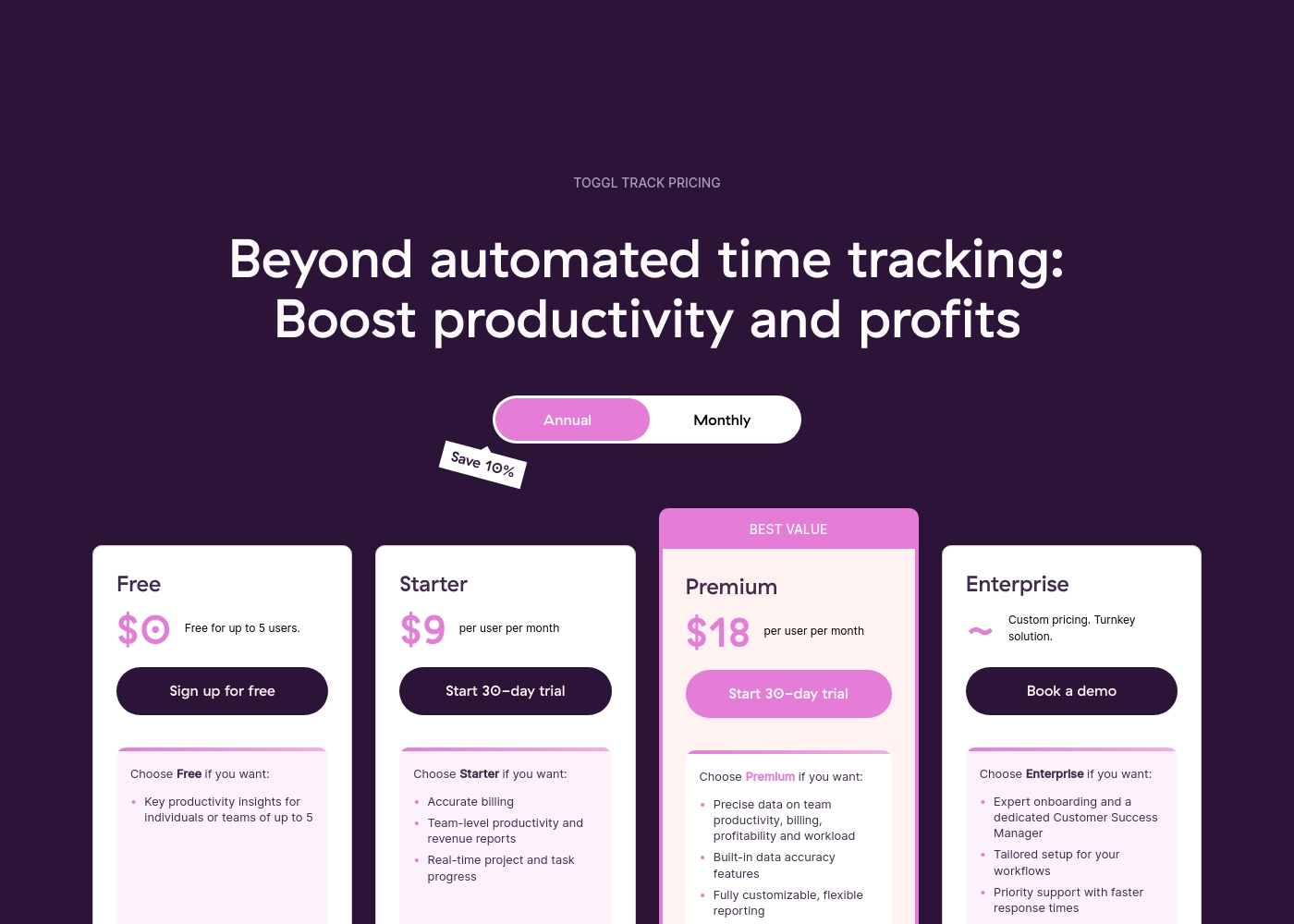
Toggl costs between $0 and Custom Pricing per month with four plans: Free at $0 (for up to 5 users), Starter at $9 per user per month, Premium at $18 per user per month, and Enterprise with custom pricing.
Let's break down what's included in each plan so you can find the perfect fit for your team. You can save 10% on paid plans by opting for annual billing.
Free
Price: $0 per month Best For: Individuals or small teams up to 5 users Other Features:
- Key productivity insights
- Time tracking on web, desktop, and mobile
- Integration with 100+ tools
- Free for up to 5 users
- Key productivity insights
- Time tracking on web, desktop, and mobile
- Productivity reports
- Calendars integrations
- Accurate billing
- Team-level productivity and revenue reports
- Real-time project and task progress
- Billable rates and project time estimates
- Team collaboration features
- Precise data on team productivity, billing, profitability and workload
- Built-in data accuracy features
- Fully customizable, flexible reporting
- Timesheet approvals and Scheduled reports
- Jira, Salesforce integrations
- Expert onboarding and a dedicated Customer Success Manager
- Tailored setup for your workflows
- Priority support with faster response times
- Custom solutions and Multiple workspaces
- Volume discounts for large teams on annual plan
Pricing Notes
- Toggl offers a generous, permanent Free plan for teams up to five users; memtime only offers a temporary free trial.
- memtime's lowest rate (€10) requires a restrictive 2-yearly commitment, saving 33% over standard pricing.
- Toggl's paid tiers ($9-$18) are generally more budget-friendly and offer a 10% discount for annual billing.
- The price for memtime's Connect plan (€15) is comparable to Toggl's Premium plan ($18) features for integrations.
Pricing Head-to-Head
User Reviews
memtime receives overwhelmingly positive feedback across review platforms, primarily highlighted by its automatic, non-intrusive operation in the background. Users consistently praise the tool for its exceptional accuracy, noting it effectively captures every minute, making manual timers obsolete.
This silent operation has been described as a "lifesaver" for consultants, accountants, and attorneys who frequently switch between client work, often resulting in significant recovery of lost billable time. Reviewers frequently mention the ease of use, the smooth onboarding process, and the value of its detailed, granular reporting.
I used to spend at least 30 minutes daily logging time against external project software. With Memtime, this now takes me less than 10 minutes, making my end-of-day tasks simple. This tool is a huge time-saver and works perfectly for consultants.
Toggl presents a highly split user experience, reflected in its current poor Trustpilot rating of 2.3. While many satisfied, long-term users praise the generous free tier, multi-platform accessibility, and simplicity for basic needs, recent feedback highlights significant reliability and support failures.
Current users report severe product deterioration, including a laggy UI, bugs, lost entries, and race conditions that mess up data 📉. The most consistent critical issue involves customer support, which users describe as non-responsive, sending generic emails, or being impossible to reach.
I’ve been using the free version daily for about a year, and it’s fantastic for simple tracking. I use it for multiple projects and clients, relying on the keyboard shortcut to toggle the timer on and off. It’s definitely easy to use.
Our Verdict
Choosing between memtime and Toggl depends entirely on your priority: internal accuracy and privacy versus team management and reporting depth. memtime is designed for professionals obsessed with guaranteed accurate billing. Toggl aims to be the centralized business intelligence engine for management. Both tools offer automation, but memtime and Toggl approach it differently. memtime’s superpower is its automatic, privacy-first time capture directly on your device. Every minute is captured passively, recovering significant billable revenue lost by manual entry. For consultants and lawyers, memtime pays for itself quickly, drastically cutting end-of-day administrative work. For ultimate data security, memtime’s local storage cannot be beaten. Toggl dominates team management, offering timesheet approvals and comprehensive, customizable reports. Toggl provides excellent cross-platform support, crucial for teams working remotely or needing mobile access. Plus, Toggl offers a very generous permanent Free plan for small teams up to five users. However, reliability is the deciding factor in this comparison. memtime is consistently highly rated (4.4 stars) and robust. Recent Toggl user reviews (2.6 stars) cite severe product instability and unreliable customer support. It is hard to trust mission-critical data to an unstable platform. Pick memtime if reliability, privacy, and maximum billable hour recovery are your top concern. Choose Toggl if you desperately need mobile access and deep, centralized financial reporting for team management, but proceed with caution regarding current product stability.
Frequently Asked Questions
Which is better for maximizing billable hours: memtime or Toggl?
memtime is explicitly designed to recover lost billable time through passive, automatic tracking. It captures activities down to the minute, guaranteeing accuracy for external invoicing. Toggl focuses more on team productivity reports and resource allocation. Choose memtime if revenue recovery is key.
Does memtime offer a permanent Free plan like Toggl?
No, memtime does not offer a permanent free tier for users. memtime provides a free trial period for the Basic and Connect paid plans. Toggl offers a permanent, generous Free plan that supports teams up to five users indefinitely.
Which tool offers better support for mobile time tracking?
Toggl is the clear winner for mobile functionality. Time tracking via Toggl is seamlessly available on web, desktop, and dedicated mobile apps. memtime is primarily a desktop application focused on local activity recording only.
Where is my activity data stored with memtime vs Toggl?
memtime stores 100% of your detailed activity data locally on your device for guaranteed privacy. Toggl stores data in the cloud, necessary for syncing and team reporting. memtime’s local storage is ideal for high-privacy needs.
Which has better user reviews and reliability: Toggl or memtime?
memtime has significantly better reviews and reliability, scoring 4.4 out of 5 stars. Toggl’s recent rating is low (2.6 stars), criticized primarily for bugs, laggy UI, and very poor customer support. memtime is the current leader in stability.
Can I set up mandatory timesheet approvals in memtime?
No, timesheet approval features are not listed as a capability in memtime. Toggl includes timesheet approval workflows starting with its Premium plan. memtime focuses on granular accuracy rather than management approval flows.
Ready to Choose?
Both tools have their strengths. Choose based on your specific needs.