Mailpoet vs Reply.io
Mailpoet and Reply.io look similar but target totally different users. Mailpoet is built directly into WordPress for content creators and e-commerce. Reply.io is a scalable AI platform for serious sales outreach teams. The key difference is Marketing integration versus pure Sales automation power.
Best for: Solo entrepreneurs or bloggers running a small WordPress site., E-commerce sites needing custom WooCommerce transactional emails.
Best for: Sales Development Representative (SDR) teams doing high-volume cold outreach., Companies requiring conditional multichannel automation (email + LinkedIn).
Reliability Issues Undercut Strong WordPress Integration
We assessed Mailpoet’s native WordPress integration, which genuinely simplifies content use and email creation right in your existing dashboard. However, the external feedback pointed to critical failures in account reliability and customer support responsiveness, particularly regarding arbitrary account suspensions and long resolution times. Overall, the reported operational inconsistency and poor support experience make it difficult for us to recommend Mailpoet for mission-critical campaigns.
Pros
- Native integration simplifies WordPress workflow and content access.
- Offers a powerful free plan for up to 500 subscribers.
- Intuitive design builder supports drag-and-drop customization.
- Automated campaigns (welcome emails, post notifications) are included.
Cons
- Frequent, arbitrary suspension of paid accounts and sending abilities.
- Customer support is often unresponsive and unavailable on weekends.
- Abandoned cart feature is limited, only working for existing subscribers.
- Onboarding process requires tedious verification and validation steps, leading to significant delays.
AI-powered multichannel outreach with industry-best support.
Reply.io is a dependable, AI-powered platform designed to supercharge sales outreach using sophisticated multichannel sequences. We found its pricing structure highly flexible, scaling from essential email volume plans starting at $49 per user up to fully automated AI SDR services. Overall, based on its robust feature set, deep deliverability tools, and industry-leading customer support, we consider Reply.io a top choice for scaling complex sales campaigns.
Pros
- Exceptionally responsive customer support (often minutes, not hours).
- Robust and reliable platform for scaling multichannel campaigns (email and LinkedIn).
- Comprehensive suite of AI tools, including advanced personalization and the Jason AI SDR agent.
- Strong deliverability focus with unlimited email warm-up and anti-spam features.
Cons
- A significant initial learning curve due to the tool's complexity and customization options.
- Users occasionally report temporary issues where features do not function logically.
- Technical problems, while rare, sometimes require extensive time and back-and-forth communication to resolve fully.
AboutMailpoet
Mailpoet is the essential email marketing plugin built specifically for WordPress 💡. It currently helps over 500,000 websites connect with their audience. Since it works right alongside your existing CMS, you use your existing media library and content instantly. This seamless integration means you can get started sending important messages in minutes, not hours. It’s designed for busy site owners who need efficiency and reliable performance.
AboutReply.io
Reply.io is a dependable AI sales platform built to help sales teams sell smarter and scale their outreach. In fact, over 3,000 businesses worldwide trust our services.
We bring together audience discovery, AI personalization, and unified communication in one place. It's truly your secret weapon for closing more deals and filling up your sales pipeline. 💡
Highlights
Feature Comparison
Features Overview
We highlight the main differences and pick a winner for each feature.
Platform Integration
Mailpoet is native to WordPress; Reply.io is a robust standalone sales platform.
Mailpoet works entirely inside your WordPress dashboard environment. You access images and content directly from your existing media library, which is highly efficient. This seamless workflow is great for busy site owners focusing exclusively on content. Reply.io is designed as a powerful, centralized sales tool. It integrates deeply with major CRMs like Salesforce and HubSpot for accurate data. Reply.io is built to optimize your entire sales pipeline, not just your CMS. If deep WordPress connectivity is your absolute priority, Mailpoet is the better choice. Reply.io wins on connecting to your existing sales tech stack. The integration decision depends entirely on your core business focus and workflow. Reply.io helps sales teams avoid switching tools. Mailpoet lets content creators stay fully immersed in the WordPress ecosystem.
Focus & Audience
Mailpoet nurtures existing subscribers; Reply.io is dedicated to new B2B sales outreach.
Mailpoet is designed for bloggers, site owners, and e-commerce stores. Its goal is automated marketing engagement like welcome emails and post notifications. This helps you build loyalty among your current list members. Reply.io is built for SDRs, sales teams, and agencies focused on pipeline growth. It handles sophisticated cold outreach sequences and lead generation. Reply.io is designed to automate the process of contacting unknown prospects. Mailpoet helps grow engagement with your current audience. Reply.io helps you find and convert potential customers you don't know yet. Mailpoet is purely inbound/marketing focused; Reply.io is purely outbound/sales focused. If your revenue comes from new leads found via outreach, Reply.io is the essential fit.
Automation Complexity
Reply.io handles adaptive multichannel sequences; Mailpoet focuses on simple email triggers.
Mailpoet offers basic, straightforward automation features like welcome emails. It can also automatically notify subscribers when you publish a new blog post. These features are effective but very simple. Reply.io excels at dynamic, multichannel sequences that adapt instantly. Sequences include steps for email, LinkedIn, SMS, and Zapier actions, based on prospect behavior. This complexity allows for highly customized outreach campaigns. Mailpoet is simple "if X, then email" marketing. Reply.io provides sophisticated outreach based on complex sales logic. Scaling your sales pipeline requires the structured logic of Reply.io. For example, Reply.io users can pause an email sequence if a prospect accepts a LinkedIn request.
Customer Support
Reply.io offers outstanding, responsive support; Mailpoet users report frequent support failures.
Paid Mailpoet users get priority email support for technical issues. However, reviews frequently cite unresponsiveness and slow or non-existent resolution times. Mailpoet's support is users' largest frustration point. Reply.io aims for a response time of under 15 minutes via in-app chat during operating hours. Users consistently praise the Reply.io support team as responsive, reliable, and truly exceptional. This is a critical difference for mission-critical operations. Reply.io's prompt support ensures campaigns rarely stall. Mailpoet's support risk is a major deciding factor. If you cannot afford hours or days of campaign downtime, prioritize Reply.io and its proven reliability.
Data & Prospecting
Reply.io includes built-in lead discovery tools; Mailpoet only manages imported subscribers.
Mailpoet requires you to generate leads through your WordPress site or other integrations. It focuses on list hygiene and managing subscribers you already possess. It is not a tool for finding new prospects. Reply.io provides access to over 1 billion B2B global contacts via its Audience Discovery feature. Paid plans receive monthly Live Data credits for real-time contact updates. This powers aggressive pipeline filling. Reply.io is designed as a 'hunter's' tool to actively source fresh, actionable data. Mailpoet is a 'farmer's' tool, built entirely for nurturing an established list. Sales teams save substantial time using Reply.io’s built-in prospect search instead of separate tools.
Pricing Model
Mailpoet is budget-friendly, based on subscribers; Reply.io is expensive, based on users and volume.
Mailpoet provides a powerful Free Plan for up to 500 subscribers indefinitely. Paid plans start at just $10 per month and scale reliably based on list size. This model is exceptionally affordable for high email volume. Reply.io requires a per-user seat cost, starting at $49/user/month for the base plan. The price then scales based on the monthly volume of 'active contacts' you reach, making it a significant expense. Mailpoet offers better value for money if simplicity and cost are your biggest concerns. Reply.io is a specialized tool with a required investment margin. If you are a solo entrepreneur, Mailpoet's Free Plan lets you start outreach without financial commitment.
Deliverability Tools
Reply.io gives users proactive warm-up tools; Mailpoet relies on general infrastructure promises.
Mailpoet assures users of high deliverability using a 'rock-solid infrastructure' that sends millions of emails monthly. They do not offer detailed user-facing tools to manage email health. Reply.io provides over 30 specialized features for inbox placement. This includes unlimited email warms-up, an anti-spam suite, and an Email Health Checker. Users actively control their email reputation. Reply.io is strictly designed to guarantee messages land in the primary inbox. Mailpoet relies on generalized service performance. For high-stakes cold outreach, Reply.io’s specific warm-up and anti-spam controls are invaluable necessities.
Agency Support
Both offer agency solutions, but Mailpoet focuses on sites while Reply.io focuses on clients.
Mailpoet's Agency Plan supports managing the plugin across 50 separate WordPress websites. Pricing is adjusted per Mailpoet instance based on subscriber count. This is ideal for managing hosting/site maintenance. Reply.io's Agency Starter plan allows for unlimited clients and unlimited users under a centralized dashboard. This is designed for high-volume sales outreach management for multiple clients. Mailpoet is site-centric. Reply.io is client-centric, designed for scaling complex campaign management efficiently. Mailpoet is better for managing many small WordPress site installations consistently. Agencies focused on B2B lead generation should prefer the flexibility of Reply.io's unlimited client model.
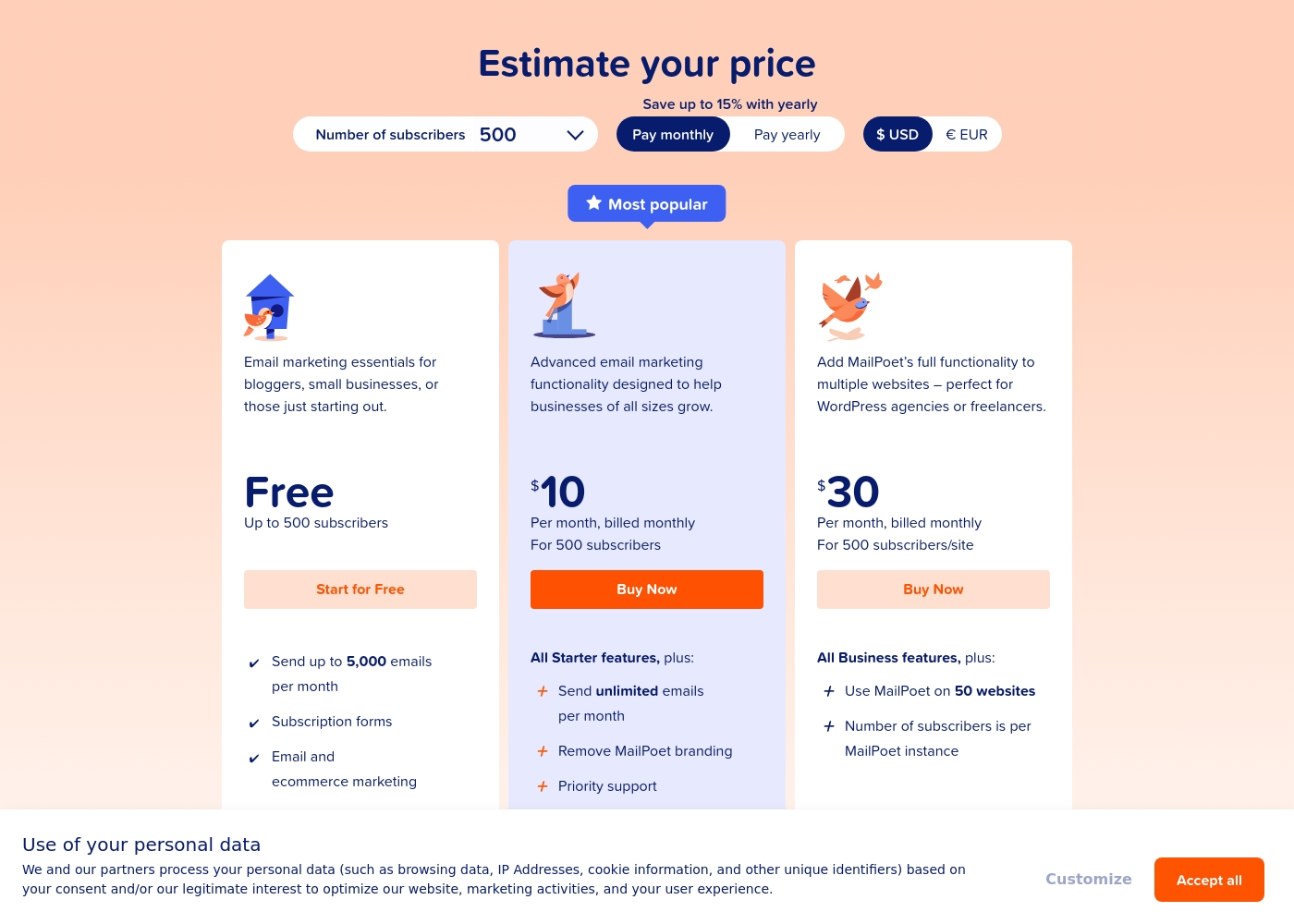
Mailpoet costs between Free and $30 per month for 500 subscribers, with three accessible plans: the Free Plan at $0, the Advanced Marketing Plan at $10/month, and the Multi-Site Agency Plan at $30/month.
Here’s a closer look at what you get with each option, based on the starting tier of 500 subscribers.
Free Plan
Price: Free Best For: Bloggers, small businesses, or those just starting out. Other Features:
- Send up to 5,000 emails per month
- Includes subscription forms
- Provides email and ecommerce marketing tools
- Send up to 5,000 emails per month
- Subscription forms
- Email and ecommerce marketing
- Send unlimited emails per month
- Remove MailPoet branding
- Priority support
- Use MailPoet on 50 websites
- Subscriber count is adjusted per MailPoet instance
Reply.io costs between $49/user/month and $3000/month across four main entry points: Email Volume starting at $49/user/month, Multichannel starting at $89/user/month, AI SDR starting at $500/month, and Agency Starter beginning at $166/month.
The following section details the primary pricing tiers available. Remember, selecting annual billing often provides savings up to 17% or more compared to monthly rates.
Email Volume
Price: Starts at $49 per user/month (Billed annually) Best For: High-volume outreach focused purely on email. Other Features:
- Unlimited mailboxes and email warm-up.
- Unlimited emails sent to active contacts.
- 50 Live data credits each month.
- Anti-spam and deliverability suite included.
- Unlimited mailboxes
- Unlimited email warmup
- Unlimited emails
- Anti-spam & deliverability suite
- Email Automation (10 mailboxes)
- LinkedIn Automation (Paid subscription required)
- Calls & SMS Automation (Paid subscription required)
- Unlimited active contacts and email warmup
- Hire Jason AI (Fully Automated Solution)
- AI personalization & generated responses
- Multichannel automation
- Unlimited mailboxes & warm-ups
- Unlimited clients and users
- Unlimited email warm-up
- Centralized inbox
- Dedicated support and custom roles/permissions

Pricing Notes
- Mailpoet's pricing is primarily based on the number of subscribers and is highly affordable for small businesses or bloggers.
- Reply.io uses a hybrid user seat ($49/month minimum) plus an 'active contact' volume model, making it much costlier to scale for large teams.
- Mailpoet offers a robust Free Plan supporting up to 500 subscribers indefinitely, which Reply.io does not offer.
- Reply.io’s AI SDR plans start at $500/month, reflecting a significant investment in autonomous sales automation.
Pricing Head-to-Head
User Reviews
The external reviews for Mailpoet reveal a stark and polarized user experience, heavily weighted toward frustration. While a few long-term users praise the affordability and ease of use for basic email creation and claim reliable deliverability, the overwhelming majority report severe technical and customer support issues. Reviewers frequently mention paid accounts being arbitrarily suspended or blocked, sometimes related to high bounce rates or fraud handling, leading to lost campaigns and high friction regardless of the subscription tier.
Crucially, complaints about support are recurrent. Users report waits of several days, receiving vague, ‘AI generated’ answers, or finding that dedicated support is unavailable on weekends ⚠️. Others note painful onboarding (delayed subscription validation) and limitations in core features, such as abandoned cart emails only targeting existing subscribers, rendering the tool useless for lead capture. Reliability and customer service responsiveness are the chief concerns consistently raised across these platforms. Ultimately, many users feel the systemic blockages entirely negate the convenience of WordPress integration.
I love using MailPoet for myself and my local business clients. It makes creating and managing emails across several client websites very easy. It is affordable and the emails always land where they are supposed to.
Reply.io users consistently report a positive experience, highlighting outstanding customer support as a major strength. Reviewers frequently note that the support team is incredibly responsive, often providing immediate help via chat and resolving complex issues quickly—sometimes within minutes.
This strong support helps users navigate the platform’s powerful features. Functionally, users praise Reply.io’s reliability and robust capabilities for scaling outreach.
Reply.io’s support team is truly exceptional. The human interaction I have with them is better than any other software I currently use for my job. The chat assistant also provides great intake support.
Our Verdict
Choosing between Mailpoet and Reply.io is really choosing your core business goal. They are built for two different worlds: marketing list management versus sales pipeline generation. Mailpoet exists seamlessly inside WordPress; Reply.io is a powerful, standalone sales tool. You must decide if you are a Content Creator or a Hunter. Mailpoet’s superpower is making email marketing simple and affordable for WordPress users. Send unlimited emails monthly starting at only $10. If you cherish the native WordPress workflow, Mailpoet eliminates extra steps and file uploads. However, be aware Mailpoet reviews flag serious issues with support reliability and account suspensions. Reply.io's superpower is automating complex, multichannel B2B sales engagement. It offers advanced AI to craft highly personalized emails and even includes a massive contact database. Plus, Reply.io guarantees deliverability with unlimited warm-up tools. Most importantly, Reply.io offers fast, reliable support, often replying in under 15 minutes. The deciding factor is complexity and reliability versus cost and simplicity. Choose Mailpoet if you focus on keeping costs low and managing a basic list inside WordPress. If converting new revenue via hyper-personalized, sophisticated sequences is your goal, Reply.io is the necessary investment. Pick Mailpoet if your list is small and lives in WooCommerce. Choose Reply.io if your sales team uses HubSpot, needs B2B prospecting data, and demands reliable, enterprise-grade support.
Frequently Asked Questions
Which is better for small teams: Mailpoet or Reply.io?
Mailpoet is better for small marketing teams or solo operators focusing on content. The Free Plan supports 500 subscribers indefinitely. Reply.io is better for small dedicated sales teams requiring AI-powered outreach. However, Reply.io starts at $49 per user per month.
Does Mailpoet have advanced CRM integration like Reply.io?
Mailpoet is primarily integrated with WordPress and WooCommerce functionality. Reply.io offers deep, native integration with CRMs like Salesforce, HubSpot, and Pipedrive. Reply.io is superior for integrating into a modern sales tech stack.
How do Mailpoet and Reply.io compare on providing customer support?
Reply.io is heavily praised for its quick support, targeting under 15-minute response times via chat. Mailpoet receives frequent negative reviews regarding unresponsiveness and arbitrary account suspension issues. Reply.io wins this category easily.
Can I use Reply.io for regular marketing newsletters, or is it only for sales?
Reply.io is specifically designed and priced for high-impact sales engagement and outreach. While you could technically use it for basic newsletters, Mailpoet is far cheaper and easier for pure marketing list management.
Which tool provides better deliverability assurance?
Reply.io provides specific, user-controlled tools like unlimited email warm-up and an anti-spam suite. Mailpoet promises reliable infrastructure but does not offer these detailed controls. Reply.io offers superior transparency and control.
Is Reply.io worth the significantly higher cost over Mailpoet?
Yes, if you derive revenue from outbound B2B sales and require multichannel automation. Mailpoet is designed for low-cost list management. Reply.io provides ROI through complex automation and lead discovery.
Ready to Choose?
Both tools have their strengths. Choose based on your specific needs.