Mailchimp vs Square Marketing
Mailchimp and Square Marketing both offer robust email campaigns, but they have fundamentally different goals. Mailchimp is a feature powerhouse built for advanced marketing and AI content creation. Square Marketing focuses on seamless integration with the Square ecosystem for immediate sales attribution.
Best for: Marketing agencies needing complex segmentation and detailed reporting, Businesses requiring integration with 300+ external systems (e.g., Shopify, Canva)
Best for: Small shops and local businesses already running Square Point of Sale (POS), Owners who need marketing linked directly to attributed sales and coupon redemption
Industry-Leading Features, Unstable Support Network
We find Mailchimp offers an industry-leading suite of email marketing features, backed by strong automation and valuable AI tools for content optimization. Overall, the platform is an excellent choice for businesses needing robust design and testing capabilities, provided they anticipate potential friction with customer service and complex billing structures.
Pros
- Intuitive UI and drag-and-drop builder simplify campaign design.
- Powerful automation features help save significant time for marketers.
- Valuable reporting tools offer insights and industry benchmarking.
- Generative AI features help improve content, including subject lines.
Cons
- Customer support is frequently cited as nonexistent, unhelpful, or slow to respond.
- Billing practices are reported as predatory, with unexpected charges for slight overages.
- Users often face technical access issues, especially with two-factor authentication.
- The interface is sometimes described as clunky or difficult to navigate.
Integrated Marketing Built for Square Users.
We find that Square Marketing provides exceptional value through its deep integration with the Square ecosystem. Its user-friendly design simplifies automated email and text campaigns effectively. Overall, we believe this is the best marketing solution available for current Square users who prioritize seamless connectivity and actionable sales data.
Pros
- Excellent integration with Square POS and Customer Directory.
- Highly user-friendly and supports easy campaign setup and tracking.
- Automated campaigns available for emails, texts, and Google review collection.
- Reliable platform performance and consistent payment processing.
Cons
- General Square processing fees are frequently viewed as high by some users.
- Interface navigation can sometimes be challenging for complex features.
- Support responsiveness varies, especially for deep technical or billing inquiries.
- Initial merchant account verification process may take several days.
AboutMailchimp
Mailchimp is recognized as the leading platform focused on email marketing and advanced automations. It's built to help businesses boost income by mastering digital outreach. With over 11 million global users and 22 years of experience, it’s a trusted choice for selling more.
This robust platform is ideal for businesses seeking seamless conversion tools, including integrated SMS campaigns. You can start sending your first email risk-free, and you don't even need a credit card to begin. Users on Standard or Premium plans may access a personalized product tour to start confidently. 💡
AboutSquare Marketing
Square Marketing is an integrated solution designed to help you connect directly with your customers. You can easily expand your business using personalized email and text campaigns. These campaigns can be sent once or set up as recurring automations. Square Marketing helps you promote new products, announce events, or share last-minute deals. It drives traffic directly to your online or physical stores. ✅
This system also works well with the free Square Customer Directory. This built-in CRM tool is integrated with your Square Point of Sale. It gives you a complete view of your customers, including their purchasing habits. This integration allows you to sync sales data and track sales attribution across all your channels and store locations.
Highlights
Feature Comparison
Features Overview
We highlight the main differences and pick a winner for each feature.
Ecosystem Integration
Square Marketing offers unrivaled native POS integration. Mailchimp requires extensive third-party connectors for similar functionality.
Mailchimp connects with over 300 platforms like Shopify and Google Analytics for sales data syncing. This offers massive flexibility across various business tools. Mailchimp requires setup effort to unify sales and marketing data sources. Square Marketing is natively built into the Square POS and Customer Directory ecosystems. You get a seamless, 360-degree customer view right away, requiring zero setup time. Thus, Square Marketing is perfect if your entire business already runs through Square operations. Mailchimp is better if your tech stack is specialized and varied.
Pricing & Email Limits
Mailchimp limits sends and charges overages; Square Marketing offers unlimited email sends. Square Marketing's pricing is more transparent for volume.
Mailchimp’s paid plans limit monthly email sends to 10X to 15X your contact count. Users report frequent automatic charges when they exceed contact limits, making costs unpredictable. Square Marketing charges a fixed monthly fee determined only by your contact tier, starting at $15 for 500 contacts. All paid tiers include unlimited email sends. Mailchimp provides a permanent, robust Free plan for up to 500 contacts. Square Marketing only offers a 30-day Free Trial of its paid services. Choosing Square Marketing simplifies budgeting if you plan to send emails frequently to fixed contact tiers.
Advanced Content Tools
Mailchimp uses generative AI and custom code; Square Marketing relies on simplicity and prebuilt templates.
Mailchimp Standard and Premium users access powerful generative AI tools to create on-brand content faster. Mailchimp also supports custom-coded email templates for highly unique designs. Square Marketing focuses on simple prebuilt templates and speed of deployment for busy small business owners. It lacks advanced design customization or AI writing assistance. If cutting-edge design flexibility and content generation are essential, Mailchimp is the stronger choice. Square Marketing prioritizes functional communication ready to deploy instantly.
Sales Attribution
Square Marketing tracks attributed sales natively; Mailchimp requires syncing external e-commerce data. Square's data is immediate.
Square Marketing tracks attributed sales and coupon redemptions directly in the Square Dashboard. This native integration ensures accurate, real-time data across all sales channels. Mailchimp relies on syncing sales data from integrations like Shopify and connecting it to reporting funnels. This process works but lacks the seamless integration of Square. For owners measuring marketing ROI against POS transactions, Square Marketing provides unequaled, singular source data. This is a critical advantage for physical retailers.
Customer Support
Square Marketing users report quick, helpful service; Mailchimp users frequently cite frustration and poor support reliability.
Mailchimp offers dedicated phone and priority support only with its highest Premium plan. However, general user reviews widely complain about slow or unhelpful support responses across lower paid tiers. Square Marketing customers (via Square) often praise the support team for being kind, professional, and fast with simple inquiries. Consistency is key for small businesses. Even though Mailchimp offers structured enterprise support, Square Marketing wins on overall positive user sentiment for general assistance.
Automated Reviews
Square Marketing automatically prompts customers for Google Reviews. Mailchimp does not include this crucial reputation feature natively.
Square Marketing includes automated campaigns specifically designed to solicit Google Reviews after a transaction is complete. This feature is free and critical for online reputation management. Mailchimp focuses on standard email marketing and lead generation forms. It does not possess a native workflow for collecting public reviews. For local businesses dependent on positive online trust signals, Square Marketing provides indispensable automated assistance. Mailchimp requires a separate, additional tool.
SMS Text Marketing
Square Marketing offers SMS as a separate, transparent subscription; Mailchimp treats SMS as a cumbersome add-on. Square sends texts for a clear base fee.
Square Marketing charges a $10 base fee plus usage for Text Message Marketing (e.g., $20 for 250 texts). This model is clear and allows flexible text volume control. Texts receive a very high 98% open rate, driving instant action. Mailchimp requires users to apply for approval and then purchase separate, recurring monthly SMS credits. Unused Mailchimp SMS credits do not roll over. Square Marketing’s text solution is simpler to subscribe to and integrate into campaign planning. Mailchimp’s SMS approach is generally more restrictive.
Scalability & Enterprise
Mailchimp supports far larger contact lists and offers enterprise features. Square Marketing focuses on small to growing mid-sized businesses. Mailchimp is designed for global scale.
Mailchimp handles unlimited contacts on its Premium plan and offers custom tiers for 250,000+ contacts. Premium tiers include role-based access and extensive priority support sessions. Square Marketing also handles high volume, but its structure is simpler and tied to the POS system operational scale. It lacks the enterprise features like specific role-based access. If you are a marketing agency or expect massive subscriber growth, Mailchimp provides a more structured scaling path. Square Marketing is best for operational scaling tied to sales volume.
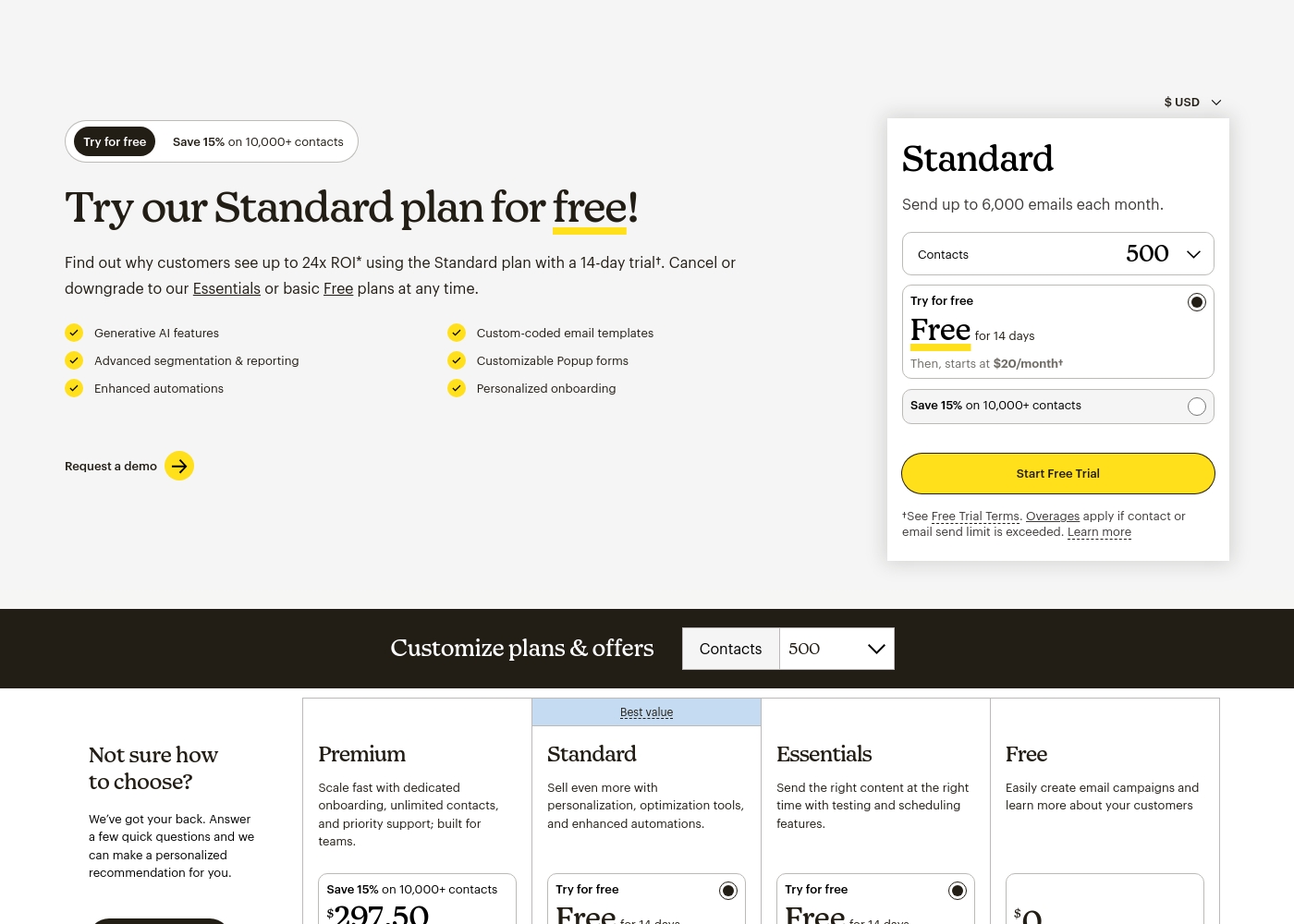
Mailchimp costs between $0 and $350 per month with four main plans: Free at $0, Essentials starting at $13/month, Standard starting at $20/month, and Premium requiring contact with sales for high volume quotes.
Here are the details about what each plan offers. Please note that prices shown here are typically for the minimum 500 contacts tier, or where noted, discounted rates for higher contact tiers.
Free
Price: $0/month Best For: Easily creating email campaigns and learning about your customers. Other Features:
- 1,000 emails per month maximum (500/day limit)
- 1 Seat (User)
- 1 Audience
- Email support for the first 30 days
- Easily create email campaigns
- Learn more about your customers
- Email support for first 30 days
- Send the right content at the right time
- Testing and scheduling features
- 24/7 Email & Chat Support
- Up to 3 users
- Sell even more with personalization
- Optimization tools
- Enhanced automations
- Generative AI features
- Custom-coded email templates
- Scale fast with dedicated onboarding
- Unlimited contacts
- Priority support; built for teams
- Generative AI Features
- Role-based Access (5 Roles)
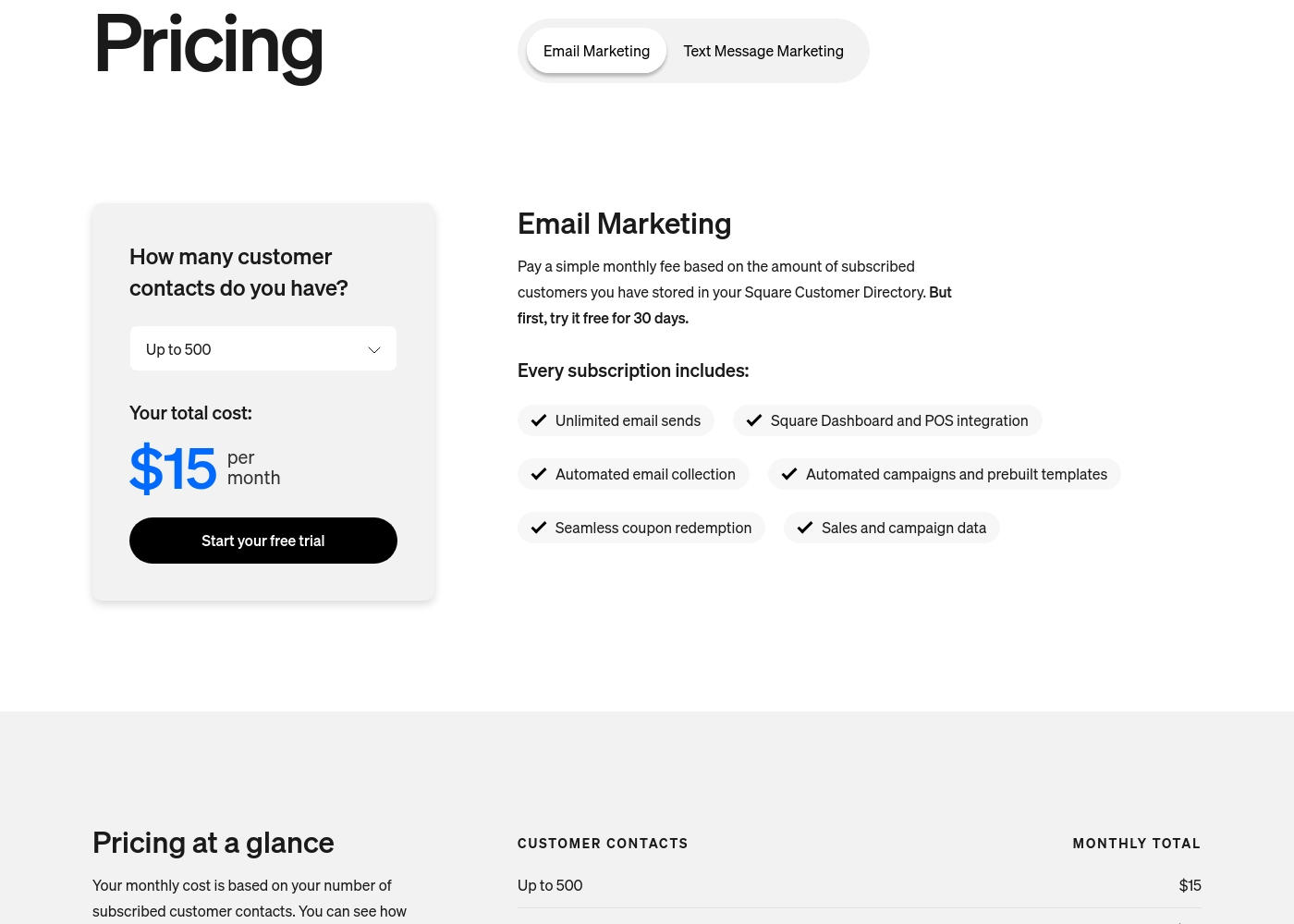
Square Marketing costs between $10 and $3,760 per month, depending on usage tiers for two distinct products: Email Marketing (based on contacts) and Text Message Marketing ($10 base plus usage fees).
The pricing below is structured around the entry points for the two main services offered, detailing the features included with any subscription.
Square Email Marketing (Up to 500 Contacts)
Price: $15 per month Best For: Small businesses just starting email outreach, or those with highly focused, small customer bases. Other Features:
- Unlimited email sends
- Square Dashboard and POS integration
- Automated email collection
- Automated campaigns and prebuilt templates
- Seamless coupon redemption
- Sales and campaign data
- Unlimited email sends
- Square Dashboard and POS integration
- Automated email collection
- Automated campaigns and prebuilt templates
- Seamless coupon redemption
- Square Dashboard and POS integration
- Complimentary toll-free phone number
- Automated campaigns
- Seamless coupon redemption
- Sales and campaign data
Pricing Notes
- Mailchimp offers a permanent, functional Free plan for up to 500 contacts, perfect for starting out.
- Square Marketing offers a longer 30-day free trial for both its Email and Text Marketing services.
- Mailchimp charges dual fees based on contacts AND monthly email send volume limits, leading to complex billing.
- Square Email Marketing provides unlimited email sends across all contact tiers, offering predictable pricing.
- Be aware of Mailchimp's frequent customer complaints regarding unexpected overage charges for slight contact list growth.
- Square Text Marketing has a mandatory $10 monthly base fee, even if no texts are sent that month.
Pricing Head-to-Head
User Reviews
Mailchimp receives polarized external feedback, highlighting a split between excellent product features and frustrating support experiences. Users consistently praise the platform's intuitive interface and ease of use, confirming that the drag-and-drop builder and extensive automation features are significant time savers for growing businesses.
Reviewers often appreciate the quality of available templates and the platform's robust integrations with CRM and website systems. However, a major concern revolving around customer support is widely reported.
The UI is easy to navigate, and the drag-and-drop email building feature is extremely well designed and simple to use. We use Mailchimp for all our prospective and current customer campaigns. It saves us a lot of time in production.
Users widely praise the reliability and straightforward design of the Square platform. They frequently highlight its effectiveness for small businesses, citing the ease of setup and operational simplicity.
The deep integration with Square POS and the ability to track sales attributes stand out as major operational benefits. Many users also compliment the customer support team, describing interactions as quick and kind, especially for simple inquiries.
I love the user friendly software for many reasons. Scheduling, payment, and customer communication are handled smoothly. It feels like Square designed this platform specifically with small business owners in mind.
Our Verdict
Choosing between Mailchimp and Square Marketing determines whether you prioritize feature depth or operational integration. If you already use Square POS, Square Marketing is the winner for speed and clear ROI. Square Marketing is simpler for most small business owners. Mailchimp’s superpower is its powerful marketing focus, offering generative AI tools and compatibility with over 300 integrations. Mailchimp provides advanced features like industry benchmarking and roles for large teams. It’s built for the specialized, high-volume marketer needing optimization. Square Marketing’s great strength is its native, seamless connection to your sales data and Customer Directory. It automatically tracks attributed sales and coupon redemptions flawlessly. Square Marketing also includes automated Google Review collection, a huge win for local businesses. The deciding factor is your transaction infrastructure: Do you use Square to run your sales? If yes, Square Marketing ties marketing directly to revenue better than any general email client. If you need maximum customization, deep analytics, and AI content, then Mailchimp is the one. Choose Square Marketing for seamless operational efficiency tied to your POS. Choose Mailchimp if you are a dedicated marketer planning complex campaigns and needing diverse integration options.
Frequently Asked Questions
Which is better for e-commerce: Mailchimp or Square Marketing?
Mailchimp integrates data from over 300 platforms, essential for diverse e-commerce needs like Shopify. Square Marketing integrates instantly with Square Online and Square POS data. Choose Mailchimp for wide integration flexibility. Choose Square Marketing for deep, native Point of Sale data attribution.
Does Mailchimp offer unlimited email sends like Square Marketing?
No, Mailchimp limits monthly sends to 10X to 15X your contact count on paid plans. Square Marketing provides unlimited email sends based on your contact tier price. High-volume email senders may find Square Marketing more cost-effective.
Can Square Marketing help me collect Google Reviews automatically?
Yes, Square Marketing includes automated campaigns to prompt customers for Google Reviews after a sale. Mailchimp does not offer this native reputation management function. This gives Square Marketing a key advantage for building online trust.
Is customer support better at Mailchimp or Square Marketing?
Square Marketing users widely report quick, positive interactions with support. Mailchimp users often cite extremely slow responses and frustrations with billing issues. For reliable everyday support, Square Marketing has better user sentiment.
Which platform has a better Free option?
Mailchimp offers a permanent Free plan for up to 500 contacts, which is ideal for new businesses. Square Marketing only provides a 30-day free trial for its paid services. For budget users, Mailchimp is the clear starting choice.
Does Mailchimp have better advanced automation tools than Square Marketing?
Yes, Mailchimp provides enhanced automations and generative AI features for high-level content creation. Square Marketing offers simple recurring automations like birthday messaging and lapsed customer targeting. Mailchimp is better for sophisticated, personalized campaigns.
Ready to Choose?
Both tools have their strengths. Choose based on your specific needs.