Mailchimp vs Reply.io
Mailchimp and Reply.io are two very different tools for communicating with your audience. Mailchimp dominates traditional broadcast email marketing for massive lists. Reply.io is the AI platform built specifically for targeted, automated B2B sales outreach. Choose your winner based on your goal: marketing or sales.
Best for: E-commerce businesses syncing sales data from Shopify and QuickBooks, Marketing teams focused on email newsletters and content velocity
Best for: SDR and B2B sales teams automating advanced, personalized sequences, Companies prioritizing high lead volume via B2B data access (1 Billion+ contacts)
Industry-Leading Features, Unstable Support Network
We find Mailchimp offers an industry-leading suite of email marketing features, backed by strong automation and valuable AI tools for content optimization. Overall, the platform is an excellent choice for businesses needing robust design and testing capabilities, provided they anticipate potential friction with customer service and complex billing structures.
Pros
- Intuitive UI and drag-and-drop builder simplify campaign design.
- Powerful automation features help save significant time for marketers.
- Valuable reporting tools offer insights and industry benchmarking.
- Generative AI features help improve content, including subject lines.
Cons
- Customer support is frequently cited as nonexistent, unhelpful, or slow to respond.
- Billing practices are reported as predatory, with unexpected charges for slight overages.
- Users often face technical access issues, especially with two-factor authentication.
- The interface is sometimes described as clunky or difficult to navigate.
AI-powered multichannel outreach with industry-best support.
Reply.io is a dependable, AI-powered platform designed to supercharge sales outreach using sophisticated multichannel sequences. We found its pricing structure highly flexible, scaling from essential email volume plans starting at $49 per user up to fully automated AI SDR services. Overall, based on its robust feature set, deep deliverability tools, and industry-leading customer support, we consider Reply.io a top choice for scaling complex sales campaigns.
Pros
- Exceptionally responsive customer support (often minutes, not hours).
- Robust and reliable platform for scaling multichannel campaigns (email and LinkedIn).
- Comprehensive suite of AI tools, including advanced personalization and the Jason AI SDR agent.
- Strong deliverability focus with unlimited email warm-up and anti-spam features.
Cons
- A significant initial learning curve due to the tool's complexity and customization options.
- Users occasionally report temporary issues where features do not function logically.
- Technical problems, while rare, sometimes require extensive time and back-and-forth communication to resolve fully.
AboutMailchimp
Mailchimp is recognized as the leading platform focused on email marketing and advanced automations. It's built to help businesses boost income by mastering digital outreach. With over 11 million global users and 22 years of experience, it’s a trusted choice for selling more.
This robust platform is ideal for businesses seeking seamless conversion tools, including integrated SMS campaigns. You can start sending your first email risk-free, and you don't even need a credit card to begin. Users on Standard or Premium plans may access a personalized product tour to start confidently. 💡
AboutReply.io
Reply.io is a dependable AI sales platform built to help sales teams sell smarter and scale their outreach. In fact, over 3,000 businesses worldwide trust our services.
We bring together audience discovery, AI personalization, and unified communication in one place. It's truly your secret weapon for closing more deals and filling up your sales pipeline. 💡
Highlights
Feature Comparison
Features Overview
We highlight the main differences and pick a winner for each feature.
Core Purpose
Mailchimp masters one-to-many broadcast marketing; Reply.io excels at one-to-one sales sequences.
Mailchimp is the leading platform for email lists and newsletters. It focuses on turning email campaigns and SMS (add-on) into revenue. This tool is ideal for communicating with large, existing customer audiences. Reply.io is purpose-built for sales teams and targeted lead generation. It uses personalized, automated sequences to book meetings with specific B2B prospects. Its focus is strictly outbound sales efficiency and growth. This is the key difference: Mailchimp for marketing broadcasting, Reply.io for sales conversations. Deciding between them depends on where your business function lies. If you run an e-commerce site focused on customer retention, Mailchimp is the better fit.
AI Capabilities
Mailchimp uses AI for content creation; Reply.io uses AI for personalization and autonomous sales automation.
Mailchimp’s Generative AI features help marketers write compelling copy fast. AI assists with subject lines and on-brand content for mass emails. Users have already sent billions of AI-assisted messages using Mailchimp. Reply.io leverages AI Variables to craft unique, hyper-personalized outreach emails instantly. It also offers the game-changing Jason AI SDR Agent for fully autonomous 24/7 operations. Reply.io's AI can handle responses and automate meeting booking. Mailchimp helps you write better; Reply.io helps you sell automatically. Reply.io's autonomous agent capability provides a unique, high-value sales function. Ask if you need AI copywriting or AI sales delegation; this determines your winner immediately.
Outreach Channels
Reply.io allows true multichannel steps, including LinkedIn; Mailchimp is primarily email and SMS.
Mailchimp’s strength is sophisticated email marketing design and delivery. SMS is available, but only as a paid add-on and in select regions worldwide. The sequences are linear and focused on marketing flows. Reply.io lets you build conditional sequences that dynamically link email with other channels. It seamlessly integrates LinkedIn, calls, and SMS steps into one unified outreach flow. LinkedIn Automation is crucial for B2B sales teams. Mailchimp stays mostly in the inbox. Reply.io follows the prospect wherever they are, maximizing contact opportunity. This comprehensive sales approach gives Reply.io the clear edge for modern outreach. If your sales cycle relies heavily on LinkedIn touchpoints, Reply.io is the essential tool.
Email Deliverability
Reply.io guarantees inbox placement with dedicated warm-up tools; Mailchimp is less proactive about deliverability.
Mailchimp's deliverability is based mainly on its large platform reputation. User reports sometimes cite issues with emails flagging as spam or reaching promotions tabs. Technical features like warm-up are not highlighted in Mailchimp’s offerings. Reply.io includes unlimited email warm-ups and unlimited mailboxes across all core plans. Its suite contains 30+ features dedicated to email health and anti-spam protocols. This focus ensures sales outreach lands in the primary inbox. Outbound sales success depends entirely on reaching the inbox, making Reply.io safer. Mailchimp users sometimes struggle with deliverability when sending cold emails. Trust Reply.io to manage the technical aspects of sending highly personalized, high-volume outbound emails.
Prospecting Data
Reply.io includes access to 1 billion B2B contacts; Mailchimp requires users to supply their own leads.
Mailchimp’s lead generation involves using forms and integrating with social platforms. You must actively gather and import all contact data yourself. It is not designed to help find new cold B2B audiences. Reply.io provides powerful Audience Discovery tools built directly into the platform. Users gain access to a database containing over 1 billion global B2B contacts. Core plans include 50 Live Data credits monthly. This is a critical functional divergence between the platforms. Reply.io helps you find prospects; Mailchimp helps you communicate with them. If growing your prospect list is your number one challenge, Reply.io provides an invaluable, ready-made asset.
Integration Ecosystem
Mailchimp offers superior breadth with 300+ integrations; Reply.io focuses on deep CRM connectivity.
Mailchimp boasts an enormous library of over 300 reliable integrations. This comprehensive ecosystem supports crucial e-commerce platforms like Shopify and analytics tools. This strong breadth helps sync massive amounts of data. Reply.io integrates deeply with major sales tools: Salesforce, HubSpot, and Pipedrive are natively supported. Reply.io also offers Zapier steps to integrate almost any channel into its sequences. Its focus is smooth sales workflow. Mailchimp wins on integration quantity and general business data sync. Reply.io wins on sales workflow quality and deep CRM alignment. For large e-commerce operations needing holistic data sync, Mailchimp is the obvious choice.
Customer Support
Reply.io delivers exceptional, rapid chat support; Mailchimp support is frequently cited as slow and unhelpful.
Mailchimp provides 24/7 Email and Chat support starting with the Essentials plan. However, user reviews heavily criticize the support team as often being slow and ineffective. Premium users get phone support. Reply.io users consistently rate their external support experience as outstanding. Reply.io aims for a response time under 15 minutes via in-app chat during operating hours. CSM onboarding is also provided for annual plans. The stark contrast in user reviews highlights the support gap. Reply.io prioritizes user happiness through responsiveness. Mailchimp struggles with high volume support demand. If timely resolution of technical issues is critical to your team, Reply.io is the safer bet.
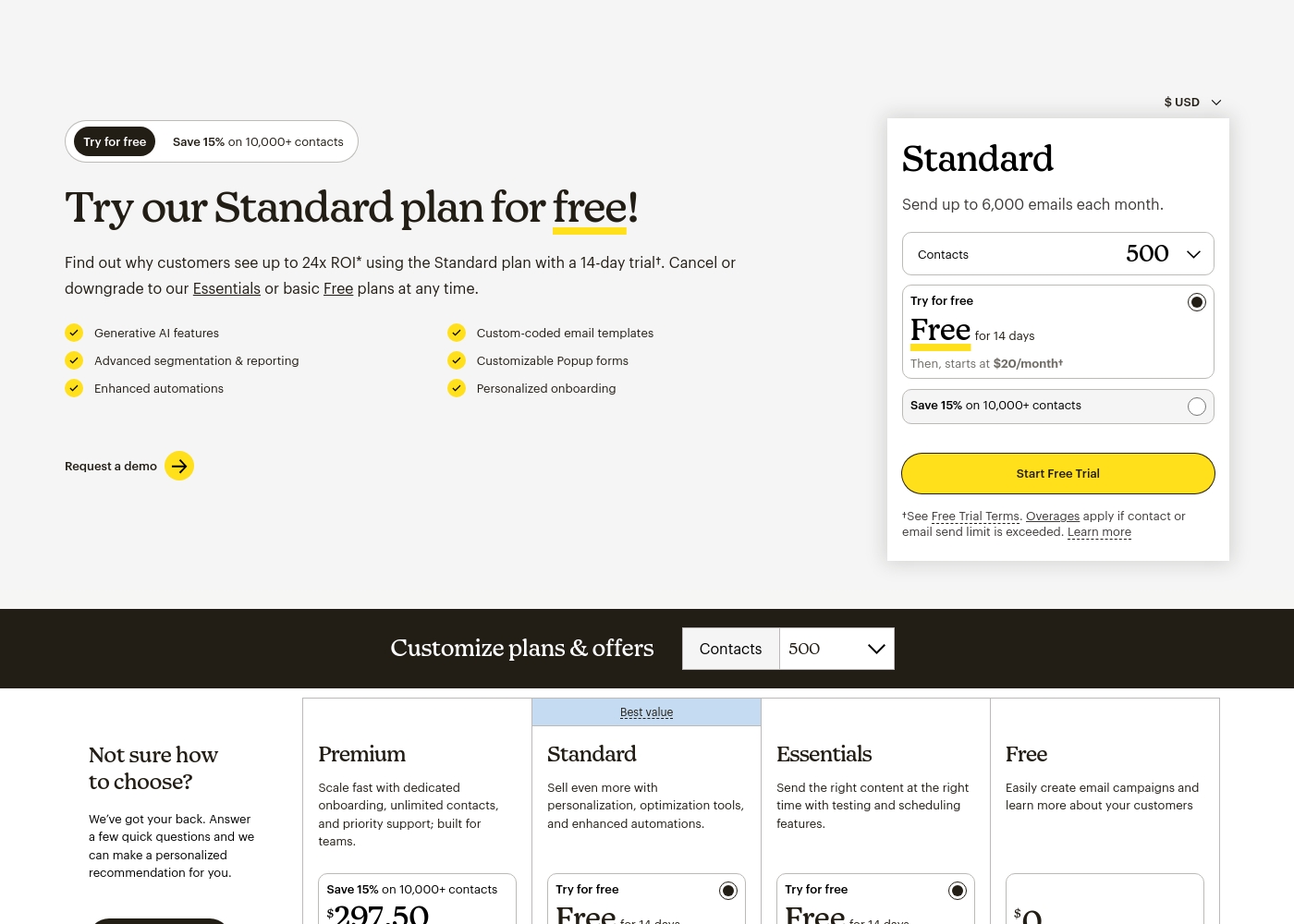
Mailchimp costs between $0 and $350 per month with four main plans: Free at $0, Essentials starting at $13/month, Standard starting at $20/month, and Premium requiring contact with sales for high volume quotes.
Here are the details about what each plan offers. Please note that prices shown here are typically for the minimum 500 contacts tier, or where noted, discounted rates for higher contact tiers.
Free
Price: $0/month Best For: Easily creating email campaigns and learning about your customers. Other Features:
- 1,000 emails per month maximum (500/day limit)
- 1 Seat (User)
- 1 Audience
- Email support for the first 30 days
- Easily create email campaigns
- Learn more about your customers
- Email support for first 30 days
- Send the right content at the right time
- Testing and scheduling features
- 24/7 Email & Chat Support
- Up to 3 users
- Sell even more with personalization
- Optimization tools
- Enhanced automations
- Generative AI features
- Custom-coded email templates
- Scale fast with dedicated onboarding
- Unlimited contacts
- Priority support; built for teams
- Generative AI Features
- Role-based Access (5 Roles)
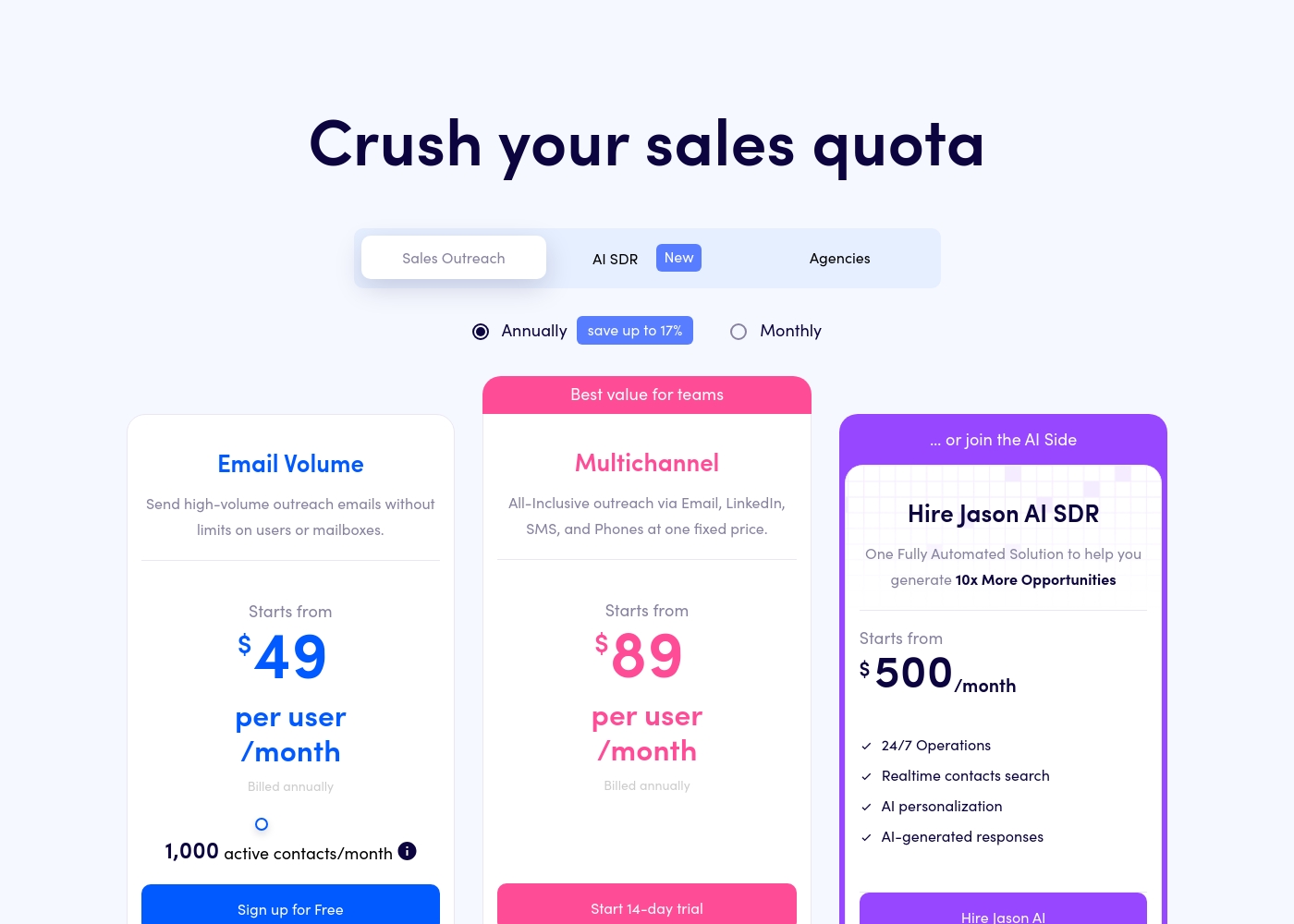
Reply.io costs between $49/user/month and $3000/month across four main entry points: Email Volume starting at $49/user/month, Multichannel starting at $89/user/month, AI SDR starting at $500/month, and Agency Starter beginning at $166/month.
The following section details the primary pricing tiers available. Remember, selecting annual billing often provides savings up to 17% or more compared to monthly rates.
Email Volume
Price: Starts at $49 per user/month (Billed annually) Best For: High-volume outreach focused purely on email. Other Features:
- Unlimited mailboxes and email warm-up.
- Unlimited emails sent to active contacts.
- 50 Live data credits each month.
- Anti-spam and deliverability suite included.
- Unlimited mailboxes
- Unlimited email warmup
- Unlimited emails
- Anti-spam & deliverability suite
- Email Automation (10 mailboxes)
- LinkedIn Automation (Paid subscription required)
- Calls & SMS Automation (Paid subscription required)
- Unlimited active contacts and email warmup
- Hire Jason AI (Fully Automated Solution)
- AI personalization & generated responses
- Multichannel automation
- Unlimited mailboxes & warm-ups
- Unlimited clients and users
- Unlimited email warm-up
- Centralized inbox
- Dedicated support and custom roles/permissions
Pricing Notes
- Mailchimp’s pricing is based fundamentally on the total size of your contact list (usage), scaling aggressively.
- Reply.io uses a hybrid model, combining a per-user fee with a cap on monthly 'active contacts' reached.
- Mailchimp offers a robust $0 Free plan for users with under 500 contacts, which is excellent for individuals starting out.
- Reply.io’s advanced AI SDR solutions (Jason AI) start significantly higher, beginning at $500/month annually.
- Many Mailchimp users report hidden costs and unexpected overage charges when contact lists slightly exceed a tiered limit.
Pricing Head-to-Head
User Reviews
Mailchimp receives polarized external feedback, highlighting a split between excellent product features and frustrating support experiences. Users consistently praise the platform's intuitive interface and ease of use, confirming that the drag-and-drop builder and extensive automation features are significant time savers for growing businesses.
Reviewers often appreciate the quality of available templates and the platform's robust integrations with CRM and website systems. However, a major concern revolving around customer support is widely reported.
The UI is easy to navigate, and the drag-and-drop email building feature is extremely well designed and simple to use. We use Mailchimp for all our prospective and current customer campaigns. It saves us a lot of time in production.
Reply.io users consistently report a positive experience, highlighting outstanding customer support as a major strength. Reviewers frequently note that the support team is incredibly responsive, often providing immediate help via chat and resolving complex issues quickly—sometimes within minutes.
This strong support helps users navigate the platform’s powerful features. Functionally, users praise Reply.io’s reliability and robust capabilities for scaling outreach.
Reply.io’s support team is truly exceptional. The human interaction I have with them is better than any other software I currently use for my job. The chat assistant also provides great intake support.
Our Verdict
Choosing between Mailchimp and Reply.io is easy; it depends on your specific goal. Mailchimp is the platform for broadcast email marketing and content creation. Reply.io is built entirely for scaling professional sales outreach. Mailchimp’s superpower is its massive ecosystem and intuitive design. It offers over 300 integrations, crucial for e-commerce stores like Shopify. Mailchimp helps marketers design beautiful campaigns quickly using its Generative AI features. Stick with Mailchimp if you manage an existing large customer list or need mass communication tools. Reply.io is the champion of personalized, targeted B2B sales cycles. It gives you access to a database of 1 billion contacts for prospecting. Reply.io supports true multichannel sequences, including LinkedIn outreach steps. Crucially, Reply.io offers excellent, quick customer support, unlike Mailchimp. The deciding factor should be the complexity of your outreach. Use Mailchimp for simple content delivery to a broad audience of 10,000 customers. You must use Reply.io if your sales team needs to convert 100 targeted, cold B2B leads. Mailchimp struggles with deliverability for cold sends. Final verdict: Pick Mailchimp for easy-to-use e-commerce marketing and content. Choose Reply.io if you are serious about automated, high-touch outbound sales and need reliable support.
Frequently Asked Questions
Which is better for B2B sales outreach: Mailchimp or Reply.io?
Reply.io is specifically designed for B2B sales and sophisticated lead generation. It offers multichannel sequences, B2B data, and AI agents. Mailchimp focuses on standard, high-volume email marketing for existing customer lists.
Does Reply.io include prospecting tools like Mailchimp?
No, Mailchimp relies on users to build their lists using forms or third-party tools. Reply.io includes its Audience Discovery tool with access to over 1 billion global B2B contacts. Reply.io provides the leads; Mailchimp manages them.
Which platform supports LinkedIn automation for sales sequences?
Mailchimp does not support LinkedIn or social channel automation. Reply.io enables LinkedIn automation as an add-on step within its integrated sales sequences. This makes Reply.io essential for modern B2B outreach.
Which platform has better customer support: Mailchimp or Reply.io?
Reply.io consistently earns top ratings for its fast, responsive customer support via chat. Mailchimp users frequently cite support as slow, unhelpful, and a major platform pain point. Reply.io has a clear advantage here.
Is Mailchimp cheaper than Reply.io for a solo entrepreneur?
Yes, Mailchimp is cheaper initially with a strong $0 Free plan for up to 500 contacts. Reply.io’s entry-level paid plans start higher, at $49/user/month. However, Mailchimp’s costs scale based on list size very quickly.
Are there unlimited email sends with Mailchimp or Reply.io?
Reply.io offers unlimited email sends to the monthly limit of 'active contacts' in their plans. Mailchimp restricts sends significantly to 10X to 15X your total contact count. Reply.io offers better email volume capacity.
Ready to Choose?
Both tools have their strengths. Choose based on your specific needs.