Mailchimp vs Mailpoet
This isn't just about email—it's about where you build your emails. Mailpoet is the seamless WordPress native solution, integrating fully into your CMS. Mailchimp is a powerful, external platform offering deep analytics and advanced AI features. Choose your fighter: centralized convenience or enterprise-level complexity.
Best for: Businesses relying on robust integration with Shopify or external CRM systems, Marketing teams needing advanced Generative AI and optimization tools
Best for: WordPress site owners prioritizing a seamless, native email workflow, Bloggers or small businesses under 500 subscribers needing high sending volume (5,000 emails/month)
Industry-Leading Features, Unstable Support Network
We find Mailchimp offers an industry-leading suite of email marketing features, backed by strong automation and valuable AI tools for content optimization. Overall, the platform is an excellent choice for businesses needing robust design and testing capabilities, provided they anticipate potential friction with customer service and complex billing structures.
Pros
- Intuitive UI and drag-and-drop builder simplify campaign design.
- Powerful automation features help save significant time for marketers.
- Valuable reporting tools offer insights and industry benchmarking.
- Generative AI features help improve content, including subject lines.
Cons
- Customer support is frequently cited as nonexistent, unhelpful, or slow to respond.
- Billing practices are reported as predatory, with unexpected charges for slight overages.
- Users often face technical access issues, especially with two-factor authentication.
- The interface is sometimes described as clunky or difficult to navigate.
Reliability Issues Undercut Strong WordPress Integration
We assessed Mailpoet’s native WordPress integration, which genuinely simplifies content use and email creation right in your existing dashboard. However, the external feedback pointed to critical failures in account reliability and customer support responsiveness, particularly regarding arbitrary account suspensions and long resolution times. Overall, the reported operational inconsistency and poor support experience make it difficult for us to recommend Mailpoet for mission-critical campaigns.
Pros
- Native integration simplifies WordPress workflow and content access.
- Offers a powerful free plan for up to 500 subscribers.
- Intuitive design builder supports drag-and-drop customization.
- Automated campaigns (welcome emails, post notifications) are included.
Cons
- Frequent, arbitrary suspension of paid accounts and sending abilities.
- Customer support is often unresponsive and unavailable on weekends.
- Abandoned cart feature is limited, only working for existing subscribers.
- Onboarding process requires tedious verification and validation steps, leading to significant delays.
AboutMailchimp
Mailchimp is recognized as the leading platform focused on email marketing and advanced automations. It's built to help businesses boost income by mastering digital outreach. With over 11 million global users and 22 years of experience, it’s a trusted choice for selling more.
This robust platform is ideal for businesses seeking seamless conversion tools, including integrated SMS campaigns. You can start sending your first email risk-free, and you don't even need a credit card to begin. Users on Standard or Premium plans may access a personalized product tour to start confidently. 💡
AboutMailpoet
Mailpoet is the essential email marketing plugin built specifically for WordPress 💡. It currently helps over 500,000 websites connect with their audience. Since it works right alongside your existing CMS, you use your existing media library and content instantly. This seamless integration means you can get started sending important messages in minutes, not hours. It’s designed for busy site owners who need efficiency and reliable performance.
Highlights
Feature Comparison
Features Overview
We highlight the main differences and pick a winner for each feature.
Ecosystem & Workflow
Mailpoet works inside WordPress; Mailchimp is an external platform with robust connectivity.
Mailchimp operates as a standalone service, requiring data syncing between systems. It connects with 300+ platforms like Shopify and Google Analytics. Mailchimp needs separate logins and dashboards for campaign management. Mailpoet is built specifically for WordPress and integrates fully into the CMS admin panel. You can access your existing media library and content instantly for seamless design. Mailpoet eliminates the effort of re-uploading content to a third-party service. Mailchimp offers vastly more external connectivity, ideal for complex business tooling. Mailpoet provides unmatched workflow convenience for dedicated WordPress users. Choose based on where your core business operations are centralized. Mailchimp is the best choice if you rely heavily on e-commerce platforms like Shopify for sales data.
Pricing Structure
Mailpoet offers unlimited sends on paid plans; Mailchimp restricts sends based on contact limits.
Mailchimp pricing is usage-based tied to contacts and email send volume (10X-15X contact limit). Mailchimp users frequently report automatic overage charges for exceeding subscriber limits. Paid Mailchimp plans start at $13/month for 500 contacts. Mailpoet’s pricing is simpler, based only on subscriber count, starting at $10/month for 500 users. Mailpoet paid plans include truly unlimited email sending capacity per month. The Mailpoet Free Plan allows 5,000 emails, five times Mailchimp's Free Plan limit. The key difference is unlimited email volume on Mailpoet versus volume constraints on Mailchimp's paid tiers. Mailchimp’s automatic billing practices cause significant user friction. Mailpoet offers better value if you send very frequently to your list. Mailchimp’s complex billing and overage fees necessitate careful monitoring of usage limits.
Automation & AI
Mailchimp provides advanced AI tools for content optimization; Mailpoet focuses on essential automated sequences.
Mailchimp provides enhanced automations designed for sales optimization and sophisticated personalization. Standard and Premium Mailchimp users access generative AI tools for faster content creation. Mailchimp helps users optimize campaigns by recommending improvements. Mailpoet excels at targeted automated campaigns like welcome sequences and automated blog post notifications. Mailpoet welcome emails boast open rates of 40% and higher. Mailpoet does not currently feature advanced content generating AI tools. Mailchimp wins on advanced feature depth like AI and optimization tools for higher conversion rates. Mailpoet automation primarily supports the WordPress publishing workflow. Mailchimp is explicitly designed to maximize measurable revenue. Mailchimp’s AI enables marketers to produce compelling, on-brand content much faster than manual composition.
Customer Support
Mailchimp offers broader support channels despite poor reviews; Mailpoet faces severe criticisms over reliability and responsiveness.
Mailchimp Essentials and Standard plans include 24/7 chat and email support. Dedicated phone support is reserved for Mailchimp's costly Premium tier users. Mailchimp provides personalized onboarding sessions to help paid users launch effectively. Mailpoet offers priority email support for paid plans and claims a 90% Happiness Score in-house. External Mailpoet reviews cite arbitrary account suspensions and unresponsive support as major issues. Support staff are reportedly unavailable on weekends. Neither tool has perfect support, but Mailchimp provides more immediate channels like 24/7 chat for mid-tier plans. Mailpoet’s critical reviews regarding service reliability make it higher risk for mission-critical campaigns. Mailchimp's onboarding helps new users start confidently. Reliability issues reported by Mailpoet users concerning account stability negate the convenience of WordPress integration.
Integration Ecosystem
Mailchimp connects to 300+ external apps; Mailpoet focuses deeply on WordPress and WooCommerce integration.
Mailchimp brings in vast amounts of sales data via connections to over 300 reliable platforms. Key Mailchimp integrations include Shopify, Google Analytics, and Canva for design. This ecosystem empowers advanced segmentation and targeted automations across all data. Mailpoet integrates exclusively and deeply with WordPress and WooCommerce due to its native design. Mailpoet ensures email data stays within the secure WordPress environment. Mailpoet is not built for broad external connectivity like Mailchimp. Mailchimp is essential for businesses needing connectivity across multiple marketing, sales, and accounting tools. Mailpoet is strictly focused on creating seamless email campaigns from within your WordPress site. Mailchimp clearly provides industry-leading API connectivity. Use Mailchimp if unified customer data requires syncing with tools beyond your WordPress site.
Reporting and Analytics
Mailchimp offers deep, revenue-focused analytics; Mailpoet provides standard campaign tracking.
Mailchimp offers advanced analytics, including funnel visualizations to track conversion points accurately. Mailchimp provides industry benchmarking data to compare success against specific competitors. The platform actively suggests optimization tactics to boost revenue, claiming 25x ROI. Mailpoet relies on standard campaign tracking metrics and external Google Analytics integration. Mailpoet focuses heavily on reliable deliverability performance. Mailpoet does not feature personalized optimization suggestions or native industry benchmarking. Mailchimp clearly provides much deeper, actionable business intelligence and sophisticated sales optimization tools. Mailpoet is sufficient for basic performance checks but lacks comparative depth. Mailchimp is built to prove financial returns on marketing investment. Sophisticated marketers prioritizing data-driven decision-making will find Mailchimp’s reports more valuable.
E-commerce Support
Mailchimp offers robust abandoned cart features; Mailpoet’s abandoned cart tool is severely limited.
Mailchimp integrates seamlessly with major platforms like Shopify and WooCommerce to sync rich data. This integration allows for powerful segmentation and comprehensive abandoned cart flows. Mailchimp's robust connectivity is reliable for unified customer journeys. Mailpoet allows full customization of WooCommerce transactional emails and purchase automations. Crucially, Mailpoet's abandoned cart feature only targets existing subscribers. This limitation makes it ineffective for new lead capture, according to user reports. Mailchimp provides a more complete, reliable e-commerce marketing and lead capture system. Mailpoet's self-imposed limitation on its abandoned cart feature is a significant functional drawback. For e-commerce growth, Mailchimp is superior. Merchants focused on mitigating cart abandonment should rely on Mailchimp’s more robust integration capabilities.
Multi-Site Management
Mailchimp handles multiple audiences; Mailpoet Agency plan manages up to 50 separate websites.
Mailchimp typically manages multiple audiences, but it is focused on large-scale campaigns for one brand. Mailchimp’s higher plans allow unlimited users and role-based access for large teams. Customer data is centralized and shared across different segments and audiences. Mailpoet offers a Multi-Site Agency Plan specifically for managing email marketing across up to 50 client sites. Subscriber counts are tracked and billed individually per Mailpoet instance. This compartmentalization is ideal for freelancers and agencies. For agencies managing dozens of client websites from one central solution, Mailpoet’s Agency plan is perfectly tailored. Mailchimp is designed more for high-volume needs within a single, very large organizational structure. Mailpoet provides the perfect structure for scaling a freelance service offering email marketing to multiple clients.
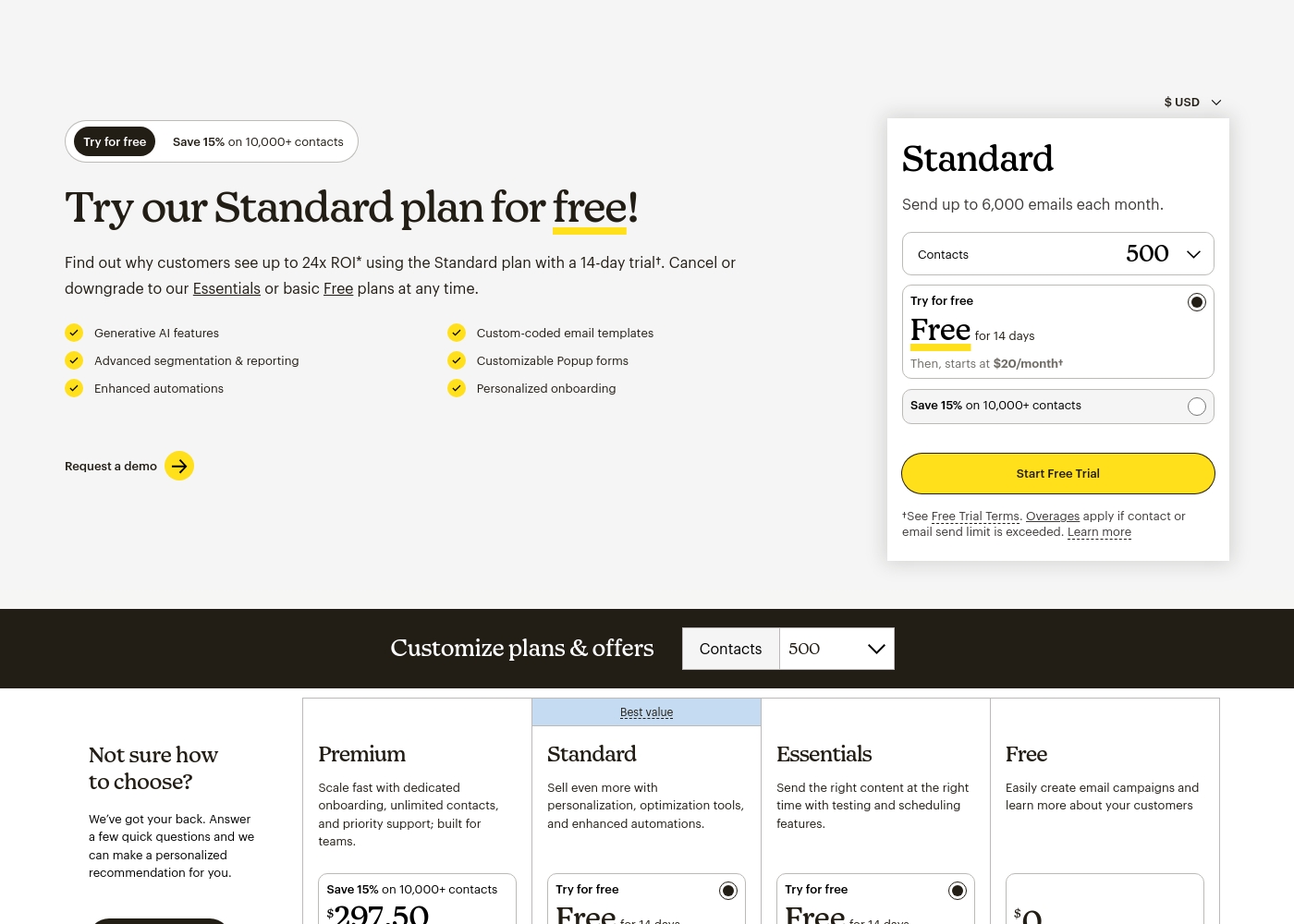
Mailchimp costs between $0 and $350 per month with four main plans: Free at $0, Essentials starting at $13/month, Standard starting at $20/month, and Premium requiring contact with sales for high volume quotes.
Here are the details about what each plan offers. Please note that prices shown here are typically for the minimum 500 contacts tier, or where noted, discounted rates for higher contact tiers.
Free
Price: $0/month Best For: Easily creating email campaigns and learning about your customers. Other Features:
- 1,000 emails per month maximum (500/day limit)
- 1 Seat (User)
- 1 Audience
- Email support for the first 30 days
- Easily create email campaigns
- Learn more about your customers
- Email support for first 30 days
- Send the right content at the right time
- Testing and scheduling features
- 24/7 Email & Chat Support
- Up to 3 users
- Sell even more with personalization
- Optimization tools
- Enhanced automations
- Generative AI features
- Custom-coded email templates
- Scale fast with dedicated onboarding
- Unlimited contacts
- Priority support; built for teams
- Generative AI Features
- Role-based Access (5 Roles)
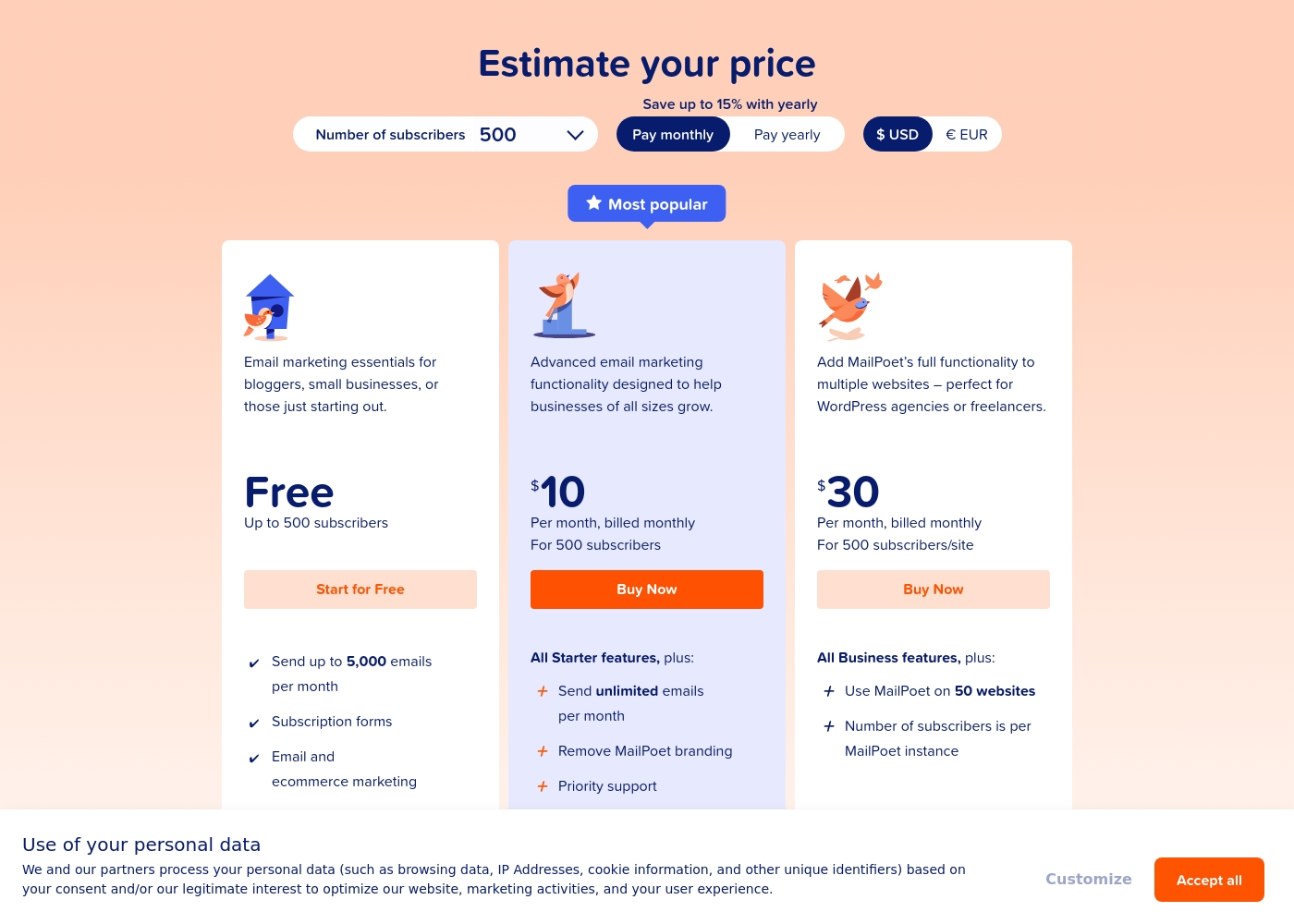
Mailpoet costs between Free and $30 per month for 500 subscribers, with three accessible plans: the Free Plan at $0, the Advanced Marketing Plan at $10/month, and the Multi-Site Agency Plan at $30/month.
Here’s a closer look at what you get with each option, based on the starting tier of 500 subscribers.
Free Plan
Price: Free Best For: Bloggers, small businesses, or those just starting out. Other Features:
- Send up to 5,000 emails per month
- Includes subscription forms
- Provides email and ecommerce marketing tools
- Send up to 5,000 emails per month
- Subscription forms
- Email and ecommerce marketing
- Send unlimited emails per month
- Remove MailPoet branding
- Priority support
- Use MailPoet on 50 websites
- Subscriber count is adjusted per MailPoet instance
Pricing Notes
- Mailchimp's pricing is highly complex, based on both contact count and monthly email send limits (10X, 12X, 15X).
- Mailpoet's pricing is simpler, based only on subscriber count, offering unlimited sends on paid plans.
- Mailchimp users frequently report automatic and unexpected overage charges for exceeding subscriber limits, leading to high user frustration.
- The Mailpoet Free Plan is very generous, allowing up to 5,000 emails per month, far exceeding Mailchimp's 1,000 limit.
- Mailchimp offers a 14-day free trial on paid plans, while Mailpoet encourages testing via its robust Free Plan.
- Mailpoet offers a 15% discount for annual commitment across all paid tiers.
Pricing Head-to-Head
User Reviews
Mailchimp receives polarized external feedback, highlighting a split between excellent product features and frustrating support experiences. Users consistently praise the platform's intuitive interface and ease of use, confirming that the drag-and-drop builder and extensive automation features are significant time savers for growing businesses.
Reviewers often appreciate the quality of available templates and the platform's robust integrations with CRM and website systems. However, a major concern revolving around customer support is widely reported.
The UI is easy to navigate, and the drag-and-drop email building feature is extremely well designed and simple to use. We use Mailchimp for all our prospective and current customer campaigns. It saves us a lot of time in production.
The external reviews for Mailpoet reveal a stark and polarized user experience, heavily weighted toward frustration. While a few long-term users praise the affordability and ease of use for basic email creation and claim reliable deliverability, the overwhelming majority report severe technical and customer support issues. Reviewers frequently mention paid accounts being arbitrarily suspended or blocked, sometimes related to high bounce rates or fraud handling, leading to lost campaigns and high friction regardless of the subscription tier.
Crucially, complaints about support are recurrent. Users report waits of several days, receiving vague, ‘AI generated’ answers, or finding that dedicated support is unavailable on weekends ⚠️. Others note painful onboarding (delayed subscription validation) and limitations in core features, such as abandoned cart emails only targeting existing subscribers, rendering the tool useless for lead capture. Reliability and customer service responsiveness are the chief concerns consistently raised across these platforms. Ultimately, many users feel the systemic blockages entirely negate the convenience of WordPress integration.
I love using MailPoet for myself and my local business clients. It makes creating and managing emails across several client websites very easy. It is affordable and the emails always land where they are supposed to.
Our Verdict
This choice is simple: where do you want your email marketing data to live? Mailpoet and Mailchimp serve wildly different needs, despite both handling email effectively. Mailchimp is the external, enterprise-level powerhouse with unrivaled depth and connectivity. It offers generative AI tools and sophisticated analytics that suggest revenue optimization. Choose Mailchimp if you integrate with multiple external platforms like Shopify, or need robust reporting. Mailpoet’s superpower is its deep, native integration right into your WordPress site. You can use images from your media library instantly without uploading anything twice. Mailpoet simplifies the workflow for busy WordPress site owners greatly. The deciding factor is workflow versus feature depth and trust. Mailchimp offers vastly superior features and integration options but risks automatic overage charges. Mailpoet keeps everything simple, but critical user complaints about arbitrary account suspension and slow support are alarming. If you are a growing e-commerce brand that requires complex data synchronization, Mailchimp is the essential choice for scaling. If you are a dedicated WordPress blogger needing easy updates and cost-effective high-volume sends, Mailpoet is suitable, but proceed with caution regarding support.
Frequently Asked Questions
Which is better for small teams: Mailchimp or Mailpoet?
Mailpoet is better for small WordPress teams because it offers unlimited seats on paid plans. Mailpoet’s workflow is simple and integrated directly into the WordPress dashboard. Mailchimp limits team members drastically, with only 3-5 users allowed in mid-tier plans.
Does Mailpoet offer unlimited email sending like some competitors?
Yes, Mailpoet provides unlimited email sending capacity on its Advanced Marketing plan and Agency plan. Mailchimp restricts email sends to a multiplier (10X-15X) of your total contact count. Mailchimp forces you to pay more if you exceed those tight sending limits.
Which tool has the stronger integration with WordPress and WooCommerce?
Mailpoet has the stronger, more seamless native integration with WordPress and WooCommerce. Since Mailpoet lives inside the CMS, you access content and media instantly. Mailchimp connects effectively via its robust integration ecosystem but operates externally.
Is Mailpoet's Free Plan better than Mailchimp's Free Plan?
Mailpoet's Free Plan offers significantly greater sending volume, up to 5,000 emails per month. Mailchimp restricts its Free Plan users to only 1,000 emails monthly maximum. Both offer a 500-contact limit, but Mailpoet provides better volume value.
Does Mailchimp provide more advanced analytics than Mailpoet?
Yes, Mailchimp offers much more sophisticated analytics and reporting features. Mailchimp includes funnel visualizations, industry benchmarking, and AI-driven optimization suggestions. Mailpoet offers standard tracking that is primarily reliant on Google Analytics.
Is it true that Mailpoet has issues with arbitrary account suspensions?
External reviews frequently cite that Mailpoet arbitrarily suspends paid accounts, leading to missed campaigns. Users report extreme difficulty and delays getting issues resolved by Mailpoet support teams. Mailchimp's reliability issues usually concern unexpected overage charges, not full service suspension.
Ready to Choose?
Both tools have their strengths. Choose based on your specific needs.