Lusha vs SeamlessAI
Choosing between Lusha and SeamlessAI boils down to breadth versus workflow focus. SeamlessAI boasts a huge database, offering massive prospect volume. Lusha is deeply focused on real-time buying signals and automated RevOps workflows. Both tools struggle with user reviews concerning trust and transparency, so choose carefully.
Best for: RevOps teams needing automatic CRM enrichment and data syncing, Sales teams prioritizing real-time buying signals and intent data
Best for: Teams prioritizing maximum database breadth (1.3B+ contacts), Sales teams needing native integration into Salesloft or Pipedrive
Serious questions about data privacy.
We observed extreme user concerns regarding Lusha’s data sourcing and privacy adherence, particularly concerning the alleged sharing of scraped personal contact numbers, which overshadows any intended utility. Overall, we cannot recommend a service facing such severe ethical and contractual complaints from its user base.
Pros
- Offers a generous Free plan to test basic functionality.
- Provides broad API and CRM integration options.
- Can be effective for prospecting when the data is accurate.
Cons
- Major concerns regarding the ethical sourcing and sharing of private contact data.
- Users struggle to opt-out or remove their personal information (GDPR violations alleged).
- Substantial complaints about high inaccuracy and obsolete contact details sold.
- Aggressive auto-renewal policies and opaque contract cancellation terms.
Unreliable data and restrictive contracts.
We found significant inconsistencies between the platform’s advertised capabilities and actual user reports regarding functionality and transparency. Recurring issues involve poor data accuracy, product instability, and severe contractual pitfalls, especially concerning mandatory, non-transparent auto-renewal policies. Overall, we advise strong caution due to major risks related to misleading billing practices and ineffective lead generation.
Pros
- Offers a continuous Free plan for platform evaluation.
- Integrates natively with major CRMs (HubSpot, Salesforce).
- Functionality dedicated to finding mobile/cell phone numbers.
- Aims to use AI for real-time contact validation.
Cons
- Data accuracy is frequently reported as poor, obsolete, or fake.
- Cancellation policies are predatory and non-transparent.
- Requires a strict 60-to-90 day advance notice to avoid forced auto-renewal.
- Users were charged thousands of dollars without prior renewal notice.
AboutLusha
Lusha powers up your entire Go-To-Market (GTM) engine. It provides access to a massive database of over 280 million verified B2B contacts, helping teams reach precise decision makers. Professionals across Sales, RevOps, Marketing, and Recruiting use Lusha to streamline their work and maximize return. 💡
For sales teams, Lusha helps the pipeline grow with live leads and faster closes. RevOps benefits by keeping data stacks clean, compliant, and connected for better ROI. Marketers power campaigns with enriched audiences, and Recruiters quickly find top talent using highly accurate contact data. This tool truly helps you scale up your business using trusted data.
AboutSeamlessAI
SeamlessAI is the #1 AI data platform for growing your business. It is a powerful, real-time search engine for validated B2B sales leads. This tool helps you acquire your total addressable market efficiently. It finds anyone's full contact profile, including over 1.8 billion business emails and 414 million phone numbers globally. Over one million professionals use it to find leads and close more sales, helping teams crush their sales quotas. 💡
Highlights
Feature Comparison
Features Overview
We highlight the main differences and pick a winner for each feature.
Database Size
SeamlessAI offers significantly broader contact volume for pure prospecting needs.
Lusha holds over 280 million verified B2B contacts in its substantial database. This focuses on accuracy and specific, targeted results rather than sheer volume. Lusha emphasizes high deliverability for emails (98%) and phone accuracy (85%). SeamlessAI offers a massive database of 1.3 billion contacts and 121 million companies worldwide. It provides 1.8 billion emails and 414 million phone numbers, prioritizing broad reach. This scope makes SeamlessAI excellent for casting a very wide net during initial segmentation. The key difference is scale; SeamlessAI simply provides access to five times more contacts. Lusha prioritizes data quality metrics over pure size in its core pitch. Choose SeamlessAI if absolute volume and breadth are your top priority for building lists.
Buying Signals & Intent
Lusha integrates buying signals natively; SeamlessAI offers similar features as an add-on.
Lusha focuses on real-time leads and buying signals to shorten your sales pipeline. Daily streams of qualified prospects arrive on your Lusha homepage automatically. This feature is fundamental to the Lusha platform experience. SeamlessAI offers Buyer Intent Data and Job Changes tracking, but these are noted as key add-ons. You might pay extra to access features Lusha offers as standard functionality. SeamlessAI’s core strength is search, not signal monitoring. Lusha wins for teams prioritizing *when* to reach out, using signals as a primary outreach trigger. SeamlessAI focuses on *who* to reach out to first, requiring add-ons for intent data. If timing your outreach is critical to your strategy, Lusha provides a better native solution for real-time lead monitoring.
Data Enrichment Speed
Both tools enrich data quickly, but SeamlessAI emphasizes ‘seconds’ for CRM updates.
Lusha focuses on MCP and API integrations to enrich existing CRM leads and prospect lists. This keeps your Salesforce or HubSpot data clean and current with high accuracy. Lusha’s processes are built for ongoing data automation. SeamlessAI aggressively markets its automatic enrichment capability, turning any email or phone into a full record in seconds. You can upload an entire CSV or CRM list and enrich it rapidly. This speed is a major selling point for SeamlessAI. Both platforms are fast, but SeamlessAI makes the 'enrichment in seconds' promise very visible. Lusha focuses more on the ongoing maintenance and clean syncing via workflows. For large, rapid, one-time list updates, the advertised speed of SeamlessAI might be the deciding factor.
Pricing Structure
Lusha offers credit roll-over on monthly plans; SeamlessAI uses less flexible per-user pricing.
Lusha uses a credit-based system, costing 1 credit for emails and 10 credits for phone numbers. Crucially, unused credits roll over up to twice the plan limit on monthly subscriptions. This offers flexibility. SeamlessAI uses per-user pricing for its Pro plan, meaning costs scale directly with team size. While it has a free plan, managing credit refresh rates and user licenses can be complex. The credit roll-over feature gives Lusha a slight edge in terms of pricing flexibility and fair usage. SeamlessAI users need to maximize their daily credit refresh or face per-user costs. If your prospecting volume fluctuates month-to-month, Lusha’s roll-over feature saves you money and unused credits.
Integration Ecosystem
SeamlessAI connects to more native tools and a massive 6,000+ apps via Zapier.
Lusha provides seamless connections with major sales tools like Salesforce, HubSpot, Outreach, and Slack. It also supports custom workflows via n8n and Zapier API enrichment. This is ideal for RevOps teams maintaining data quality. SeamlessAI offers native one-click integrations for Salesforce, HubSpot, Pipedrive, and Salesloft, among others. Its Zapier connectivity extends to over 6,000 applications, showcasing superior breadth. If you use a diverse stack of sales tools beyond the major CRMs, SeamlessAI offers wider compatibility. Lusha's focus is efficient sync with the core GTM platforms. For teams needing deep connectivity across a giant tech stack, SeamlessAI clearly dominates the integration ecosystem.
Review & Trust Issues
Both platforms face low ratings, but Lusha deals with privacy concerns while SeamlessAI struggles with hidden billing.
Lusha reviews frequently flag privacy concerns, GDPR worries, and unsolicited outreach linked to their data sources. Users report skepticism about how personal information is obtained. This undermines confidence in the platform's ethical sourcing. SeamlessAI users often complain about non-transparent auto-renewal terms and difficult, unclear cancellation processes. They also report slow customer support responses. This raises serious billing and customer experience red flags. Neither tool generates high user trust; the pain points are just different. Lusha challenges the data *source*, while SeamlessAI challenges the *service* contract. Before choosing either, review their billing terms and data sourcing policies extremely closely to mitigate future risk.
Lusha offers plans starting at Free, with paid plans requiring contact for pricing details.
Details for specific pricing tiers were unavailable due to a technical error on the Lusha website itself, but we can review the featured plans based on the available text.
Free plan
Price: Free Best For: Getting started with B2B prospecting Refund Policy: Not applicable Other Features:
- Up to 70 credits per month
- Access to basic prospecting features
- Browser extension
- CRM integrations
- Up to 70 credits per month
- Basic prospecting features
- Browser extension
- CRM integrations
- Fully customizable
- Ability to limit credit usage per user
- Includes annual credit rollover option
- Designed for teams larger than 5 users
This overview highlights the options available. Let's look closer at what each plan offers for your sales intelligence needs.
Free
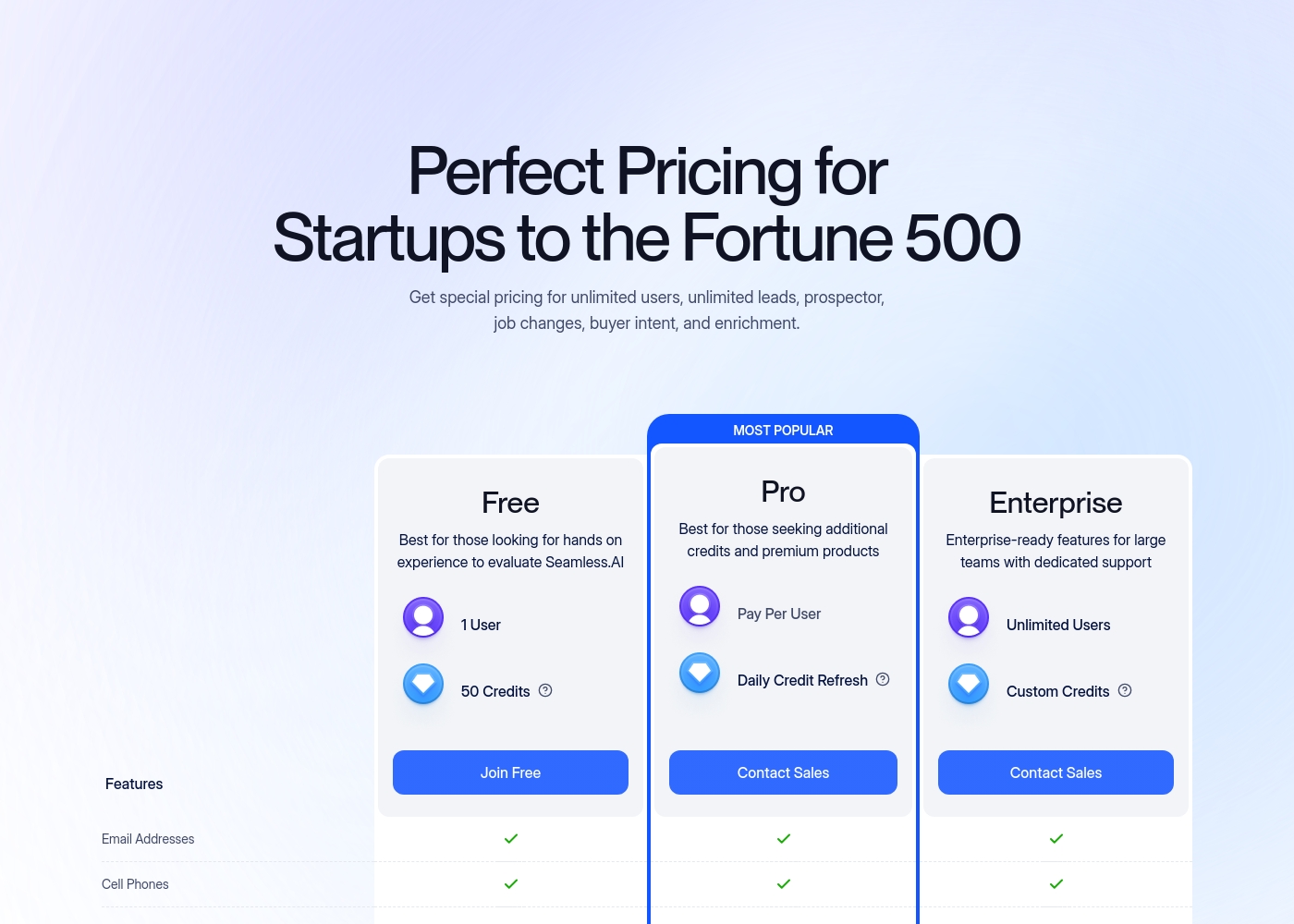
Price: $0 Best For: those looking for hands on experience to evaluate Seamless.AI Other Features:
- Email Addresses and Cell Phones
- Real-time Search Engine access
- Export Download and Premium Integrations
- Free Admin Seat
The Free plan is perfect if you're just starting out and need to test the platform. You get 1 user and 50 credits right away to find crucial contact information. Use this tier to properly evaluate if Seamless.AI fits your goals before committing to a paid subscription. Enjoy finding leads! ✨
- Email Addresses
- Cell Phones
- Real-time Search Engine
- Premium Integrations
- Free Admin Seat
- Pay Per User structure
- Daily Credit Refresh
- All features from Free plan
- Advanced Org Management
- Unlimited Users
- Custom Credits
- Dedicated Success Manager
- Quarterly Business Reviews
- Phone Support
Pricing Notes
- Lusha has a flexible credit system where unused credits roll over on monthly plans, which is great value.
- Lusha’s pricing climbs significantly for enterprise-level Scale plans exceeding $8,000/month.
- SeamlessAI Pro plans use pay-per-user pricing, tying costs directly to team headcount.
- Reviewers frequently warn that SeamlessAI uses hidden auto-renewal terms, making cancellation difficult.
- Both Lusha and SeamlessAI offer a Free tier, providing 50-70 credits monthly for evaluation.
Pricing Head-to-Head
User Reviews
User feedback concerning Lusha is overwhelmingly negative, centering on severe data ethics and privacy violations. Many reviewers allege Lusha scrapes and distributes personal contact information—including private mobile numbers—without user consent, leading to a huge volume of unsolicited calls and spam.
Users feel this is a "scammy" or "spam-enabling" practice that violates GDPR. A major complaint is the difficulty in getting personal details removed; many requests for data deletion are reportedly ignored, or the information reappears soon after.
I keep receiving daily unsolicited calls to my personal phone number. When I ask where they got my details, they consistently cite Lusha. This company shows a blatant disregard for privacy.
External feedback paints a contradictory picture compared to the vendor's marketed high accuracy and support. Users repeatedly state data accuracy is alarming, reporting that contacts are often obsolete, fake, or require extensive cleaning before use.
Reviewers mention poor functionality, instability, and a terrible overall user experience. However, the most critical dissatisfaction stems from the company's business practices and contract management.
I used the service for a year and tried to cancel. Without any prior warning, I was charged $2,200 for an unauthorized annual auto-renewal, which I never explicitly agreed to. Beware of this shady practice.
Our Verdict
Deciding between Lusha and SeamlessAI is tough because both have excellent features and critical flaws. If you need vast contact volume, SeamlessAI is the theoretical powerhouse, offering 1.3 billion contacts. Lusha, however, gives you specific accuracy claims and better workflow features. Lusha’s superpower is connecting data directly to action via real-time signals and automation. It excels when integrating with your existing CRM and sales sequence tools. Lusha ensures your data is clean and your outreach is timely based on active buying signals. SeamlessAI shines brightest with its sheer breadth and add-on specialty features. If you need to search for contacts across the widest possible spectrum, SeamlessAI has the volume. Features like Job Changes and dedicated AI Research offer powerful context for segmentation. The decisive factor often lies in managing trust versus managing administration. Lusha users worry about privacy and data sourcing. SeamlessAI users dread auto-renewals and poor customer service when scaling. Choose the hassle you can mitigate. Pick Lusha if you are a RevOps team focused on clean data, accurate signals, and flexible credit usage. Opt for SeamlessAI if your sole mission is finding the largest possible pool of prospects, regardless of the billing risks involved.
Frequently Asked Questions
Which tool has the larger contact database: Lusha or SeamlessAI?
SeamlessAI holds a much larger database, boasting over 1.3 billion contacts and 121 million companies. Lusha focuses on a smaller, highly verified dataset of 280 million contacts. SeamlessAI is better for sheer volume.
Does Lusha offer buying signals like SeamlessAI's Buyer Intent?
Lusha integrates real-time leads and buying signals as a core platform feature, delivering them via daily streams. SeamlessAI provides Buyer Intent data, but it is listed as a feature add-on. Lusha makes signals more central to its offering.
Which tool offers better pricing flexibility: Lusha or SeamlessAI?
Lusha is slightly more flexible due to its credit policy. On Lusha's monthly plans, unused prospecting credits roll over to the next month. Both Lusha and SeamlessAI offer a Free plan to start.
Are there known issues with cancellation or billing for Lusha and SeamlessAI?
Yes, user reviews frequently mention billing friction for both services. SeamlessAI users widely report aggressive auto-renewal terms and challenging cancellation processes. Lusha users sometimes cite general customer support issues related to billing.
Which software is better for integrating with a large tool stack?
SeamlessAI offers stronger integration breadth, connecting natively with many CRMs and over 6,000 apps via Zapier. Lusha focuses on deep, automated syncing with primary sales and marketing platforms like HubSpot and Salesforce.
Is SeamlessAI's data more accurate than Lusha's?
It's hard to say definitively based on reviews, as both face accuracy complaints. Lusha makes specific claims: 98% email and 85% phone accuracy. SeamlessAI relies on 'real-time AI validation' without providing specific percentages.
Ready to Choose?
Both tools have their strengths. Choose based on your specific needs.