Leadfeeder vs Proof
Leadfeeder and Proof solve two different website problems. Leadfeeder uncovers which companies visit your site. Proof makes those visitors convert with personalized experiences. Your choice depends on whether you need better lead identification or better lead conversion.
Best for: B2B sales teams needing to identify companies visiting their website, Marketing teams wanting to see which companies engage with their campaigns
Best for: Startup marketers looking to increase website conversions., Growth teams wanting to personalize user experiences.
Advanced B2B Lead Identification, High Risk.
We found Leadfeeder offers powerful B2B visitor identification features, including robust filtering and unique remote employee recognition capabilities. However, we note consistent customer reports detailing unresolved CRM integration failures and problematic auto-renewal billing policies that undermine its fundamental value proposition. Overall, the powerful features are currently overshadowed by serious concerns regarding support responsiveness.
Pros
- Highest company recognition rate available, identifying remote workers.
- Quick setup requiring a simple Google Analytics connection.
- Robust filtering system using over 50 firmographic and behavioral signals.
- Allows identification of companies engaging with ad campaigns.
Cons
- Reportedly flawed and unresolved two-way Dynamics CRM integration features.
- Aggressive annual auto-renewal policy lacking timely notification reminders.
- Customer support is frequently criticized as non-existent or unhelpful.
- High subscription cost scaling based significantly on volume of identified companies.
Solid personalization tool, but reviews missing.
We reviewed Proof as a website personalization platform aimed at boosting conversions. It offers clear features and structured pricing for growth-focused teams. Overall, we find it a promising tool for targeted marketing, but the lack of accessible user reviews makes it hard to fully validate its real-world performance and support.
Pros
- Offers a 14-day free trial to test core features.
- Usage-based pricing scales with your monthly visitors.
- Features like A/B testing and analytics are included in higher tiers.
- Provides educational resources and case studies for learning.
Cons
- External user reviews are unavailable or inaccessible.
- No public money-back guarantee is stated.
- Pricing can become costly for high-traffic sites.
- May require a strategic setup, not a plug-and-play solution.
AboutLeadfeeder
Leadfeeder is a powerful tool designed to help salespeople, marketers, and agencies find hidden opportunities in their web traffic. Its unique technology scans incoming traffic and identifies the companies visiting your website based on their IP address. This works even if employees are working from home. Once identified, the tool helps you uncover exactly what those companies are interested in, confirming their true buying intent. This crucial data processing meets all necessary GDPR legislation requirements. ✅
AboutProof
Proof is a platform focused on website personalization. 🎯
It's designed for marketers and growth teams at startups and fast-growing companies. The idea is to move beyond a one-size-fits-all website. Instead, you can tailor content, offers, and messaging to different visitor segments. This can help you increase conversions and engage your audience more effectively.
Highlights
Feature Comparison
Features Overview
We highlight the main differences and pick a winner for each feature.
Core Purpose
Leadfeeder is a lead identification tool. Proof is a website personalization platform.
Leadfeeder scans website traffic and identifies visiting companies using IP addresses. It then provides contact information for decision-makers at those companies. Proof helps you change what visitors see on your website. You can tailor content, offers, and social proof notifications to different visitor segments. Leadfeeder answers 'who is visiting?' while Proof answers 'how do we convert them?'. They solve different parts of the sales funnel. If your main problem is not knowing which companies are interested, Leadfeeder is the tool. If your problem is low conversion rates from existing traffic, Proof is the solution.
Visitor Intelligence
Leadfeeder identifies companies. Proof uses personalization, not identification.
Leadfeeder uses a large IP database to identify the company behind a website visit. It claims the highest recognition rate, even for remote employees. You get firmographic data like company size and industry. Proof does not identify anonymous visitors. Its focus is on personalizing the experience for all visitors based on behavior or segments you define. This is the fundamental difference. Leadfeeder provides intelligence on *who* is on your site. Proof provides tools on *what* to show them. For sales teams needing to know which target accounts are researching them, Leadfeeder is essential. Proof doesn't provide this intelligence.
Conversion Optimization
Proof is built to increase conversions. Leadfeeder is a lead feeder, not a converter.
Proof's entire platform is designed to boost website conversions. It offers social proof notifications, personalization, and A/B testing to optimize the user journey. Leadfeeder's goal is to identify and qualify leads for your sales team. It doesn't optimize the website experience itself to increase conversion rates. Proof can show a visitor that 50 others signed up today, creating urgency. Leadfeeder will tell you that 'Acme Corp' just viewed your pricing page. If you want to turn more visitors into leads on the spot, Proof is the direct tool. Leadfeeder helps your sales team follow up *after* a company has shown interest.
CRM Integration
Leadfeeder offers robust, two-way CRM sync. Proof's integrations are unspecified.
Leadfeeder provides native, two-way integrations with major CRMs like Salesforce and HubSpot. Visit data automatically syncs into your CRM, enriching lead records. Proof's documentation does not detail specific CRM integrations. The focus is more on the website-side experience and analytics. This makes Leadfeeder a stronger choice for teams that want seamless data flow between web visits and their sales pipeline. Proof's value is more on the website itself. For a marketing team focused on conversion rates on their site, Proof's lack of deep CRM sync may be fine. For sales ops, Leadfeeder's integration is critical.
Pricing & Value
Leadfeeder has a free plan. Proof's lowest plan costs $29/month.
Leadfeeder offers a free plan that identifies up to 100 companies monthly. Paid plans start at $99/month (annual) and scale based on identified company volume. Proof has no free plan. Its Basic plan starts at $29/month for up to 1,000 unique visitors. Higher tiers unlock more features and traffic limits. Leadfeeder's free plan is a major advantage for small teams or those testing lead identification. Proof's entry cost is lower than Leadfeeder's paid plan. Value depends on your need. If identifying anonymous companies is key, Leadfeeder's free tier is unbeatable. If you need conversion tools immediately, Proof's lower entry price for its Pro features might be better.
Learning Curve
Both tools require setup. Proof offers more educational resources to guide you.
Leadfeeder requires connecting to Google Analytics and installing tracking code. Some users report installation issues. The interface focuses on lead lists and filters. Proof provides a 6-lesson course on website personalization. This suggests a steeper learning curve but offers more strategic guidance for growth teams. Leadfeeder's complexity is in setting up filters and understanding lead data. Proof's complexity is in designing effective personalization strategies. A sales rep might find Leadfeeder easier after setup. A marketer might appreciate Proof's educational content to build a long-term strategy.
Customer Support
Leadfeeder has mixed reviews on support. Proof's support details are limited.
Leadfeeder customer support receives criticism for being unresponsive and unhelpful, especially regarding integration issues. Some users report unresolved bugs for over a year. Proof's support information is sparse. Live chat is only available on the Pro plan ($79/month) and above. No specific support quality data is available. Based on available data, Leadfeeder has a known support problem. Proof's support quality is unknown, which is a risk. For complex technical issues, Leadfeeder's reported support gaps are a serious concern. Proof's lack of information makes it hard to evaluate, but its feature gating of live chat is a downside.
Scalability
Leadfeeder scales with identified companies. Proof scales with website visitors.
Leadfeeder's pricing and plans scale based on the volume of unique companies identified monthly. This is ideal for growing B2B sales pipelines. Proof's plans scale based on total monthly unique visitors. This suits businesses with growing website traffic needing higher conversion rates. Leadfeeder scales with your sales team's lead generation goals. Proof scales with your marketing team's website traffic and conversion needs. A fast-growing SaaS company might need both: Leadfeeder for lead gen and Proof for on-site conversion.
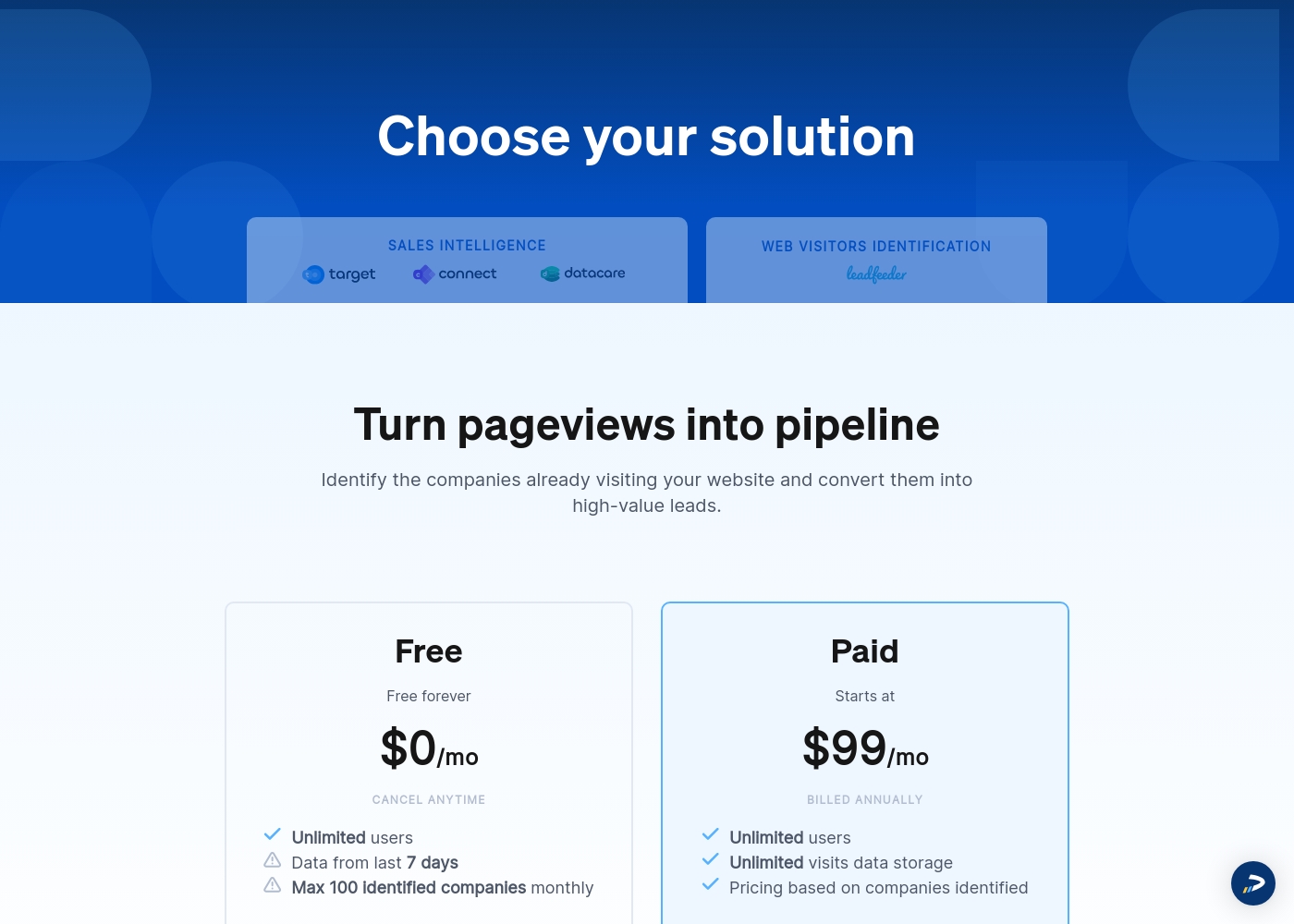
Leadfeeder costs between $0 and $99 per month (billed annually) with two plans: Free at $0 per month and Paid starting at $99 per month.
Here is a breakdown of what you get with each of the available identification solutions.
Free
Price: $0 per month Websites Supported: One per subscription (as subscriptions are priced per website) Best For: Small websites, evaluation, or testing the core feature set Refund Policy: Not applicable (It's free forever) Other Features: Unlimited users, data from the last 7 days, cancel anytime
- Free forever
- Unlimited users
- Verified company details (limited)
- Visitor data storage for the last 7 days
- Unlimited users
- Unlimited visits data storage
- All identified companies access
- Verified company details (firmographics & contact details)
- 25 contact export credits
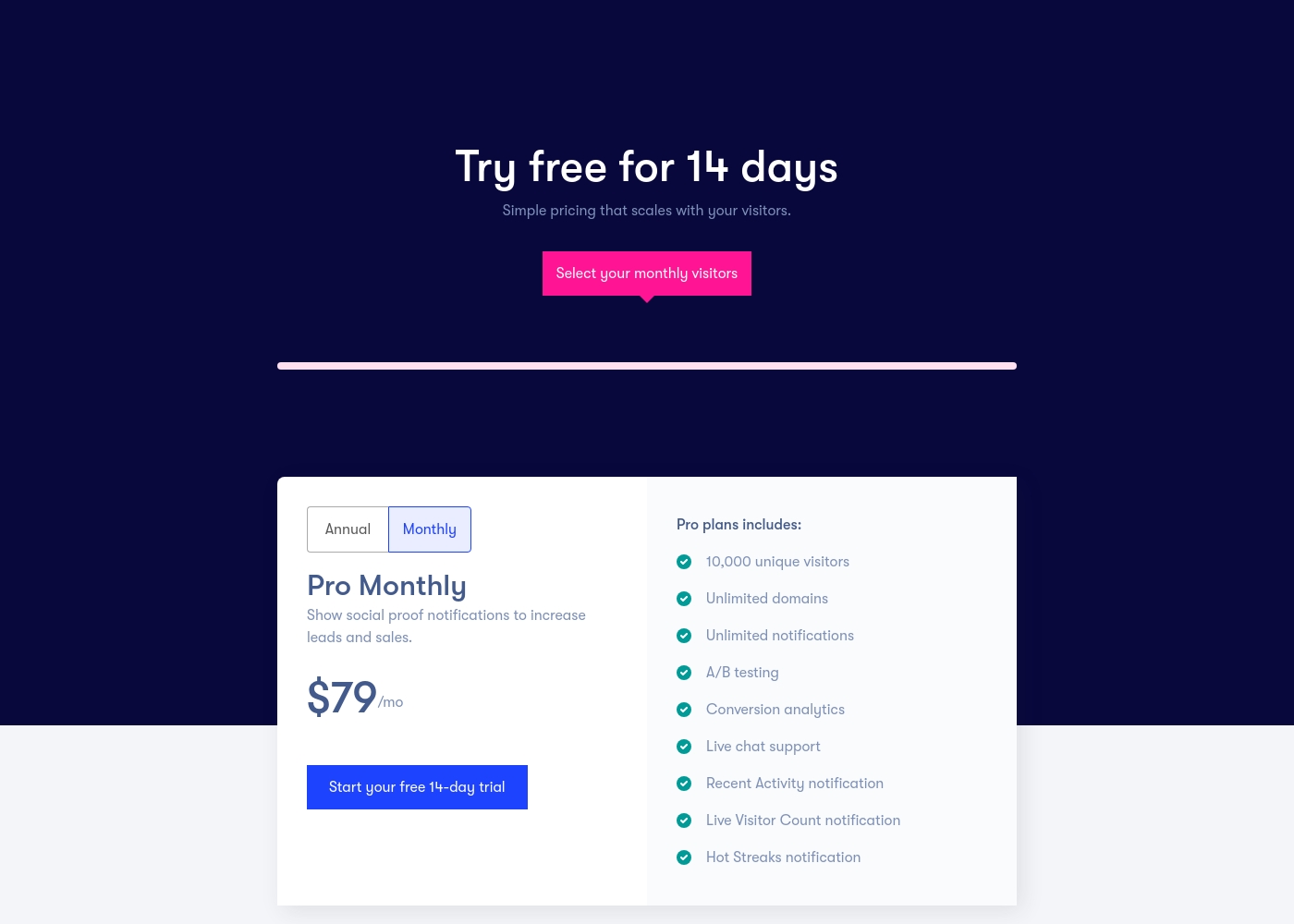
Proof costs between $24 and $108 per month billed annually with at least 5 plans: Basic at $24/mo, Pro at $66/mo, Business at $108/mo, Premium, and Platinum.
Choose the plan that fits your monthly traffic to start growing your conversion rates.
Basic
Price: $29/mo or $24/mo billed annually Best For: Small sites starting with social proof Other Features: Recent Activity notifications, Lead increase tools
- Show social proof notifications
- Recent Activity notifications
- Unlimited domains
- A/B testing
- Conversion analytics
- Live chat support
- Everything in Pro
- Unlimited notifications
- Hot Streaks notification
Pricing Notes
- Leadfeeder offers a free plan forever, which Proof does not.
- Leadfeeder's paid pricing is based on the number of companies identified. Proof's is based on unique visitors.
- Both offer a 14-day free trial for their paid plans.
- Leadfeeder's paid plans start at $99/month (billed annually). Proof's paid plans start at $29/month.
- Proof's annual billing offers up to 20% savings. Leadfeeder states ~30% savings for annual billing.
Pricing Head-to-Head
User Reviews
The customer feedback available paints a highly polarized picture of Leadfeeder. While users appreciate the core functionality—its ability to identify visiting companies and connect quickly with Google Analytics—recent experiences highlight significant operational and support issues.
Many users found the tool useful for generating leads when paired with high website traffic. However, recurring negative comments focus heavily on the financial practices.
Leadfeeder is a very useful tool and an honest company. It helps us correctly identify website visitors, which allows us to add high-quality prospects to our sales database. The support team has been genuinely helpful throughout our time using the product.
We found external reviews for Proof to be limited and mixed, with a notable absence of substantive feedback from major review platforms. ⚠️ On Trustpilot, the profile is largely empty, offering no clear user sentiment.
Capterra returned a security error, preventing access to any reviews. Consequently, we lack concrete user feedback on key themes like accuracy, ease of use, or support.
Our Verdict
This isn't a typical 'A vs B' battle. Leadfeeder and Proof solve two completely different problems for two different teams. Leadfeeder's superpower is peeling back the curtain on your anonymous web traffic. It tells your sales team exactly which companies are checking you out, even if their employees are remote. That's intelligence you can act on immediately. Proof's superpower is making the most of the traffic you already have. It lets you personalize what visitors see, show social proof, and A/B test to turn more of them into leads right on the spot. The deciding factor is your biggest pain point. Is it not knowing who's interested? That's Leadfeeder. Is it that your traffic isn't converting well enough? That's Proof. Choose Leadfeeder if you're in sales or lead gen and need to identify companies for outreach. Choose Proof if you're in marketing or growth and need to optimize on-site conversions. Some advanced teams might even use both, but for most, picking one depends on which part of the funnel needs fixing first.
Frequently Asked Questions
Can I use Leadfeeder and Proof together?
Technically, yes, but they serve different purposes. Use Leadfeeder to identify companies visiting your site. Use Proof to personalize the experience for those visitors. You'd be using them for separate stages of the funnel.
Which is better for small businesses on a budget?
Leadfeeder's free plan makes it the better choice for tight budgets. You can identify up to 100 companies monthly at no cost. Proof's cheapest plan is $29/month.
Does Leadfeeder work with Google Analytics?
Yes, Leadfeeder requires connecting to your Google Analytics account as part of its setup. This is how it accesses your website traffic data for company identification.
Is Proof good for e-commerce websites?
Proof can be used on e-commerce sites to show social proof like recent purchases. However, its core focus is broader website personalization for marketers and growth teams, not specifically e-commerce tools.
How does Leadfeeder identify remote workers?
Leadfeeder uses a large, constantly updated IP database. It claims to have the highest company recognition rate, identifying the company even if employees work from home with dynamic IPs.
Does Proof offer a free plan?
No, Proof does not offer a free plan. Its lowest tier is the Basic plan at $29/month. However, all plans come with a 14-day free trial.
Ready to Choose?
Both tools have their strengths. Choose based on your specific needs.