JivoChat vs Tidio
JivoChat and Tidio both centralize customer communication, but their core strategies differ wildly. JivoChat focuses on securing high-volume, multi-agent chat efficiency. Tidio bets heavily on AI, letting Lyro handle two-thirds of repetitive queries instantly.
Best for: Small businesses needing a robust permanent Free plan with 5 agents, Teams focused on maximizing operator throughput (5 simultaneous chats)
Best for: SMBs prioritizing AI automation and deflection using Lyro AI, Teams needing to integrate support channels with 120+ external applications
Reliability and support are critical failures.
We recognize JivoChat offers a powerful promise: consolidating omnichannel communication, live chat, and social messengers into one integrated hub. However, we cannot overlook the consistent and critical reports concerning software reliability, poor customer support, and abrupt, aggressive pricing changes. Overall, while the feature set is comprehensive, the documented operational failures and severe trust issues mean we strongly recommend caution before committing significant resources.
Pros
- Simple and fast implementation, ready to start in minutes.
- Effective unified platform for various social media messengers.
- Comprehensive features available (Telephony, AI, advanced APIs).
- Offers a generous permanent Free Plan supporting up to five agents.
Cons
- Major reliability problems (app syncing failures, lost customer chats, connection drops).
- Extremely poor customer support described as non-responsive and unhelpful.
- Frequent reports of unjustified, high price increases for existing customers.
- Strict No Refund policy and zero pro-rated credits, regardless of service issues.
Great AI automation, difficult billing practices.
We found Tidio excels in delivering powerful AI chat automation supported by remarkably fast and expert human assistance. Overall, we must caution that frequent reports of unexpected price hikes and aggressive billing strategies significantly cloud this positive technical experience.
Pros
- Superior and professional customer support with fast response times.
- Easy setup process and smooth website integration.
- Lyro AI effectively automates responses to common customer questions.
- Reliable chat platform with a user-friendly interface.
Cons
- Reports of unexpected rate increases and unnotified plan changes.
- Concerns raised about misleading pricing and billing practices.
- Some users experienced difficulty canceling subscriptions or receiving refunds.
- Limited customization options reported for chatbot design.
AboutJivoChat
JivoChat is a comprehensive communication hub trusted by over 200,000 businesses globally. This platform is designed for organizations seeking to centralize all customer interactions into a single, efficient application. Your team gains the toolkit required to provide fast and helpful responses, regardless of how the customer reaches out. 💡
It’s built to ensure operators can combine all incoming messages from various sources into one clean stream. This approach maintains high quality service by letting your team communicate effectively from one simple interface.
AboutTidio
Tidio is a complete customer service stack built to optimize your support offering. It provides the most intuitive real-time Live Chat combined with a robust Help Desk.
This structure helps you turn departmental chaos into streamlined efficiency. The platform uses Lyro AI, which handles about 90% of repetitive tasks across chat, email, and social media.
Tidio is built for brands that refuse to compromise on their customer experience. 💡 They aim to make your human agents more effective, not redundant.
Highlights
Feature Comparison
Features Overview
We highlight the main differences and pick a winner for each feature.
AI Automation
Tidio’s Lyro AI is central to its offering; JivoChat's AI is a basic, paid add-on feature.
JivoChat offers an AI Assistant as a $13 monthly add-on for faster agent responses. Chatbots are used to resolve simple pre-scripted queries. The automation focus is primarily to support live operator speed. Tidio uses Lyro AI as a core, powerful feature designed for ticket deflection. Lyro aims to resolve 67% of repetitive queries automatically. It boasts an overall 89% resolution rate without human intervention. The key difference is strategic: JivoChat augments the live agent, but Tidio replaces the live agent for routine questions. Tidio’s Lyro AI significantly reduces your required agent headcount for increased efficiency and reduced cost.
Pricing Model
JivoChat uses predictable per-agent pricing, while Tidio relies on usage-based conversations.
JivoChat pricing is straightforward, ranging from $0 to $56 per agent monthly. Their generous permanent Free plan supports five full-featured agents. Scaling costs scale linearly with your necessary team headcount. Tidio pricing is usage-based, focusing on unpredictable billable conversations which spike with volume. This model links your cost directly to shifts in customer demand. Tidio offers a strong Resolution Rate Guarantee on some plans. JivoChat offers cost certainty based on seats, making budgeting simpler. Tidio's costs fluctuate with customer service demand, which requires closer monitoring. If your support volume is highly cyclical, Tidio’s usage-based model might offer unexpected savings or spikes.
Security & Control
JivoChat explicitly secures social media accounts; Tidio focuses on standard security protocols.
JivoChat provides critical security by eliminating staff need for passwords. Staff operate securely through the JivoChat app without gaining actual social media credentials. This minimizes security risks if an employee leaves. Tidio does not detail specific features for securing third-party corporate accounts from staff access. Its data security is focused on standard platform privacy and data retention controls. JivoChat is the superior choice for companies concerned about staff access to corporate social accounts. This feature protects valuable digital assets. Tidio assumes a higher level of internal trust, lacking this proprietary security layer.
Integration Breadth
Tidio connects to over 120 apps; JivoChat offers a Web API and only 50 ready-made solutions.
JivoChat gives you a robust Web API and about 50 ready-made integrations, mainly for popular CRMs. If deep customization is needed, the Chat API is restricted to the highest VIP Enterprise plan. Tidio integrates with a massive library of 120+ external tools to fit complex technology stacks. This vast ecosystem allows for smoother data flow and connectivity across your business platforms. Tidio offers significantly superior breadth and compatibility for diverse software needs than JivoChat. JivoChat users rely heavily on the 50 provided solutions. If you use niche or unique software, Tidio is more likely to provide a seamless, easy connection.
Agent Efficiency
JivoChat maximizes simultaneous engagement; Tidio achieves efficiency through AI deflection.
JivoChat allows a single agent to handle up to five different chat conversations simultaneously. Team members can massively boost throughput compared to traditional one-on-one interactions. This leverages agent parallelization. Tidio increases efficiency using Lyro AI to handle 67% of repetitive tickets automatically. Human agents only handle complex, higher-value work, maximizing their impact per ticket. If your goal is agents answering the max number of chats, choose JivoChat. If your goal is overall ticket reduction, choose Tidio. The approaches to efficiency are fundamentally different based on staffing needs.
Trust & Support
Tidio has stable performance and helpful support; JivoChat suffers from widespread, critical failures.
JivoChat users widely report major reliability problems, including connection drops and lost customer chats. Customer support is consistently described as a non-responsive disaster. Price increases are sudden. Tidio reviews are largely positive, praising responsive support and platform stability. Users noted only minor issues regarding pricing clarity and refunds. Tidio is considered a dependable tool. JivoChat's documented reliability and operational failures are a major red flag for using it in core business operations. Tidio offers a much more stable and reliable working environment. Trust and stability alone justify choosing Tidio over JivoChat repeatedly.
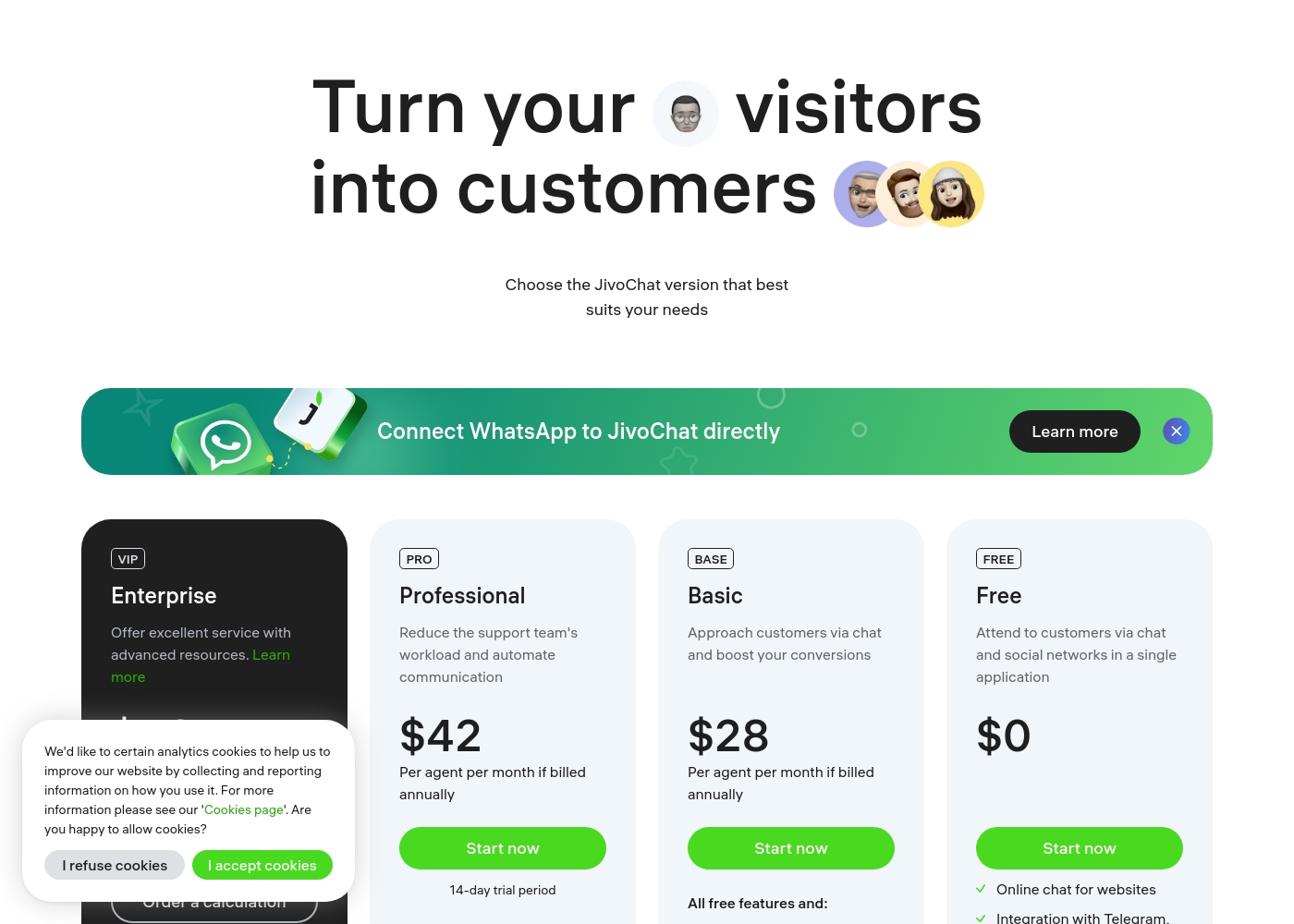
JivoChat costs between $0 and $56 per agent per month with four plans: Free at $0, Basic at $28, Professional at $42, and VIP Enterprise at $56 (all paid prices are based on annual billing).
Let's look at the details of each tier so you can find the perfect fit for your business needs.
Free
Price: $0 Websites Supported: Unlimited Best For: Businesses starting conversation via chat and social media Other Features:
- Online chat for websites
- Integration with Telegram, Facebook, Instagram, Viber
- Callback feature and offline forms
- Supports up to 5 agents
- Online chat for websites
- Integration with Telegram, Facebook, Instagram, Viber
- Callback feature and Offline forms
- Applications for Desktop, Mobile and web browsers
- Proactive invitations and pre-chat buttons
- Real-time monitoring of visitors
- Ready answers with Automatic Assistant
- Anti-Spam protection and JivoChat CRM
- All Basic features
- Telephony Plus module and voice messages on social media
- Integration with WhatsApp and chatbots
- Chat rescue
- All Professional features
- Mobile SDK
- Chat routing and Video call module
- Chat API
Tidio costs between $0 and $749+ per month with 5 main plans: Free at $0/mo, Starter at $24.17/mo, Growth starting at $49.17/mo, Plus starting at $749/mo, and Premium requiring contact for pricing.
Here’s a breakdown of what each subscription offers so you can choose the best fit for your business needs.
Free
Price: $0/mo. Other Features:
- 10 seats
- 50 Billable conversations per month
- Live chat & Ticketing
- Your first 50 Lyro AI Agent conversations (lifetime limit)
- 10 seats
- Live chat & Ticketing
- Copilot New
- Website scraper
- 10 seats
- Basic analytics
- Social media integrations
- Email management system
- Everything in Starter
- Advanced analytics
- Permissions
- Live typing
- Automatic response
- Everything in Growth
- Dedicated Success Manager
- Custom branding
- Multiproject
- Multilanguage

Pricing Notes
- JivoChat offers a generous permanent Free plan enabling up to 5 agents for basic features.
- JivoChat pricing is predictable; costs scale linearly with the number of licensed agents required.
- Tidio uses usage-based pricing on billable conversations, making costs variable and volume-dependent.
- Tidio offers a Resolution Rate Guarantee, promising a refund if resolution doesn't increase by 50%.
- JivoChat has reports of sudden, aggressive price increases and a strict No Refund policy.
Pricing Head-to-Head
User Reviews
External feedback for JivoChat presents a complex and concerning picture. While the platform is occasionally praised for its ease of deployment and ability to seamlessly handle social media messengers, the overwhelming majority of reviews report critical systemic failures.
Users consistently complain about app reliability, noting that the software frequently fails to sync, kicks agents out, and results in lost customer chats and disrupted communication. Customer support is universally described as a “disaster,” often being non-responsive, unhelpful, or requiring users to re-explain their problems repeatedly.
This company abruptly increased prices by 300% for existing users without any notice or justification. This breach of trust, coupled with app failures and poor sync reliability, makes it impossible to work with them. We strongly advise looking elsewhere for reliability.
Users predominantly praise Tidio for its exceptional customer support. Reviewers consistently describe the staff as knowledgeable, friendly, and fast-responding, often resolving complex issues quickly via live chat—many naming agents personally for providing ‘flawless’ and ‘top-notch’ service.
The platform itself is widely regarded as user-friendly and reliable, noted for its quick setup and smooth website integration. Customers highly value the Lyro AI features, particularly the ability to train the chatbot based on existing help center content.
I had an exceptional experience with Tidio’s customer service team! They provided clear guidance and helped me choose the perfect plan that aligns with my team's needs. Their response time was incredibly fast and helpful.
Our Verdict
Technically, JivoChat and Tidio both offer unified communication, but Tidio is the unequivocal winner. Tidio provides a stable platform, reliable customer support, and aggressive Lyro AI automation. JivoChat's powerful feature set is unfortunately overshadowed by severe reliability issues and terrible user trust reviews. JivoChat's major strength is maximizing agent capacity, allowing a single agent to handle five parallel chats. JivoChat also offers excellent security, protecting corporate social media accounts from shared staff passwords. If you run a small operation needing five agents for free, JivoChat is worth testing cautiously. Tidio’s superpower is maximizing ticket deflection, using Lyro AI to handle up to 67% of initial conversations. Tidio also offers a massive 120+ integration library, fitting into complex existing tech stacks easily. Tidio backs its product with a Resolution Rate Guarantee and fast, helpful human support. The key deciding factor is stability: do you risk service outages for marginal efficiency gains? Tidio simply offers a professional, reliable system that won't lose customer data. JivoChat's user reports of lost chats make it a non-starter for business-critical communications. Choose Tidio if you value AI scalability and integration breadth, especially if you have high volume. Stick with JivoChat only if securing social media passwords is your absolute primary security concern, and you are willing to overlook the major reliability warnings.
Frequently Asked Questions
Which offers better AI automation: JivoChat or Tidio?
Tidio is superior; its Lyro AI handles 67% of repetitive queries automatically. JivoChat only offers its basic AI assistant as a paid add-on. Tidio’s AI creates a much larger deflection impact.
Does JivoChat or Tidio offer a better Free plan?
JivoChat offers a more agent-centric Free plan, supporting 5 authorized agents permanently. Tidio's Free plan primarily scales based on billable conversations. If you staff many agents, JivoChat offers better free value.
Is Tidio's usage-based pricing cheaper than JivoChat's per-agent fee?
Tidio is cheaper if your support volume is low or highly deflected by Lyro AI. JivoChat is more predictable but quickly becomes expensive if you need many paid agents. Tidio costs fluctuate with customer demand.
Which tool is more reliable according to user reviews?
Tidio is significantly more reliable and offers much better support performance. JivoChat users report constant app failures, lost customer chats, and unresponsive support teams. Tidio ensures a more stable platform.
Does JivoChat have more third-party integrations than Tidio?
No, Tidio offers over 120 integrations across various platforms and tools. JivoChat provides a Web API and is limited to about 50 ready-made integration solutions.
Which software is better for proactive sales engagement?
JivoChat includes explicit tools for real-time visitor monitoring and proactive chat invitations. Tidio focuses more on automating lead qualification via guided Flows. JivoChat gives agents direct control.
Ready to Choose?
Both tools have their strengths. Choose based on your specific needs.