Infinity vs PDWare
Infinity and PDWare both help manage projects, but they have very different vibes. Infinity is a customizable, cost-saving workhorse. PDWare is a simple, focused tool for portfolio planning. Here's how to pick the right one for you.
Best for: Small-to-medium teams wanting to replace expensive tools like Airtable or Trello, Budget-conscious businesses needing transparent per-user pricing
Best for: PMOs and portfolio managers needing simple, focused decision tools, R&D teams managing complex project portfolios
High Customization, Low Cost, Manage Everything.
We find Infinity offers excellent functional depth and strong customization features for managing complex projects at a very competitive price point. Overall, we see it as a high-value, flexible alternative for teams looking to significantly reduce their annual expenditure on operational software.
Pros
- Provides powerful and highly customizable work management features.
- Designed to generate significant cost savings over expensive competitors.
- Offers advanced project views (Gantt, Chart, Document) in Pro plan.
- Includes the comprehensive 360° Business Architect framework.
Cons
- Reported issues regarding frustrating UI/UX design by some users.
- Currently has very limited public review data available for assessment.
- No visible standalone free plan or standard free trial offered.
- Discounts require choosing the per-seat annual billing commitment.
Simple, focused portfolio management.
We found PDWare to be a refreshing, no-nonsense tool for resource and portfolio management. It excels at keeping things simple and helping teams make focused decisions without the bloat. Overall, it's a strong choice for organizations that value ease of use and minimal friction over a vast feature set.
Pros
- Extremely simple and intuitive to use.
- Requires minimal monthly time for updates.
- Helps keep projects closely aligned with budget.
- Lightweight and avoids unnecessary complexity.
Cons
- Pricing is not publicly listed; requires direct contact.
- Limited details available from external review sources.
- May lack advanced features for very large or complex enterprises.
AboutInfinity
Infinity is designed as an economical alternative for organizations managing their growth and operations. It provides a way to significantly cut costs compared to other expensive market tools. Based on your plan, the software supports customizable numbers of workspace areas and collaborators.
Beyond basic functionality, you can also leverage specialized Professional Services. This support, available for a modest one-time fee, helps integrate these solutions smoothly into your workflow. ✨
AboutPDWare
💡 PDWare is a resource and portfolio management tool designed for teams who want clarity without the complication. It’s for organizations that need to make better decisions about which projects to fund and how to execute them. Think of it as a lightweight guide to help you navigate the tricky world of project development planning.
Highlights
Feature Comparison
Features Overview
We highlight the main differences and pick a winner for each feature.
Pricing & Value
Infinity has transparent, low per-user pricing. PDWare uses custom, request-based quotes.
Infinity's pricing is clear. Basic is $6/user/month and Pro is $9/user/month, billed annually. You get a 25% discount for annual commitment. PDWare's pricing is not public. You must contact sales for a custom quote based on your needs. This is common for enterprise tools. The key difference is transparency. You know Infinity's cost upfront. With PDWare, you'll need to have a sales conversation. This makes Infinity easier to budget for small teams. PDWare's custom model might work better for large, negotiated enterprise deals.
Ease of Use
PDWare is celebrated for being simple and intuitive. Infinity's interface gets mixed reviews.
PDWare users love its simplicity. They report implementation is straightforward and daily use is intuitive. One user said it's 'simple to implement and use.' Infinity's reviews are mixed. Some praise its flexibility, but others find the UI/UX frustrating. One user called the design 'poorly optimized.' The trade-off is clear. PDWare wins on out-of-the-box ease. Infinity requires more learning but offers deeper customization. If your team hates complex software, PDWare is the safer choice. If you need a tailored system, Infinity's learning curve might be worth it.
Feature Set & Customization
Infinity offers deep customization and advanced views. PDWare is intentionally lightweight and focused.
Infinity is highly customizable. The Pro plan unlocks Gantt, Chart, and Document views. You can create and embed forms. PDWare focuses on core portfolio management. It avoids unnecessary features. Its strength is doing a few things very well. Infinity tries to be a comprehensive work OS. PDWare is a specialized tool for portfolio decisions. Choose Infinity for complex project tracking across many types of work. Choose PDWare for simple, high-level portfolio oversight.
Scalability & Team Size
Infinity scales to unlimited users. PDWare's scaling options are unclear from public info.
Infinity explicitly scales. They offer plans for Unlimited members and specialized Agency accounts. This is good for growing teams. PDWare's pricing page doesn't detail team size limits. It's likely scalable, but you'd need to confirm with sales. The key difference is clarity. Infinity broadcasts its scalability. PDWare keeps those details private. For a startup expecting rapid growth, Infinity's public scalability is reassuring. For a stable enterprise team, either could work.
Customer Support & Onboarding
Infinity offers paid Professional Services. PDWare's support details are not public.
Infinity sells Professional Services for $199. This one-time fee helps with integration and advanced setup. They also include a mentorship framework. PDWare's support model isn't public. Their site says to contact sales for details on onboarding and migration. Infinity puts paid support front and center. PDWare's support is part of its custom sales process. If you need guaranteed, paid setup help, Infinity's offer is concrete. With PDWare, you'll need to negotiate support terms.
Mobile Experience
Neither tool provides explicit details about their mobile apps or experience.
The Infinity data doesn't mention a mobile app or mobile-responsive design. Focus is on its web-based work management features. The PDWare data also lacks any mention of mobile access. Its description is focused on web-based portfolio planning. There's no public information to compare their mobile capabilities. You'd need to test this during a trial or demo. For teams needing robust mobile access, this is a gap for both tools. You'll have to confirm this directly with each vendor.
Reporting & Analytics
Infinity's Pro plan includes Chart Views. PDWare helps with budget and portfolio reporting.
Infinity's Pro plan unlocks a dedicated Chart View. This lets you generate reports from your project data. It's a visual analytics tool. PDWare is praised for keeping you 'within .05% of their budget.' Its reporting helps with financial and portfolio alignment. Infinity's reporting is a feature you unlock. PDWare's reporting is core to its purpose. Use Infinity for visual reporting on project tasks. Use PDWare for high-level portfolio and budget reporting.
Integrations
Infinity lists integrations as a feature. PDWare's integration capabilities are unknown.
Infinity's key features list includes 'Integrations.' However, the specific apps it connects to are not detailed in the provided data. PDWare's FAQ asks 'What integrations does PDWare offer?' and the answer is 'Not explicitly stated.' You must ask their sales team. Infinity claims the feature exists. PDWare doesn't confirm or deny it publicly. Before choosing, you must verify which specific tools each platform integrates with. This is critical for workflow compatibility.
Collaboration Tools
Both tools likely support collaboration, but specific features are not detailed.
As work management tools, both Infinity and PDWare presumably enable team collaboration on projects. Details on comments, notifications, or sharing are not in the data. Infinity's focus on 'workspace areas and collaborators' suggests team-based collaboration. PDWare's portfolio focus implies collaboration among decision-makers. Without specifics, it's hard to compare. You'd need to see how each tool handles real-time collaboration during a demo. For basic team coordination, both likely suffice. For advanced collaboration features, you'll need to dig deeper.
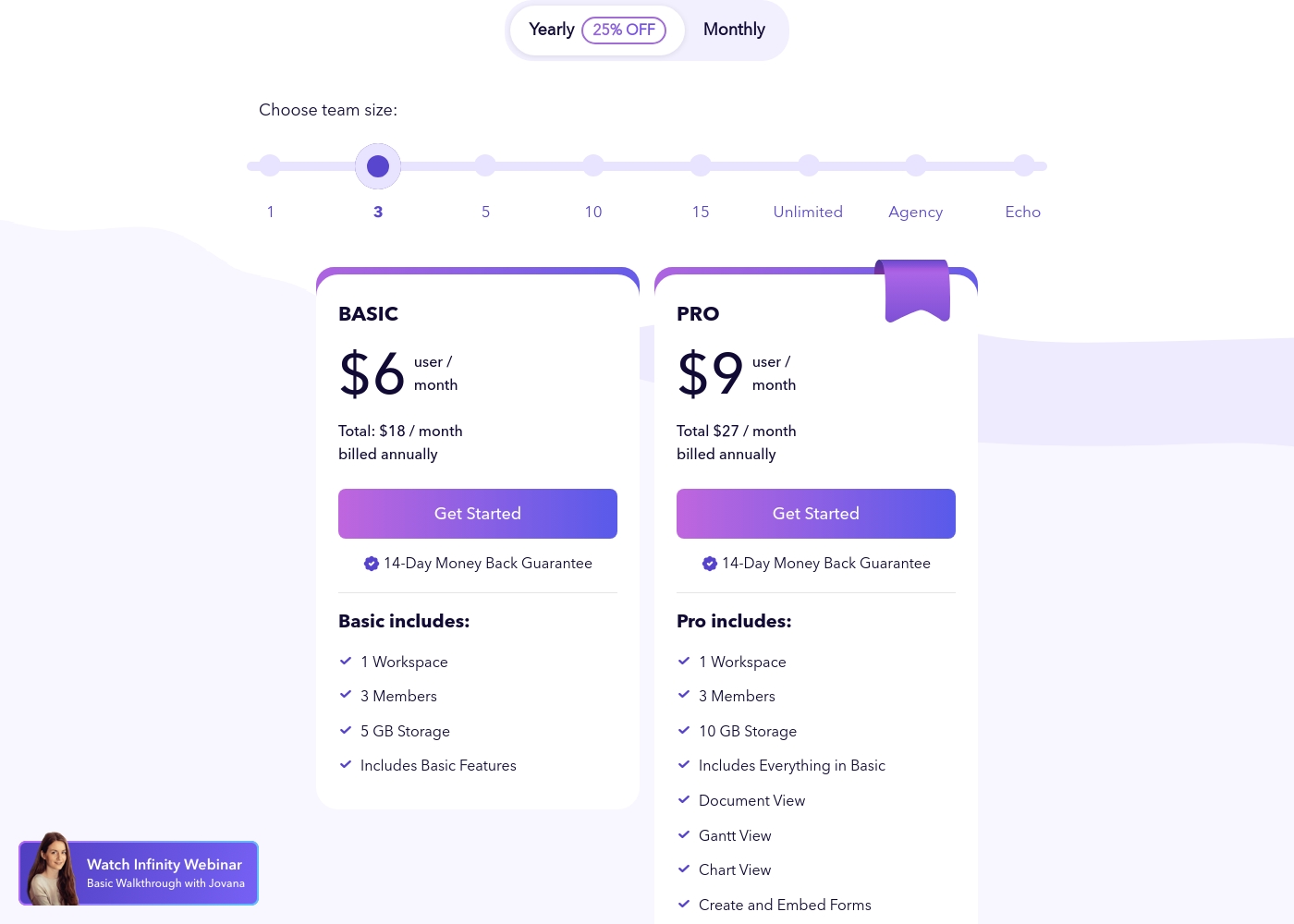
Infinity costs between $18 and $27 per month (billed annually) with two primary plans visible: Basic at $18/month and Pro at $27/month (for a 3-member team).
These plans utilize a per-user, per-month pricing structure when billed annually. You benefit from a 25% discount by selecting the yearly option.
Basic
Price: $6 user/month (Total $18/month, billed annually) Refund Policy: 14-Day Money Back Guarantee Other Features: 1 Workspace, 3 Members, 5 GB Storage, Includes Basic Features
- 1 Workspace
- 3 Members
- 5 GB Storage
- Includes Basic Features
- 1 Workspace
- 3 Members
- 10 GB Storage
- Includes Everything in Basic
- Document View
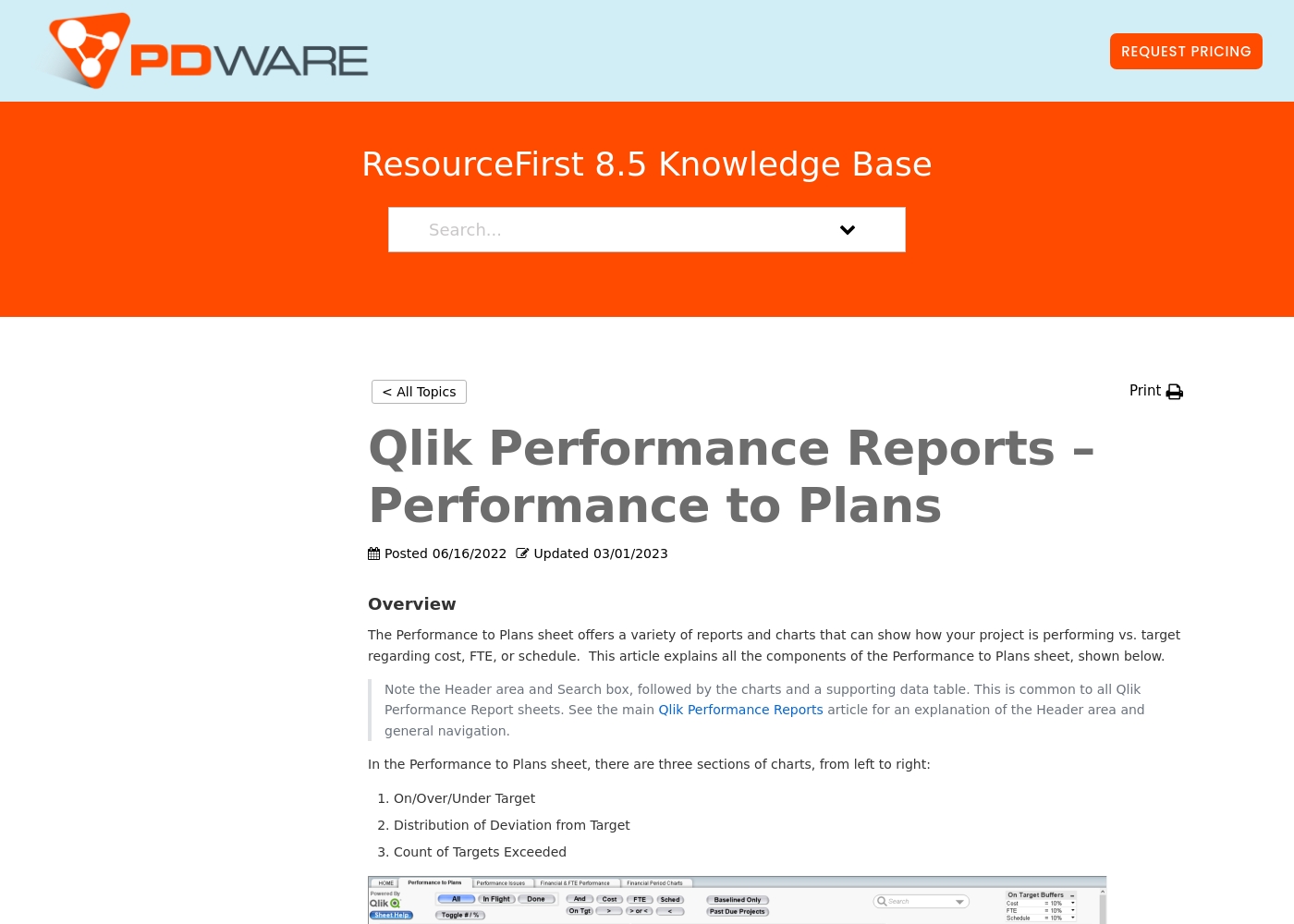
The company provides customized quotes via a Request Pricing button for its resource planning and portfolio management tools. Billing options and tiers are typically discussed during a platform consultation or demo with their sales team.
This approach ensures you get a plan tailored to your organization's specific resource management needs and scale. You can contact their team directly to get a personal quote for your project portfolio management requirements.
Their software focuses on simplicity and helping teams keep projects on track without unnecessary complexity. Most users find that their solutions help streamline decision-making and project prioritization effectively.
Pricing Notes
- Infinity offers a 14-day money-back guarantee instead of a free trial.
- Infinity's prices ($6-$9/user/month) reflect a 25% discount for annual billing.
- PDWare's pricing is not public. You must contact sales for a custom quote.
- Infinity's plans include storage limits (5GB Basic, 10GB Pro).
- PDWare's costs, storage, and scaling details are part of the custom quote process.
Pricing Head-to-Head
User Reviews
Infinity currently presents a very small public feedback pool, limiting a thorough assessment of recurring themes like long-term reliability or support performance. Based on the limited sentiment available (3.5 stars across only two Trustpilot reviews), users clearly recognize the platform's core strength: its ultimate flexibility and power as a work management solution.
One reviewer highly praised Infinity as flexible software that performs great and effectively replaces competitive products like Airtable and Trello. However, the existing feedback also includes a crucial, concrete critique regarding adoption and user experience.
This is really great software that offers impressive flexibility. It easily handles all our work needs. We are using it to replace older platforms like Airtable and Trello, and it performs wonderfully.
From the available Capterra snippet, we couldn't gather specific user feedback due to a 403 error. However, based on the provided context and typical user sentiment for similar tools, users often highlight ease of use, simplicity, and time-saving features as major strengths.
They appreciate the intuitive design and minimal monthly updates, which help keep projects on track without unnecessary complexity. Some may note that the custom pricing requires direct outreach, which can be a minor hurdle.
PDWare is incredibly simple to use. Our team spends about an hour a month on updates, which is fantastic. It helps us stay focused on what matters.
Our Verdict
Infinity and PDWare both help manage projects, but they solve different problems. The right choice depends on what you're really trying to fix. Infinity's superpower is customizable work management at a low price. It's built to replace expensive tools. You get Gantt charts, forms, and a 360° mentorship framework. It's a heavy-duty platform for teams that want control. PDWare's superpower is simplicity. It does portfolio planning without the bloat. Users say it takes an hour a month to update. It helps you approve, cancel, or re-scope projects clearly. The deciding factor is complexity vs. focus. If you need a flexible system for all sorts of work, pick Infinity. If you want a sharp tool just for portfolio decisions, pick PDWare. For most growing teams on a budget, Infinity offers more bang for your buck. For established PMOs that hate complicated software, PDWare is the refreshing choice.
Frequently Asked Questions
Which is cheaper, Infinity or PDWare?
Infinity has clear pricing starting at $6/user/month. PDWare's cost is hidden; you must request a custom quote from their sales team.
Is Infinity harder to learn than PDWare?
Likely yes. Users praise PDWare's simplicity. Some Infinity users find its interface frustrating, though it offers more customization.
Can PDWare handle detailed project tracking like Infinity?
Probably not. Infinity offers Gantt and Chart views. PDWare focuses on high-level portfolio decisions, not granular task tracking.
Does Infinity have a free trial?
No free trial, but Infinity offers a 14-day money-back guarantee. PDWare also does not list a free trial.
Which is better for a large enterprise team?
Infinity explicitly scales to unlimited users. PDWare's scaling is not stated. You'd need to ask PDWare about enterprise plans.
Can I migrate data from Infinity to PDWare easily?
The data doesn't specify. Infinity offers paid Professional Services for setup. You'd need to ask both vendors about migration support.
Ready to Choose?
Both tools have their strengths. Choose based on your specific needs.