Infinity vs Ora
People often debate power versus polish when comparing these two tools. Infinity offers massive cost savings and deep customization for complex needs. Ora excels with superior usability and a great free plan for growing teams.
Best for: Organizations focused on budget optimization and cost reduction., Teams migrating off high-cost platforms like Airtable or Trello.
Best for: Individuals and small teams (up to 10 users) needing a free plan., Teams prioritizing a modern, user-friendly interface.
High Customization, Low Cost, Manage Everything.
We find Infinity offers excellent functional depth and strong customization features for managing complex projects at a very competitive price point. Overall, we see it as a high-value, flexible alternative for teams looking to significantly reduce their annual expenditure on operational software.
Pros
- Provides powerful and highly customizable work management features.
- Designed to generate significant cost savings over expensive competitors.
- Offers advanced project views (Gantt, Chart, Document) in Pro plan.
- Includes the comprehensive 360° Business Architect framework.
Cons
- Reported issues regarding frustrating UI/UX design by some users.
- Currently has very limited public review data available for assessment.
- No visible standalone free plan or standard free trial offered.
- Discounts require choosing the per-seat annual billing commitment.
The Modern, User-Friendly Command Center
We found Ora provides an impressive balance between comprehensive features and usability, positioning itself as a strong alternative to established systems. Its generous free tier and unique calendar-focused organization greatly benefit small, growing teams and individuals. Overall, we recommend Ora highly for collaborative organizations seeking a focused, effective project management solution.
Pros
- Generous free plan available for small teams (up to 10 users) forever.
- Exceptional user-friendliness; users prefer it over competitors like Trello.
- Comprehensive task cards support RTF, Markdown, and custom code highlights.
- Agenda Calendar helps users achieve better focus and plan dedicated work time.
Cons
- External review volume is currently very limited (only 3 Trustpilot reviews).
- File size limit is restrictive on the Basic (free) tier (a maximum of 10mb).
AboutInfinity
Infinity is designed as an economical alternative for organizations managing their growth and operations. It provides a way to significantly cut costs compared to other expensive market tools. Based on your plan, the software supports customizable numbers of workspace areas and collaborators.
Beyond basic functionality, you can also leverage specialized Professional Services. This support, available for a modest one-time fee, helps integrate these solutions smoothly into your workflow. ✨
AboutOra
Ora is a powerful platform designed for productive individuals and collaborative teams. It serves as your daily planner and central hub for managing work. The core Agenda Calendar helps you organize your time and be more effective. Instead of dealing with separate tools, all your critical information, tracked time, and completed tasks appear directly on your calendar. You can quickly view both your tasks and those of your teammates, ensuring smooth collaboration. 💡
Highlights
Feature Comparison
Features Overview
We highlight the main differences and pick a winner for each feature.
User Interface & Design
Ora is praised for exceptional usability and clean design. Infinity users often complain about its somewhat frustrating UI/UX.
Ora consistently receives high praise for its excellent user-friendliness and modern interface. Reviewers call Ora superior to older competitors like Trello for daily use. This makes Ora adoption quick and painless for new teams. Infinity is powerful and delivers incredible customization potential to users. However, several users report that Infinity’s UI/UX design can feel poorly optimized. This poor optimization sometimes makes Infinity frustrating to navigate daily. Ora presents an intuitive command center that prioritizes a seamless user flow. Infinity trades visual Polish for deeper functional flexibility and immense power. If fast adoption and fluid daily work are your goals, Ora is the clear winner for UI execution. Infinity requires users to tolerate its design flaws for the feature depth.
Cost vs. Free Access
Ora provides a generous free plan, perfect for small teams. Infinity focuses on saving thousands in subscription costs using low per-user fees.
Ora offers a robust Basic plan that is completely free forever for up to 10 users. It includes unlimited projects and tasks, making Ora a fantastic starting point. Ora transitions to $5.99/user/month when billed annually for paid features. Infinity uses a budget-conscious, per-user pricing model starting at $6/user/month annually. Infinity does not offer a free plan but provides a 14-day money-back guarantee. Infinity claims it saves users thousands compared to higher-cost rivals. Ora provides unparalleled free accessibility for teams just starting out or staying small. Infinity offers lower costs for power users who would otherwise pay much more monthly. If you need a reliable free option right now, Ora wins easily. If cost savings at scale are the goal, Infinity provides compelling budget optimization.
Advanced Project Views
Infinity offers essential advanced views like Gantt and Chart for tracking growth. Ora focuses on task relationships and calendar visualization instead.
Infinity’s Pro plan unlocks critical advanced visualization tools for complex projects. These powerful tools include Gantt View to manage detailed dependencies and timelines. Users can also utilize Chart View to generate high-level, informative reports easily. Ora emphasizes individual task management and relationship mapping, but it lacks traditional Chart and Gantt views. Ora’s focus is helping users master their focus using the unique Agenda Calendar tool. Ora relies on team discussions for high-level project reporting. Infinity is built to handle professional, complex project tracking from initiation to completion. Ora is better suited for managing dynamic project execution rather than formal project scheduling. For anyone managing complex project portfolios or official timelines, Infinity’s specialized views are indispensable.
Productivity & Focus
Ora’s Agenda Calendar centralizes time management and tracks user effectiveness. Infinity provides powerful dashboards but lacks a dedicated focus tool.
Ora's unique Agenda Calendar feature acts as your daily planner and command center. It helps users block dedicated time and prioritize truly essential tasks. The calendar shows tracked time and completed tasks in one central place. Infinity provides effective workspace management and strong customization options. Users must rely on third-party integrations or manual processes for deep personal time tracking. Infinity emphasizes project data over personal workday visualization. Ora helps the user escape email clutter and concentrate on a productive schedule. Infinity ensures the project has the necessary structure and data management features. If you want a tool that directly helps you manage your time and attention daily, Ora delivers that capability seamlessly.
Dependency Mapping
Ora excels by defining task relationships like blocking and subtasks easily. Infinity’s platform does not explicitly feature dynamic task dependency mapping.
Ora includes robust functionality for managing complex workflows using task relationships. Users can mark tasks as blocking, dependent, or add them as subtasks within the system. This clarifies production flows and helps manage accurate timelines. The documentation for Infinity emphasizes custom fields and advanced views for tracking progress. While powerful, Infinity does not clearly offer the structured dependency mapping found in Ora. Team coordination relies more on manual data visualization in Infinity. Ora simplifies complex project planning by clearly visualizing sequential task flows for the whole team. Infinity requires more manual checks to ensure tasks are completed in the correct order. Ora is better suited if complex tasks relying on specific order completion are part of your core workflow management.
Unique Business Support
Infinity offers personalized mentorship via the 360° Business Architect framework. Ora focuses strictly on providing software tools for project execution.
Infinity provides a highly specialized and unique feature with its 360° Business Architect service. This framework includes dedicated software, comprehensive lessons, and personalized one-on-one mentorship. It is designed to guide scalability and business growth efforts effectively. Ora focuses on perfecting the user experience and core project management functions. While Ora is highly effective for execution, it does not offer associated operational guidance or mentorship services. Ora lets the user define their own success plan. Infinity sees itself as a partner in growth, offering guidance alongside the software platform. Ora is purely a powerful system executor that relies on user expertise. This specific service makes Infinity a strong choice for business owners actively seeking strategic operational support.
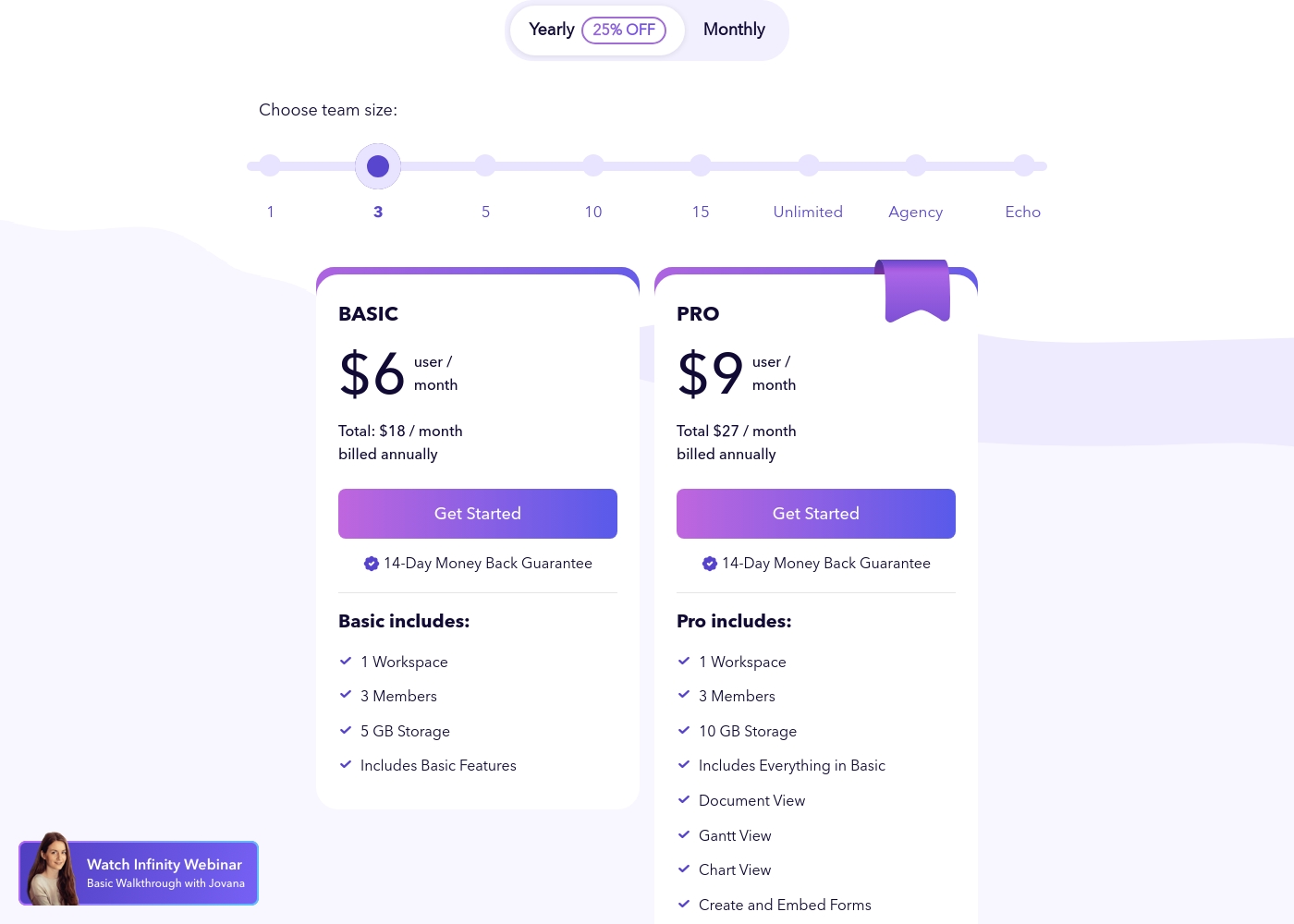
Infinity costs between $18 and $27 per month (billed annually) with two primary plans visible: Basic at $18/month and Pro at $27/month (for a 3-member team).
These plans utilize a per-user, per-month pricing structure when billed annually. You benefit from a 25% discount by selecting the yearly option.
Basic
Price: $6 user/month (Total $18/month, billed annually) Refund Policy: 14-Day Money Back Guarantee Other Features: 1 Workspace, 3 Members, 5 GB Storage, Includes Basic Features
- 1 Workspace
- 3 Members
- 5 GB Storage
- Includes Basic Features
- 1 Workspace
- 3 Members
- 10 GB Storage
- Includes Everything in Basic
- Document View
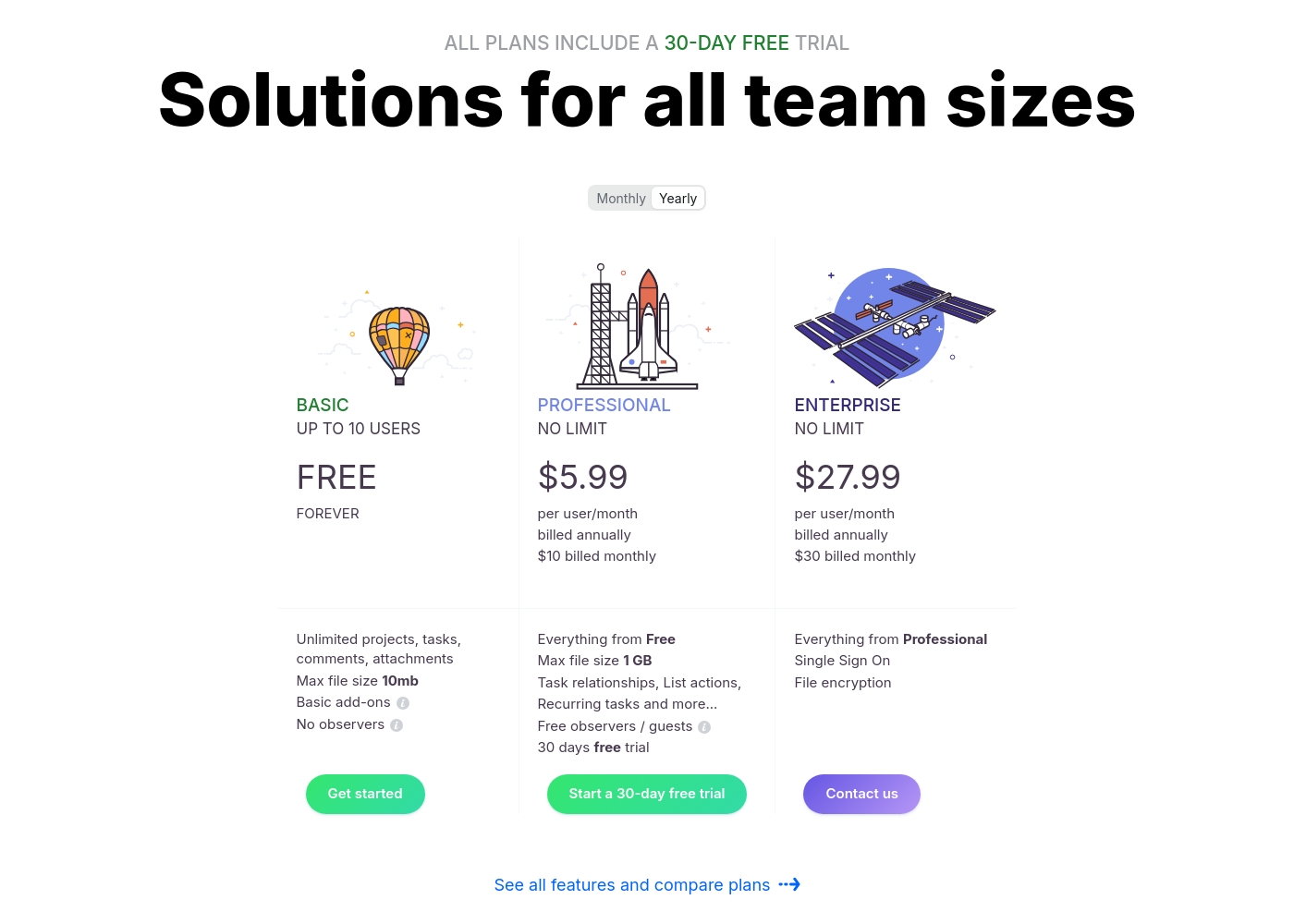
Ora costs between $0 and $30 per user/month with three plans: Basic at $0, Professional starting at $5.99 per user/month, and Enterprise starting at $27.99 per user/month.
We provide solutions for all team sizes, ensuring you only pay for the features and scale you truly need.
Ora Basic
Price: $0.00 / month (Free Forever) Best For: Teams of up to 10 users needing core project management and collaboration. Other Features:
- Unlimited projects, tasks, comments, and attachments
- Max file size is 10mb
- Includes Basic add-ons
- Supports up to 10 organization members
- Unlimited projects
- Unlimited tasks, comments, attachments
- Web, desktop, iOS, and Android apps
- Max file size 1 GB
- Task relationships
- Recurring tasks
- List actions (automation)
- Free observers / guests
- Single Sign On (SSO)
- File encryption
- Everything from Professional tier
Pricing Notes
- Ora offers a powerful free-forever plan supporting up to 10 users.
- Infinity's paid tiers are significantly cheaper, starting at $6/user/month annually vs. Ora's $5.99/user/month annual rate for Professional.
- Infinity secures investment with a strong 14-day money-back guarantee instead of a standard free trial for basic plans.
- Ora offers a 30-day free trial for its paid Professional and Enterprise plans.
- Ora provides a generous 50% discount for qualifying non-profits and educational institutions.
Pricing Head-to-Head
User Reviews
Infinity currently presents a very small public feedback pool, limiting a thorough assessment of recurring themes like long-term reliability or support performance. Based on the limited sentiment available (3.5 stars across only two Trustpilot reviews), users clearly recognize the platform's core strength: its ultimate flexibility and power as a work management solution.
One reviewer highly praised Infinity as flexible software that performs great and effectively replaces competitive products like Airtable and Trello. However, the existing feedback also includes a crucial, concrete critique regarding adoption and user experience.
This is really great software that offers impressive flexibility. It easily handles all our work needs. We are using it to replace older platforms like Airtable and Trello, and it performs wonderfully.
Customer sentiment for Ora is strongly positive, emphasizing its robust capabilities and outstanding usability. Several reviewers highlight that Ora is exceptionally user-friendly and superior to competitors like Trello, even though it is a relatively younger product.
Users rely on the platform daily for managing diverse projects, and one reviewer called it simply "the best platform for PM." While the current feedback volume is low, the recurring themes suggest high satisfaction regarding core functionality and daily reliability. The enthusiasm indicates that users find the platform’s functional depth combined with its ease of use provides strong value for teams seeking a productive command center.
Ora is one of my favorite daily web services for managing various tasks. It’s exceptionally user-friendly and handles diverse projects easily. I recommend it as a superior option compared to Trello.
Our Verdict
Choosing between Infinity and Ora is easy if you clearly identify your priority focus. Ora wins if exceptional usability and a free plan are your main concerns. Infinity is the clear winner for organizations focused on extreme budget cutting and deep customization. Both platforms offer extremely robust work management tools. Infinity’s superpower is delivering high functional power at an incredibly low cost. It helps businesses save thousands by replacing expensive tools like Airtable or Trello. The Infinity Pro plan provides crucial advanced views like Gantt and Chart tools. Infinity also offers unique 360° Business Architect mentorship services for growing teams. Ora excels in superior user experience and boosting team productivity and focus. The Agenda Calendar centralizes planning and helps users block dedicated work time easily. Ora includes better built-in features like time tracking and detailed task relationship mapping. Plus, Ora offers a feature-rich free plan that supports up to ten total people. If your team scales beyond 10 people but needs low annual costs, Infinity’s pricing structure is hard to beat. If fluid daily use and defining task dependencies are critical, Ora is the better choice. Ora offers a fast, friendly start; Infinity requires more initial configuration commitment. Pick Ora if you need an excellent, intuitive command center deployed right now. Choose Infinity if you need a deeply customizable, powerful system where budget optimization is the paramount organizational goal.
Frequently Asked Questions
Which is better for small teams: Infinity or Ora?
Ora is better for small teams because it offers a free plan for up to ten users. Infinity does not offer a free plan, starting its pricing at $6 per user/month annually. However, if you need Gantt Charts, only Infinity offers them in the Pro plan.
Does Infinity have a free plan like Ora?
No, Infinity does not offer a free tier for access to features. Infinity secures your investment with a 14-day money-back guarantee, allowing risk-free testing. Ora offers a powerful, free-forever Basic plan for small teams.
Which tool offers better project visualization (Gantt, Charts)?
Infinity is superior for project visualization on its Pro plan. It unlocks crucial advanced views like Gantt View, Chart View, and Document View. Ora focuses on task relationships and time management rather than formal visualization tools.
Is Ora truly more user-friendly than Infinity?
Yes, Ora receives exceptionally positive reviews regarding its usability and UI design. Some Infinity users mention the software is powerful but criticize the confusing or frustrating UI/UX experience. Ora wins on daily ease of use.
Which platform handles task dependencies better?
Ora specifically supports built-in task relationships like blocking and dependent tasks. This helps manage complex workflows internally. Infinity does not explicitly list this crucial dependency feature in its core offering.
Which tool is more focused on enterprise security features?
Ora is more focused on high-level security for large businesses. Ora's Enterprise plan includes features like Single Sign-On (SSO) and robust file encryption. Infinity lacks those high-level security features in its public plan details.
Ready to Choose?
Both tools have their strengths. Choose based on your specific needs.