Ignition vs Typewise
Ignition and Typewise solve very different problems. Ignition is a client proposal and billing engine for service providers. Typewise is an AI orchestration platform for customer support and sales teams. Your choice depends entirely on whether you need to automate getting paid or automate customer conversations.
Best for: Freelancers and agencies tired of manual invoicing., Consultants and service providers billing by project or retainer.
Best for: Customer support teams handling high volumes of inquiries, Sales teams automating quotes, renewals, or follow-ups
Solid automation for getting paid faster.
We found Ignition to be a robust platform that truly automates the proposal-to-payment cycle, saving service businesses considerable admin time and improving cash flow. Overall, it's an excellent choice for firms wanting to professionalize their client onboarding and eliminate manual invoicing work.
Pros
- Automates proposals, agreements, and upfront billing in one flow.
- Helps eliminate manual payment chasing and reduces accounts receivable delays.
- Provides professional templates and tools to upsell and capture additional work.
- Saves significant admin time with bulk actions and automated renewals.
Cons
- Pricing, likely annual, may be a barrier for some budgets.
- Requires commitment to a specific workflow, not a simple standalone invoicer.
- Initial setup and learning curve can be steep for some users.
- May have limitations with deep integrations for non-standard accounting software.
Powerful AI for customer conversations.
We find Typewise offers a compelling AI orchestration layer that promises to automate support and sales workflows across your entire tech stack. Its strength lies in rapid deployment and outcome-based pricing, though teams should be prepared for an initial learning curve to maximize its potential.
Pros
- Promises fast 15-minute initial launch.
- Pricing model is outcome-based, starting at $1 per resolution.
- Integrates deeply with 200+ platforms like Salesforce and Zendesk.
- Allows workflow creation with natural language instructions.
Cons
- External feedback notes a potential steep learning curve.
- Success-based pricing may be costly for very high-volume teams.
- Some users report occasional reliability issues with complex tasks.
- Full value may require significant integration and setup effort.
AboutIgnition
Ignition is a platform for service businesses that want to automate proposals, agreements, and billing. 🔄 It's designed for professionals who bill clients for projects or recurring work. The goal is to make getting paid a seamless, automatic part of starting a new engagement.
AboutTypewise
✨ Typewise is an AI orchestration platform for customer-facing teams. It's designed for support, sales, and commerce departments that want to use AI across their whole operation. The platform acts as an intelligent supervisor, working across your CRM, billing, knowledge base, and more to handle complex workflows.
Highlights
Feature Comparison
Features Overview
We highlight the main differences and pick a winner for each feature.
Core Purpose
Ignition automates getting paid. Typewise automates customer conversations.
**Ignition** is built to solve one problem: turning a signed proposal into automatic payment. It collects payment details upfront and bills clients automatically once they agree. This eliminates the entire cycle of sending invoices and chasing payments. **Typewise** is an AI layer that sits above your entire tech stack. It coordinates specialized AI agents to handle tasks across your CRM, ERP, billing, and support systems. The goal is to automate complex customer workflows end-to-end. The key difference is the battlefield. Ignition wins in the finance department by guaranteeing cash flow. Typewise wins in the operations center by automating customer interactions at scale. For a consultant sending 10 proposals a week, Ignition saves hours of admin. For a support team handling 500 tickets a day, Typewise saves hours of agent time.
Automation & AI
Ignition automates billing tasks. Typewise automates entire business processes with AI.
**Ignition**'s automation is focused and practical. It auto-bills after agreement, handles renewals, and lets you add scope changes for instant billing. Its AI provides pricing optimization insights based on your data. **Typewise**'s automation is foundational and expansive. You can build complex, multi-step workflows using plain English instructions. Its AI agents can read, reason, and take action across 200+ integrated platforms. Typewise offers a far deeper level of AI-driven process automation. Ignition provides smart automation for a specific financial workflow. If your problem is 'I waste time chasing payments,' Ignition's automation is perfect. If your problem is 'Our agents juggle too many tools,' Typewise's orchestration is transformative.
Ease of Setup
Ignition may have a learning curve. Typewise promises a 15-minute first launch.
**Ignition**'s setup involves configuring proposals, templates, and payment integration. Reviews mention an initial learning curve to master its specific workflow and features. **Typewise** advertises a dramatically fast start. It claims you can get your first AI agent live in about 15 minutes by connecting knowledge sources and defining a goal. Full scale-out may take weeks. Typewise clearly wins on initial time-to-value for a basic deployment. Ignition's value is realized after fully adopting its proposal-to-payment system. A freelancer can start sending smarter proposals in a day with Ignition. A support lead can deploy a pilot AI agent answering FAQs in an afternoon with Typewise.
Integration Depth
Ignition connects to key tools. Typewise connects deeply across your entire stack.
**Ignition** lists specific integrations like Zapier, XPM, and Karbon. It's designed to work within the ecosystem of accounting and practice management software. **Typewise** boasts over 200 deep, out-of-the-box integrations. This includes major platforms like Salesforce, Zendesk, and various ERPs, plus support for webhooks and APIs for custom connections. Typewise is built from the ground up to be a central hub that reads and writes to your core systems. Ignition is a specialized tool that integrates where it needs to for billing. For an agency using Xero and Karbon, Ignition fits neatly. For a company with a complex stack of Zendesk, Salesforce, and a custom ERP, Typewise is the integration powerhouse.
Pricing Model
Ignition uses fixed monthly plans. Typewise charges only for successful outcomes.
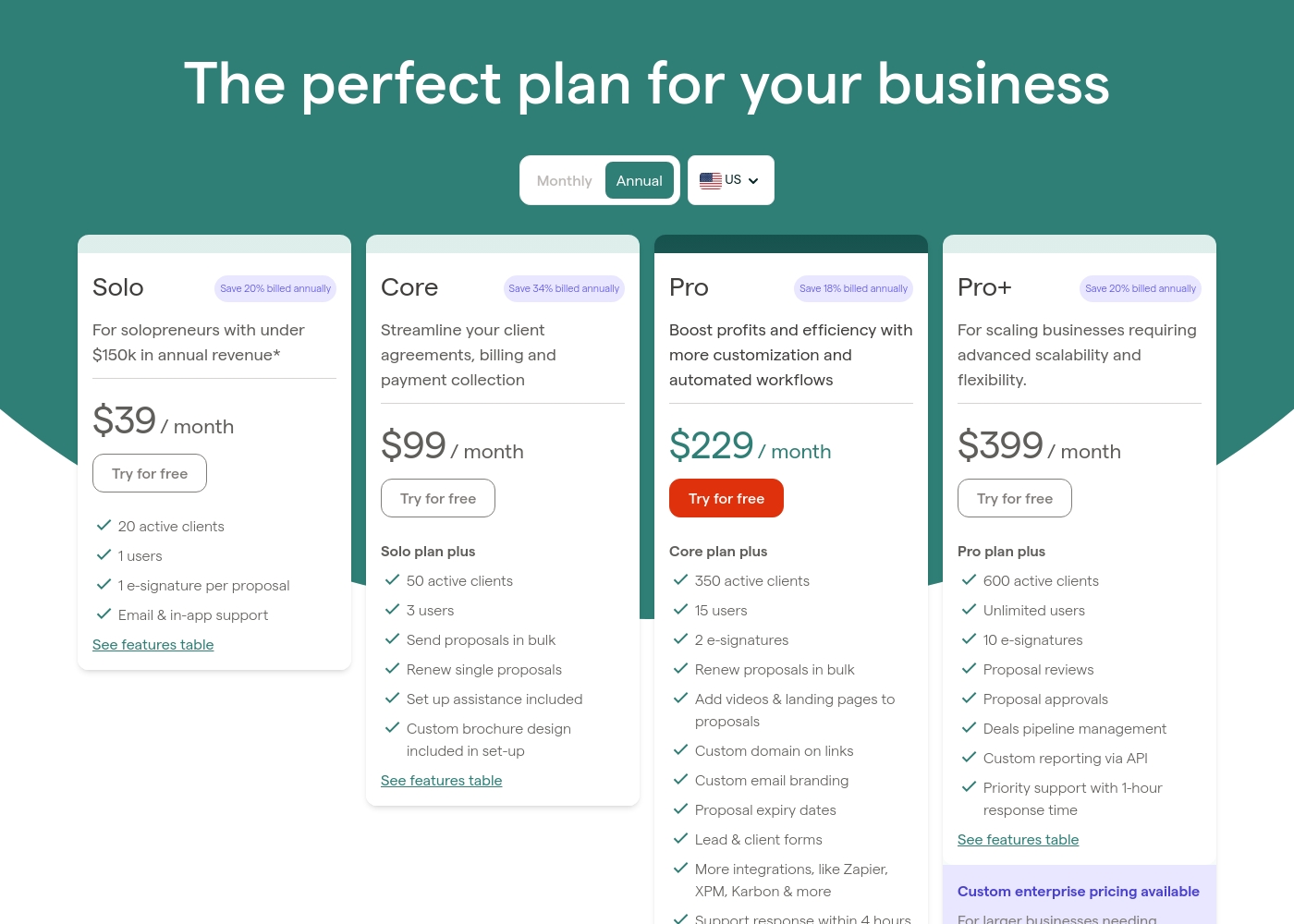
**Ignition** uses a traditional SaaS model with tiered plans based on active clients and users. Pricing ranges from $10 to $200, billed monthly or annually with savings for annual commitment. **Typewise** uses success-based pricing starting at $1 per resolution. You pay only when the AI successfully handles a customer issue. There are no per-user fees. Typewise's model directly ties cost to results, which can be very efficient but also unpredictable. Ignition's model provides predictable, fixed costs. A small agency with 10 clients knows their Ignition cost is, say, $49/month. A support team's Typewise bill varies directly with ticket volume and AI success rate each month.
User Interface & Experience
Ignition focuses on a professional client-facing proposal experience. Typewise is a backend AI orchestration platform.
**Ignition**'s UI is centered on creating polished, professional proposals that impress clients. The experience is designed to be seamless for both the business user and the client signing and paying. **Typewise** is an internal operational tool. Its interface is for business teams to define workflows, monitor AI performance, and manage handoffs. The customer never sees the Typewise UI directly. They serve different audiences. Ignition's UI is a sales and collection tool. Typewise's UI is an operations control panel. You don't judge a hammer and a screwdriver on the same UI criteria. Ignition needs to look good to clients; Typewise needs to give agents clear control.
Scalability
Ignition scales with client numbers. Typewise scales with automation complexity and ticket volume.
**Ignition** scales by plan tier, adding more active clients and users. Its automation (like bulk renewals) helps manage growing client lists efficiently. **Typewise** scales by deploying more AI agents and handling higher volumes of customer interactions. Its architecture is designed to grow from a single pilot to company-wide orchestration. Ignition scales horizontally to manage more of the same work (client agreements). Typewise scales vertically to handle more complex and higher-volume automated work. An agency can move from the Solo to Core plan to handle 50 clients instead of 15. A support team can add AI agents for billing, then sales, then IT, to automate across departments.
Security & Compliance
Ignition's security details aren't provided. Typewise emphasizes enterprise-grade security features.
**Ignition**'s provided data does not detail specific security protocols, certifications, or compliance features. Users should verify this directly with the vendor. **Typewise** explicitly lists enterprise-grade security features. This includes audit logs, access controls, policy-based permissions, and data residency options to meet compliance requirements. Based on available information, Typewise demonstrates a clearer focus on security and governance features for enterprise use. For a financial services firm handling sensitive client data, Typewise's documented audit trails are a major consideration. For a small creative agency, Ignition's security may be sufficient without being a primary differentiator.
Ignition pricing: Plans from 0 Plans range: 0–200
Typewise costs from $1 per resolution with 1 plan: Success-Based Pricing at $1 per resolution.
Here's a breakdown of how our pricing works for your team.
Success-Based Pricing
Price: Starting from $1 per resolution Best For: Customer support and sales teams looking to automate resolutions responsibly. Other Features: Multi-Agent Orchestration, Knowledge & Actions Hub, Hybrid Intelligence, Automated Evaluations, Outcome performance tracking
- Multi-Agent Orchestration
- Natural Language Instructions
- Hybrid Intelligence & Approvals
- Knowledge & Actions Hub
- Outcome performance tracking
Pricing Notes
- Ignition's pricing is based on tiers of active clients and users, with annual billing offering savings.
- Typewise's pricing is purely outcome-based, starting at $1 per successful AI resolution. No per-user fees.
- Ignition's annual commitment may be a barrier for some budgets. Typewise's variable cost can scale unpredictably with high volume.
- Ignition includes all features in its plans (templates, automation). Typewise's cost includes multi-agent orchestration and integrations.
Pricing Head-to-Head
User Reviews
Based on external reviews, Ignition receives praise for automating proposals and billing, which users say saves significant time and eliminates payment chasing. Many appreciate the professional client experience and ease of use, especially for integrating agreements and upfront payments.
💡 However, recurring concerns include pricing, which some find expensive, and occasional technical glitches or integration issues. Support responsiveness is noted as a highlight by many, though a few mention a steep initial learning curve and that the annual billing model isn't ideal for all budgets.
Ignition has transformed our proposal and billing process. Getting payment details upfront means we never chase invoices anymore. The automation saves our team hours every week.
The limited external sentiment from Trustpilot suggests a generally positive view of Typewise, focusing on its powerful AI for email and chat. Users appreciate the significant accuracy improvements and time savings it brings to daily communication.
However, some note that the learning curve can be steep initially and the pricing model might feel expensive for smaller teams or occasional users. We see recurring mentions of strong support responsiveness when needed, but also feedback on occasional reliability hiccups with very complex requests.
Typewise has transformed how we handle customer emails. The AI suggestions are incredibly accurate and save us hours every day. It feels like having a super-smart assistant in our inbox.
Our Verdict
This isn't a fair fight—it's a choice between two different tools for different jobs. **Ignition**'s superpower is killing payment chasing. It locks in payment details with the proposal, so you get paid the moment work starts. This is pure gold for service providers tired of following up on invoices. **Typewise**'s superpower is orchestrating AI across your entire business. It connects your tools and automates complex customer workflows in plain English. This is a game-changer for support teams drowning in tickets across disconnected systems. The deciding factor is your biggest pain point. Do you waste hours creating proposals and chasing payments? Ignition will give you that time back. Do your agents waste hours context-switching between tools to solve customer issues? Typewise will automate that away. For most freelancers and agencies focused on getting paid faster, **Ignition** is the clear choice. For customer-facing teams ready to build an AI-powered operation, **Typewise** is the transformative investment.
Frequently Asked Questions
Which is better for a small freelance business: Ignition or Typewise?
Ignition is almost certainly better for a solo freelancer. Its core automation for proposals and payments directly solves your biggest admin headache. Typewise is designed for larger teams automating customer support workflows.
Does Typewise handle proposals and billing like Ignition?
No, Typewise does not handle client proposals or direct billing workflows. It can automate billing-related customer inquiries if connected to your billing system, but its focus is broader AI orchestration, not proposal creation.
Is Typewise worth the cost for a team that only needs basic email automation?
Probably not. Typewise's value comes from deep integration and orchestrating complex, multi-step workflows across your stack. If you only need simple email drafts, its advanced capabilities and pricing model might be overkill.
Can I use Ignition for customer support?
No, Ignition is not designed for customer support. It is specialized for the financial side of client relationships: proposals, agreements, and payments. You would need a separate tool like Typewise for support automation.
Which tool has better integrations for accounting software?
Ignition integrates directly with specific practice management tools like XPM and Karbon. Typewise has broader integration capabilities (200+ tools) that may include your accounting software via API, but Ignition's are more tailored for accountants and agencies.
How long does it take to see ROI with each tool?
Ignition can show immediate ROI by eliminating hours of manual invoicing and payment chasing per week. Typewise's ROI comes from reducing agent handling time and improving resolution rates, which may take weeks to measure after deployment.
Ready to Choose?
Both tools have their strengths. Choose based on your specific needs.