HireBeat vs Tellent
HireBeat and Tellent are both modern HR platforms, but they solve different problems. HireBeat is a focused, collaborative hiring tool that saves time. Tellent is a full, modular suite for the entire employee journey. The choice comes down to your hiring volume and need for broader HR features.
Best for: Teams hiring a few people per year, Organizations prioritizing collaborative hiring simplicity
Best for: Growing companies needing a scalable, modular HR suite., HR teams seeking to automate manual tasks and centralize data.
Streamlined ATS for collaborative hiring.
We find HireBeat presents a robust, feature-rich solution focused on maximizing time savings and improving team collaboration, offering powerful tools like AI resume screening and video interviews. Overall, this is a strong contender for businesses needing flexible ATS functionality but requiring clearer subscription pricing details.
Pros
- Offers a flexible $99 'Pay As You Go' pricing alternative per job.
- Includes advanced features like transparent AI resume screening.
- Designed specifically to simplify and speed up collaborative hiring workflows.
- Robust Applicant Tracking System (ATS) centralized into one platform.
Cons
- Subscription pricing tiers are not explicitly displayed on the website.
- The conditional 48-hour refund policy is notably strict.
- No general user feedback or sentiment data was available for analysis.
Strong modular suite for growing teams.
We find Tellent offers a powerful, integrated platform for automating HR and recruitment. Its modular design is ideal for mid-sized companies scaling their operations. Overall, it's a solid choice for centralizing people data, though implementation requires planning.
Pros
- Unifies recruiting, HR, and performance management in one platform.
- Offers strong automation and AI features to reduce manual tasks.
- Provides a flexible, modular system that scales with company growth.
- Features a large partner ecosystem (500+ integrations) for connectivity.
Cons
- Pricing is not transparent publicly and requires contacting sales.
- The modular setup may involve a complex initial configuration.
- May not be cost-effective for very small businesses or solopreneurs.
- Advanced customization and deeper technical features can have a learning curve.
AboutHireBeat
HireBeat is a comprehensive, single platform designed for modern recruitment teams. It acts as a cohesive source for all your hiring activities, from initial sourcing to final interviews. This tool is ideal if you need a centralized structure for recruiters and hiring managers. It successfully brings everything you need into one useful solution. 💡
AboutTellent
It's a People Decision Platform. Think of it as a single, connected suite for recruiting, core HR, and performance management. It's built for mid-sized and growing companies (they mention 7,000+ customers globally) that want to streamline operations. The system is modular, so you can start with what you need, like the ATS, and add an HRIS or performance tools later. 💡
Highlights
Feature Comparison
Features Overview
We highlight the main differences and pick a winner for each feature.
Collaborative Hiring
HireBeat is built for instant team alignment. Tellent focuses on customizable workflows.
HireBeat lets you instantly invite reviewers to see resumes and video interviews. It’s designed to be the 'world's easiest' collaborative tool, saving teams over 100 hours. Tellent’s ATS offers customizable workflows to match your team’s process. It focuses on structured collaboration to ensure compliance. HireBeat’s superpower is simplicity and speed for ad-hoc team feedback. Tellent’s strength is a formal, scalable process for recurring hiring. If your hiring managers often complain about scattered emails, HireBeat offers immediate relief.
AI & Automation
Both use AI, but Tellent’s automation is broader and more deeply integrated.
HireBeat features transparent AI for resume screening and on-demand video interviews. This replaces slow phone screens. Tellent includes AI to generate personalized candidate emails, translate job posts, and summarize feedback. This automation is part of a larger suite. HireBeat’s AI is focused on the initial screening stage. Tellent’s AI aims to automate tasks across the entire recruiting and HR lifecycle. For pure candidate screening, both are capable. For automating administrative drudgery across teams, Tellent offers more.
Platform Breadth
HireBeat is a specialist ATS. Tellent is a comprehensive, modular people platform.
HireBeat is a single, cohesive platform for hiring activities. It includes an ATS, job posting, and video interviews. It does not cover HR or performance. Tellent is a modular suite combining ATS, HRIS, and performance tools. You can start with recruiting and add HR or performance modules as you grow. The key difference is scope. HireBeat solves hiring; Tellent aims to solve the entire employee journey. A company needing only to hire a few people a year needs HireBeat. A company managing ongoing HR and development needs Tellent.
User Experience
HireBeat emphasizes simplicity. Tellent offers power but with a learning curve.
HireBeat markets itself as avoiding 'bloat' and complexity. The goal is a clean, centralized dashboard for all hiring data. Tellent is powerful and customizable, which can mean initial setup requires planning. Users praise its intuitive feel once configured. HireBeat prioritizes a straightforward, focused experience. Tellent prioritizes flexibility and depth for complex needs. If you want to start hiring in minutes, HireBeat is likely quicker. If you can invest time in setup, Tellent offers a more customizable environment.
Pricing Model
HireBeat has a clear pay-per-job option. Tellent uses modular, employee-count pricing.
HireBeat offers a transparent $99 'Pay As You Go' per job. Subscription costs are not public but include a 25% annual discount. Tellent’s pricing is based on your company’s employee count. It’s modular, so costs adjust based on which solutions (ATS, HRIS) you choose. HireBeat provides excellent cost control for occasional hiring. Tellent’s model scales with company size, which can be better for long-term growth. A startup hiring 5 people this year benefits from HireBeat. A scaling team of 100 with growing HR needs fits Tellent’s model.
Customer Support
HireBeat guarantees 24/7 support. Tellent offers tiered support with dedicated managers.
HireBeat includes 24/7 customer support and free onboarding training with all plans. Tellent provides live chat support on all plans. Higher tiers add dedicated onboarding and a Customer Success Manager. HireBeat’s support model is straightforward and accessible to everyone. Tellent’s scales with your plan, offering deeper partnership for larger clients. For immediate, round-the-clock help, HireBeat is clear. For strategic, ongoing guidance, Tellent’s dedicated CSM can be valuable.
It offers two main pricing structures: PAY AS YOU GO at $99 per job, and Subscriptions (Monthly or Annual).
Based on your hiring frequency, you can choose the option that best fits your company's needs.
PAY AS YOU GO
Price: $99 /job Best For: Organizations with occasional hiring needs Refund Policy: 48-hour conditional refund (must not have created any interviews) Other Features: Start Free Trial, Free onboarding training, 24/7 customer support
- $99 per job posting
- Designed for organizations with occasional hiring needs
- Free onboarding training
- 24/7 customer support
- Active Job Postings
- Branded Career Website
- Resume Parsing
- Candidate Rating & Feedback
- Email & Web Support
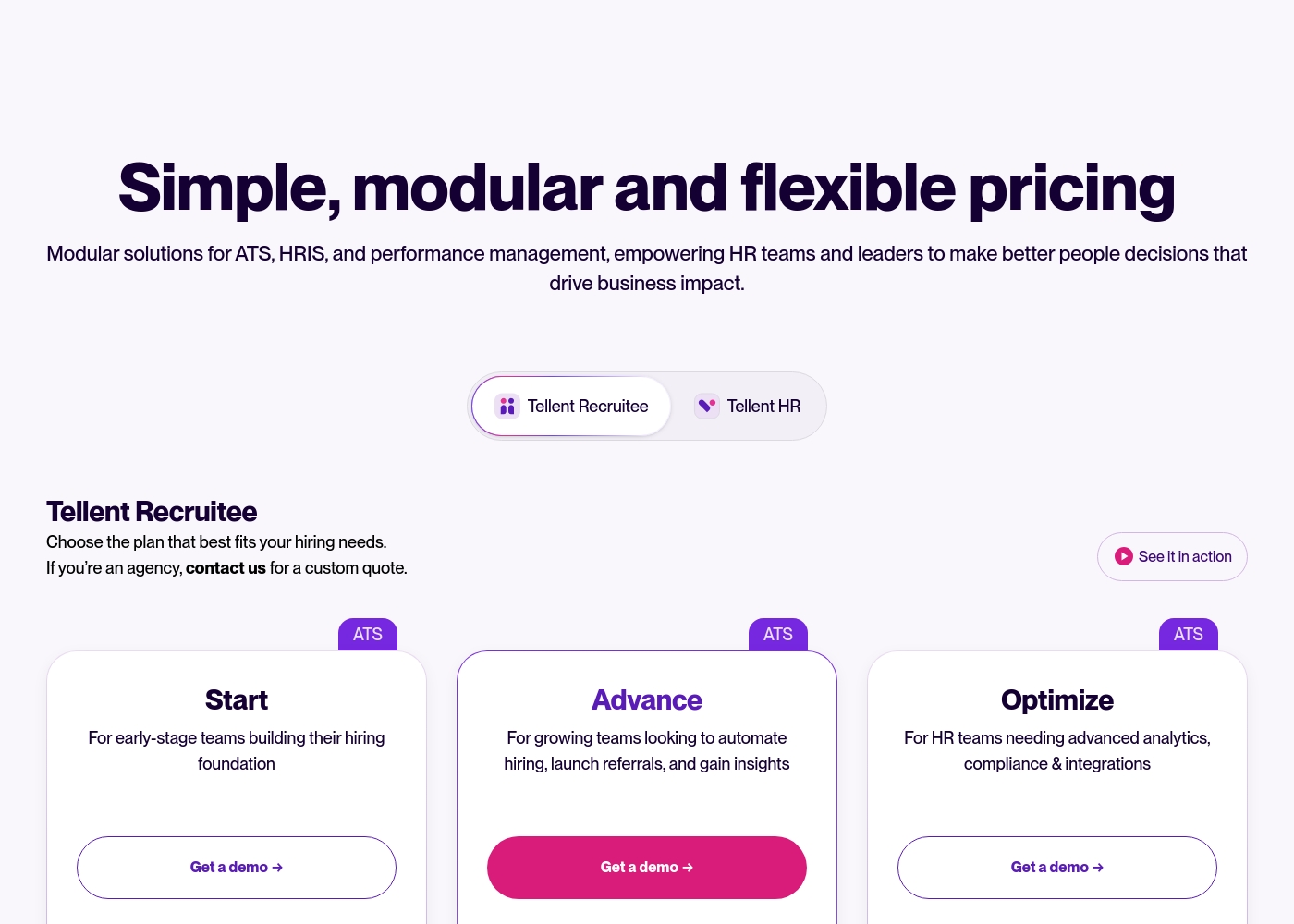
Tellent pricing: Tellent offers modular pricing with specific tiers for recruitment and HR management. Subscription costs increase based on your company's employee count with 20% savings available on annual plans. Plans range: 1–360/month Billing options: Free plan, Free trial, Monthly subscription, Yearly subscription, One-time payment, Usage-based pricing
Pricing Notes
- HireBeat’s Pay As You Go model is ideal for infrequent hiring, offering clear cost per job.
- Tellent’s pricing requires contacting sales, making it less transparent upfront.
- HireBeat offers a 25% discount for annual subscriptions on its undisclosed subscription plans.
- Tellent’s cost scales with employee count, which may be better for large, growing teams.
- HireBeat has a strict 48-hour refund policy if no interviews are created.
Pricing Head-to-Head
User Reviews
We note that HireBeat maintains a public presence on major review sites like Capterra, though specific user insights from these platforms were not provided in the source data. This makes it challenging to confidently evaluate recurring user themes such as support responsiveness, true ease of use, or platform reliability based on external public sentiment.
HireBeat’s marketing emphasizes strong features, including a highly streamlined ATS, collaborative tools, and proprietary AI screening designed to save over 100 hours of recruiter time. They also offer a very flexible '$99 Pay As You Go' option.
The collaborative hiring feature is exactly what our remote team needed. We can invite reviewers instantly to see resumes and video interviews, which streamlines our feedback cycles significantly. It truly is the simplest way to achieve team alignment.
From external reviews, Tellent receives praise for its intuitive interface and strong customer support, which helps teams onboard smoothly. Users often highlight the ease of use and the platform's ability to streamline recruitment and HR tasks.
However, some feedback points to occasional bugs and a learning curve with advanced features. Pricing can feel steep for smaller teams, and a few reviewers mention delays in support responsiveness during peak times.
The platform is really intuitive. It streamlined our hiring process and saved our team hours each week. Support has been helpful whenever we had questions.
Our Verdict
For most people choosing between these two, it’s not about which is better—it’s about which fits your stage. HireBeat and Tellent are built for different moments in a company’s growth. HireBeat’s superpower is focused collaboration. It eliminates hiring chaos with instant reviewer access and transparent AI screening. It saves teams over 100 hours on manual follow-ups. This is perfect if your main pain is coordinating feedback. Tellent’s superpower is the unified people platform. It connects recruiting to core HR and performance in one modular system. It automates admin work with AI and scales across 100+ countries. This is for companies building a long-term HR foundation. The deciding factor is your hiring volume and broader needs. If you hire occasionally and just need to streamline team feedback, HireBeat is simpler and more cost-effective. If you’re scaling and need to replace disjointed HR tools, Tellent offers a scalable path. **Final Verdict:** Choose **HireBeat** if you’re a small team hiring a handful of people per year and want a simple, collaborative ATS. Choose **Tellent** if you’re a growing company ready to invest in a modular suite that handles recruiting, HR, and performance from one platform.
Frequently Asked Questions
Is HireBeat easier to set up than Tellent?
Yes, HireBeat is designed for simplicity and quick start. Tellent’s modular platform requires more planning and configuration upfront. If immediate ease is your priority, HireBeat wins.
Can Tellent do everything HireBeat does for hiring?
Yes, Tellent’s ATS includes AI screening and video interviews. It also adds broader HR automation. However, HireBeat’s collaborative hiring flow is its core strength and may feel more streamlined for pure hiring tasks.
Which is more affordable for a startup hiring 5 people?
HireBeat’s $99 per job Pay As You Go model is likely cheaper. You’d pay roughly $495 total. Tellent’s employee-count pricing requires a quote and may have a higher minimum for a full suite.
Does Tellent replace the need for separate HR software?
Yes, Tellent is designed to be that replacement. It combines an ATS, HRIS, and performance tools in one platform. HireBeat only covers the recruiting portion.
If I pick HireBeat now, can I switch to Tellent later?
You can switch platforms, but data migration will be needed. Tellent’s partner ecosystem offers over 500 integrations and support, which may help. There’s no built-in migration tool between them.
Which tool is better for hiring in multiple countries?
Tellent is explicitly designed for global compliance across 100+ countries. HireBeat mentions GDPR compliance but doesn’t highlight multi-region features. For global hiring, Tellent is the stronger choice.
Ready to Choose?
Both tools have their strengths. Choose based on your specific needs.