HeyGen vs Pictory
HeyGen and Pictory both automate video creation, but their aims differ greatly. HeyGen focuses on creating lifelike avatars and scaling global communication effortlessly. Pictory excels at turning existing blogs or long videos into short, shareable clips. Choose based on whether you need a digital spokesperson or an efficient content repurposing machine.
Best for: Marketing teams needing hyper-realistic AI spokespeople or digital clones., Agencies specializing in global content localization (175+ languages).
Best for: Content marketers repurposing existing blog posts or written content into video., Creators needing to transform long webinars or podcasts into short social media clips.
Professional AI video production, scaled.
HeyGen provides a highly advanced platform for generating realistic AI avatars and rapid video content, effectively replacing traditional studio setups. Overall, we see it as a powerful tool for scaling video operations, provided you can navigate the occasional glitches and complexities in billing and support responsiveness.
Pros
- Generates hyper-realistic and high-quality AI avatars.
- Interface is intuitive, making professional video creation easy.
- Rapidly accelerates complex video production timelines.
- Features impressive capabilities like voice cloning and 4K output.
Cons
- Platform reliability is inconsistent (glitches, volume issues, slow rendering).
- Customer support response times are often slow and ineffective for urgent issues.
- Subscription model limitations can be confusing or feel deceptive to users.
- Some users report unexpected charges following subscription cancellations.
Fast video concepts, variable stability.
We find Pictory effective at quickly converting text and long videos into short, captioned clips, utilizing powerful integrations like Getty Images and ElevenLabs voices; this is a strong value proposition. However, we cannot overlook the widespread user complaints regarding severe technical instability, inconsistent AI accuracy, and frustratingly slow customer support response times. Overall, the tool offers huge potential for high-volume content, but we advise caution due to reported reliability issues that may impact time savings.
Pros
- Quickly transforms long-form content (blogs, webinars) into short, social-ready clips.
- Access to vast stock media libraries (18M+ assets from Getty Images and Storyblocks).
- Features realistic AI voiceovers powered by ElevenLabs.
- Interface is described as beginner-friendly and web-based (no download required).
Cons
- Frequent glitches, bugs, and reliability issues (e.g., audio going out of sync or freezing).
- AI’s output accuracy is inconsistent; generated visuals often fail to match the script.
- Customer support is slow to respond, sometimes taking days.
- Cancellation process is reported as difficult and confusing via the chatbot.
AboutHeyGen
HeyGen is an advanced AI video platform designed to make creating professional content easy. It handles the entire video process automatically, from script to final sync.
You don’t need special cameras or a full studio setup anymore. It’s perfect for business teams and creators who value quality, simplicity, and speed.
HeyGen’s foundation is built on its AI Studio, a text-based editor that makes refining your videos feel as easy as modifying a document. That means you can focus entirely on human-first storytelling.
AboutPictory
Pictory is an intuitive, web-based AI video generator designed for a wide range of creators. Whether you are a YouTuber, a marketing professional, a teacher, or part of an Enterprise collaboration team, this software is built for you. It empowers users, regardless of video editing experience, to quickly create high-quality videos. You simply use your existing content—like text, scripts, or existing long videos—and the smart AI handles the complex steps. ✅
Highlights
Feature Comparison
Features Overview
We highlight the main differences and pick a winner for each feature.
Avatar Realism
HeyGen offers hyper-realistic, 4K digital human clones; Pictory uses only stock video and text.
HeyGen is focused on generating the most realistic digital spokespeople available today. Users can create Custom Video Avatars that look and sound precisely like them. The quality is available in stunning 4K resolution. Pictory relies entirely on stock footage, stock images, and text overlays to visualize the script. Pictory does not offer any AI avatars or digital human presenters for your videos. HeyGen wins easily here by specializing in the creation of highly professional, custom video presenters. Check out HeyGen if you strictly need a virtual representative. This makes HeyGen ideal for high-end corporate training or sophisticated marketing campaigns requiring a consistent speaker.
Content Repurposing
Pictory turns long videos and blogs into clips easily; HeyGen focuses purely on script-to-avatar generation.
HeyGen requires an input script and specializes in delivering that script using an avatar or voiceover. It is designed for generating new, scripted video content from scratch. HeyGen does not offer URL-to-video conversion. Pictory excels at using existing assets like blog post URLs or recorded webinars up to 180 minutes long. The AI quickly summarizes and transforms that content into short, ready-to-publish video clips. This capacity is Pictory’s biggest strength. If scaling content reuse is your goal, Pictory provides dedicated features like URL-to-video conversion and powerful video summarization. HeyGen lacks these crucial repurposing tools. Content marketers who spend hours turning blog posts into social clips will find Pictory to be an essential time-saver.
Global Localization
HeyGen supports 175+ languages with specialized lip-sync; Pictory offers 29+ ElevenLabs voices.
HeyGen offers robust AI translation into over 175 languages and dialects with one click. It uses accurate lip-sync and retains the original speaker's voice, tone and pacing. HeyGen is superior for massive international scale and consistency. Pictory uses ElevenLabs voice integration, offering high-quality AI voices in 29+ languages. However, ElevenLabs usage is capped by monthly minutes on Pictory's paid plans, restricting high international volume. HeyGen’s 175+ language support and reliable translation engine give it a huge advantage for global businesses. Pictory is limited by its voice partner quota and smaller language selection. For reaching underserved markets quickly and efficiently, HeyGen provides unmatched linguistic scalability.
Output Quotas
HeyGen is unlimited video creation (capped length); Pictory is strictly limited by monthly video minutes.
HeyGen’s Creator and Team plans offer truly unlimited video generations every month. The limit is only on the max video length (30 minutes), not on the number of projects. This model favors high-volume, short video creators who post often. Pictory's pricing is strictly controlled by monthly video minutes (e.g., 200, 600, 1800 minutes). If you exceed the quota, you must upgrade immediately or wait for the reset. Unused minutes never roll over. HeyGen offers superior predictability and value for users creating many short videos per month without worrying about consumption limits. Pictory requires careful monitoring of usage allowances. If you plan to publish more than one video daily, HeyGen's unlimited model will save you from unexpected pricing tiers.
Stock Media Library
Pictory includes a massive 18 million asset library; HeyGen uses stock avatars primarily.
Pictory provides users with access to an enormous 18 million library of videos from Getty Images and Storyblocks. This massive stock selection ensures you almost always find a visual match for your script. This library is key to the effectiveness of Pictory's text-to-video function. HeyGen focuses mainly on its own library of 500+ stock video avatars and its custom avatar technology. Visual background assets are secondary, as the AI spokesperson is the main visual element. For users needing extensive background footage and b-roll chosen automatically by AI, Pictory presents the clear advantage here. HeyGen is not focused on stock asset visualization. Anyone making descriptive videos that require diverse scenery or illustrations will prefer the depth of Pictory's media access.
Free Access
HeyGen offers a permanent free plan; Pictory only provides a limited 14-day trial.
HeyGen provides a permanent Free plan that includes generating three videos per month. This allows users to test HeyGen's foundational features and avatar technology indefinitely. The Free plan is perfect for occasional, low-volume use. Pictory offers a 14-day free trial that limits users to exporting three total projects within that period. Once the trial ends, you must subscribe to a paid plan to continue using Pictory. There is no perpetual free tier. If you want to test the full potential of the tools without a time limit, HeyGen offers far more accessible free access. HeyGen allows you to keep prototyping content long-term. This distinction makes HeyGen easier for solo creators or students who need light usage without immediate payment commitment.
Collaboration Tools
Both offer shared workspaces, but HeyGen supports smaller team structures more readily.
HeyGen’s Team plan starts with a required minimum purchase of two seats for collaboration features. It includes shared workspace and detailed video draft commenting options for streamlined reviews. HeyGen supports professional collaboration effectively even for small teams. Pictory's Team plan requires a minimum commitment of three or more users to access shared asset and project sharing features. Pictory also includes professional onboarding and team training for larger organizations. Both platforms are strong in team features. Both platforms provide necessary infrastructure for scaled video production across multiple users. However, HeyGen is more accessible for very small businesses just starting their collaboration efforts. For enterprises prioritizing deep support and customized integration, both HeyGen and Pictory offer flexible, custom enterprise solutions.
Output Resolution
HeyGen provides critical 4K resolution exports; Pictory focuses on standard 1080p output.
HeyGen allows users on the Team plan to export their final videos in stunning 4K ultra-high definition resolution. This is vital for high-end brand content or large screen digital signage. Creator plans still support crisp 1080p. Pictory does not advertise 4K export capability on any of its current plans. Users should expect standard high-definition 1080p videos for social and web use, which is adequate for most needs. Pictory favors rapid creation volume. If crystal-clear, ultra-high-resolution output is a requirement, HeyGen is the definitive choice. Pictory is sufficient for most standard online video distribution. HeyGen offers greater visual fidelity and detail due to its 4K option.
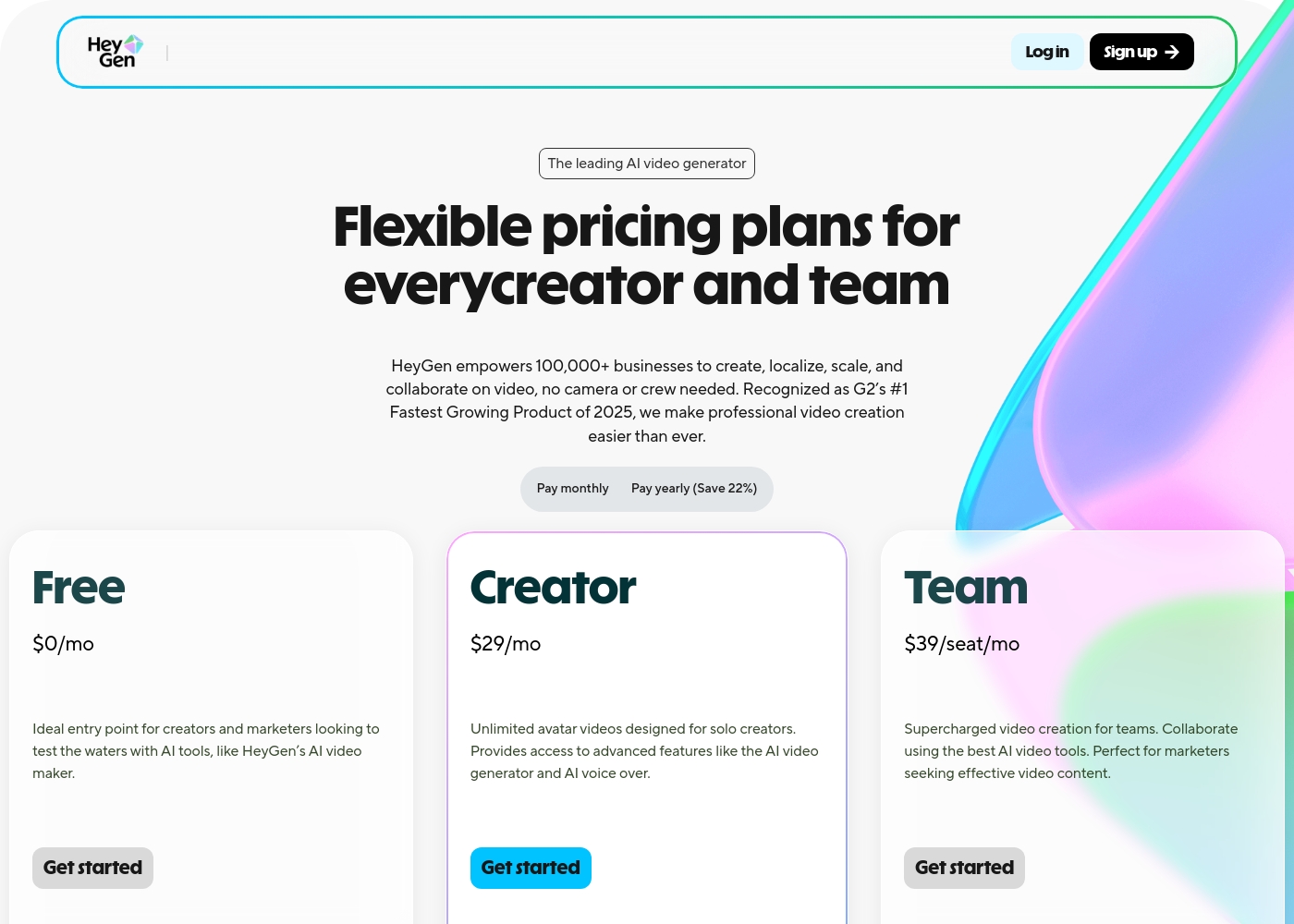
HeyGen plans cost between $0 and $39 per seat per month with four primary options: Free at $0/month, Creator at $24/month (annual), and Team at $30/seat/month (annual).
Below you’ll find a detailed breakdown of the features included in each plan.
Free
Price: $0/mo (Free tier) Best For: Creators and marketers looking to test the waters with AI tools. Other Features:
- Generate 3 videos monthly
- Videos up to 3 minutes long
- 720p video export resolution
- 1 Custom Video Avatar included
- 3 videos per month
- Videos up to 3-mins
- 720p video export
- 1 Custom Video Avatar
- 500+ Stock Video Avatars
- Unlimited videos per month
- Videos up to 30-mins
- 1080p video export
- Voice cloning
- Watermark removal
- Unlimited videos per month
- Videos up to 30-mins
- 4K video export
- Workspace collaboration
- Video draft commenting & editing
Pictory costs between $19 and $99 per month (when billed annually) with four plans: Starter at $19/month, Professional at $29/month, Team at $99/month, and Enterprise at Custom.
Let's explore which Pictory plan might be the right fit for your video creation needs.
Starter
Price: $19/month (billed annually) or $25/month (billed monthly) Websites Supported: 1 User Best For: Creators starting their video journey Refund Policy: No refunds, but you can cancel any time before renewal. Other Features:
- 200 video minutes per month
- 1 brand kit
- 2 million royalty-free videos from Storyblocks
- No watermark
- Basic AI Tools
- 200 video minutes
- 2 million royalty-free videos from Storyblocks
- 1 brand kit
- No watermark
- 600 video minutes
- 18 million videos from Getty Images and Storyblocks
- 5 brand kits
- Advanced AI Tools
- Video summarizations of long videos
- 1800 video minutes
- 18 million videos from Getty Images and Storyblocks
- 10 brand kits
- Team workspace to share assets & collaborate
- Professional onboarding and team training
- Dedicated success manager
- Expert video consulting
- Uploaded asset indexing
- Custom-built templates
- Done-for-you video creation

Pricing Notes
- HeyGen utilizes a permanent Free plan, while Pictory only offers a limited 14-day free trial.
- Pictory's paid plans are based on strict monthly video export minutes, which do not roll over month-to-month.
- HeyGen's Creator and Team plans offer unlimited video generation, limited instead by maximum video length (30 minutes).
- Pictory's top non-enterprise plan ($119/month) is significantly more expensive than HeyGen's top monthly plan ($39/seat/month).
Pricing Head-to-Head
User Reviews
HeyGen prompts mixed but generally strong external feedback, combining high praise for its technology with sharp criticism regarding execution. Users frequently emphasize the shockingly realistic AI avatars and the platform’s intuitive, easy-to-use experience, calling it a major time-saver for content creation.
The integration capabilities, such as using ElevenLabs voices, are highly valued. However, enthusiasm is tempered by recurring operational issues.
HeyGen was so easy to use. I created an instant avatar, uploaded a script, and the video was ready instantly. It was so fast and simple; I plan to use this much more going forward.
Pictory currently holds a widely mixed 3.1-star rating based on over 400 reviews. Users generally agree that the tool is beginner-friendly and offers a powerful premise, providing a massive royalty-free stock library and fast video generation from text or long assets, making it a solid ‘one-stop shop’ for creators.
However, stability and service are recurring critical concerns. Many users report that the software is buggy and slow, frequently suffering from glitches, unsaved work, and crucial audio/video sync errors that ruin final exports.
The platform does have some major positives. It offers various pricing options and is extremely beginner-friendly. Plus, you get a genuinely large image library to use. It’s a great concept for quick, initial video creation.
Our Verdict
This comparison truly defines two different AI video workflows. If you prioritize professional quality and digital human realism, HeyGen is the definitive winner here. HeyGen offers superior technology, better pricing value, and much stronger global scaling capabilities. HeyGen’s superpower is generating hyper-realistic human avatars and digital clones up to 4K resolution. No other platform offers 175 language translations while perfectly retaining voice tone and lip-sync accuracy. HeyGen includes unlimited video generation on Creator and Team plans which simplifies budgeting. Choose HeyGen if you need a reliable, professional video spokesperson for your brand. Pictory excels when your goal is turning existing assets, not humanoids, into video content. It instantly converts blog post URLs or recorded webinars into short, shareable clips. Pictory integrates an enormous 18 million stock library to visualize your scripts. However, be wary of Pictory's restrictive monthly video minute quotas and frequent bugs. The key deciding factor is the pricing model alongside your need for an avatar. HeyGen gives you unlimited output volume, while Pictory strictly caps your usage with defined minutes. If you anticipate high volume under 30 minutes per video, HeyGen provides better value. HeyGen is the best choice for professional businesses aiming for realism, global spread, and predictable costs. Pictory is ideal for busy content marketers focused only on maximizing blog repurposing velocity. Overall, HeyGen delivers superior technology, realism, and a more favorable pricing structure.
Frequently Asked Questions
Which platform generates more realistic AI avatars between HeyGen and Pictory?
HeyGen specializes in creating hyper-realistic avatars, including custom clones of yourself. Pictory does not offer AI avatars; it relies exclusively on stock video footage. HeyGen provides vastly superior digital human technology and 4K output for realism.
For high-volume content, is HeyGen's or Pictory's pricing model better?
HeyGen is better for high volume because paid plans include unlimited videos up to 30 minutes long. Pictory uses a consumption model with restrictive monthly limits on video export minutes. HeyGen offers more predictable costs for heavy creators.
Which tool is better for turning existing blog articles or URLs into videos?
Pictory is purpose-built for this, converting blog post URLs directly into video content efficiently. HeyGen focuses only on script-to-avatar generation and lacks the URL-to-video feature. Choose Pictory for repurposing written assets.
Which tool offers stronger support for global localization and translation features?
HeyGen is the clear winner, supporting over 175 languages and dialects with voice cloning and lip-sync. Pictory utilizes ElevenLabs voices in 29+ languages, but usage is capped by monthly minute quotas. HeyGen is built for massive global scale.
Is HeyGen or Pictory better when access to a large stock media library is critical?
Pictory is much better, providing access to over 18 million high-quality stock assets from two providers. HeyGen's visual library focuses primarily on its 500+ stock avatars and custom backgrounds. Pictory has the asset advantage.
Why do HeyGen and Pictory user reviews consistently mention stability issues?
Both HeyGen and Pictory frequently receive user complaints about platform glitches and slow customer support response times. HeyGen users praise its core technology quality, while Pictory users criticize inconsistent AI visual matching.
Ready to Choose?
Both tools have their strengths. Choose based on your specific needs.