Google Cloud vs Microsoft Azure
This is the ultimate infrastructure showdown between cloud titans. Google Cloud leads with cutting-edge AI and superior data analytics efficiency. Microsoft Azure specializes in deep enterprise migration and unmatched global reach. Your choice depends entirely on your current workload and future strategy.
Best for: Scaling startups maximizing free credits (up to $350k), Organizations building next-generation Generative AI applications
Best for: Large enterprises migrating extensive SQL, SAP, or Oracle databases, Organizations requiring the maximum number of global deployment regions
Powerful Infrastructure, Risky Billing and Support.
We recognize Google Cloud delivers leading infrastructure, offering powerful AI integration and significant scaling for enterprise workloads. However, the high volume of reports detailing inaccessible customer support and confusing, non-transparent billing is deeply concerning. Overall, we see this platform as high-risk for users prioritizing responsive help or granular cost control.
Pros
- Access to top-tier generative AI tools like Gemini and Vertex AI.
- Supports open source, multilcloud, and hybrid development strategies.
- New users receive $300 in free credits upon signing up.
- Offers potential savings up to 57% via committed use discounts.
Cons
- Customer service support is frequently inaccessible and hidden.
- Users report non-transparent billing and unexpected charges despite having credits.
- Extremely high costs for technical support subscriptions (up to $12,500/month).
- Lack of hard spending limits for pay-as-you-go services is a common pain point.
Powerful features, deeply problematic user experience.
Microsoft Azure offers powerful global infrastructure for AI, HPC, and large-scale data migration. However, external feedback reflects serious issues regarding customer support, billing transparency, and reliability protocols, especially concerning data retention. Overall, we see transformative technological potential, but the reported operational and service problems demand caution before heavy investment.
Pros
- Accelerates high-scale Generative AI solutions and deployment capabilities.
- Unmatched global reach across more worldwide regions than any other provider.
- Offers infrastructure flexibility through Azure Arc for hybrid environments.
- Streamlines migration for extensive legacy databases like SQL Server and SAP.
Cons
- Customer support is widely reported as unresponsive, slow, and purposefully difficult to access.
- Billing structure is confusing and often results in unexpected or deceptive hidden fees.
- Service unreliability causes downtime and high user stress.
- Policy allows automatic, permanent data deletion 90 days after an invoice is overdue.
AboutGoogle Cloud
Google Cloud is a comprehensive cloud platform offering more than 150 products and capabilities. It helps businesses modernize existing infrastructure or build entirely new AI-driven applications from scratch. The service is designed for developers, business leaders, and startups ready to digitally grow and transform.
New customers can try Google Cloud with free usage of over 20 products. Plus, you’ll receive $300 in free credits upon signing up to help you explore. 💡
AboutMicrosoft Azure
Azure is a comprehensive cloud platform designed for limitless innovation. It facilitates solutions across everything from application development to robust data transformation. The platform specifically serves developers, IT professionals, data analysts, and organizational leaders. Azure provides the global infrastructure needed to go beyond the limits of on-premises datacenters. It offers more worldwide regions than any other provider. 💡
Highlights
Feature Comparison
Features Overview
We highlight the main differences and pick a winner for each feature.
AI Platform & Innovation
Google Cloud leads on immediate access to cutting-edge models. Microsoft Azure focuses on enterprise-scale AI deployment.
Google Cloud offers Vertex AI, a managed platform enhanced by Gemini. You get instant access to an ecosystem of over 200 foundation models. This accelerates building sophisticated generative AI agents. Microsoft Azure utilizes Azure AI Foundry for enterprise-scale solutions. Teams can build custom agents using Azure OpenAI in Foundry Models. Azure allows swift deployment of intelligent applications across the organization. Google Cloud strongly integrates AI directly into developer tooling like Gemini Code Assist. Microsoft Azure emphasizes AI search capabilities for hyper-personalized responses. Both are powerful, but Google Cloud feels slightly ahead in the innovation curve.
Enterprise Migration
Microsoft Azure simplifies moving legacy enterprise databases. Google Cloud focuses more on core compute workload optimization.
Microsoft Azure facilitates major workload migrations easily. This includes SQL Server, SAP, Windows Server, and Oracle. Migration often requires minimal application code changes, simplifying modernization. Google Cloud supports application migration into VMs or containers. They emphasize optimizing compute costs later with instances like Axion C4A. Their focus is less on direct legacy system migration paths. Organizations with heavy reliance on Microsoft legacy systems benefit greatly from Microsoft Azure’s tools. Google Cloud is better suited for new builds or companies moving away from older x86 infrastructure. Microsoft Azure dramatically simplifies moving established core systems to the cloud.
Hybrid Cloud Management
Microsoft Azure uses Azure Arc to unify diverse infrastructure. Google Cloud is strategically committed to multicloud flexibility.
Microsoft Azure provides Azure Arc for centralized management and governance. Arc unifies infrastructure running on-premises, hybrid, or across other cloud environments. This simplifies complex multicloud security operations. Google Cloud is committed to hybrid and multicloud strategies explicitly. Their strategy helps users avoid vendor lock-in. However, Google Cloud does not specify a single cross-platform management tool like Arc. For companies running complex, distributed environments, Azure Arc provides a necessary single pane of glass. Google Cloud offers underlying architectural flexibility. Microsoft Azure wins on explicit management capabilities for mixed environments.
Price-Performance Ratio
Google Cloud provides specific, aggressive TCO savings data. Microsoft Azure offers cost predictability via reservation plans.
Google Cloud touts impressive savings figures based on performance and TCO. BigQuery offers 26%–34% lower TCO compared to alternatives. Axion C4A instances provide up to 65% better price-performance for general workloads. Microsoft Azure focuses on savings achieved through reserved plans (1 or 3 years). These commitments ensure price predictability. Monthly estimates are calculated based on 730 hours of usage. Google Cloud appears to deliver superior value for data and compute workloads based on specific metrics. Microsoft Azure has a strong option for securing stable pricing long-term. Google Cloud takes the edge with quantifiable TCO advantages.
Global Infrastructure
Microsoft Azure holds the lead on worldwide physical coverage. Google Cloud offers world-class but standard global scalability.
Microsoft Azure boasts unmatched global reach for its clients. The platform hosts more worldwide regions than any other cloud provider. This allows deployment close to the end user for low latency. Google Cloud offers highly robust infrastructure and ensures digital sovereignty compliance globally. Its focus is more on optimized internal performance and security. Google Cloud ensures high availability, like Spanner’s 99.999% SLA. If you require deployment in the maximum number of geographical locations, Microsoft Azure is the clear winner. Google Cloud focuses its infrastructure on maximizing data insights and security. Global reach is undeniably Microsoft Azure's strength here.
Billing Transparency
Both platforms are heavily criticized for deceptive, non-transparent billing. Neither offers a clear win for the user experience.
Google Cloud users widely report unexpected charges despite having free credits available. The lack of a hard spending limit is a common pain point. Technical support subscriptions can cost exorbitant amounts, up to $12,500/month. Microsoft Azure is also called out for deceptive and hidden fees. They emphasize that taxes and egress charges are not included in monthly estimates. They use a precise, non-rounded billing system for usage duration. Critical complaints plague both services regarding unexpected costs and opaque invoicing. Users of both companies often feel trapped by confusing cost management practices. This area requires extreme caution regardless of your choice.
Customer Support
Users report that responsive customer support is nearly impossible to find on both services. Both services rate poorly.
Google Cloud support is frequently cited as inaccessible and intentionally hidden. Users report being forced into endless loops when trying to reach a human. New customers receive 24/7 billing support, but technical support is heavily criticized. Microsoft Azure customers also describe support as unresponsive, slow, and non-competent. Issues take weeks to resolve, often resulting in financial loss to the customer. When facing system errors, their response has been 'too bad.' Because of the severity and frequency of negative support reports, users should expect self-service reliance. High-cost technical support for Google Cloud offers little reassurance to enterprise users. It’s hard to call a winner when both services fail basic customer demands.
Developer Productivity
Google Cloud accelerates development using embedded AI assistance. Microsoft Azure focuses on comprehensive DevOps integration.
Google Cloud offers Gemini Code Assist for AI-powered code generation and recommendations. Cloud Code allows writing and debugging cloud-native apps locally or in the cloud. Cloud Build handles continuous testing and deployment across languages. Microsoft Azure leverages Azure DevOps for streamlined CI/CD pipelines. Azure App Service and Azure Functions support rapid deployment of web and serverless applications. They focus on unifying processes and products for continuous delivery. Google Cloud provides a strong advantage through immediate, integrated AI developer assistance. Microsoft Azure has a broader platform for full team collaboration and process integration. Google Cloud slightly edges out due to its AI coding tools.
Google Cloud costs vary widely as it uses a usage-based payment structure, offering new customers $300 in free credits and access to 20+ free products.
You won't find fixed monthly plans here, but instead three flexible ways to utilize the platform's computational resources.
Pay-as-you-go (Standard Pricing)
Best For: Organizations of all sizes needing flexible scaling Other Features:
- You only pay for the services you use.
- No up-front fees or termination charges.
- Potential savings up to 57% with committed use discounts.
- Includes free 24/7 billing support.
- Only pay for the services you use
- No up-front fees or termination charges
- Save up to 57% with committed use discounts
- Free 24/7 billing support
- $300 in free credits
- Access to 20+ products for free
- Run, test, and deploy workloads
- Up to $350,000 in Cloud credits
- Customized support and solutions
- Scaling support for innovative companies
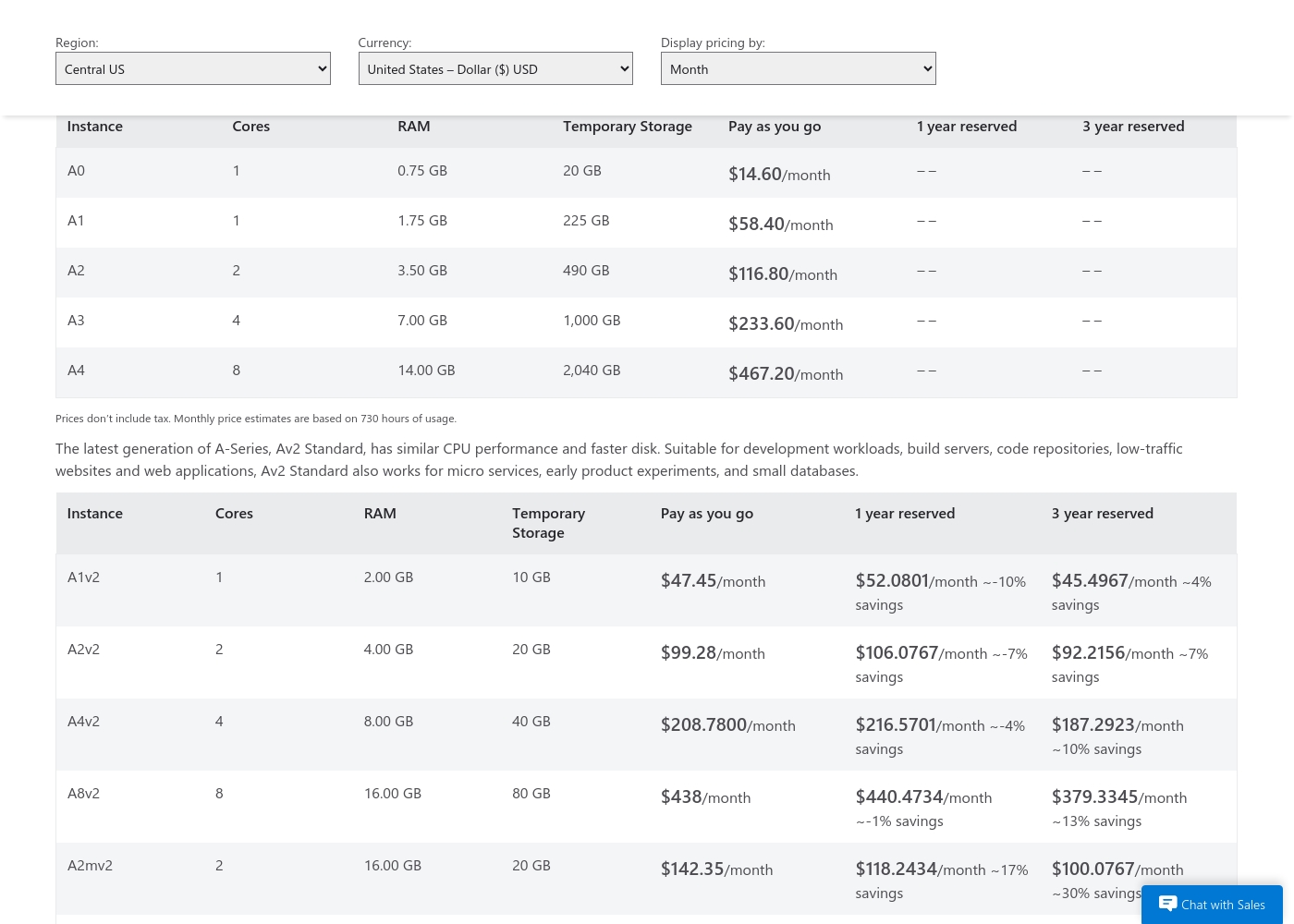
Microsoft Azure costs between $14.60/month and $467.20/month with four main instance categories: General Purpose A-Series, Av2 Standard, Memory Intensive, and Network Optimized.
We provide monthly price estimates based on 730 hours of usage. The cost you pay is determined by factors like instance size, region, and whether you choose reserved commitment or Pay as you go.
General Purpose (A-Series A0–A4)
Price: $14.60/month (A0) to $467.20/month (A4) Best For: Websites, small-to-medium databases, and other everyday applications Other Features:
- Instances range from 1 to 8 cores
- RAM options from 0.75 GB to 14.00 GB
- Temporary storage up to 2,040 GB
- 1 Core
- 0.75 GB RAM
- 20 GB Temporary Storage
- Best for everyday applications and testing
- 1 Core
- 2.00 GB RAM
- 10 GB Temporary Storage
- Similar CPU performance to A-Series
- Faster disk for low-traffic sites
- 8 Cores
- 56.00 GB RAM
- 2,040 GB Temporary Storage
- Ideal for large databases and high-throughput applications
- 16 Cores
- 224.00 GB RAM
- 2,000 GB Temporary Storage
- Designed for high performance computing (HPC)
- Uses Intel Xeon E5-2667 v3 processor
Pricing Notes
- Google Cloud offers a superior $300 free credit to start, compared to Microsoft Azure's $200 credit.
- Google Cloud's BigQuery has a proven TCO advantage (26%–34% lower) over cloud data warehouse alternatives.
- The major pain point for Google Cloud is the lack of a hard spending cap, leading to unexpected charges.
- Microsoft Azure offers 1-year and 3-year reserved commitment plans for predictable cost savings.
- Microsoft Azure excludes taxes and egress charges from displayed prices; factor these into your budget.
- Both providers are heavily criticized by users for non-transparent post-trial billing and unexpected fees.
Pricing Head-to-Head
User Reviews
The external sentiment, primarily captured by Trustpilot, is overwhelmingly negative, resulting in a very poor 1.5-star rating. The most frequently cited issues revolve around non-transparent billing and absolutely dysfunctional customer support ⚠️. Users report unexpected charges, sometimes totaling hundreds of dollars, even when they possess substantial free credits. Many feel this lack of transparency is a "deliberate trap" designed for new users. Furthermore, getting help is nearly impossible; users describe support as intentionally hidden and unreachable, sending them into frustrating, endless loops. Those requiring technical help face exorbitant fees, with specialized technical support costing steep thousands per month.
Beyond cost management, users criticize the low ease of use. Complaints include the console being "unusably slow" and the process for simple tasks, like retrieving an API key, demanding excessive clicks. Users also struggle with important account management functions, such as deleting active projects that continue to generate fees or updating billing information. This strongly indicates that while the platform is technologically powerful, the surrounding user experience, administration, and financial control are severely flawed.
My account incurred €327 in API costs, even though I had €264 in free credits available which weren't used. Support is completely hidden and impossible to reach, making it seem like a deliberate trap. This platform has an extremely non-transparent pricing structure.
External feedback drawn exclusively from Trustpilot is overwhelmingly critical, resulting in a significantly low TrustScore of 1.5. The primary source of frustration is customer service, which users frequently describe as unresponsive, difficult to reach, and lacking competence, sometimes taking weeks to address urgent tickets.
Many customers report opaque pricing and billing practices, including unexpected fees and continuous charging even after they deleted services entirely. Serious issues related to reliability and data security also emerged: multiple users noted account data was automatically and permanently deleted due to an overdue 90-day invoice policy, even when they struggled to make the payment through the system.
Azure's pricing is completely deceptive, hitting me with totally unexpected fees. I strongly advise everyone to avoid it. It’s definitely going to rip you off eventually.
Our Verdict
Choosing your cloud provider is a massive commitment; you must look past the hype. This core battle is highly competitive in terms of raw features. However, real-world user reports show catastrophic failures in service reliability on both sides. If you prioritize groundbreaking technology, Google Cloud is the current AI leader. Vertex AI and Gemini give you a faster runway for next-gen intelligent applications. Additionally, Google Cloud provides aggressive, proven TCO savings for big data operations like BigQuery. Microsoft Azure is the undisputed champion for large, highly diversified organizations. Azure Arc unifies your hybrid infrastructure seamlessly, running everything across clouds. Microsoft Azure is also the safer bet if you must migrate existing SQL Server or SAP systems easily. The deciding factor should be your existing ecosystem and core use case. If you need powerful data analytics and AI advantage, choose Google Cloud. If you need maximum corporate integration and global deployment reach, Microsoft Azure wins. Be warned: anticipate poor customer support and tight cost management on both platforms.
Frequently Asked Questions
Which cloud provider is better for adopting cutting-edge Generative AI features?
Google Cloud excels here with Vertex AI and Gemini’s ecosystem of 200+ foundation models. Microsoft Azure is strong, but Google Cloud offers faster access to new AI developments. Their Gemini Code Assist also helps developers build faster.
Can I set a hard spending limit to avoid surprise costs on Google Cloud or Microsoft Azure?
Google Cloud users heavily complain about the inability to set a hard spending cap. Both services use confusing usage-based pricing models. You must rely on internal budget alerts and quota limits, not a true stop mechanism.
Is Microsoft Azure worth it for companies focused on legacy database migration?
Yes, Microsoft Azure excels in this niche. It simplifies moving extensive systems like SQL Server, SAP, and Oracle with few code changes. Google Cloud does not offer such comprehensive, streamlined migration support.
Which provider offers better free credits for new cloud users?
Google Cloud provides a higher initial credit, giving new users $300 in free credits. Microsoft Azure offers $200 in credit, but also features a clear 30-day trial period. Google Cloud also offers 20+ products permanently free.
Does Microsoft Azure have an explicit data deletion policy I should worry about?
Yes, user reports indicate Microsoft Azure has a harsh policy. Accounts with an overdue invoice may have data permanently deleted after 90 days. Always ensure timely payments to protect your mission-critical data.
Which cloud platform is better for managing infrastructure across multiple clouds (Hybrid/Multicloud)?
Microsoft Azure is superior due to Azure Arc. Azure Arc unifies governance and management across on-premises, hybrid, and cross-cloud environments. Google Cloud supports the strategy but lacks this specific unification tool.
Ready to Choose?
Both tools have their strengths. Choose based on your specific needs.