GitLab vs Quadient
GitLab and Quadient solve totally different business problems. GitLab unifies software development, while Quadient automates finance and customer communications. It's not about which is 'better,' but which solves your specific pain point.
Best for: Software development teams of all sizes, Organizations adopting DevSecOps practices
Best for: Enterprise finance teams automating AP and AR workflows, Customer communications managers handling omnichannel document delivery
Comprehensive DevSecOps, but complex.
GitLab is a powerful, all-in-one platform that unifies the entire software lifecycle. We find it delivers on its promise of acceleration and unified security, though its depth can create a steep learning curve for smaller teams. Overall, it's an excellent choice for organizations seeking a single, scalable solution for planning, building, and deploying software securely.
Pros
- Single platform for the entire DevSecOps lifecycle
- Built-in security scanning accelerates vulnerability detection
- AI-powered workflows (Duo Agent) enhance productivity
- Offers a functional Free tier for individuals and small projects
Cons
- Learning curve can be steep due to platform breadth
- Enterprise features like advanced security require costly Ultimate tier
- Compute and storage limits on lower tiers may require paid add-ons
- Annual billing commitment for paid plans
Powerful automation, but support concerns us.
We find Quadient offers robust tools for automating AP/AR and managing customer communications at scale. However, persistent user complaints about customer support and contract flexibility temper our recommendation. Overall, it's a capable suite for larger enterprises, but smaller teams should proceed with caution.
Pros
- Automates end-to-end AP and AR workflows.
- Strong omnichannel document creation and delivery.
- Empowers business users, reducing IT dependency.
- Scales well for high-volume, complex needs.
Cons
- Significant concerns about customer service and support responsiveness.
- Contracts and billing terms can be rigid or difficult.
- May be too complex or costly for small businesses.
- Onboarding and integration can present challenges.
AboutGitLab
GitLab is an end-to-end DevSecOps platform for teams of all sizes, from startups to large enterprises. It’s the single place to plan, build, test, secure, and deploy your software. You get all your projects, releases, and code in one data plane, so both your team and AI agents work from the same information. 💡
AboutQuadient
Quadient is a suite of process automation solutions focused on two core areas: customer communications management (CCM) and financial workflow automation. It's designed for mid-to-large enterprises that need to design, manage, and deliver personalized documents and messages across digital, print, and mobile channels, while also automating key AP and AR processes. 💡
Highlights
Feature Comparison
Features Overview
We highlight the main differences and pick a winner for each feature.
Platform Focus
GitLab is for building software. Quadient is for automating business processes.
GitLab provides a complete DevSecOps platform. Teams use it to write code, run tests, scan for security issues, and deploy applications. It's the single source of truth for your entire software lifecycle. Quadient offers specialized solutions for Accounts Payable, Accounts Receivable, and Customer Communications Management. It automates manual tasks like invoice processing and document delivery across digital and print channels. The key difference is the end goal. GitLab accelerates software delivery. Quadient accelerates business workflows and cash cycles.
Pricing Transparency
GitLab lists clear prices. Quadient requires a custom sales quote.
GitLab has published pricing for its tiers: Free, Premium ($29/user/month), and Ultimate ($99/user/month). You can calculate costs upfront. Add-ons for extra compute or AI credits are also listed. Quadient uses a customized pricing model. You must contact sales for a quote. Plans include unlimited users, so cost is based on your specific workflow needs and features. GitLab's transparency is better for budgeting. Quadient's model may scale better for large teams, but lacks upfront clarity.
User Experience
GitLab has a learning curve for its breadth. Quadient empowers business users but has support issues.
GitLab consolidates many tools, so new users face a learning curve. Once configured, it streamlines developer workflows and reduces context switching between planning, coding, and security. Quadient aims to empower non-IT staff to manage templates and workflows. This reduces IT bottlenecks. However, external reviews cite complex onboarding and frustrating customer support. GitLab's challenge is initial complexity. Quadient's challenge is post-purchase support and contract flexibility.
Customer Support
GitLab offers tiered support with clear SLAs. Quadient's support is a common complaint.
GitLab's paid plans include priority support. Premium gets 24/5 support. Ultimate adds SLA Management for guaranteed response times on critical issues. Quadient reviews on Trustpilot frequently mention slow and unresponsive support. Users report difficulties getting help with technical or billing questions. This is a major pain point. Reliable support is crucial. GitLab's structured approach appears more dependable than the experiences reported by many Quadient users.
Automation Scope
GitLab automates software delivery. Quadient automates financial and communication tasks.
GitLab's automation centers on CI/CD pipelines. It can build code 80x faster and reduce cycle time by 82%. AI agents help with code review and issue triage. Quadient automates end-to-end AP workflows (POs to payments) and AR processes to reduce Days Sales Outstanding. It also automates the creation and delivery of personalized customer documents. They automate different parts of a business. GitLab for tech teams. Quadient for finance and customer-facing operations.
Security Capabilities
GitLab has built-in security scanning. Quadient focuses on document compliance.
GitLab integrates security scanning (SAST, SCA, DAST) directly into development. It finds vulnerabilities 50% faster and shows issues right in merge requests for developers to fix. Quadient's security focus is on ensuring customer communications are compliant and personalized. It doesn't scan source code for vulnerabilities. Its deployment can be on-premise for data control. GitLab secures your software supply chain. Quadient helps secure and manage sensitive customer data in communications.
Scalability
Both scale for enterprises, but in different domains.
GitLab is built for teams from individuals to large enterprises. It handles complex, high-security projects for industries like finance and public sector. Its Ultimate tier is for the most demanding needs. Quadient is designed for mid-to-large enterprises with high-volume needs. It powers over 2 trillion connections annually. Its AP/AR and CCM solutions are built for scale and reliability. Both are enterprise-grade. GitLab scales for software complexity and security. Quadient scales for transaction volume and document throughput.
Mobile Experience
GitLab focuses on a strong web IDE. Quadient ensures mobile-friendly document delivery.
GitLab's primary interface is its powerful web-based platform and IDE. It allows developers to manage projects, review code, and monitor pipelines from a browser. Quadient's mobile focus is on the end-user experience. Its CCM solution ensures that customer communications like statements and notices are delivered in a mobile-optimized format for easy viewing on phones. GitLab provides tools for building mobile apps. Quadient makes sure the documents your customers receive on mobile look great.
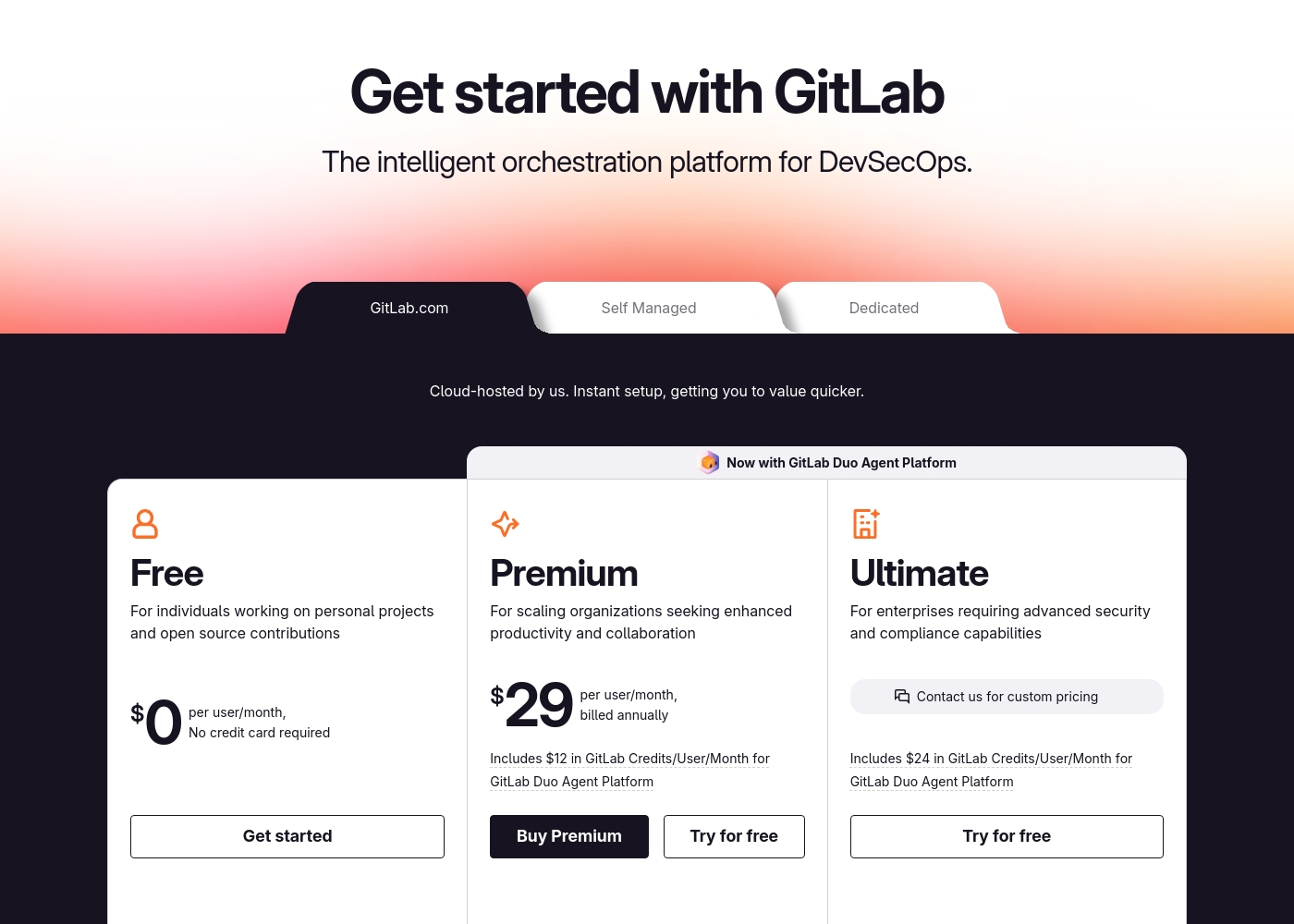
GitLab pricing: GitLab offers a range of DevSecOps plans from a free tier for individuals to an Ultimate enterprise solution for $99/month. Subscriptions include various compute minutes, storage allocations, and security features to fit different team sizes and needs.
Please note: the provided screenshot shows $29/user/month for Premium, while the text mentions $99 for Ultimate elsewhere; we have prioritized the current primary source values below for clarity. Actually, the provided text includes $0, $29 annually, and custom pricing options depending on the deployment method (SaaS or Self-Managed).
Overall it is a per-seat annual subscription model with usage-based add-ons for credits and compute time. For current SaaS pricing: Free $0, Premium $29/mo annually, Ultimate $99/mo annually (implied for custom).
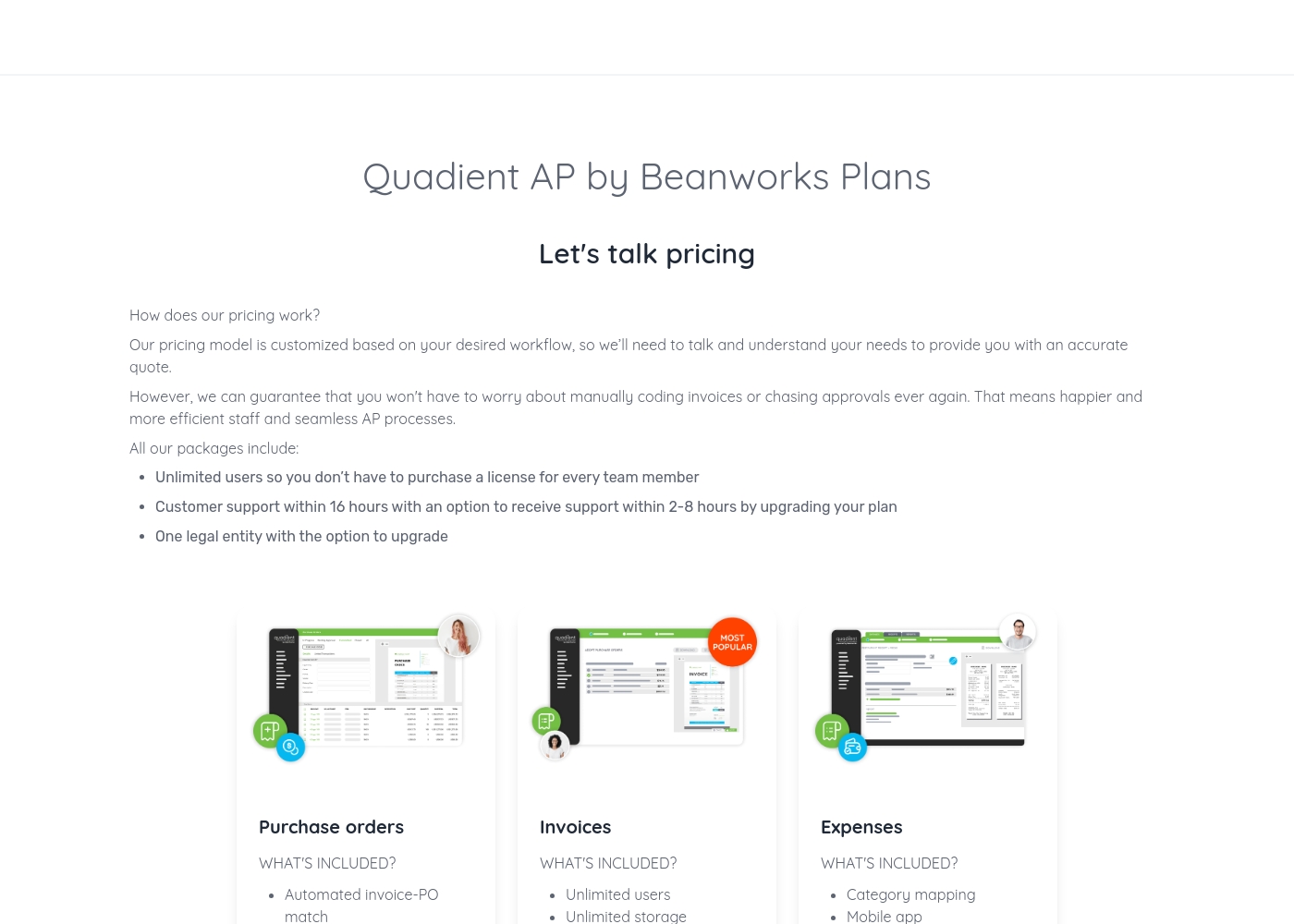
Quadient pricing: Quadient AP by Beanworks uses a custom pricing model based on your specific workflow and needs. They offer feature-specific packages for purchase orders, invoices, and expenses to ensure you only pay for what you use.
All plans include unlimited users and standard support, with the option to upgrade for faster response times or more entities. This tailored approach allows the platform to scale with your business while removing the burden of manual AP processes once and for all.
Contact them for a personalized quote today and discover how much you could save by automating your business's workflows. Their team of experts is ready to help you find the perfect solution for your accounts payable needs, whether you're a small business or a large corporation.
Pricing Notes
- GitLab offers a transparent Free tier, while Quadient has no public free plan.
- GitLab's paid plans are per-user, making costs predictable. Quadient's unlimited-user model is custom-quoted.
- GitLab's free trial is available without a credit card for the Free tier. Quadient requires contacting sales for a demo.
- Quadient's pricing is opaque and may involve long-term contracts, a common complaint in user reviews.
Pricing Head-to-Head
User Reviews
External user reviews for GitLab are currently inaccessible for a full synthesis, as both Trustpilot and Capterra returned security verification errors. 📄 Therefore, we cannot provide a balanced, specific summary of recurring user themes on accuracy, ease of use, support, or pricing at this time. We recommend checking these sources directly for up-to-date sentiment.
GitLab streamlined our entire development pipeline. Having CI/CD, security, and planning in one place saves our team significant time each week.
External reviews for Quadient are mixed. On Trustpilot, users frequently complain about poor customer service, slow support, and billing issues, creating a frustrating experience.
💔 Some mention difficult contracts and a lack of responsiveness. However, on Capterra, the limited feedback for the Impress platform is more positive, with a user praising its document creation capabilities and template management as highly important features.
The software itself might work, but the customer service is a nightmare. Getting any help or a simple question answered takes forever. We've wasted so much time trying to get support.
Our Verdict
This isn't a fair fight—it's a comparison of different tools for different jobs. GitLab wins for any team building software. Quadient wins for enterprises automating finance and communications. GitLab's superpower is being the single source of truth for your entire development lifecycle. It unifies planning, coding, security, and deployment. Teams report saving 4 hours per engineer per week and cutting cycle time by 82%. Quadient's superpower is transforming manual business processes. It automates complex AP workflows from purchase orders to payments. It also delivers personalized customer documents across digital, mobile, and print channels at scale. The deciding factor is your core problem. If your bottleneck is software delivery, GitLab is the answer. If your bottleneck is manual invoice processing or impersonal customer communications, Quadient is built for that. Choose GitLab if you're a software team that wants to ship faster and more securely from one platform. Choose Quadient if you're a finance or operations team drowning in paperwork and needing to automate high-volume workflows.
Frequently Asked Questions
Can GitLab do what Quadient does for finance automation?
No, GitLab is a software development platform. It doesn't handle accounts payable, receivable, or customer communications like Quadient. They serve completely different business needs.
Is Quadient suitable for small businesses?
Likely not. Quadient targets mid-to-large enterprises with high-volume needs. Its custom pricing and complexity may be overkill for small teams with simple requirements.
Which has better customer support, GitLab or Quadient?
GitLab generally has better-reported support. It offers structured support tiers with SLAs on paid plans. Quadient reviews frequently cite slow and unresponsive customer service as a major pain point.
Is Quadient worth the extra cost over GitLab?
They aren't competing on cost directly. GitLab's value is in consolidating dev tools. Quadient's value is in automating finance and communication workflows. Compare based on the specific problem you need to solve.
Can I get a free trial for Quadient like GitLab?
No. GitLab offers a free tier and trial for paid plans. Quadient does not advertise a free trial. You must request a demo through their sales team to evaluate the platform.
Which is better for security, GitLab or Quadient?
It depends on the context. GitLab has built-in security scanning for source code (SAST, SCA). Quadient focuses on secure delivery of customer data and compliance in communications. They secure different assets.
Ready to Choose?
Both tools have their strengths. Choose based on your specific needs.