GetResponse vs Mailpoet
This comparison pits an all-in-one giant against a WordPress native solution. GetResponse is a reliable, feature-stacked external marketing hub. Mailpoet lives natively inside your WordPress dashboard for ultimate simplicity. You must decide if deep integration or comprehensive features matter more for growth.
Best for: E-commerce businesses needing cart recovery and sales funnels, Creators monetizing content with webinars and online courses
Best for: Bloggers prioritizing workflow efficiency in WordPress, Solopreneurs needing basic welcome and post automation
Exceptional support meets scalable marketing automations.
We found GetResponse to be an exceptionally powerful and affordable platform offering limitless features like autoresponders, automation workflows, and newsletters, designed specifically for scaling businesses. Customer support is consistently praised as immediate and highly knowledgeable, mitigating the platform’s initial navigation complexity. Overall, GetResponse provides superior value, high deliverability, and proactive guidance through its industry-leading onboarding calls.
Pros
- Industry-leading 24/7 customer support (fast, professional, and real people).
- Personalized onboarding calls offer detailed, tailored guidance.
- Reliable email deliverability rate (reported 99%).
- Supports unlimited newsletters, landing pages, and automations.
Cons
- Strict no-refund policy for annual subscriptions.
- Navigation can be confusing for new users starting out.
- Landing page editor interface is perceived as needing a modernization update.
- Pricing scales significantly based on contact list size.
Reliability Issues Undercut Strong WordPress Integration
We assessed Mailpoet’s native WordPress integration, which genuinely simplifies content use and email creation right in your existing dashboard. However, the external feedback pointed to critical failures in account reliability and customer support responsiveness, particularly regarding arbitrary account suspensions and long resolution times. Overall, the reported operational inconsistency and poor support experience make it difficult for us to recommend Mailpoet for mission-critical campaigns.
Pros
- Native integration simplifies WordPress workflow and content access.
- Offers a powerful free plan for up to 500 subscribers.
- Intuitive design builder supports drag-and-drop customization.
- Automated campaigns (welcome emails, post notifications) are included.
Cons
- Frequent, arbitrary suspension of paid accounts and sending abilities.
- Customer support is often unresponsive and unavailable on weekends.
- Abandoned cart feature is limited, only working for existing subscribers.
- Onboarding process requires tedious verification and validation steps, leading to significant delays.
AboutGetResponse
GetResponse is a scalable email marketing and automation platform designed for entrepreneurs, ecommerce stores, and Global Brands. It helps you manage and automate channels you own, like email, your website, landing pages, and SMS. You can use powerful, smart AI tools to personalize campaigns and launch products faster. It's trusted by over 350,000 customers worldwide. 💡
AboutMailpoet
Mailpoet is the essential email marketing plugin built specifically for WordPress 💡. It currently helps over 500,000 websites connect with their audience. Since it works right alongside your existing CMS, you use your existing media library and content instantly. This seamless integration means you can get started sending important messages in minutes, not hours. It’s designed for busy site owners who need efficiency and reliable performance.
Highlights
Feature Comparison
Features Overview
We highlight the main differences and pick a winner for each feature.
Integration & Workflow
Mailpoet is built directly into WordPress; GetResponse is a separate, powerful external platform.
GetResponse operates as a massive, standalone, all-in-one marketing platform. It connects easily via APIs to 150+ third-party tools like Shopify. You manage all campaigns from GetResponse's dedicated dashboard. Mailpoet lives right inside your WordPress admin dashboard, streamlining creation. Users instantly access existing content and media from the WordPress library. This makes Mailpoet extremely efficient for busy site owners. If you live in WordPress, Mailpoet eliminates the need to jump between systems. GetResponse necessitates learning a new, feature-heavy external interface. This native workflow makes Mailpoet instantly familiar and simple for any existing WordPress user.
Customer Support & Trust
GetResponse offers exceptional, reliable 24/7 support; Mailpoet users report frustrating support abandonment.
GetResponse provides highly-rated, 24/7 customer support via live chat and email. Users frequently praise the fast, knowledgeable human agents. They even offer personalized onboarding calls to ensure smooth setup. Mailpoet offers priority email support for paid plans, but user reviews report severe unresponsiveness. Critics cite arbitrary account suspensions that require unresponsive support resolution. Reliability is a major concern reported by Mailpoet users. GetResponse's support structure builds user trust and solves setup issues quickly. Mailpoet's support is a serious operational risk, especially for critical campaigns. For a mission-critical tool like email, GetResponse's 5-star support rating provides superior peace of mind.
Marketing Automation
GetResponse offers complex, unlimited workflows; Mailpoet provides only basic post and welcome automation.
GetResponse provides unlimited, highly complex marketing automation across all paid tiers. You can utilize powerful features like sales funnels and retargeting sequences. The platform is designed for revenue-driving customer journeys. Mailpoet offers helpful, basic automation like automated welcome emails and blog post notifications. Its primary goal is efficient delivery of simple campaigns. Behavior-based workflows are generally limited in Mailpoet. GetResponse is engineered for deep segmentation and complex sequences reacting to user actions. Mailpoet serves users needing to automatically share recent content. If you need sophisticated abandoned cart or win-back sequences, GetResponse offers the necessary power and reliability.
Advanced Features (AI/E-comm)
GetResponse is feature-rich with AI, courses, and webinars; Mailpoet focuses purely on core email delivery.
GetResponse includes significant advanced tools like AI email and landing page generators. The Creator plan even provides an AI course creator and hosting for webinars. GetResponse supports multi-channel strategies via SMS and web-push notifications. Mailpoet does not offer these advanced marketing channels or AI creation tools. Its feature scope is strictly limited to standard email lists and WooCommerce transactional edits. Mailpoet is not attempting to be an all-in-one suite. If you require capabilities beyond standard newsletters, GetResponse is the clear winner here. Mailpoet cannot support creators looking to monetize knowledge via courses. GetResponse provides tools to scale revenue streams, whereas Mailpoet optimizes content delivery.
Pricing Structure
GetResponse scales by contacts and limits users; Mailpoet scales by contacts but offers unlimited seats.
GetResponse scales pricing based on contact list size, starting at $15.58/month for 1k subscribers. Standard plans limit you to 3-5 collaborating users. You get vast feature density in every tier. Mailpoet also scales by subscriber count, starting very low at $10/month for 500 contacts. All paid tiers include unlimited team seats. Mailpoet is cheaper for very small lists. GetResponse offers better value for features but limits collaboration seats on lower plans. Mailpoet is ideal if you need many employees accessing basic email functions. Remember that Mailpoet has a perpetual Free Plan up to 500 subscribers, which GetResponse does not match.
Lead Capture Tools
GetResponse offers unlimited landing pages and forms; Mailpoet lacks dedicated off-site capture tools.
GetResponse is built for lead generation, providing unlimited AI-generated landing pages and forms. It includes features like web-push notifications and automated sales funnels. You can launch campaigns completely within the GetResponse ecosystem. Mailpoet relies on native WordPress forms for capture. The system offers no dedicated, external landing page builder. Its abandoned cart recovery is limited to existing subscribers, blocking new lead capture efforts. GetResponse is an all-in-one solution for building lists through new web assets. Mailpoet is better for managing the list you already generated. If lead capture is a massive priority, GetResponse provides the superior toolset and scalability.
Design Customization
Both offer drag-and-drop editors, but Mailpoet makes sourcing content easier.
GetResponse offers functional drag-and-drop editors for email, landing pages, and forms. Users sometimes find the editor interface looks slightly dated. It assists creation using built-in AI generators. Mailpoet’s intuitive drag-and-drop builder works excellently within WordPress. It simplifies content sourcing by pulling images directly from your media library. This is a massive time saver for regular newsletters. While both are capable, Mailpoet leverages the WordPress environment for superior content import flow. GetResponse requires uploading content separately. Mailpoet feels more integrated and less hassle for users who frequently publish blog content to email lists.
Deliverability & Reputation
GetResponse reports 99% deliverability; Mailpoet has high sends but poor user trust reports.
GetResponse guarantees a high 99% deliverability rate across platforms and countries. This reliable performance minimizes missed sales opportunities. They offer dedicated IPs for Enterprise customers, demonstrating focus on security. Mailpoet reports delivering over 30 million emails monthly with reliable infrastructure. They aim to avoid spam folders effectively. Reliability is key to their success metric. GetResponse provides a concrete, industry-leading deliverability number (99%). Mailpoet's infrastructure is strong, but user concerns about arbitrary suspension severely undermine trust. For high volume and critical operational stability, GetResponse is the safer and more proven solution.
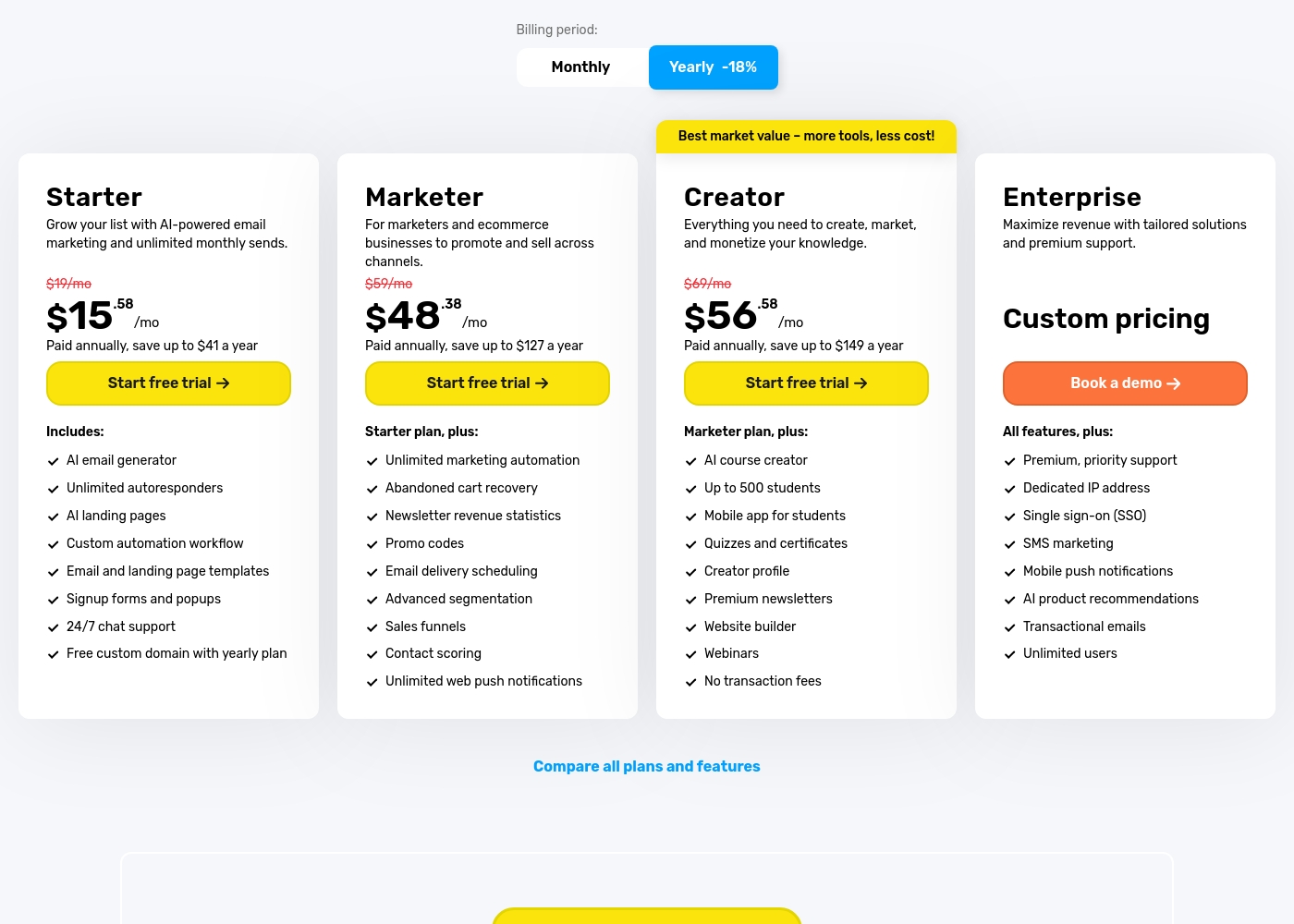
GetResponse costs between $15.58 and $56.58 per month (billed annually for a 1k list size) with four plans: Starter at $15.58/mo, Marketer at $48.38/mo, Creator at $56.58/mo, and Enterprise requiring custom pricing.
Here is a detailed look at what each plan includes. You should know that all paid plans scale their price based on the size of your specified contact list.
Starter
Price: $15.58/month (Billed annually) or $19/month (Monthly) Websites Supported: 5 active websites Best For: Growing your list and AI-powered email marketing Other Features:
- AI email generator and AI landing pages
- Unlimited autoresponders and monthly sends
- Custom automation workflow (limited to 1)
- 24/7 chat support
- Free custom domain with yearly plan The Starter package is perfect if you’re focusing on essential email marketing functions and building your subscriber list quickly. This entry-level tier allows for collaboration among 3 users and provides the core tools needed to run effective email campaigns.
- AI email generator
- Unlimited autoresponders
- AI landing pages
- 24/7 chat support
- Custom automation workflow (1)
- Unlimited marketing automation
- Abandoned cart recovery
- Sales funnels
- Advanced segmentation
- Unlimited web push notifications
- AI course creator (up to 500 students)
- Webinars
- Premium newsletters
- Website builder
- No transaction fees
- Dedicated IP address
- SMS marketing
- Premium, priority support
- Unlimited users
- Single sign-on (SSO)
Mailpoet costs between Free and $30 per month for 500 subscribers, with three accessible plans: the Free Plan at $0, the Advanced Marketing Plan at $10/month, and the Multi-Site Agency Plan at $30/month.
Here’s a closer look at what you get with each option, based on the starting tier of 500 subscribers.
Free Plan
Price: Free Best For: Bloggers, small businesses, or those just starting out. Other Features:
- Send up to 5,000 emails per month
- Includes subscription forms
- Provides email and ecommerce marketing tools
- Send up to 5,000 emails per month
- Subscription forms
- Email and ecommerce marketing
- Send unlimited emails per month
- Remove MailPoet branding
- Priority support
- Use MailPoet on 50 websites
- Subscriber count is adjusted per MailPoet instance

Pricing Notes
- GetResponse pricing scales solely on contact list size, offering excellent feature density per tier.
- Mailpoet offers a valuable perpetual Free Plan supporting up to 500 subscribers indefinitely.
- Mailpoet offers unlimited user seats on all paid plans, whereas GetResponse limits users on standard plans.
- If you pre-pay annually, you can save up to 18% on GetResponse and 15% on Mailpoet.
- GetResponse has a strict no-refund policy for annual contracts, which users should note.
Pricing Head-to-Head
User Reviews
GetResponse consistently earns high marks for its exceptional customer support and expansive features. Users frequently describe the 24/7 live chat as fast, professional, and composed of knowledgeable human agents who go the extra mile.
A recurring highlight is the personalized, live onboarding call, which many reviewers called a "GAME CHANGER" for accelerating setup and understanding the complex feature set. Customers find the platform user-friendly, noting the effectiveness of drag-and-drop tools for emails and landing pages, alongside reliable autoresponders and marketing automation features that drive increased ROI.
Get Response is awesome! Like anything new, it takes some time to get set up and used to things, but the customer support is second to none in helping out and quickly answering all my questions along the way.
The external reviews for Mailpoet reveal a stark and polarized user experience, heavily weighted toward frustration. While a few long-term users praise the affordability and ease of use for basic email creation and claim reliable deliverability, the overwhelming majority report severe technical and customer support issues. Reviewers frequently mention paid accounts being arbitrarily suspended or blocked, sometimes related to high bounce rates or fraud handling, leading to lost campaigns and high friction regardless of the subscription tier.
Crucially, complaints about support are recurrent. Users report waits of several days, receiving vague, ‘AI generated’ answers, or finding that dedicated support is unavailable on weekends ⚠️. Others note painful onboarding (delayed subscription validation) and limitations in core features, such as abandoned cart emails only targeting existing subscribers, rendering the tool useless for lead capture. Reliability and customer service responsiveness are the chief concerns consistently raised across these platforms. Ultimately, many users feel the systemic blockages entirely negate the convenience of WordPress integration.
I love using MailPoet for myself and my local business clients. It makes creating and managing emails across several client websites very easy. It is affordable and the emails always land where they are supposed to.
Our Verdict
This is a contest between seamless efficiency and reliable, expansive features. For most growing businesses, GetResponse clearly wins this comparison. GetResponse handles multi-channel marketing and operational reliability far better than Mailpoet. GetResponse is the reliable, all-in-one machine engineered for serious growth and revenue. You receive unlimited marketing automation and built-in AI tools for swift campaign creation. GetResponse offers webinars, SMS, and sales funnels, making it a robust marketing hub. Mailpoet’s superpower is its seamless execution right inside WordPress, which is incredibly efficient. Its free plan is extremely robust, helping bloggers easily manage small lists. Mailpoet simplifies email creation greatly by using your existing image library instantly. However, the critical deciding factor is operational trust and customer support for critical email tasks. Mailpoet has pervasive user complaints about severe reliability issues and unresponsive customer support. GetResponse offers highly-rated 24/7 service and proven deliverability (99%). If you truly rely on email marketing for ongoing revenue, choose GetResponse for stability and advanced features. Only pick Mailpoet if your list is small and leaving the WordPress dashboard is absolutely unacceptable.
Frequently Asked Questions
Which is better for small teams: GetResponse or Mailpoet?
It depends on user count and feature need. Mailpoet is better if your team needs many users with unlimited seats for basic email tasks. GetResponse is better for small teams of 3-5 users requiring complex features like funnels and landing pages.
Can GetResponse be used easily with WordPress like Mailpoet?
GetResponse integrates with WordPress via a connector plugin, but it's not native like Mailpoet. Mailpoet allows you to manage everything directly within your WordPress dashboard. GetResponse requires you to use its separate, external marketing hub.
Does Mailpoet offer advanced features like webinars or sales funnels?
No. Mailpoet focuses strictly on core email marketing functions within WordPress. GetResponse offers advanced features like built-in webinars, AI course creation, and automated sales funnels. GetResponse provides a much wider toolset.
Why are Mailpoet's user reviews significantly lower than GetResponse's?
Mailpoet faces consistent negative feedback regarding reliability and unresponsive customer support. Users report account suspensions and long delays resolving issues. GetResponse maintains a high rating based on 24/7 support reliability.
Which tool is more affordable for a list approaching 10,000 subscribers?
GetResponse and Mailpoet pricing both scale significantly based on subscriber count. Mailpoet starts cheaper at 500 contacts, but GetResponse offers more feature value per dollar as you scale. You must compare the exact 10k tier rates.
Which tool is better for an e-commerce business?
GetResponse is vastly better for e-commerce, offering dedicated sales funnels and guaranteed abandoned cart recovery. Mailpoet's cart recovery feature only targets existing subscribers, limiting its utility for new customer acquisition.
Ready to Choose?
Both tools have their strengths. Choose based on your specific needs.