Freshbooks vs NetSuite
Freshbooks versus NetSuite is the ultimate showdown between simplicity and serious scale. Freshbooks simplifies billing and tasks for small teams and freelancers. NetSuite offers a complex, integrated AI Cloud ERP for global operations. This comparison helps you pick the right financial backbone for your growth stage.
Best for: Solo entrepreneurs and freelancers starting out, Growing businesses managing 5-50 billable clients
Best for: Global enterprises with multi-country operations, Organizations needing unified ERP, CRM, and Financials
Top-Tier Invoicing with Exceptional Support.
We found Freshbooks to be an excellent solution focused on streamlining invoicing and expense tracking for small businesses and freelancers. Its intuitive interface simplifies daily accounting tasks, while the highly rated support staff stands ready to assist if technical issues arise. Overall, we recommend Freshbooks strongly for users prioritizing ease of use and professional support over deeply complex accounting machinery.
Pros
- Intuitive design makes setup and daily navigation simple.
- Creates quick, professional, and pleasant-looking invoices.
- Customer support is consistently rated as excellent, fast, and knowledgeable.
- Effective tracking of time and expenses (aided by the mobile app).
Cons
- Value perception is low for some long-term users as pricing has increased.
- Lacks direct functionality for features like printing checks without third-party apps.
- Users report occasional difficulties processing certain digital payments.
- Some functionality is considered basic (e.g., struggles to download bank income/deposits automatically).
Powerful ERP, Difficult Implementation, High Cost.
We recognize NetSuite’s position as a dominant AI Cloud ERP, capable of handling complex integrations and large-scale data requirements for over 43,000 customers. Overall, the significant costs, mandatory reliance on outside consultants, and consistent reports of poor customer support and outdated usability prevent us from recommending this solution without major reservations.
Pros
- Comprehensive AI Cloud ERP designed for scalable, complex enterprises.
- Provides a single source of truth across ERP, CRM, and ecommerce data.
- Proven market adoption with over 43,000 current customers.
- Powered by a robust and powerful Oracle database backend.
Cons
- Extremely high costs and aggressive, unpredictable annual renewal price hikes.
- Outdated, bulky, and unintuitive user interface (UI).
- Customer support is frequently non-existent, unresponsive, or rude.
- Difficult integration API throws frequent, non-specific errors.
AboutFreshbooks
FreshBooks is powerful accounting software designed to respect your time. It’s built to automate routine tasks like expense tracking and professional client invoicing. This tool is valuable for various stages of growth, whether you are a freelancer just starting out or a business managing contractors and employees. It organizes your finances so you always know where you stand in real time. 💡
AboutNetSuite
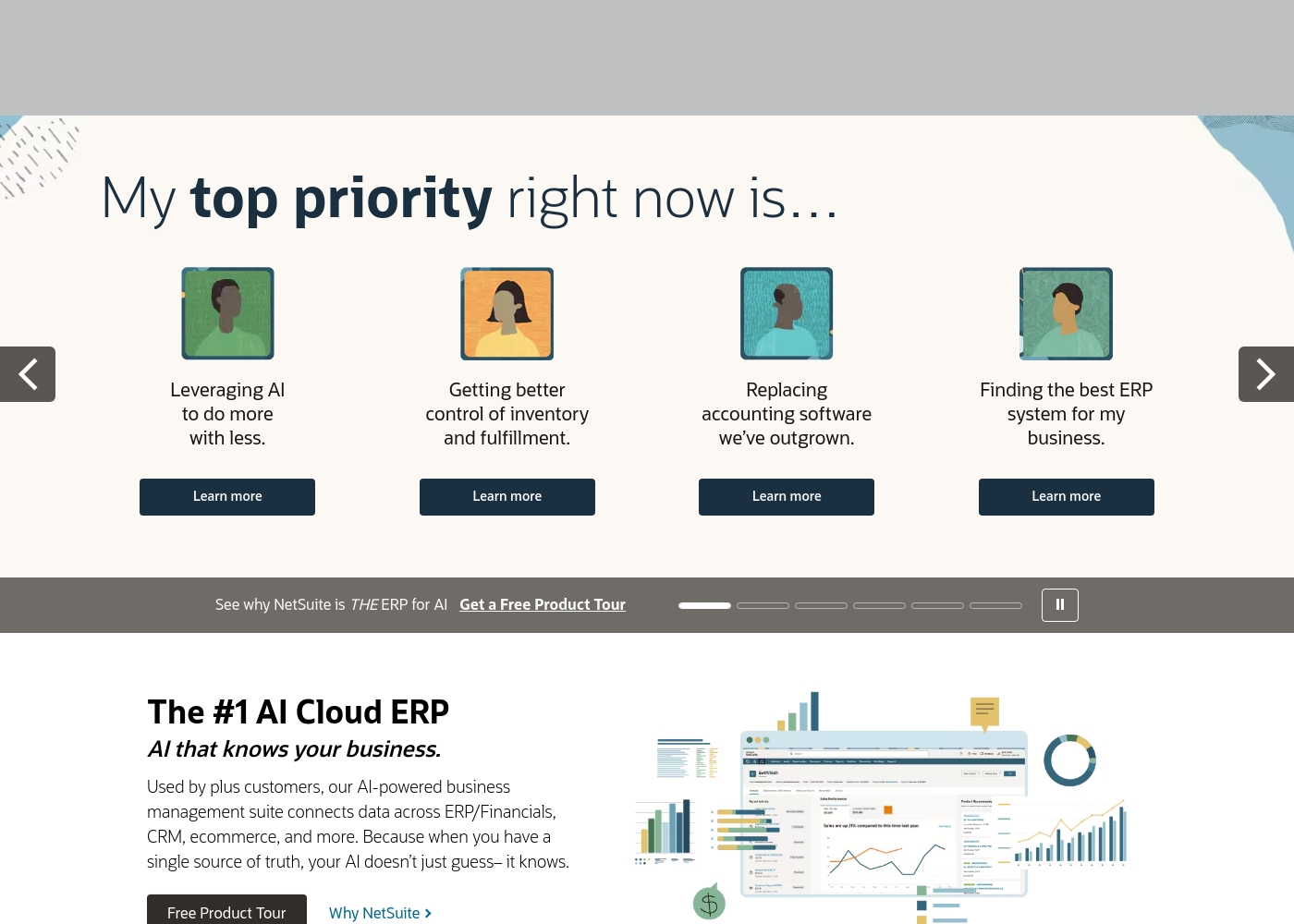
NetSuite is clearly positioned as an AI-powered business management suite. It's known widely as the #1 AI Cloud ERP. This powerful suite is designed to connect key functional areas of your enterprise.
It expertly handles everything from ERP/Financials to CRM and ecommerce data. Over 43,000 customers rely on these integrated products to help fuel their essential growth. 💡
Highlights
Feature Comparison
Features Overview
We highlight the main differences and pick a winner for each feature.
Ease of Use
Freshbooks is designed for speed and simplicity. NetSuite feels bulky and highly complex.
Freshbooks offers an intuitive design focused on simple setup and daily navigation. Users migrating from spreadsheets find Freshbooks easy to use immediately. It streamlines tasks like invoicing and time tracking efficiently. NetSuite is widely reported to be unintuitive and outdated. The bulky interface requires extensive training and specialized knowledge. Reviewers often need expensive consulting just to configure NetSuite features. This difference directly reflects the target user: Freshbooks is for the non-accountant. NetSuite requires specialized IT staff. If minimizing setup time and daily friction is key, Freshbooks is the clear choice.
Customer Support
Freshbooks provides highly rated, reliable support. NetSuite support is frequently unresponsive and difficult.
Freshbooks boasts highly praised support staff with a 4.8/5.0 approval rating. They promise fast, knowledgeable help and will not transfer your call. Freshbooks support is a major selling point for small business owners. NetSuite users consistently report that support is non-existent or rude. Account managers are often unreachable when critical data issues arise. This is a severe weakness for an enterprise product like NetSuite. The stark difference in quality reflects user focus and investment. Freshbooks invests heavily in user happiness. This makes Freshbooks far more dependable if you run into technical issues or need quick guidance.
Core Functionality
Freshbooks excels at accounting fundamentals. NetSuite is a full, integrated AI Cloud ERP system.
Freshbooks centralizes invoicing, expense tracking, and time management. It provides strong double-entry accounting needed for tax preparation. Freshbooks is focused primarily on revenue generation and client billing. NetSuite is not just accounting; it’s an AI Cloud ERP suite. It connects Financials, Inventory, CRM, and Ecommerce data together. NetSuite provides a single source of truth across all enterprise functions. Freshbooks provides the necessary tools for small businesses. NetSuite delivers deep, organizational control required by large corporations. If you need supply chain or full CRM integration built-in, NetSuite offers far greater power than Freshbooks.
Scalability and Audience
Freshbooks scales with client numbers up to unlimited. NetSuite is designed for massive enterprise data scale.
Freshbooks scales by removing billable client limits on Premium plans. It serves freelancers up through established businesses with employees. Freshbooks handles growing billing and team management needs effectively. NetSuite is explicitly built for enterprises with complex operational needs and large data volumes. It serves over 43,000 customers globally, proving its immense scale capacity. NetSuite handles hundreds or thousands of users easily. Freshbooks provides accounting tools that support growth stages. NetSuite provides the infrastructure *for* massive, global operations. If your business manages multi-country financials and requires deep ERP integration, NetSuite is the only viable choice.
Pricing Model
Freshbooks uses clear, tiered public pricing. NetSuite requires custom quotes and expensive agreements.
Freshbooks uses transparent monthly pricing, ranging from $10.50 to $32.50 (promotional). Pricing scales based on the number of billable clients you serve. Annual billing offers an extra 10% discount on Freshbooks. NetSuite has no public pricing and requires contact with sales for a custom quote. Costs are based on modules, complexity, and number of users. NetSuite is extremely expensive, often reaching hundreds of thousands annually. The Freshbooks model is accessible and predictable for small budgets. The NetSuite model demands significant capital investment. Users should anticipate aggressive price hikes from NetSuite, while Freshbooks offers clear promotional and annual savings.
Advanced Data Intelligence
Freshbooks focuses on basic automation. NetSuite is driven by expert, integrated AI management.
Freshbooks automates expense categorization and recurring invoices to save time. It uses basic features to streamline workflows for the small business owner. The Premium plan helps check project profitability. NetSuite is marketed as the #1 AI Cloud ERP, using AI that 'knows your business.' NetSuite establishes a single source of truth across all modules. This integrated intelligence provides smart, reliable business recommendations. Freshbooks uses automation for convenience. NetSuite uses AI for critical strategic decision-making. If leveraging deeply informed AI for enterprise-wide predictions is crucial, NetSuite has the technological edge.
Freshbooks costs between $10.50 and Custom per month (promotional pricing) with 4 plans: Lite at $10.50/month, Plus at $19.00/month, Premium at $32.50/month, and Select (Custom Pricing).
Details of these subscription levels are below, covering key features and target users.
Lite
Price: $10.50 USD/mo (Promotional. Was $21.00 USD/mo) Best For: Freelancers Refund Policy: 30-Day Money Back Guarantee Other Features:
- Send invoices to 5 clients
- Track expenses in real time
- Get paid via credit cards and bank transfers (ACH)
- Create and send estimates
- Send invoices to 5 clients
- Track expenses in real time
- Create and send estimates
- Get paid via credit cards and bank transfers (ACH)
- Generate tax-time reports
- Send invoices to 50 clients
- Create estimates, proposals, and client retainers
- Run financial and accounting reports
- Expense receipt scanning
- Give your accountant access
- Send invoices to unlimited clients
- Bill receipt scanning with the ability to add line items
- Check project profitability
- Customize your email templates
- Double-Entry Accounting Reports
- Send invoices to unlimited clients
- Access lower credit card transaction fees and capped ACH fees
- Import your data via Easy Switch
- Gain access to dedicated phone support
- 2 Team Member accounts included

NetSuite operates primarily on a customized enterprise model. Because it is a powerful AI Cloud ERP solution, you won't find standard, predefined pricing tiers. Pricing requires a direct quote based on your specific business size and needs.
Custom ERP Implementation
Best For: Businesses needing a scalable, integrated ERP solution or replacing outgrown accounting software Other Features:
- Connects data across ERP/Financials, CRM, and ecommerce
- AI-powered business management suite
- Used by 43,000+ customers
- Provides a single source of truth
This is the right choice if you need a comprehensive system that leverages AI to connect all your data. It's designed to help growing companies move past disparate systems and gain better control over operations like inventory and fulfillment.
Pricing Notes
- Freshbooks offers a strong 30-day Free Trial and a Money Back Guarantee.
- Freshbooks provides massive promotional savings, including 50% off for the first six months.
- NetSuite requires a personalized quote and is notoriously expensive, often costing tens of thousands annually.
- NetSuite users frequently report aggressive annual renewal price hikes, making long-term budgeting difficult.
- Freshbooks successfully keeps its cost low by limiting billable clients on lower tiers (5 clients for Lite).
Pricing Head-to-Head
User Reviews
Freshbooks generally receives positive feedback, particularly regarding its intuitive design and minimal setup. Users frequently mention how simple the software is, making basic tasks like tracking time and creating professional invoices fast and efficient.
Many reviewers who switched from competitors appreciate that Freshbooks is far less complex and easy to navigate. Customer support is a significant strength and repeatedly praised.
Migrated over from Quickbooks. Quickbooks was an expensive nightmare. Freshbooks is so simple and easy to use. Their customer support is reachable and helpful.
User reviews for NetSuite present a stark contrast to its marketed position, frequently highlighting issues with pricing, support, and usability. Many users describe the system as unintuitive, bulky, and slow, noting that the interface feels decades outdated; one reviewer suggested the UI looks like it is from the 1980s.
This complexity often necessitates hiring expensive consultants, even for routine tasks. Pricing is a major pain point; users report that the software is significantly more expensive than competitors, with costs frequently reaching tens or hundreds of thousands annually, and aggressive price increases during renewals are common.
I wasted thirty minutes getting the runaround about pricing. When they finally gave a quote, the rep was extremely rude and said my business wasn't a 'good fit' due to the high starting price. Poor customer service is unacceptable for an enterprise product like this.
Our Verdict
Should you choose Freshbooks or NetSuite? The decision is clearly based on business size and complexity. Freshbooks is the easiest, friendliest accounting experience for small operations. NetSuite offers unparalleled depth and integration for global enterprises. Freshbooks is the undisputed champion of invoicing and customer support focused on the SMB market. It helps freelancers manage clients and track expenses quickly and accurately. Use Freshbooks to automate billing and get paid fast with professional invoices. If minimizing friction is your priority, Freshbooks wins easily. NetSuite delivers true enterprise scale as the #1 AI Cloud ERP solution. NetSuite unifies all your critical systems like ERP, CRM, and e-commerce data. This creates a powerful 'single source of truth' for massive, complex organizations. NetSuite is designed only for organizations committed to serious, large-scale financial coordination. The critical deciding factor is cost and ease of implementation. Freshbooks starts extremely low and has clear public pricing tiers. NetSuite is highly expensive, requires specialized consultants, and has zero price transparency. Pick Freshbooks if you are a small business owner prioritizing speed, great support, and simple billing. Choose NetSuite if you are an enterprise needing 500+ employees and integrated financial management. Never choose NetSuite if high-quality customer support is mandatory.
Frequently Asked Questions
Is Freshbooks or NetSuite better for small businesses and freelancers?
Freshbooks is explicitly designed for small businesses and solo entrepreneurs. It offers simple expense tracking and professional invoice automation starting at low competitive prices. NetSuite is overkill and far too expensive for small businesses.
Which platform offers truly unified ERP, CRM, and financial data management?
NetSuite offers this highly specific capability as a core feature of its AI Cloud ERP solution. NetSuite creates a single source of truth across all modules for full enterprise control. Freshbooks requires third-party integrations to achieve similar functionality depth.
How does NetSuite's custom pricing compare to Freshbooks' tiered plans?
Freshbooks offers clear, low-cost tiers starting at $10.50 per month (promotional). NetSuite requires a custom quote based on complexity and user count. NetSuite is vastly more expensive, costing tens of thousands annually.
Does Freshbooks offer real double-entry accounting like NetSuite?
Yes, Freshbooks offers robust double-entry accounting tools in its Premium and Select plans. This capability ensures your financial reports are accurate for tax time. NetSuite also includes this, as it's foundational to any ERP system.
Which software offers better customer service and technical support?
Freshbooks wins overwhelmingly, with users rating its support 4.8 out of 5.0. Freshbooks promises knowledgeable help without transferring calls. NetSuite's support is notoriously unresponsive, rude, and difficult to reach, according to user reports.
Can I get a free trial of Freshbooks and NetSuite before committing?
Yes, Freshbooks offers a risk-free 30-day money-back guarantee and a free 30-day trial. NetSuite does not offer a free trial; you must request a Free Product Tour instead.
Ready to Choose?
Both tools have their strengths. Choose based on your specific needs.